PSY 3306 - Week 3.2
 Studied by 0 people
 Call with Kai
 Learn
Learn Practice Test
 Spaced Repetition
 Match
Match Flashcards
 Knowt Play
1/24

Earn XP
Description and Tags
Guest Lecture
Name | Mastery | Learn | Test | Matching | Spaced | Call with Kai |
|---|
No study sessions yet.
25 Terms
How does the WHO define health promotion?
Health promotion is the process of enabling people to increase control over, and improve, their health by identifying and realizing aspirations, satisfying needs, and changing or coping with their environment to achieve physical, mental, and social wellbeing.
What is the stream analogy of health prevention?
Upstream is prevention
E.g., Promoting healthy environments, preventing injury and illness, addressing social injustice
Downstream is reaction
E.g., Reacting to problems, treating injury and illness, ignoring social inequities
What are the levels of prevention?
Primary - most upstream, population health
Secondary
Tertiary - most downstream, individual health
What is primary prevention + example?
Helps people stay healthy by preventing illness and injury
E.g., vaccinations for illnesses like the flu, low risk drinking, and fall prevention
What is secondary prevention + example?
Screens and monitors for illness and injury for people at risk
E.g., cancer and diabetes screening, monitoring blood sugars and blood pressure
What is tertiary prevention + example?
Helps people with illness or injury manage their conditions and prevent more problems
E.g., cardiac rehabilitation, managing diabetes, and cancer treatment
Which key document is associated with the WHO definition of health promotion?
The Ottawa Charter for Health Promotion.
What are the goals of the Ottawa Charter for Health Promotion?
Strengthen community action
Develop personal skills
Create supportive environments
Reorient health services
Enable, mediate, advocate
What are the prerequisites for health?
Peace
Shelter
Education
Food
Income
A stable eco-system
Sustainable resources
Social justice and equity
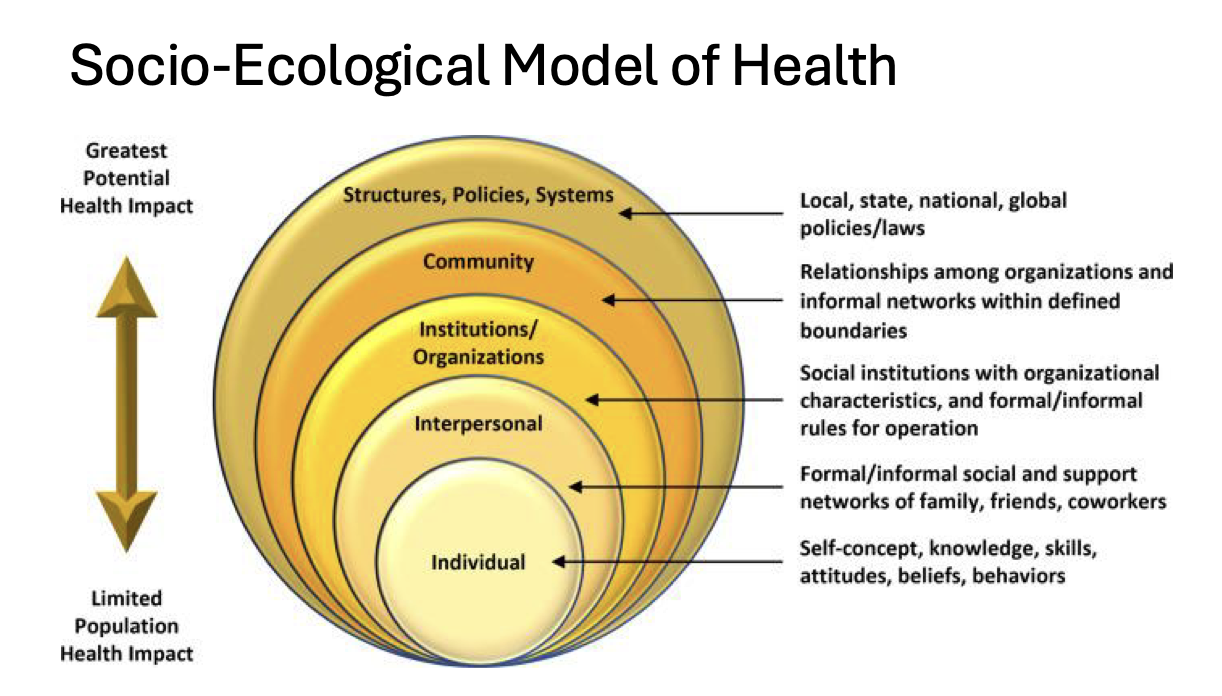
What are the layers of the socio-ecological model of health?
From greatest potential health impact to limited population health impact":
Structures, policies, systems
Community
Institutional organizations
Interpersonal
Individual
What does the Transtheoretical Model explain?
How people change behaviors over time through stages of readiness, using cognitive and behavioral processes, decisional balance, and self-efficacy.
What are the core concepts of the transtheoretical mode?
Focus on the individual
Five stages of change
Ten processes of change
Decisional balance (pros and cons of changing)
Self-efficacy
Temptation
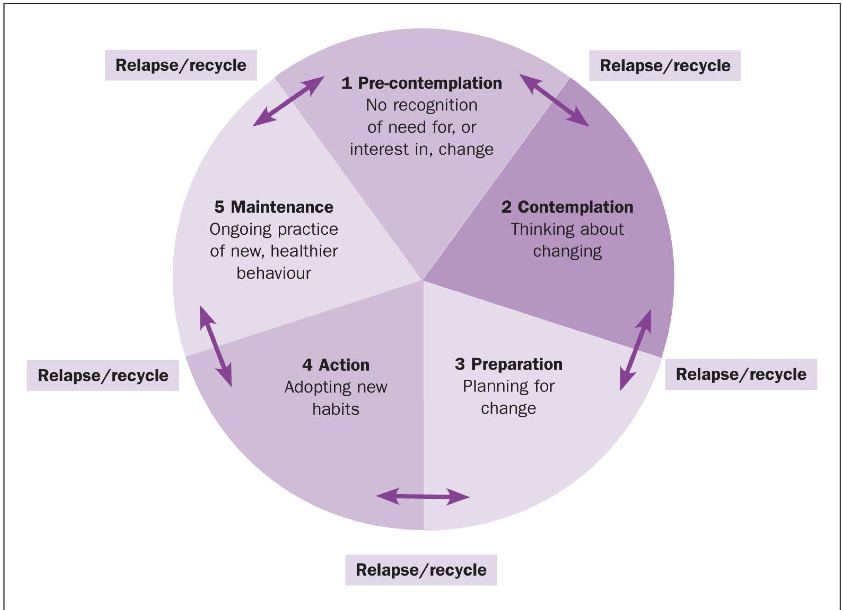
What are the fives stages of change according to Prochaska and Di Clemente’sTranstheoretical Model of Behaviour Change?
Pre-contemption: no recognition of need for, or interest in change
Contemplation: thinking about changing
Preparation: planning for change
Action: adopting new habits
Maintenance: ongoing practice of new, healthier behaviour
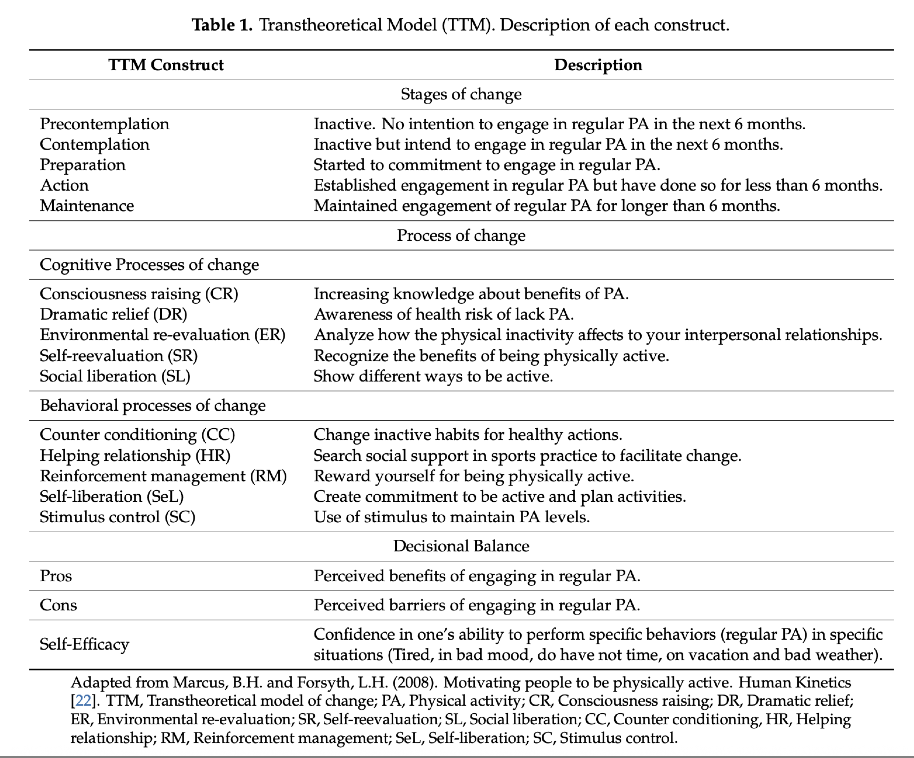
What are cognitive processes of change in the Transtheoretical Model?
Mental strategies that increase awareness and motivation, such as learning about benefits, recognizing risks, and reflecting on personal values.
What are behavioral processes of change in the Transtheoretical Model?
Action-based strategies like replacing unhealthy habits, seeking social support, rewarding oneself, committing to change, and managing cues.
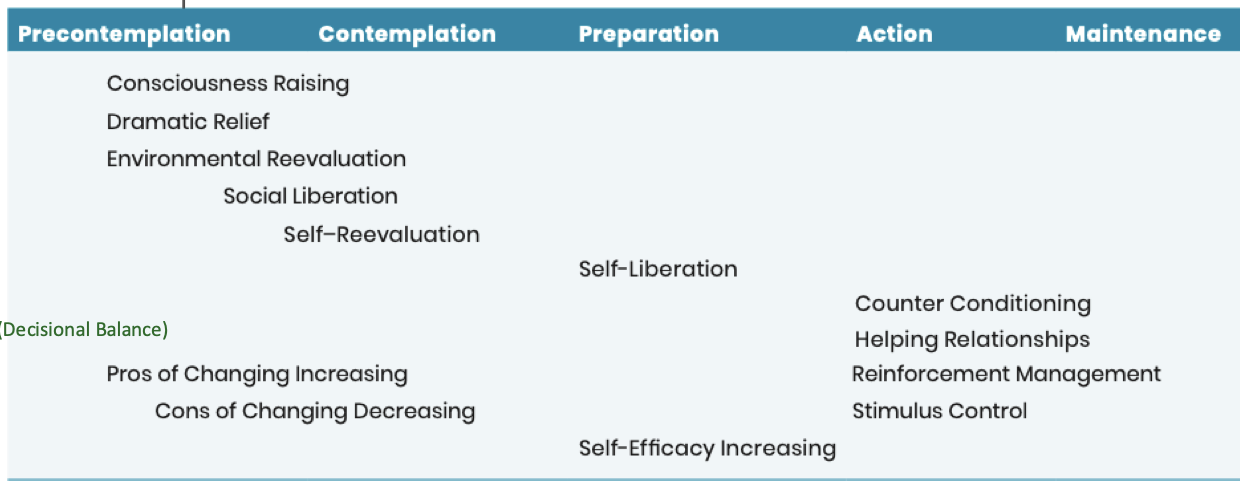
What are the 10 key processes of change?
Consciousness-Raising: Increasing awareness about causes and consequences of behavior.
Dramatic Relief (Emotional Arousal): Experiencing negative emotions associated with risks, or hope.
Environmental Reevaluation: Realizing the impact of behavior on others.
Self-Reevaluation: Assessing one's self-image with and without the behavior.
Social Liberation: Realizing society supports the new behavior.
Self-Liberation: Making a firm commitment to change.
Counterconditioning: Replacing unhealthy behaviors with healthier ones.
Environment Control (Stimulus Control): Managing cues that trigger unhealthy habits.
Reinforcement Management: Rewarding positive behavior.
Helping Relationships: Utilizing social support for change.
What is temptation in the TTM?
Negative affect or emotional distress, positive social situations, and cravin
What is motivational interviewing?
Spirit of MI: partnership, evocation, acceptance, compassion
Fundamental processes: engage, focusing, evoking, planning
Core skills: open questions, affirmation, reflections, summarizing
What does DARN stand for in motivational interviewing?
Desire
Ability
Reasons
Needs
What does CAT stand for in motivational interviewing?
Commitment
Activation
Taking steps
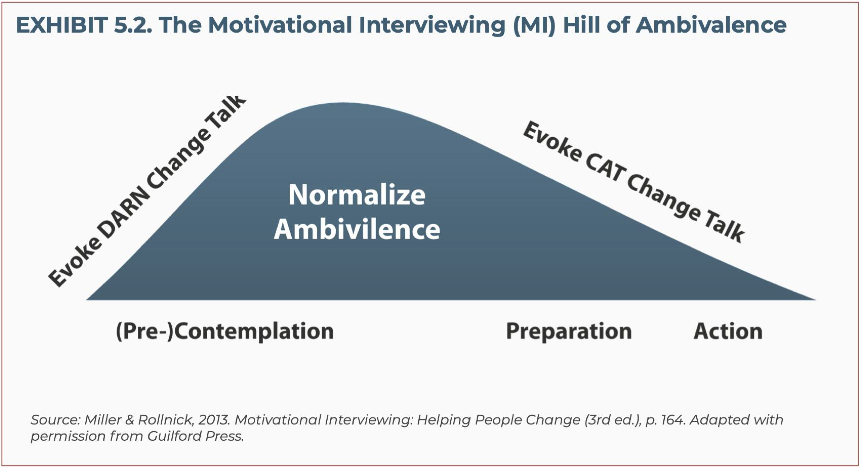
What is the motivational interviewing hill of ambivalence?
Upward Climb (Contemplation): The client feels stuck, experiencing two-sided, conflicting feelings ("I want to change" vs. "I don't want to change").
The Peak: Represents the height of tension and discomfort.
Downward Slope (Resolution): Through Motivational Interviewing (MI), the client resolves this tension by focusing on the importance of change, increasing confidence, and developing actionable steps.
MI Strategy: Rather than pushing the client, the practitioner helps them navigate this "tug-of-war," normalizing the struggle and facilitating movement toward change.
What was the aim and design of the study on hospitalized patients with coronary heart disease?
To test the effects of a transtheoretical model-based intervention with motivational interviewing on depression; it was a randomized controlled trial with 110 patients (55 intervention, 55 control).
What measures were assessed in the study on depression in patients with coronary heart disease?
Measures: Hamilton Rating Scale for Depression and Depression Prevention & Management Survey items (stages of change, perceived benefits/barriers, process of change, self-efficacy).
What were the main findings and conclusions of the study on hospitalized patients with coronary heart disease?
Depression scores improved significantly in the intervention group.
Outcomes: the intervention group showed more positive behavior changes, higher perceived benefits and self-efficacy, lower barriers, and reduced depression.
 Note
Note  Flashcards (95)