entm mt 2
0.0(0)
 Studied by 0 people
 Call Kai
 Learn
Learn Practice Test
 Spaced Repetition
 Match
Match Flashcards
 Knowt Play
Card Sorting
1/100

There's no tags or description
Looks like no tags are added yet.
Last updated 1:28 AM on 6/10/23
Name | Mastery | Learn | Test | Matching | Spaced | Call with Kai |
|---|
No analytics yet
Send a link to your students to track their progress
101 Terms
1
New cards
Hexapoda
Includes two subclasses Entognatha and Insecta
2
New cards
Order: Collembola (Springtails)
Small .3-6 mmm; Primitive compound eye (1-8 ommatidia); Mouthparts concealed; can molt as adults; Live in moist soil feeding; Dense populations
3
New cards
Furcula
Springtails use what as a jumping mechanism
4
New cards
Collaphore
Ventral tube structure on springtail
5
New cards
Order: Thysanura (silverfish)
Small; Apterygote (Lack wings); Have scales and cerci; Live in debris ; Detritivore; Molt after adult
6
New cards
How do Thysanura find mates; what do they give to females
Silk threads; Spermatophores
7
New cards
Order: Ephemeroptera (Mayflies)
Short lived adults 24-48 hrs; Hemi-metabolous; No mouthparts; wings as adult; Live 1-2 years as aquatic nymphs with gills (chewing mouthparts); Mate in swarms; sensitive to pollution
8
New cards
Order: Odonata (Dragonflies and damselflies)
Immatures: Aquatic with rectal gills, Terminal gills, predacious; Adults: Winged; Strong fliers; Chewing mouthparts; Hemimetabolous; predacious; claspers for maating
9
New cards
Odonata nymphs
Insect that has labium modified to capture prey
10
New cards
Order: Plecoptera (Stoneflies)
Adults: Soft bodied, membranous wings folded flat over body, Antennae chewing mouthparts; two terminal cerci; Immatures: Elongate, flattened, Gills on thorax or base of the legs, aquatic pred or graz., sensitive to pollution
11
New cards
How do male and female stoneflies attract eachother
Drumming
12
New cards
Order: Dermaptera (Earwigs)
Slender, elongate and flattened, Chwing mouthparts, short leathery front wings: cerci forceps, Hemimetabolous; Primarily tropical and nocturnal; Omnivores; some parasitic
13
New cards
Dermaptera (Earwigss)
One of the rarest insect habits because the mother take care of the eggs.
14
New cards
Order: Orthoptera (Grasshoppers, Crickets, and Kaytidids
Chewing mouthparts, compound eyes; front and back wings; Cerci and ovipositor, Phytophagous (plant feeders), many use sounds
15
New cards
Tegmina
Front wings that protect the delicate back wings
16
New cards
Tympanum
Located on first abdominal segment in grasshoppers and locusts; Crickets, long horned grasshoppers, and katydids on front tibia.
17
New cards
Mole Crickets
Use burrow shape hole to amplify mating calls
18
New cards
Gregarious
Crowded conditions cause this phase for 2-3 generations
19
New cards
Solitary
Uncrowded conditions promote this state.
20
New cards
Order: Phasmatodea (Walkingsticks and Leaf Insects)
Chewing mouthparts, phytophagous. frequently wingliess; sometimes wings mimic leaves. excellent mimicry; can regenerate legs. uses chemical defenses
21
New cards
Order: Mantodea (soothsayer; praying mantids)
Prothorax elongated, fore legs raptorial; compound eyes; chewing mouthparts; Well developed wings; Can turn around an look behind them; have tegmina; ambush predators; females eat males after mating
22
New cards
ootheca
Praying matids use this frothy case to lay eggs in.
23
New cards
Order: Blattodea (Cockroaches)
Chewing mouthparts, compound eyes, long antennae and cerci; Flattened body shape; Legs adapted for running; Ancient group; Mating through pheromones; Tropical; use chemical defenses; Can digest cellulose in wood.
24
New cards
German cockroach
Cockroach defined by its two brown dark stripes on dorsal thorax
25
New cards
Order: Isoptera (Termites)
Soft bodied, chewing mouthparts, workers blind; Abdomen broadly joined at thorax; Social insects; Eat cellulose; adult reproductive have wings; workers sterile; soldiers have mandibulate pinchers
26
New cards
Nasute
Chemical nozzleheads that soldier termites use
27
New cards
Subterranean termites
Underground location, that live under ground, to terminate you need to treat soil
28
New cards
Drywood termites
Do not live in the soil; Can be identified through their frass or poop. Tenting to terminate them.
29
New cards
Order: Thysanoptera (Thrips)
Uses left mandible to puncture plant tissues; Small; Unusual metamorphosis feeding nymphs and then non-feeding stages; can cause damage to crops; Fringed wing
30
New cards
Order: Hemiptera (Auchenorrhyncha cicadas and hoppers, Sternorrhyncha aphids, whiteflies, scales; Heteroptera)
3 suborders; All have piercing or sucking mouthparts because they are liquid feeders; wings when adults
31
New cards
Honeydew
Sugar excretion that bugs pump out of anus
32
New cards
Cornicles
Tail pipes that secrete defensive chemicals (aphids or plantlice)
33
New cards
Scales
Male has wings, female no wings, nymphs are crawlers, parthenogentic
34
New cards
Heteroptera (true bugs)
Wings flat over back, Forewing leathery at base, mouthparts beak like, Wings form triangle shape. All liquid feeders, Some predators and blood-feeders.
35
New cards
Order: Phthiraptera (Lice)
All ectoparasites of birds and mammals, Eggs cemented to feathers or hair, small flattened, legs adapted to hanging onto hosts, worse in cold weather and stress.
36
New cards
Chewing Lice
Head broader than prothorax, hosts birds an mammals, feed on feathers, skin, hair; Damage host.
37
New cards
Sucking Lice (Anoplura)
Head narrower than prothorax, Pharynx good at sucking blood, Eyes Reduced, Symbiants (crab louse and body louse)
38
New cards
Order: Siphonaptera
(Fleas)
Small, laterally flattened, rows of combs, spines, wingless, jumpers; Ectoparasites
Small, laterally flattened, rows of combs, spines, wingless, jumpers; Ectoparasites
39
New cards
What are some cues for fleas to jump
vibration, warmth, shadows
40
New cards
Order: Neuroptera
(Dobson flies, lacewings, antlions)
Weak Fliers, Chewing mouthparts, some sickle shpared piercing mandibles, predaceous, aquatic or terrestrial
Weak Fliers, Chewing mouthparts, some sickle shpared piercing mandibles, predaceous, aquatic or terrestrial
41
New cards
Family: Corydalidae (Dobsonflies)
(Dobsonflies)
Larvae aquatic predators; pupate in cells in soil; adults have sexual dimorphism;
Larvae aquatic predators; pupate in cells in soil; adults have sexual dimorphism;
42
New cards
Family: Chrysopidae (Lacewings)
(Lacewings)
Eggs laid on stalks, Biological control against plant-feeding insects; larvae predaceous (aphid lions); Pupate in silk cocoon
Eggs laid on stalks, Biological control against plant-feeding insects; larvae predaceous (aphid lions); Pupate in silk cocoon
43
New cards
Family: Myrmeleontidae (Antlions)
(Antlions)
(lyrmeleontidae) → make traps to capture ants (prey)
Larvae in conical pits hunt ants through this pit; adults are long soft and slender.
(lyrmeleontidae) → make traps to capture ants (prey)
Larvae in conical pits hunt ants through this pit; adults are long soft and slender.
44
New cards
Convergent Evolution
Species develop in a similar way even though they are not related
45
New cards
Family: Mantispidae (Mantidflies)
(Mantidflies)
fine leg → raptorial legs; Larvae predaceous on spiders, convergent evolution with mantids
fine leg → raptorial legs; Larvae predaceous on spiders, convergent evolution with mantids
46
New cards
Hypermetamorphosis
Egss hatch into very active early stage larvae late stage larvae less active.
47
New cards
Order: Mecoptera
(Scorpionflies)
Bulbous terminal genitalia of males; adult head with the elongated beak; weak fliers; eggs laid in soil; Eat small-bodied insects.
Bulbous terminal genitalia of males; adult head with the elongated beak; weak fliers; eggs laid in soil; Eat small-bodied insects.
48
New cards
scorpion flies
Bring nuptial gift or construct piles of saliva or force mating.
Female lacks a “scorpion” tail
Female lacks a “scorpion” tail
49
New cards
Order: Trichoptera
(caddisflies)
Related to moths and butterflies; Chewing mouthparts, hairy wings held roof-like; Females may enter water; Larvae aquatic, net-spinners, pupate in case
Related to moths and butterflies; Chewing mouthparts, hairy wings held roof-like; Females may enter water; Larvae aquatic, net-spinners, pupate in case
50
New cards
Function of caddisfly case
Respiration, protection, streamlining
51
New cards
Order: Strepsiptera: Twisted-wing parasites
Hypermetamorphosis; Internal parasites of insects; First larval stage active and remaining instar immobile. Males fly while females cannot. Pheremones used. Pupation in host. Females drop larvae into flowers.
52
New cards
Acrididae
\
grasshoppers, locusts (common families in orthoptera)
grasshoppers, locusts (common families in orthoptera)
53
New cards
Thigmotaxic
Wanting to be in a tight crevice
54
New cards
Autotomy
Loses leg in defense
55
New cards
Catalepsis
Acting dead as defense mechanism (Web-spinners)
56
New cards
Trophallaxis
→ food exchange process
→ Frequent liquid **food exchange** among colony mates
(important biological aspects of ants)
→ Frequent liquid **food exchange** among colony mates
(important biological aspects of ants)
57
New cards
Spittlebugs
(frog hopper)
live within bubbles on plants
makes bubbles. use bubbles as protection from their body. Live in rosemary plants. drink liquid from rosemary plants and use liquid to make a foamy layer. compound eye
live within bubbles on plants
makes bubbles. use bubbles as protection from their body. Live in rosemary plants. drink liquid from rosemary plants and use liquid to make a foamy layer. compound eye
58
New cards
Ant-hemipteran mutualism
* Both partners benefit
* Aphids gain control
* Ants gain carbohydrate-rich resource
* Aphids gain control
* Ants gain carbohydrate-rich resource
59
New cards
Aphididae
\
1. Aphids: usually wingless during cloning phases
1. Alates: winged reproductives during the sexual phase
2. __Transmit plant diseases__
3. **Ant-aphid mutualism**: **both** partners benefit
1. Aphids: gain protection
2. Ants: gain carbohydrate-rich resource
1. Aphids: usually wingless during cloning phases
1. Alates: winged reproductives during the sexual phase
2. __Transmit plant diseases__
3. **Ant-aphid mutualism**: **both** partners benefit
1. Aphids: gain protection
2. Ants: gain carbohydrate-rich resource
60
New cards
Buprestidae
HERBIVORES BEETLES
1. Jewel beetles (Family Buprestidae)
Shiny/ Metallic
1. Thin film interference
2. Textured cuticle
3. Diet/habits:
1. wood (prefer dying or weaken trees)
2. bore-tunnels in wood (larvae)
4. Pyrophilous “fire-loving” or heart → infrared organ can detect heat radiation from a distance
1. Jewel beetles (Family Buprestidae)
Shiny/ Metallic
1. Thin film interference
2. Textured cuticle
3. Diet/habits:
1. wood (prefer dying or weaken trees)
2. bore-tunnels in wood (larvae)
4. Pyrophilous “fire-loving” or heart → infrared organ can detect heat radiation from a distance
61
New cards
Bombardier beetle
defensive strategy:
1. Chemical weapons (common defensive strategy among carabid beetles)
Bombardier beetle example: Hydroquinone & hydrogen peroxide (highly targeted)
1. Chemical weapons (common defensive strategy among carabid beetles)
Bombardier beetle example: Hydroquinone & hydrogen peroxide (highly targeted)
62
New cards
Capitulum
a swollen, fatty extension of the stick insect egg
(Phasmida (walking sticks & leaf insects)
(Phasmida (walking sticks & leaf insects)
63
New cards
Carrion beetles
(Family Silphidae)
Diet: dead animal (carrion) → decaying flesh of a dead animal
Forensic importance:
colonize carrion during all stages of decomposition → great forensic importance
Beneficial? Ecological Importance:
ecological role: recycling nutrients
Defense against predators: chemical defense warning coloration (aposematic)
Diet: dead animal (carrion) → decaying flesh of a dead animal
Forensic importance:
colonize carrion during all stages of decomposition → great forensic importance
Beneficial? Ecological Importance:
ecological role: recycling nutrients
Defense against predators: chemical defense warning coloration (aposematic)
64
New cards
Chagas disease
transmitted by Family Reduviidae- assassin bugs → **kissing bug**; caused by the parasite Trypanosoma cruzi) → swollen in the eyelids
65
New cards
Chewing lice vs. sucking lice
__**Mallophaga Chewing Lice**__ Feed on dead skin cells, hair, or feathers
**Anoplura Sucking Lice** Feed on blood, Human disease vector
**Anoplura Sucking Lice** Feed on blood, Human disease vector
66
New cards
Cicadellidae
\
1. **leafhoppers & sharpshooters**:
1. feed on plant sap
2. often colorful
3. can be very damaging (feeding, disease-transmitting) (e.g. Pierces’ disease)
4. Excessive honeydew production
1. **leafhoppers & sharpshooters**:
1. feed on plant sap
2. often colorful
3. can be very damaging (feeding, disease-transmitting) (e.g. Pierces’ disease)
4. Excessive honeydew production
67
New cards
Cicadidae
\
1. **cicada**s: produce very loud **sounds (tymbals)** -fossorial front legs in nymphs (digging tunnel); Synchronous emergence; periodical cicadas → There are seven species of North American periodical cicadas, all in the genus Magiciada. Four species live on a 13-year cycle, and three for 17 years
1. **cicada**s: produce very loud **sounds (tymbals)** -fossorial front legs in nymphs (digging tunnel); Synchronous emergence; periodical cicadas → There are seven species of North American periodical cicadas, all in the genus Magiciada. Four species live on a 13-year cycle, and three for 17 years
68
New cards
Coccinellidae
ladybird
1. Description: larvae potted a banded w/ minute spines
2. Adult w/ oval body shapes, bright coloration
3. Beneficial role: feed on other plant pests (e.g. aphids)
4. Signals to their predators? Aposematic coloration (reflex bleeding) → noxious chemical
5. Overwintering: some ladybugs “mograte” to specific overwintering spots
1. Description: larvae potted a banded w/ minute spines
2. Adult w/ oval body shapes, bright coloration
3. Beneficial role: feed on other plant pests (e.g. aphids)
4. Signals to their predators? Aposematic coloration (reflex bleeding) → noxious chemical
5. Overwintering: some ladybugs “mograte” to specific overwintering spots
69
New cards
Common cockroach pests
\
1. Brown-banded, German, American. Oriental are common household roaches in the U.S
1. Brown-banded, German, American. Oriental are common household roaches in the U.S
70
New cards
Convergent evolution
\
1. independent evolution of similar features in species at different lineages
2. convergent evolution w/ antlions: independent evolution of similar features ins species of different lineages
1. independent evolution of similar features in species at different lineages
2. convergent evolution w/ antlions: independent evolution of similar features ins species of different lineages
71
New cards
Corixidae
1. Family Corixidae- water boatmen
1. freshwater aquatic
2. lack gills, carry air bubbles down into the water to take oxygen from the water
3. natatorial legs
4. mostly herbivores (eat algae)
72
New cards
Dactylopiidae
\
\
cochineals
1. sessile parasites on plants
2. lives on cacti in the genus Opuntia
3. natural dye carmine is derive
\
cochineals
1. sessile parasites on plants
2. lives on cacti in the genus Opuntia
3. natural dye carmine is derive
73
New cards
Sound production/detection in Grasshoppers
stridulate by rubbing their hind legs against the edge of closed wings; Short peg-like bumps on the inside of their hind femurs: file; the edge of the closed wing: scraper
74
New cards
Sound production/detection in Katydids and cricket
\
stridulate with the __wings only.__ A sharp edge or “scraper” on the lower wing is rubbed against a “file” on the underside of the other wing
stridulate with the __wings only.__ A sharp edge or “scraper” on the lower wing is rubbed against a “file” on the underside of the other wing
75
New cards
**Tympanal organ** in katydid and cricket
front tibia
76
New cards
**Tympanal organ** in grasshopper
first abdominal segment
77
New cards
Tympanal organ
Hearing Organ
78
New cards
Subterran v. Drywood Termites
subterranean: from the soil, live in colonies in soil and feed on wood in contact w/ soil, travel underground
Drywood termites: live in colonies above, produce fecal pellets
Drywood termites: live in colonies above, produce fecal pellets
79
New cards
Spittlebug (frog hopper)
**Order: Hemiptera**
**Suborder: Auchenotrhyncha**
\
**makes bubbles. use bubbles as protection from their body. Live in rosemary plants. drink liquid from rosemary plants and use liquid to make a foamy layer. compound eye**
**Suborder: Auchenotrhyncha**
\
**makes bubbles. use bubbles as protection from their body. Live in rosemary plants. drink liquid from rosemary plants and use liquid to make a foamy layer. compound eye**
80
New cards
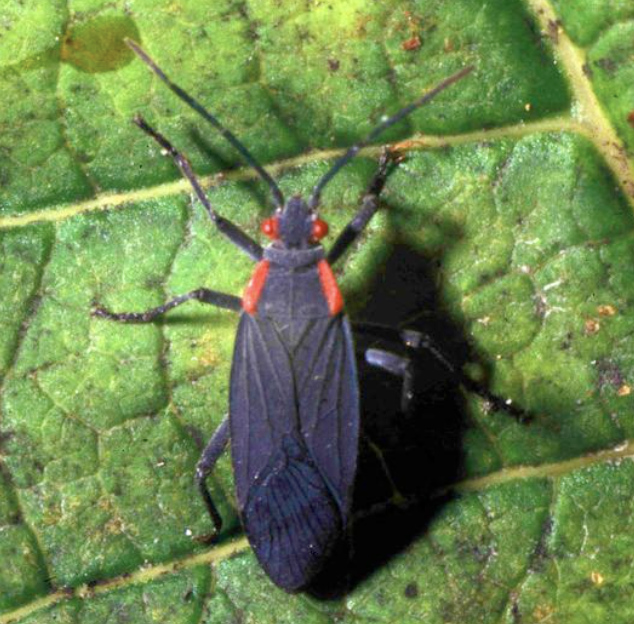
Red-shouldered bug
**order: Hemiptera**
**family: rhopalidae**
**family: rhopalidae**
81
New cards
Order Heteroptera **(true bug)** mouthpart
Sucking mouthparts (proboscis)
* Mandibles and maxillae: sheathed within a __modified labium__ to form a proboscis
* Filter chamber- Modification in a gut
* “Filter chamber” separates the excess fluid from plant sap for rapid removal (**“honeydew”)** → eat too much sugar → eliminates acid fluids
* Mandibles and maxillae: sheathed within a __modified labium__ to form a proboscis
* Filter chamber- Modification in a gut
* “Filter chamber” separates the excess fluid from plant sap for rapid removal (**“honeydew”)** → eat too much sugar → eliminates acid fluids
82
New cards
Mandibles and maxillae (in true bugs)
sheathed within a __modified labium__ to form a proboscis
83
New cards
Filter Chamber in True Bug
* Modification in a gut
it separates the excess fluid from plant sap for rapid removal
it separates the excess fluid from plant sap for rapid removal
84
New cards
Order **Psocodea**
(bark lice, book lice, true lice)
* “gnawed wings”
* Feed primarily on fungi, algae, lichen, and organic debris in nature but also feed on starch-based household items like grains, wallpaper glue and book bindings
* Generally, prefer humid condition
* “gnawed wings”
* Feed primarily on fungi, algae, lichen, and organic debris in nature but also feed on starch-based household items like grains, wallpaper glue and book bindings
* Generally, prefer humid condition
85
New cards
Suborder Phthiraptera (“true” lice)
1. Scansorial legs (for clinging)
1. **Ectoparasitic lifestyle** → Chewing and sucking ice, Ectoparasites of mammals and birds, Wingless
Both groups of lice are highly host-specific.
\
86
New cards
Mallophaga Chewing lIce
* Feeds on: Feed on dead skin cells, hair, or feathers
* Hosts: Mammals & birds
* Head vs. prothorax: the head is wider than the prothorax
\
* Hosts: Mammals & birds
* Head vs. prothorax: the head is wider than the prothorax
\
87
New cards
Anoplura
* Feeds on: Feed on blood
* Hosts: found on specific body parts of mammalian host
* Head vs. prothorax: the head is narrower than the prothorax
* Hosts: found on specific body parts of mammalian host
* Head vs. prothorax: the head is narrower than the prothorax
88
New cards
Head lice vs. Body lice
* Head lice (*Pediculus humanus* __*capitis)*__
1. Egg (nits) of head lice attached to the hair
2. Hygiene is NOT a factor in the likelihood of getting head lice
3. Up to 5% of elementary-age children may have head lice at any time
2. Transmission of disease by ___human body lice ______
**- Epidemic typhus fever**
* Body lice (*Pediculus humanus humanus*)
1. Hygiene DOES affect the likelihood of body lice
2. can cause intense itching & rash
1. Egg (nits) of head lice attached to the hair
2. Hygiene is NOT a factor in the likelihood of getting head lice
3. Up to 5% of elementary-age children may have head lice at any time
2. Transmission of disease by ___human body lice ______
**- Epidemic typhus fever**
* Body lice (*Pediculus humanus humanus*)
1. Hygiene DOES affect the likelihood of body lice
2. can cause intense itching & rash
89
New cards
Epidemic typhus fever
transmitted by human BODY lice
90
New cards
Beetles as vectors of diseases
1. **Disease**- a disorder of structure or function in __a plant__ that produces specific symptoms
2. **Vector**- an organism that transmits a disease or parasite __from one animal or plant__ to another
3. Causative agent or agent of disease: the pathogen or organism that actually causes disease
91
New cards
Click Beetles (Family Elateridae)
Adults can flip through the air (spinal & notch on the thoracic segments) → used to scare away predators -used to flip self
Some are **bioluminescent (producing light)**
→ bend body backward & move fat forwardly
Some are **bioluminescent (producing light)**
→ bend body backward & move fat forwardly
92
New cards
Fireflies or Lightning Bugs (Family Lampyridae)
Bioluminescence in the abdominal region
Specialized cell: **phagocytes** (Luciferin, luciferase, energy, oxygen)
* involves specialized cells, phagocytes
* Luciferin (chemical digested by →), luciferase (enzyme), energy, and oxygen = when **mixed will produce light (no heat)**
* Highly efficient
* Fireflies are in the west
Specialized cell: **phagocytes** (Luciferin, luciferase, energy, oxygen)
* involves specialized cells, phagocytes
* Luciferin (chemical digested by →), luciferase (enzyme), energy, and oxygen = when **mixed will produce light (no heat)**
* Highly efficient
* Fireflies are in the west
93
New cards
Differences between function of light in larvae versus adult in fireflies
\
1. sed to **attract mates (ADULTS)**
2. __Larvae__ (not all larvae produce light) use their glow as an **APOSEMATIC SIGNAL**
1. sed to **attract mates (ADULTS)**
2. __Larvae__ (not all larvae produce light) use their glow as an **APOSEMATIC SIGNAL**
94
New cards
Pheromones
chemical signals between individuals within the same species
95
New cards
Order Diptera (two wings): flies
Holometabolous, large, successful, and highly diverse order
a. Adults day-fliers, but some important groups are nocturnal (also crepuscular -active at dusk or dawn)
b. Eggs laid in larval habitat (typically moist habitats environment)
(8-24 hrs)
c. Larval habitat: stay in or around their food source (relatively sedentary)
a. Adults day-fliers, but some important groups are nocturnal (also crepuscular -active at dusk or dawn)
b. Eggs laid in larval habitat (typically moist habitats environment)
(8-24 hrs)
c. Larval habitat: stay in or around their food source (relatively sedentary)
96
New cards
Morphology: Adults flies
a. Halteres: gyroscope
(one pair of wings is modified to halteres)
b. Some with sucking mouthparts: lots of variation
(one pair of wings is modified to halteres)
b. Some with sucking mouthparts: lots of variation
97
New cards
Morphology: Larvae fly
a. No legs, sometimes spines -helps in movement within their food substrate
b. “Primitive” flies with well-developed ___head capsule___________ (___culiciform____________-type larvae)
(**culiciform-type larvae (presence if distinctive head capsule)**
c. More derived flies have no ___head capsule ___________and reduced ___mouthparts ___(to hook)______ (____vermiform ___________-type larvae)
\n d. Puparium: hardened last larval skin (exoskeleton) enclosing the pupa (in higher “ derived” dipterans w/ maggot-like imitates
b. “Primitive” flies with well-developed ___head capsule___________ (___culiciform____________-type larvae)
(**culiciform-type larvae (presence if distinctive head capsule)**
c. More derived flies have no ___head capsule ___________and reduced ___mouthparts ___(to hook)______ (____vermiform ___________-type larvae)
\n d. Puparium: hardened last larval skin (exoskeleton) enclosing the pupa (in higher “ derived” dipterans w/ maggot-like imitates
98
New cards
Reproduction flies
1\. Courtship- diverse
a. Sound: wing beat frequency of females detected by male antennal organ (mosquitoes)
b. Vision: Many dipterans are visually oriented insects! Males aggregate around a larval food resource in which females will lay eggs (some dung flies)
c. Leks: Males gather in places not associated with a resource and display/ defund territories
a. Sound: wing beat frequency of females detected by male antennal organ (mosquitoes)
b. Vision: Many dipterans are visually oriented insects! Males aggregate around a larval food resource in which females will lay eggs (some dung flies)
c. Leks: Males gather in places not associated with a resource and display/ defund territories
99
New cards
Family Tipulidae
crane flies
1. Description: stilt-like legs-easily shed (defensive mechanism)
2. Unique or interesting characteristics→ Larvae can be important soil engineers
3. 3. Larvae may be important because they: are important soil engineers
1. Description: stilt-like legs-easily shed (defensive mechanism)
2. Unique or interesting characteristics→ Larvae can be important soil engineers
3. 3. Larvae may be important because they: are important soil engineers
100
New cards
Family Chironomidae
(non-biting midgets)
* common nuisance around bodies of water frequently mistaken for mosquitoes
* common nuisance around bodies of water frequently mistaken for mosquitoes
 Note
Note  Flashcards (44)