regulation of the cell cycle
 Call Kai
 Learn
Learn Practice Test
 Spaced Repetition
 Match
Match Flashcards
 Knowt Play
1/19

There's no tags or description
Looks like no tags are added yet.
Name | Mastery | Learn | Test | Matching | Spaced | Call with Kai |
|---|
No analytics yet
Send a link to your students to track their progress
20 Terms
Mutations
•Mutation:
Mutation means a change in the DNA sequence of an organism. 🧬
It can happen naturally when cells copy DNA.
It can also be caused by radiation, chemicals, or viruses.
Mutations can change traits (like eye colour, hair type, or disease risk).
Some mutations are harmful, some are neutral, and some can be beneficial.
Example: A mutation in a gene might cause a plant to grow taller or give a person a genetic condition.
If mutations occur during the cell cycle, they need to be repaired and the cell cycle needs to stop.
Genes that regulate the cell cycle
Two genes that play a major role in the control the cell cycle are:
1.Proto-oncogenes
2.Tumour suppressor genes
These two genes must be in balance for a cell to function normally, any damage or mutation may cause uncontrolled cell replication
•
1. Proto-oncogenes
•Proto-oncogenes are a group of normal genes in a cell. They contain the necessary information for your body to make the proteins responsible for:
•stimulating cell division
•inhibiting cell differentiation
•preventing apoptosis (cell death)
•These processes are essential for cell growth and development and for maintaining healthy tissues and organs in your body.
When proto-oncogenes go rogue...
•If an error (mutation) occurs in a proto-oncogene, the gene can become turned on when isn't supposed to be turned on.
•Cells will start to grow out of control.
•Uncontrollable cell growth leads to cancer.
•These are now called oncogenes.
2. Tumour suppressor genes
Tumor suppressor genes are normal genes that:
•slow down cell division,
•repair DNA mistakes,
•tell cells when to undergo apoptosis.
When tumor suppressor genes don't work properly, cells can grow out of control, which can lead to cancer.
A third gene: P53 gene
•The p53 gene plays a critical role in controlling damage to genetic material.
•In a normal cell cycle, p53 is inactive - but if the DNA in a cell is damaged in any way, the gene becomes active and produces the p53 protein.
•This protein activates one of two pathways depending on the stage of the cell cycle - see diagram on the left.
A third gene: P53 gene
•So what happens if the p53 gene itself mutates? It will not be able to stop the cell cycle, so any DNA that is damaged cannot be repaired.
•Instead, the cell cycle continues in an uncontrolled way, causing the accumulation of mutated or damaged DNA in cells and resulting in tumours.
•Tobacco smoke, several viruses and some fungal toxins are known to alter the p53 gene. About 50% of cancers in humans contain a p53 mutation.
Apoptosis
•Apoptosis is programmed cell death. This is a 'self-destruct' mechanism for multicellular organisms.
•It is used to:
•regulate cell numbers
•remove cells that are no longer needed
•remove cells that contain damaged DNA that cannot be repaired
•
Why do we need it?
•Important in normal physiology and development
•Development: immune system maturation, morphogenesis and neural development
•Adult: immune privilege, DNA damage and immune repair
•Excessive apoptosis can cause neurodegenerative diseases.
•Deficient apoptosis can lead to cancers and auto immunity.
•
Apoptosis and Development
•Important in limb formation in animals
•Help shape the hands and toes in humans
•Maturing tadpoles lose their tails
•Dorsal (back) closure on fruit flies
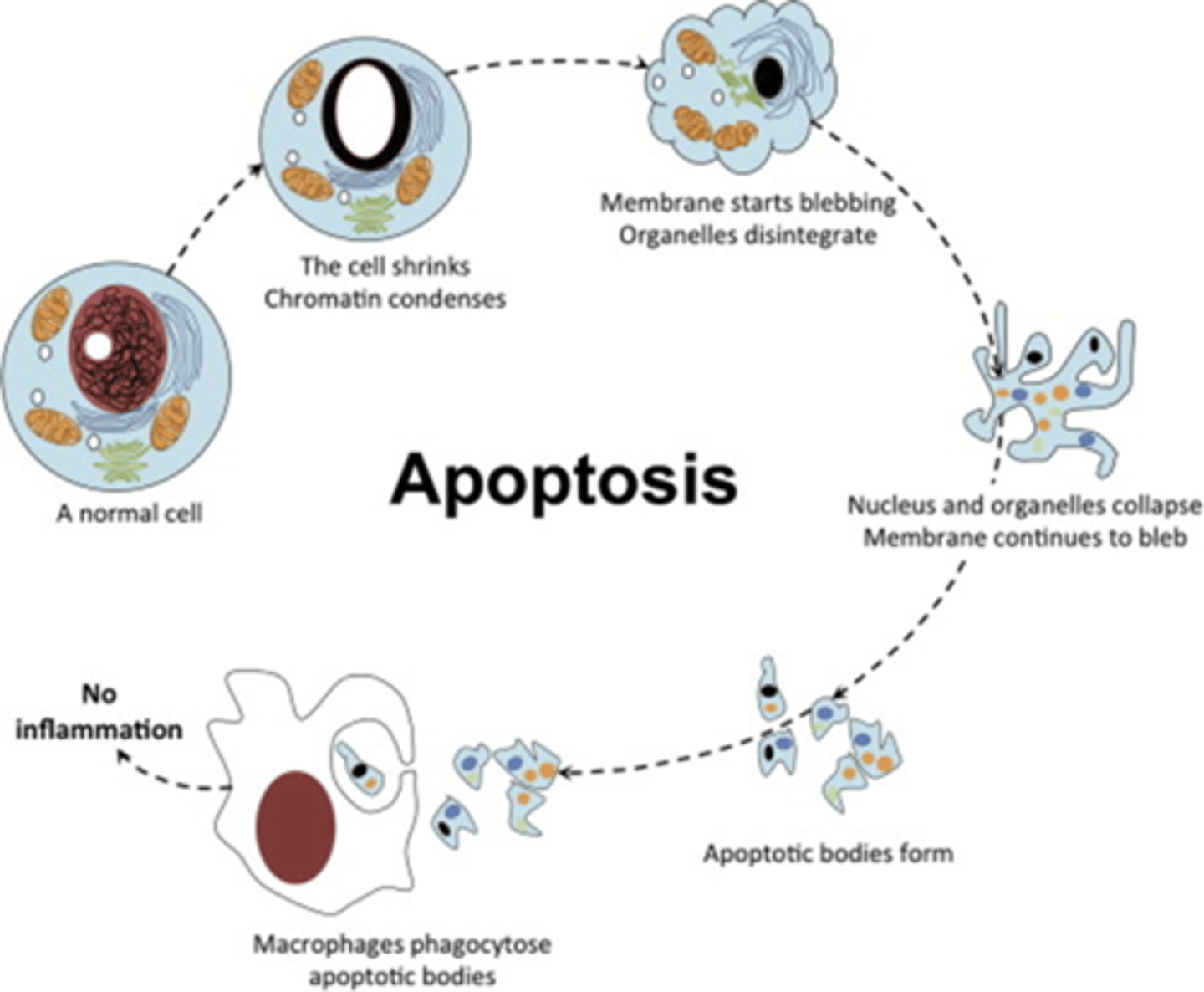
Steps in apoptosis
1.separation from adjacent cells
2.collapse of the cell's cytoskeleton
3.cell shrinkage
4.breakdown of organelles and nucleus
5.blebbing of the plasma membrane
6.budding of the plasma-membrane-bound vesicles called apoptotic bodies
7.phagocytosis of the apoptotic bodies by specialized cells
Cell separates from nearby cells.
The cell’s internal support structure breaks down.
The cell shrinks.
The nucleus and organelles break apart.
The cell membrane forms small bulges (blebs).
The cell breaks into small pieces called apoptotic bodies.
Other cells engulf and remove the pieces.
Summary of cell fates
•Genes are made of sequences of DNA that contain the information necessary for cells to function and grow properly.
•Genes contain instructions (codes) that tell a cell to make a specific type of protein.
•Each protein has a specialized function in the body.
Genetic predispositions
•Having a genetic predisposition means that you have an increased risk of getting a disease.
•It is not a guarantee that a person with a high genetic disposition will get the disease.
•Many other factors contribute to developing cancer such as
•Lifestyle factors
•Environmental factors
•Viral infections
Apoptosis and anti-cancer drugs
Apoptosis and anti-cancer drugs
mutations
A mutation is a change in the DNA sequence of an organism. DNA carries the instructions for making proteins, so changes can affect how an organism develops or functions.
Action of mutagens on the cell cycle
•Mutagens are chemical, physical or biological factors that cause mutations.
•Mutations are changes to the DNA code of an organism
•They an be favourable e.g. antibiotic resistance
•They can be detrimental e.g. cancers
•
Examples of mutagens
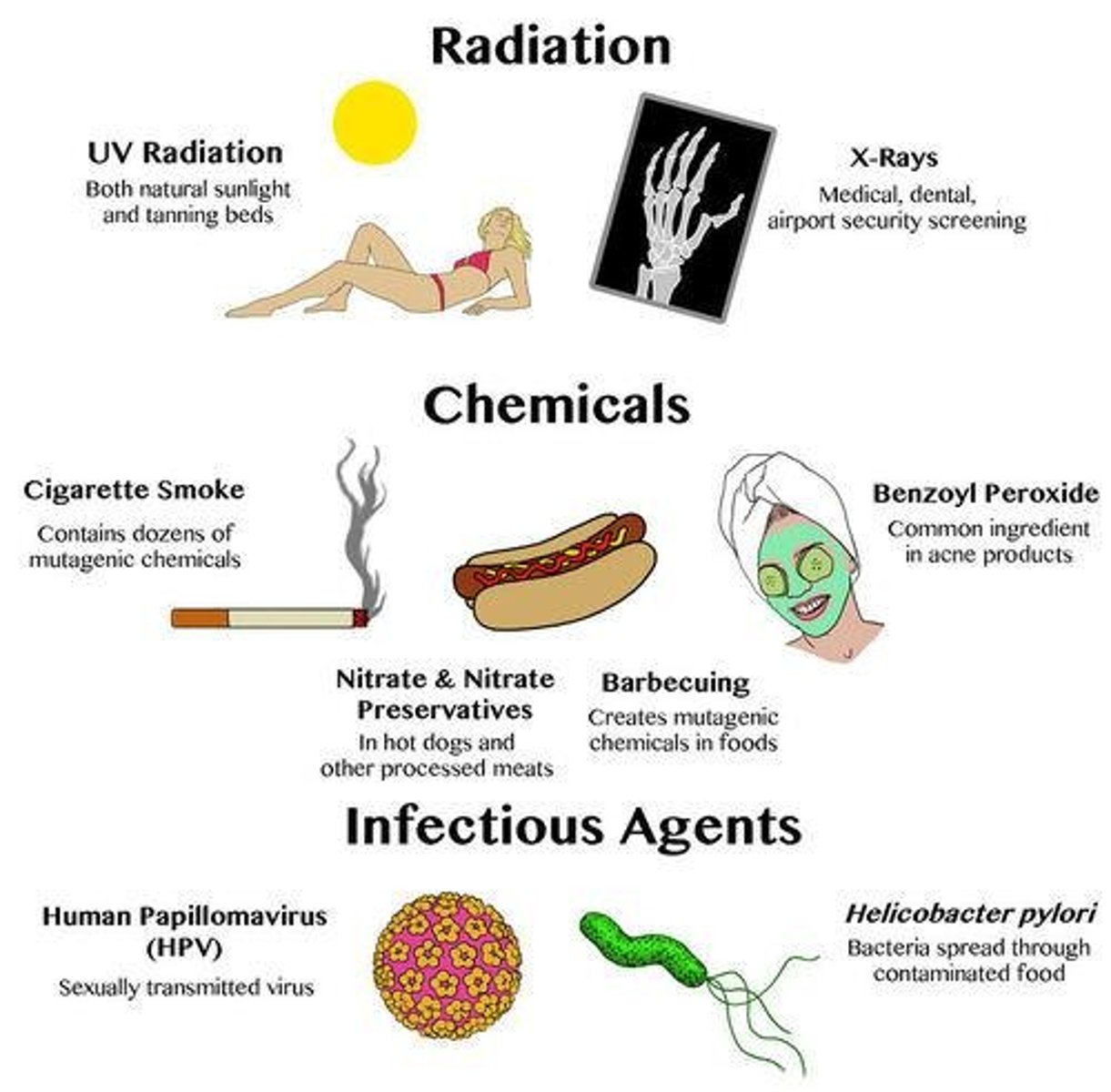
Chemical mutagens
•Chemicals that interfere with the structure, sequence or replication of DNA.
•Carcinogens are chemicals that are cancer causing i.e. tobacco smoke, asbestos, benzene.
•Teratogen is a chemical that causes physical defects in developing foetuses i.e. thalidomide, LSD, marijuana, some hormones, antibiotics and other medications.
•
Physical mutagens
•Include ultraviolet light, x-rays and nuclear radiation.
•Radiation directly damages the DNA or nucleotide structure.
•
Biological mutagens
•Viruses can insert their DNA into our genome and disrupt the traditional function of DNA or genes.
•Examples known to cause mutations in humans are Human Papilloma Virus, Hepatitis B and Epstein-Barr Virus.

