Ch 6 - Space Perception & Binocular Vision
 Call Kai
 Learn
Learn Practice Test
 Spaced Repetition
 Match
Match Flashcards
 Knowt Play
1/57

There's no tags or description
Looks like no tags are added yet.
Name | Mastery | Learn | Test | Matching | Spaced | Call with Kai |
|---|
No analytics yet
Send a link to your students to track their progress
58 Terms
realism
a philosophical position arguing that there is a real world to sense
positivism
a philosophical position arguing that all we really have to go on is the evidence of the senses, so the world might be nothing more than an elaborate hallucination
binocular
referring to two eyes
probability summation
the increased detection probability based on the statistical advantage of having two (or more) detectors rather than one
binocular summation
the combination of signals from both eyes in ways that make performance on many tasks better than with either eye alone
binocular disparity
the differences between the two retinal images of the same scene
basis for stereopsis, a vivid perception of the three-dimensionality of the world that is not available with monocular vision
monocular
referring to one eye
stereopsis
the ability to use binocular disparity as a cue to depth
monocular depth cue
a depth cue that is available even when the world is viewed with one eye alone
binocular depth cue
a depth cue that relies on information from both eyes
stereopsis is the primary example in humans, but convergence and the ability of two eyes to see more of an object than one eye sees are also binocular depth cues
pictorial depth cues
a cue to distance or depth used by artists to depict 3D depth in 2D pictures
occlusion
a cue to relative depth order in which, for example, one object obstructs the view of part of another object
nonmetrical depth cue
a depth cue that provides information about the depth order (relative depth) but not depth magnitude
metrical depth cue
a depth cue that provides quantitative information about distance in the third dimension
projective geometry
for purposes of studying perception of the three-dimensional world, the geometry that describes the transformations that occur when the three-dimensional world is projected onto a two-dimensional surface
texture gradient
a depth cue based on the geometric fact that items of the same size form smaller images when they are farther away
an array of items that change in size smoothly across the image will appear to form a surface tilted in depth
relative height
as a depth cue, the observation that objects at different distances from the viewer on the ground plane will form images at different heights in the retinal image
objects farther away will be seen as higher in the image
relative size
a comparison of size between items without knowing the absolute size of either one
familiar size
a depth cue based on knowledge of the typical sizes of objects, such as humans or pennies
relative metrical depth cue
a depth cue that could specify that object A is twice as far away as object B without providing information about the absolute distance to either A or B
absolute metrical depth cue
a depth cue that provides quantifiable information about distance in the third dimension
aerial perspective (haze)
a depth cue based on the implicit understanding that light is scattered when we look through more atmosphere
more distant objects are subject to more scatter and appear fainter, bluer, and less distinct
linear perspective
a depth cue based on the fact that liens that are parallel in the three-dimensional world
vanishing point
the apparent point at which parallel lines receding in depth converge
anamorphosis (anamorphic projection)
use of the rules of linear perspective to create a two-dimensional image so distorted that it looks correct only when viewed from a special angle or with a mirror that counters the distortion
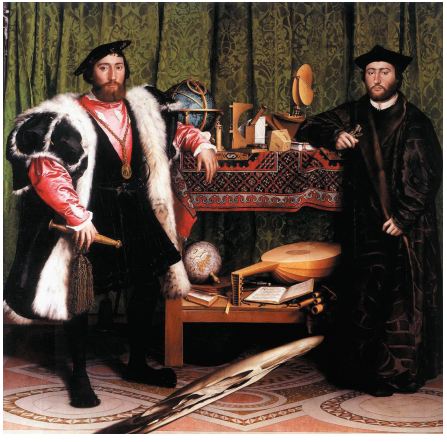
triangulation
refers to the triangle formed by the two eyes and the point on which they fixate in the 3D world
the angles of that triangle are related to the location of the fixated point in depth
motion parallax
depth cue based on head movement
geometric information obtained from an eye in two different positions at two different times is similar to the information from two eyes in different positions in the head at the same time
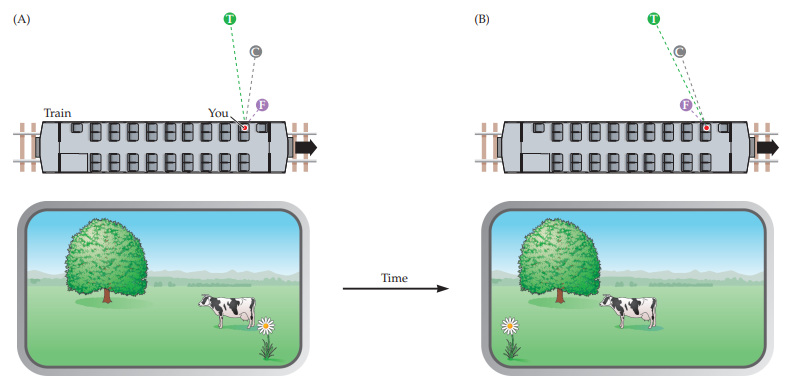
optic flow
the pattern of apparent motion of objects in a visual scene produced by the relative motion between the observer and the scene
accommodation
the process by which the eye changes its focus
lens gets fatter as gaze is directed toward nearer objects
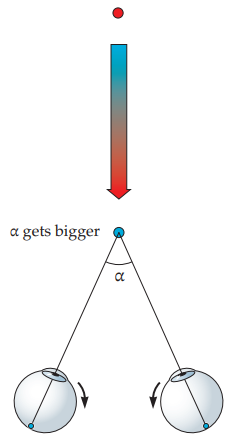
convergence
ability of the two eyes to turn inward, often used in order to place the two images of a feature in the world on corresponding locations in the two retinal images (typically the fovea)
reduces the disparity of that feature to zero
divergence
ability of the two eyes to turn outward, often used in order to place the two images of a feature in the world on corresponding locations in the two retinal images (fovea)
reduces the disparity of that feature to zero
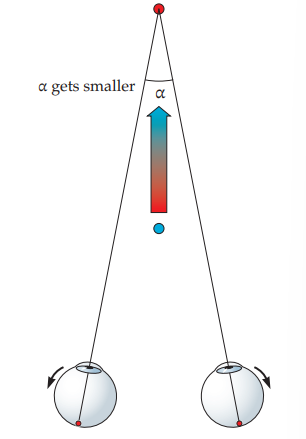
vergence angle
the angle formed by lines from each eye to the current object of fixation
the larger it is, implies a closer object
absolute disparity
the difference in the angular distance of the images of an object from the foveas of the two eyes
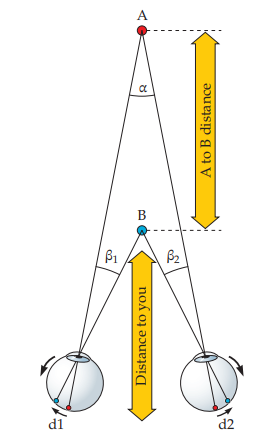
relative disparity
the difference in the absolute disparities of two objects
corresponding retinal points
two monocular images of an object in the world are said to fall on corresponding points if those points are the same distance from the fovea
the two foveas are these
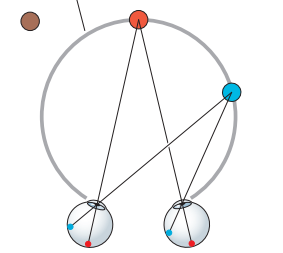
horopter (vieth-muller circle)
the location of objects whose images lie on corresponding points
the surface of zero binocular disparity
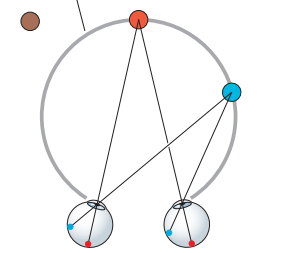
diplopia
double vision
if visible in both eyes, stimuli falling outside of panum’s fusional area will appear this way
panum’s fusional area
the region of space, in front and behind the horopter, within which binocular single vision is possible
crossed disparity
the sign of disparity created by objects in front of the plane of fixation (horopter)
images of objects located in front of the horopter appear to be displaced to the left in the right eye and to the right in the left eye
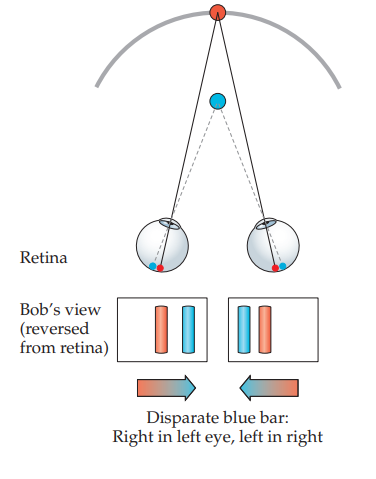
uncrossed disparity
the sign of disparity created by objects behind the plane of fixation (horopter)
used because images of objects located behind the horopter will appear to be displaced to the right in the right eye and to the left in the left eye
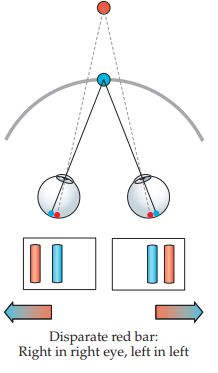
stereoscope
a device for simultaneously presenting one image to one eye and another image to the other eye
free fusion
the technique of converging or diverging the eyes in order to view a stereogram without a stereoscope
stereoblindness
an inability to make use of binocular disparity as a depth cue
typically used to describe individuals with vision loss in both eyes
random dot stereogram (RDS)
a stereogram made of a large number of randomly placed dots
contain no monocular cues to depth
look like barcodes
cyclopean
referring to stimuli that are defined by binocular disparity alone
correspondence problem
in reference to binocular vision, the issue of figuring out which bit of the image in the left eye should be matched with which bit in the right eye
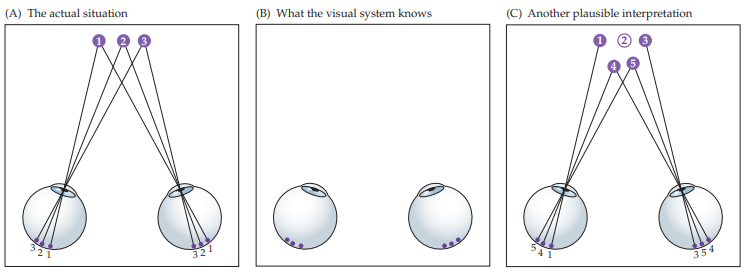
uniqueness constraint
in reference to stereopsis, the observation that a feature in the world is represented exactly once in each retinal image
simplifies the correspondence problem
continuity constraint
in reference to stereopsis, the observation that, except at the edges of objects, neighbouring points in the world lie at similar distances from the viewer
helpful in solving the correspondence problem
the bayesian approach
a way of formalizing the idea that our perception is a combination of the current stimulus and our knowledge about the conditions of the world
what is and is not likely to occur
binocular rivalry
the competition between the two eyes for control of visual perception, which is evident when completely different stimuli are presented to the two eyes
stereoacuity
a measure of the smallest binocular disparity that can generate a sensation of depth
dichoptic
referring to the presentation of two different stimuli, one to each eye
different from binocular presentation, which could involve both eyes looking at a single stimulus
critical period
a period of time during development when the organism is particularly susceptible to developmental changes
strabismus
a misalignment of the two eyes such that a single object in space is imaged on the fovea of one eye and on a nonfoveal area of the other (turned) eye
esotropia
strabismus in which one eye deviates inward
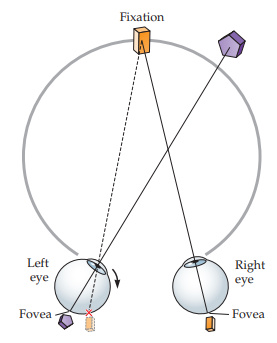
exotropia
strabismus in which one eye deviates outward
tilt aftereffect
the perceptual illusion of tilt, produced by adaptation to a pattern of given orientation
suppression
the inhibition of an unwanted image
occurs frequently in people with strabismus

