U.S. Government and Constitution: Federalism, Branches, and Amendments
 Studied by 1 person
 Call Kai
 Learn
Learn Practice Test
 Spaced Repetition
 Match
Match Flashcards
 Knowt Play
1/44

There's no tags or description
Looks like no tags are added yet.
Name | Mastery | Learn | Test | Matching | Spaced | Call with Kai |
|---|
No analytics yet
Send a link to your students to track their progress
45 Terms
Debates between Federalists and Anti-Federalists were primarily about
scope of power of the central government
A system of republican representation helps to
limit the excesses of factionalism was argued by James Madison in The Federalist paper number 10
Brutus was an example of an Anti-Federalist because
he believed a centralized government posed a major threat to individual rights
Madison's beliefs about political representation is
the people are best represented by a few politicians chosen to voice their issues.
What is the best example of checks and balances as it functions today?
The ratification of treaties by the Senate
Compared to government under the Articles of Confederation, the Constitution called for
separation of powers among the three branches of government.
What was NOT a weakness of government under the Articles of Confederation
That the national judiciary resolved arguments between the states
Commerce and Slave Trade Compromise describes
how the Founding Fathers resolved the issues of Slavery and the taxation of exports.
The Bill of Rights includes
the first 10 amendments.
Amending the Constitution
a multi-step process which requires proposal at the national level.
A major strength of federalism lies in the fact that it
promotes both national and state activities and avoids concentration of political power.
McCulloch v. Maryland (1819) was an important Supreme Court case involving federalism
because the Supremacy Clause of the Constitution was upheld.
What are NOT concurrent powers of national and state governments? Why?
Things like protecting the public's health, welfare, and morals; they belong to the states, alone
Cooperative federalism can best be described as
"marble-cake federalism".
Richard Nixon
The president most responsible for the implementation of new federalism
Example of fiscal federalism
Nixon's revenue-sharing plan
Block grants have
the fewest "strings" attached when it comes to spending government monies.
A major disadvantage of federalism is
that conflicts may arise over authority of government.
What is the effect that is commonly called reapportionment?
When after a national census has been taken, changes in population distribution cause the changing of congressional seats among the states.
It is the responsibility of the party whip to
keep track of vote counts and pressure members to vote with the party.
What is NOT a step that a proposed bill would encounter on its journey through Congress?
The bill is introduced by a president or by a member of the executive branch
After a presidential veto of a bill, Congress may override the president's veto with
a two-thirds vote of both houses of Congress.
Filibustering
is a legislative tactic is most effectively used only in the Senate.
Recognition in their districts is
an advantage congressional incumbents possess in seeking reelection over challengers.
What is an example of casework?
Helping a constituent resolve a problem involving the Veterans Administration
The pork barrel aids the district of a member of Congress by
bringing federal funds and projects to a district.
The role of Speaker of the House is
officially selected only by the majority party.
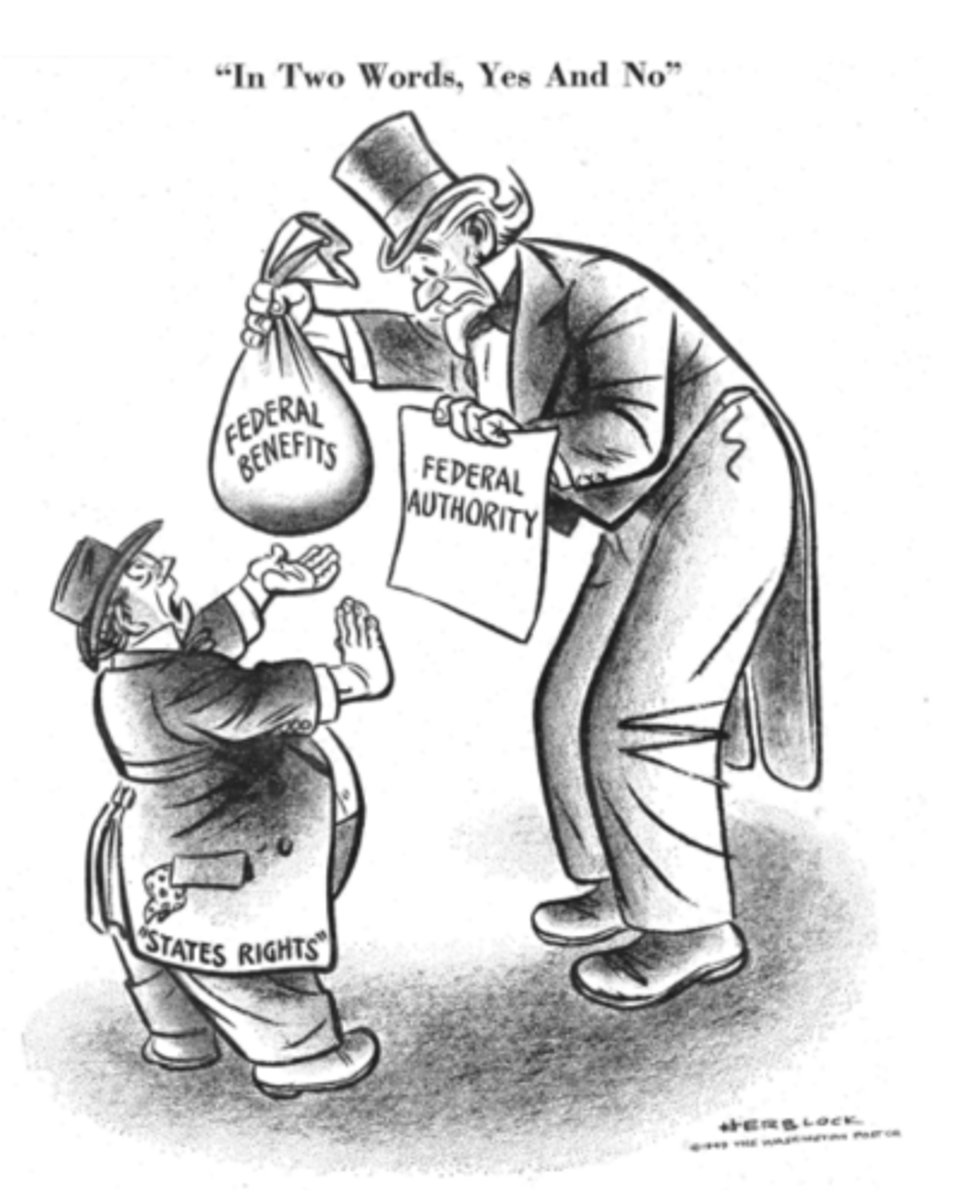
(Political cartoon) State governments prefer
federal funding but do not want federal oversight over how the money is spent.
The necessary and proper clause in the Constitution justifies
the "implied powers doctrine"
The decision of the Supreme Court in McCulloch v. Maryland (1819) established
that the federal government had the authority to establish a national bank, and Maryland's tax was unconstitutional.
The decision in United States v. Lopez (1995) struck down
the Gun-Free School Zones Act of 1990 as unconstitutional because it exceeded the commerce clause.
The practical effect the necessary and proper clause has been to
allow the national government to extend its powers beyond those enumerated in the Constitution.
The supremacy clause in the United States Constitution states that
federal law will prevail in the event of a conflict between federal and state law.
The 10th Amendment to the Constitution has been
interpreted by the Supreme Court to reserve powers to the states.
What is an example of the president's power as commander-in-chief?
The president power to send American troops into Syria to help in the fight against ISIS
For the SCOTUS comparison question, you will analyze and compare a case provide with United States v. Lopez. In section A, the Congressional power upon which the Court ruled (2 points). In Section B, you must state the facts of Lopez (2 points) and compare them with the provided case and draw a conclusion (2 points). In section 3, you must describe an action congress could take if it disagreed with the decision in the provided case (2 points).
For the Quantitative analysis question, you will analyze an electoral college map. In section A, you must describe the data presented 3 points. In B, you must describe a similarity or difference (2 points) and draw a conclusion based upon said similarity of difference (2 points). In C, you must explain how the graphic data demonstrates the principle of federalism (2 points). You may make an index card (one) that will be of assistance. My suggestion is that you put on as much federalism and electoral college knowledge as you can, as well as the task break down provided above.
What is an example of regulatory policy?
A policy that sets emission standards for automobiles
Chart (Look for a pattern on the chart)
(Chart) A way Congress interacts with the bureaucracy to address the problems is
that Congress could have members of the department testify before a committee discuss the issue and potential solutions.
What are examples of independent agencies?
the National Aeronautics and Space Administration (NASA) and the Environmental Protection Agency (EPA)
Independent regulatory agencies risk violating the constitutional concept of separation of powers
When they make rules, enforce those rules, and adjudicate disputes arising under those rules,
This scenario is an example of: Lobbyists from the Airlines for America, an advocacy group that represents commercial airlines, work with members of the House Committee on Transportation and Infrastructure and officials from the United States Federal Aviation Administration (FAA) to discuss a new policy that addresses issues of airline safety.
an iron triangle:
Laws passed by Congress have since undergone
judicial review by the Supreme Court to ensure that the commerce clause and other parts of the Constitution are interpreted correctly.
If a SCOTUS Justice retires,
the President can nominate a federal judge who shares the president's ideology.
 Note
Note  Flashcards (64)