1.2 Carbohydrates
 Call Kai
 Learn
Learn Practice Test
 Spaced Repetition
 Match
Match Flashcards
 Knowt Play
1/13

There's no tags or description
Looks like no tags are added yet.
Name | Mastery | Learn | Test | Matching | Spaced | Call with Kai |
|---|
No analytics yet
Send a link to your students to track their progress
14 Terms
What are monosaccharides? Give 3 common examples
● Monomers from which larger carbohydrates are made
● Glucose, fructose, galactose
Describe the structure of α-glucose
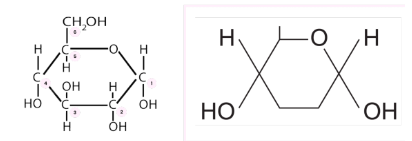
Describe the difference between the structure of α-glucose and β-glucose
OH group is below carbon 1 in α-glucose but above carbon 1 in β-glucose
Define an isomer and give an example
Molecules with the same molecular formula, differently arranged atoms.
Alpha and beta glucose are isomers.
What are disaccharides and how are they formed?
● Two monosaccharides joined together with a glycosidic bond
● Formed by a condensation reaction, releasing a water molecule
List 3 common disaccharides & monosaccharides from which they’re made
Maltose = Glucose + glucose
Sucrose = Glucose + fructose
Lactose = Glucose + galactose
Draw a diagram to show how two monosaccharides are joined together

What are polysaccharides and how are they formed?
● Many monosaccharides joined together with glycosidic bonds
● Formed by many condensation reactions, releasing water molecules
Describe the basic function and structure of starch
Energy store in plant cells
● Polysaccharide of α-glucose
● Amylose - 1,4-glycosidic bonds → unbranched
● Amylopectin - 1,4- and 1,6-glycosidic bonds → branched
Describe the basic function and structure of glycogen
Energy store in animal cells
● Polysaccharide made of α-glucose
● 1,4- and 1,6-glycosidic bonds → branched
Explain how the structure of starch relates to its function (amylose)
● Helical → compact for storage in cell
● Large, insoluble polysaccharide molecule → can’t leave cell / cross cell membrane
● Insoluble in water → water potential of cell not affected (no osmotic effect)
Explain how the structure of glycogen related to its function (and starch amylopectin)
● Branched → compact / fit more molecules in small area
● Branched → more ends for faster hydrolysis → release glucose for respiration to
make ATP for energy release
● Large, insoluble polysaccharide molecule → can’t leave cell / cross cell membrane
● Insoluble in water → water potential of cell not affected (no osmotic effect)
Describe the basic function and structure of cellulose
Provides strength and structural support to plant / algal cell walls
● Polysaccharide of β-glucose
● 1,4-glycosidic bond → straight, unbranched chains
● Chains linked in parallel by hydrogen bonds forming microfibrils
Explain how the structure of cellulose relates to its function
● Every other β-glucose molecule is inverted in a
long, straight, unbranched chain
● Many hydrogen bonds link parallel strands
(crosslinks) to form microfibrils (strong fibres)
● Hydrogen bonds are strong in high numbers
● So provides strength to plant cell walls

