Tectonic hazards
0.0(0)
 Studied by 50 people
 Call Kai
 Learn
Learn Practice Test
 Spaced Repetition
 Match
Match Flashcards
 Knowt Play
Card Sorting
1/37

Last updated 7:10 PM on 1/16/26
Name | Mastery | Learn | Test | Matching | Spaced | Call with Kai |
|---|
No analytics yet
Send a link to your students to track their progress
38 Terms
1
New cards
What are tectonic plates ?
and what are the two types of tectonic plates?
and what are the two types of tectonic plates?
The earth's crust is broken into large pieces called tectonic plates.
Continental plates and Oceanic plates.
Continental plates and Oceanic plates.
2
New cards
Why can tectonic plates move?
Tectonic plates can move because the rock in the mantle is only semi-solid and molten.
-Extreme temperature from the core of the earth heats up the mantle
-This causes the magma in the mantle to rise and when it cools, it sinks creating a current.
-Extreme temperature from the core of the earth heats up the mantle
-This causes the magma in the mantle to rise and when it cools, it sinks creating a current.
3
New cards
Continental plates
They are thicker, older and lighter, so they do not sink (subduct).
4
New cards
Oceanic Plates
They are thinner, younger and denser so they can sink (subduct) under another plate
5
New cards
What is plate boundary/margin?
They describe the location on earth where 2 plates meet or sit next to each other
6
New cards
Where do convection current happen in the earth?
In the upper mantle
7
New cards
How many types of plate margins are there and what are they?
There are 3 types of plate margin. Constructive, destructive and conservative.
8
New cards
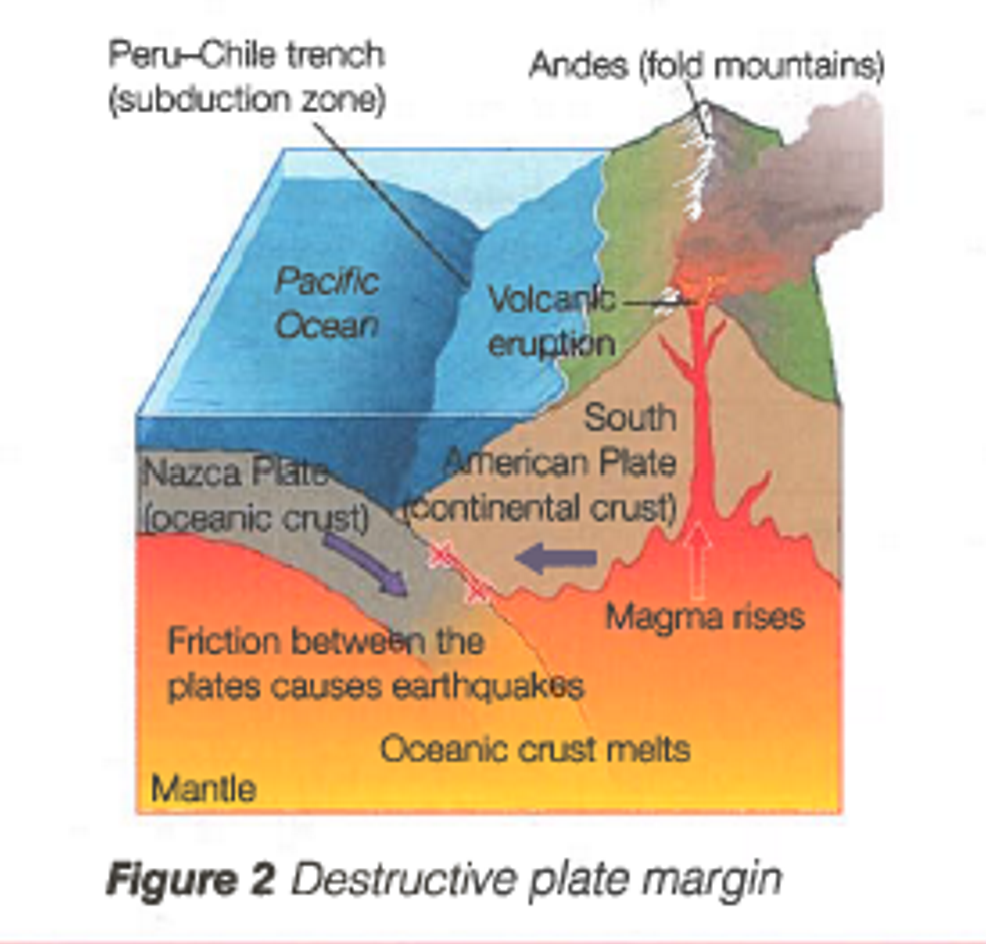
Destructive plate margins/ volcaones
-When a continetal plate meets an oceanic plate
-here the dense oceanic plate is subducted beneath the less dense continental plate.
-As the oceanic plate moves downwards, it melts creating magme which breaks through to the surface to form steep sided composite volacones.
-Eruptions are often violet and explosive
-here the dense oceanic plate is subducted beneath the less dense continental plate.
-As the oceanic plate moves downwards, it melts creating magme which breaks through to the surface to form steep sided composite volacones.
-Eruptions are often violet and explosive
9
New cards
Destructive plate margin / mountain
-when two conetinental plates meet, there is no subduction.
-Instead, the two plates collide and the crust becomes crumpled and uplifted.
-This collosion forms fold mountains (such as himalayas)
-These mountain building process causes earthquakes (volcanoes dont occur as there is no magma)
-Instead, the two plates collide and the crust becomes crumpled and uplifted.
-This collosion forms fold mountains (such as himalayas)
-These mountain building process causes earthquakes (volcanoes dont occur as there is no magma)
10
New cards
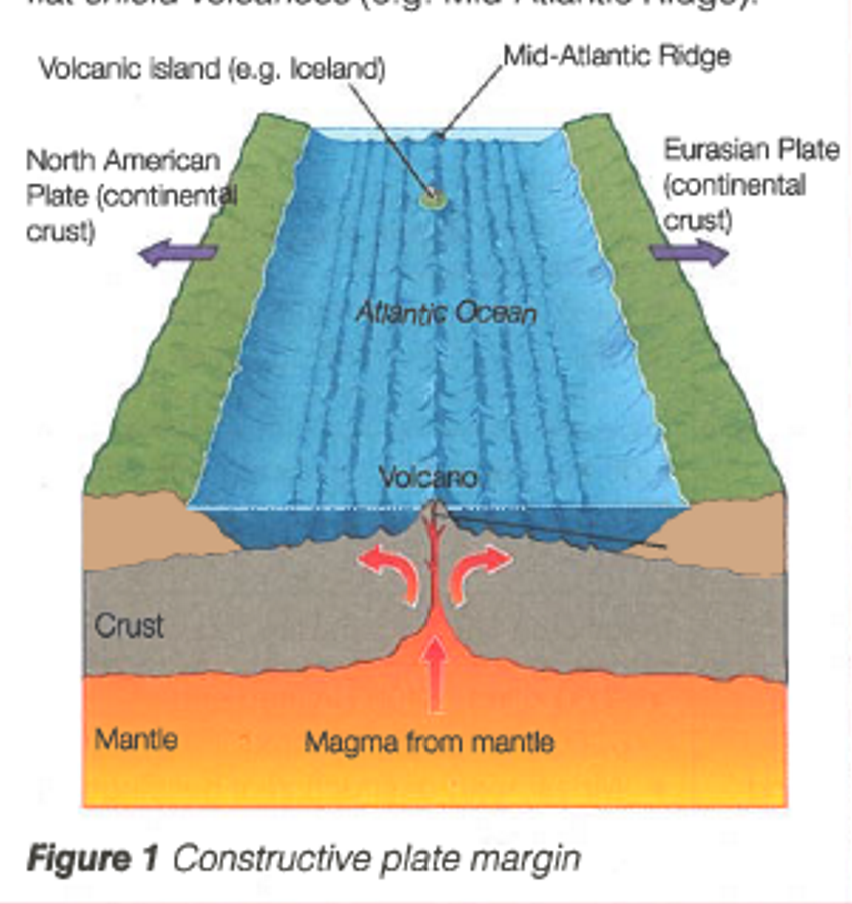
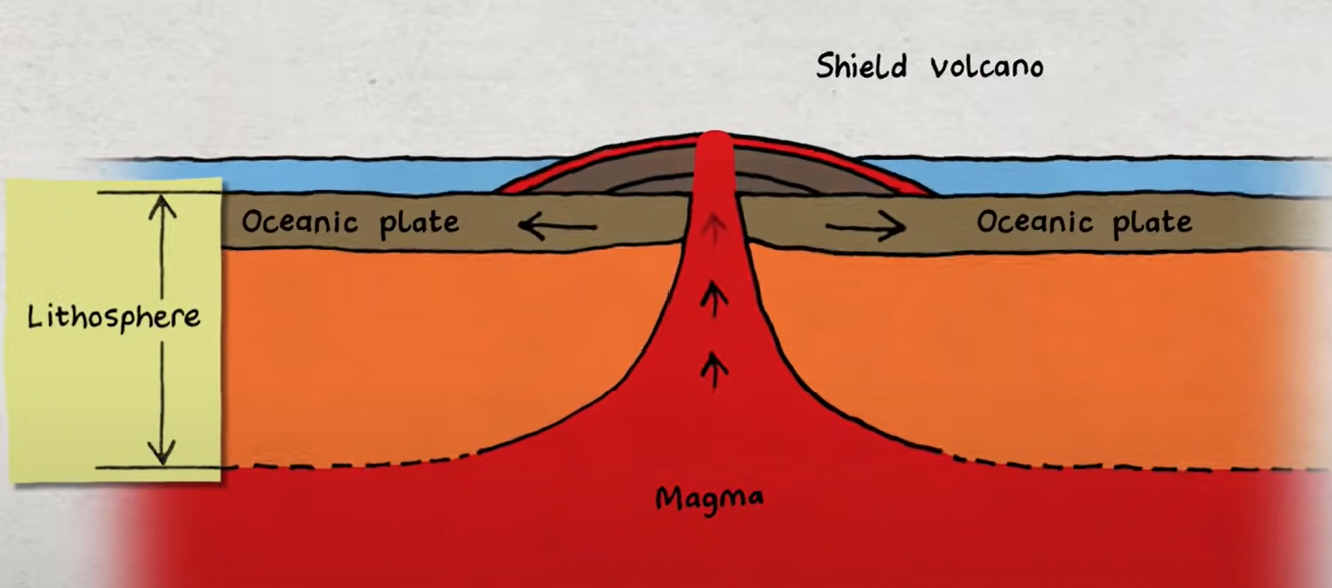
Constructive Margin
- Two plates move apart
-Magma forces its way to the surface along the mid-atlandtic ridge
-The convection currents diverge (push apart) and cause a gap to form between the plates.
-as it breaks through the overlying crust it causes earthquakes.
- Magma rises up to fill the gap that is created between the 2 plates
-on reaching the surface it forms shield volcanoes because the lava erupted flows a long way before cooling.
-Magma forces its way to the surface along the mid-atlandtic ridge
-The convection currents diverge (push apart) and cause a gap to form between the plates.
-as it breaks through the overlying crust it causes earthquakes.
- Magma rises up to fill the gap that is created between the 2 plates
-on reaching the surface it forms shield volcanoes because the lava erupted flows a long way before cooling.
11
New cards
Conservative (transform) margin
- Two plates slide past each other
- The plates are made of rock that has jagged edges so they catch and snag against one another.
-Friction between the plates cause earthquake.
-Eartquake happens along conservative margins as stresses gradually build up over many years.
-They can be destructive as they are closer to the earths surface.
-They are released when plates slip and shift.
(there are no volcanoes as there is no magma)
- The plates are made of rock that has jagged edges so they catch and snag against one another.
-Friction between the plates cause earthquake.
-Eartquake happens along conservative margins as stresses gradually build up over many years.
-They can be destructive as they are closer to the earths surface.
-They are released when plates slip and shift.
(there are no volcanoes as there is no magma)
12
New cards
Sumarised version of destructive margin
Plates COLLIDE at DESTRUCTIVE margines causing STRONG earthquakes and violent volcolcanic eruptions.
Plates move towards each other.
Plates move towards each other.
13
New cards
Summarised version of constructive margin
Plates SEPERATE at CONSTRUCTIVE margin cauisng MILD earthquakes and volcanic eruotions.
Plates move away from each other.
Plates move away from each other.
14
New cards
Summarised version of conservative margin
- Plates SLIDE by at the conservative margin casuing POWERFUL earthquakes.
plates move sideways past each other.
plates move sideways past each other.
15
New cards
Primary effects of a volcano
- Ash covers fields of rocks in volcanic rocks and kill livestock.
- Ashes can suffocate people due to sulphur
- Lava and hot ash can damage houses and start fires. This can leave people homeless.
-Volcanic bombs (large pieces of magma/lava) can burn people or knock people out.
Pyroclastic flows (masses of very hot ash, lava fragments and gases) destroy everything in their path, including buildings, homes, workplaces.
People can die as a result of any of these.
- Ashes can suffocate people due to sulphur
- Lava and hot ash can damage houses and start fires. This can leave people homeless.
-Volcanic bombs (large pieces of magma/lava) can burn people or knock people out.
Pyroclastic flows (masses of very hot ash, lava fragments and gases) destroy everything in their path, including buildings, homes, workplaces.
People can die as a result of any of these.
16
New cards
Secondary effects of a volcano
- volcanic winter
-infrastucture damage
(people can become homeless, roads and trains can be blocked which harms the clean up operation and local economy. could also distrup tourism)
-economic damage
-lahars
- can icrease soil fertility
-infrastucture damage
(people can become homeless, roads and trains can be blocked which harms the clean up operation and local economy. could also distrup tourism)
-economic damage
-lahars
- can icrease soil fertility
17
New cards
What is volcanic winter
Ash can cause a volcanic winter by entering the upper atmosphere and reflecting sunlight.
This causes cooling of around 2-4oC.
This can cause famine as crops don’t ripen.
This causes cooling of around 2-4oC.
This can cause famine as crops don’t ripen.
18
New cards
What does MPPP stand for (add a description for each one)
(ways of Management that can reduce the effects of a tectonic hazard.)
•Monitoring – recording physical changes, such as earthquake tremors
around a volcano, to help forecast when and where a natural hazard
might strike.
• Prediction – attempts to forecast when and where a hazard will strike.
This can be done to some extent for volcanic eruptions, but less reliably
for earthquakes.
• Planning – actions taken to enable communities to respond to, and
recover from, natural disasters, through emergency evacuation plans
and warning systems.
• Protection -actions taken before a hazard strikes to reduce its impact,
such as educating people or improving building design
around a volcano, to help forecast when and where a natural hazard
might strike.
• Prediction – attempts to forecast when and where a hazard will strike.
This can be done to some extent for volcanic eruptions, but less reliably
for earthquakes.
• Planning – actions taken to enable communities to respond to, and
recover from, natural disasters, through emergency evacuation plans
and warning systems.
• Protection -actions taken before a hazard strikes to reduce its impact,
such as educating people or improving building design
19
New cards
MPPP for eathquakes
For earthquakes, monitoring and prediction may involve using
seismometers to monitor earth tremors, but specific times and locations
are not possible to predict
• Protection includes constructing earthquake safe buildings so that they are safe to live in and will not collapse. Some examples of building improvements are rubber shock absorbers in the foundations to absorb the Earth tremors,
steel frames that can sway during Earth movements, and open areas
outside of the buildings where people can assemble during an
evacuation.
• Planning. Hospitals, emergency services and residents may practise
for an earthquake. They have drills in all public buildings so that people
know what to do in the event of an earthquake. This helps to reduce the
impact and increases their chance of survival. Planning may also
involve emergency evacuation plans.
seismometers to monitor earth tremors, but specific times and locations
are not possible to predict
• Protection includes constructing earthquake safe buildings so that they are safe to live in and will not collapse. Some examples of building improvements are rubber shock absorbers in the foundations to absorb the Earth tremors,
steel frames that can sway during Earth movements, and open areas
outside of the buildings where people can assemble during an
evacuation.
• Planning. Hospitals, emergency services and residents may practise
for an earthquake. They have drills in all public buildings so that people
know what to do in the event of an earthquake. This helps to reduce the
impact and increases their chance of survival. Planning may also
involve emergency evacuation plans.
20
New cards
MPPP for volcano
-monitoring and prediction may involve measuring gas concentrations, using tiltmeters to monitor changes in the volcano’s surface), using seismometers to measure small earthquakes and tremors and thermal heat sensors to detect changes in the temperature of the volcano’s surface.
•-Protection is difficult but it may be possible to use earth
embankments or explosives to divert lava flows away from property.
Planning. Hazard maps have been produced for many of the world’s
most dangerous volcanoes, showing the likely areas to be affected.
-They can be used in planning to restrict certain land uses or to identify
which areas need to be evacuated when an eruption is about to
•-Protection is difficult but it may be possible to use earth
embankments or explosives to divert lava flows away from property.
Planning. Hazard maps have been produced for many of the world’s
most dangerous volcanoes, showing the likely areas to be affected.
-They can be used in planning to restrict certain land uses or to identify
which areas need to be evacuated when an eruption is about to
21
New cards
Immediate responses to volcano
-aid
-evacuation
-warnings and monitoring
-temporary infrastructure
-evacuation
-warnings and monitoring
-temporary infrastructure
22
New cards
What is the difference between lava and magma?
Magma is molten rock beneath the earth’s surface.
Lava is solidified magma on the earth’s surface.
Lava is solidified magma on the earth’s surface.
23
New cards
Why do people live near volcanoes?
-Volcanic soils are very fertile.
-Tourists like to see volcanic hot springs, geysers and boiling mud.
-Geothermal energy produces electricity.
-Precious stones and minerals are often found in extinct volcanoes.
-Tourists like to see volcanic hot springs, geysers and boiling mud.
-Geothermal energy produces electricity.
-Precious stones and minerals are often found in extinct volcanoes.
24
New cards
How is the strength of an earthquake measured?
On the Richter scale
25
New cards
Primary effects of earthquake
-Homes destroyed
-people killed
-shipping ports destroyed
-trees and buildings rubble block roads
-power cables destroyed
-shops fronts damaged/destroyed
-people killed
-shipping ports destroyed
-trees and buildings rubble block roads
-power cables destroyed
-shops fronts damaged/destroyed
26
New cards
Secondary effects of erthquake
-people left homless/has to live in temporary accomodations
-dead bodies in the street can cause disease to spread
- unable to trade (import/export) = loss of income
-emergency survices are unable to acess the area
-phone lines distrupted- cannot call for help
-looting and violence break out
-dead bodies in the street can cause disease to spread
- unable to trade (import/export) = loss of income
-emergency survices are unable to acess the area
-phone lines distrupted- cannot call for help
-looting and violence break out
27
New cards
Tsunami
A very large ocean wave caused by an underwater earthquake
28
New cards
Liquifaction
When the strength and stiffness of a soil is reduced by earth shaking.
29
New cards
What has been done to reduce the effects of volcanoes?
-More accurate forecasting of earthquakes allows
earlier evacuation.
-Use of cross bracing and installing rubber shock
absorbers in foundations make buildings more resistant to shock.
earlier evacuation.
-Use of cross bracing and installing rubber shock
absorbers in foundations make buildings more resistant to shock.
30
New cards
Long term responses o volcanoes
-improve local economy (tax subsidies)
-rebuild infrastructure
-relocate
-rebuild infrastructure
-relocate
31
New cards
(Case study HIC) New Zealand short term repsonses from the earthquake
-International aid was provided (around $6-7 million).
-Aid workers from charities such as the Red Cross came to help.
-Areas were zoned to assess damage.
-300 Australian police officers were flown in.
-Aid workers from charities such as the Red Cross came to help.
-Areas were zoned to assess damage.
-300 Australian police officers were flown in.
32
New cards
(Case study HIC) New Zealand primry effects
-181 people were killed.
-2,000 injured.
-Over 50%t of the city's buildings were damaged.
-The city's cathedral spire collapsed.
-Water and sewage pipes were damaged.
-2,000 injured.
-Over 50%t of the city's buildings were damaged.
-The city's cathedral spire collapsed.
-Water and sewage pipes were damaged.
33
New cards
(Case study HIC) New Zealand secondary effects
-Businesses were closed for a long time.
-Christchurch couldn't hold the five Rugby World Cup matches.
-Schools were closed for two weeks due to the damage.
-Christchurch couldn't hold the five Rugby World Cup matches.
-Schools were closed for two weeks due to the damage.
34
New cards
(Case study LIC) Haiti; facts and information about the earthquake
-12 January 2010,
-7.0 magnitude.
-occurred on a destructive plate margin between the Caribbean and North American plates.
-focus was only 13 km deep
-epicentre was just 26 km from the capital, Port-au-Prince.
-7.0 magnitude.
-occurred on a destructive plate margin between the Caribbean and North American plates.
-focus was only 13 km deep
-epicentre was just 26 km from the capital, Port-au-Prince.
35
New cards
(Case study LIC) Haiti; long term responses
-dependent on overseas aid.
-New homes were built to a higher standard although the response was slow. -One year after the earthquake, over one million people were still living in temporary shelters.
-The port needed rebuilding which required a large amount of investment.
-New homes were built to a higher standard although the response was slow. -One year after the earthquake, over one million people were still living in temporary shelters.
-The port needed rebuilding which required a large amount of investment.
36
New cards
(Case study LIC) Haiti; short term responses
-Crucial aid was slow to arrive due to the damaged port.
-USA sent rescue teams and 10,000 troops.
-Bottled water and purification tablets were provided.
-235,000 people were moved to less-damaged cities away from Port-au-Prince.
-The UK government donated £20 million.
-USA sent rescue teams and 10,000 troops.
-Bottled water and purification tablets were provided.
-235,000 people were moved to less-damaged cities away from Port-au-Prince.
-The UK government donated £20 million.
37
New cards
(Case study LIC) Haiti; primary effects
-220,000 people were killed.
-300,000 people were injured.
-The main port was badly damaged.
-Eight hospitals collapsed.
-100,000 houses were destroyed and 200,000 were damaged.
-1.3 million people became homeless.
-300,000 people were injured.
-The main port was badly damaged.
-Eight hospitals collapsed.
-100,000 houses were destroyed and 200,000 were damaged.
-1.3 million people became homeless.
38
New cards
(Case study LIC) Haiti; secondary effects
-2 million people were left without food and water.
-Frequent power cuts occurred.
-Crime increased - looting became a problem and sexual violence escalated.
-People moved into temporary shelters.
-By November 2010 there were outbreaks of cholera
-Frequent power cuts occurred.
-Crime increased - looting became a problem and sexual violence escalated.
-People moved into temporary shelters.
-By November 2010 there were outbreaks of cholera
 Note
Note  Flashcards (72)