KNH184-Exam 2
0.0(0)
 Studied by 8 people
 Call Kai
 Learn
Learn Practice Test
 Spaced Repetition
 Match
Match Flashcards
 Knowt Play
Card Sorting
1/184

Earn XP
Description and Tags
Modules 3, 4 and 5: information processing, anticipation, attention, control systems, types and sources of feedback, visual movement, reflexive closed-loop control, motor programs and central generators
Last updated 11:08 PM on 3/28/23
Name | Mastery | Learn | Test | Matching | Spaced | Call with Kai |
|---|
No analytics yet
Send a link to your students to track their progress
185 Terms
1
New cards
What type of metaphor is information processing associated with?
with a computer metaphor
2
New cards
How do computer process information?
receive input, process information, and then produce output
3
New cards
What is the human processing model?
input, human and then output
4
New cards
Why is the human component of the human processing model referred to as a black box?
because input goes in, then something happens that we can’t see (the black box) and then output comes out
5
New cards
Since information processing cannot be observed directly, how is it studied?
reaction time
6
New cards
What does reaction time tell us about information processing?
it can help us study the duration and nature of information processing
7
New cards
What is reaction time (define)?
time between the presentation of a the stimulus and the beginning of movement (duration of information processing)
8
New cards
What is movement time?
the time between the time it takes from start to the end of the task
9
New cards
What is reaction time?
reaction time plus movement time
10
New cards
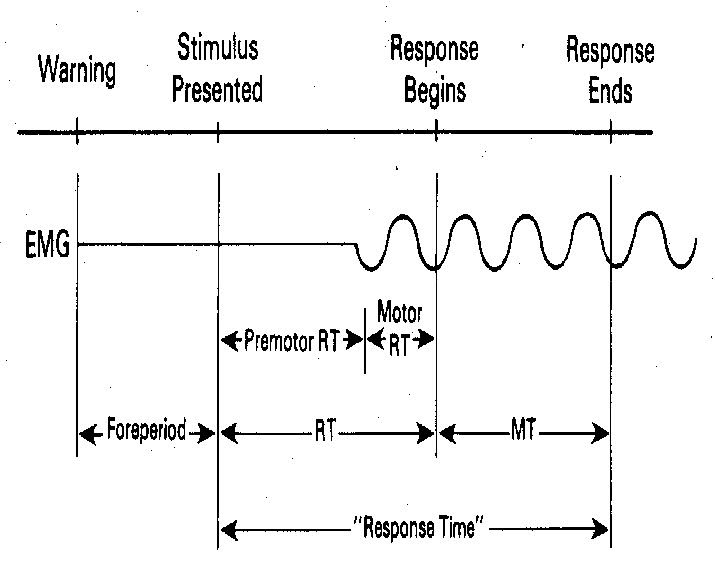
What is the foreperiod?
time between the warning was given to the time the stimulus is presented
11
New cards
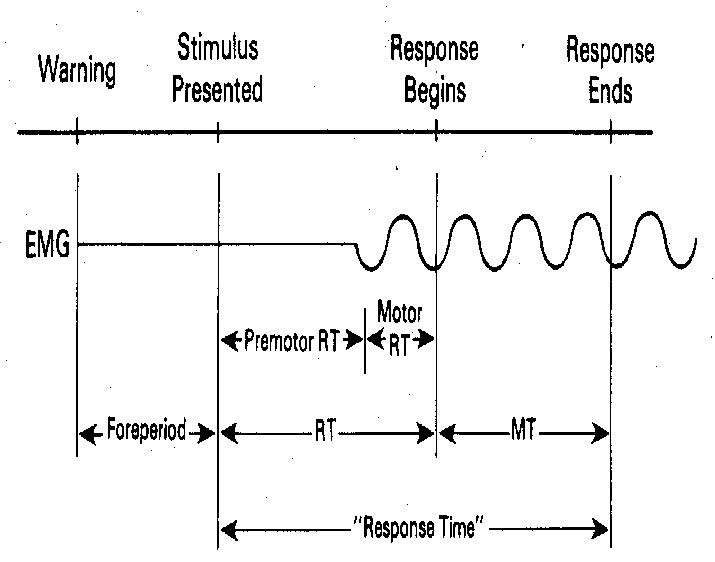
What does reaction time consist of?
premotor RT and motor RT
12
New cards
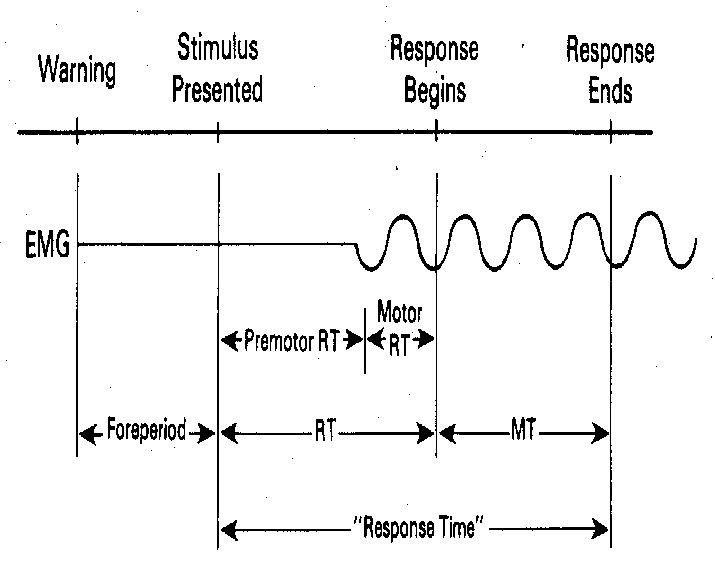
What is premotor RT?
period of time with no muscle contraction and no muscle movement
13
New cards
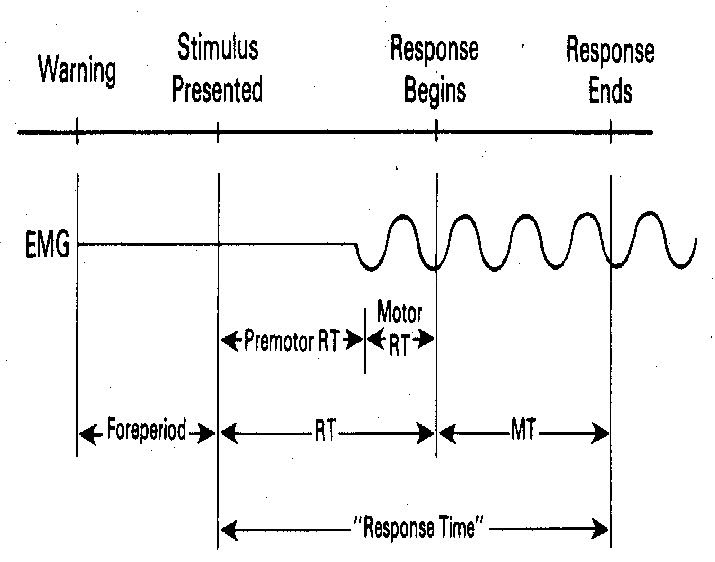
What is motor reaction time?
period of time with muscle contraction but no movement
14
New cards
Why reaction time important?
because it is an important component of skilled motor performance, as it tell does us the duration of information processing
15
New cards
What the the three stages of information processing?
stimulus identification, response selection, movement programming
16
New cards
What happens during the stimulus identification stage?
we identify a stimulus
17
New cards
How do we know the stimulus identification stage exists?
because there is a difference in reaction time to different stimulus and out reaction time (ex. we react slower to light than we do to sound)
18
New cards
What is the theory on why we react faster to sound than light?
it’s more important to know which direction a sound comes from and we determine this by the difference in sound between our ears
19
New cards
What is simple stimulus detection?
as stimulus that is simple and straightforward, that does not require experience to know how to react (ex. red light)
20
New cards
What is a pattern recognition stimulus?
a stimulus where you must read the situation and be able to recognize a certain pattern (ex. football play)
21
New cards
Is stimulus identification inherited or learned?
stimulus identification is both inherited and learned
22
New cards
What is the looming effect?
when something is approaching rapidly into the visual field and the body avoids it by blinking or taking a step back
23
New cards
New research on babies and the looming effect found what?
that babies were able identify how dangerous different stimuli are
24
New cards
What is the response selection stage?
decision making
25
New cards
How do we know that the response selection stage exists?
because of studies that manipulated the number of possible response alternatives and measuring reaction time found that increasing the number of stimulus response alternatives increases the reaction time (get slower)
26
New cards
What is Hick’s law?
describes a linear relationship between Log2 and the number of stimulus response alternatives (N) and reaction time, increasing the number of stimulus-response alternatives increase the reaction time
27
New cards
What is a scientific law?
statement of the relationship between two variables
28
New cards
Why is Hick’s law important?
it allows us to predict
29
New cards
What is movement progamming?
devoted planning of a movement response
30
New cards
How do we know motor programming exists?
Henry and Rodger experiment which found that increases in movement complexity causes increases in reaction time, this supports the idea that we organize/plan movements
31
New cards
What is anticipation?
expecting or predicting something will happen
32
New cards
What are the two types of anticipation?
spatial and temporal anticipation
33
New cards
What is spatial anticipation?
knowing what the stimulus will be
34
New cards
What is temporal anticipation?
knowing when the stimulus will be presented
35
New cards
How does accurate spatial anticipation speed reaction time?
knowing what the stimulus is allows you to skip the response selection stage and go from stimulus identification to response programming
36
New cards
How does accurate temporal anticipation speed reaction time?
allows the performer to begin movement programming in advance of the stimulus (skip the stimulus identification stage and response selection)
37
New cards
How are sprinters in track discouraged from using temporal anticipation?
disqualified for a false start, starter varies length of fore period, and electronic monitoring of RT
38
New cards
What is the reaction time the consists disqualification in track?
less than 100ms because it is assumed no human could react that quickly
39
New cards
Why was Devon Allen disqualified from his track event?
because his reaction time was just barely under 100ms
40
New cards
What is a benefit of anticipating correctly?
you usually gain the benefit of being faster
41
New cards
What is an example of when anticipating always outweighs the benefits of waiting to react?
soccer goalkeeper is better off guessing which side a ball will go rather than waiting to decide how to react
42
New cards
What is the cost of anticipating incorrectly?
it usually take more time to complete a task if you anticipate incorrectly
43
New cards
What is example when of when the cost of anticipating correctly always outweighs the benefits of anticipating correctly?
driving and you approach a red light at an intersection (anticipating that it will turn green by the time you get there and it doesn’t)
44
New cards
What is attention?
the capacity to process information
45
New cards
Why is attention considered a limit resoruce?
because you cannot attend to everything
46
New cards
What is interference (distraction)?
when the demand for attention exceeds your capacity to allocate attention and performance suffers
47
New cards
What percent of distractions are avoidable?
92%
48
New cards
How does attention influence stimulus identification?
parallel processing and serial processing
49
New cards
What is parallel processing?
doing more than one thing at a time because the demand is low
50
New cards
What is serial processing?
only processing one thing at a time because demand for attention is high
51
New cards
What is the Stroop effect and what does it show?
Stroop effect was a test that showed a color word in different color fonts, and you were to supposed to say the color of the word. This showed parallel processing because the word and color are processed a the same time and then they conflict
52
New cards
Does attention affect response selection and how is it determined?
controlled processing and automatic processing, depends on the amount of practice
53
New cards
What is controlled processing?
slow, serial, attention demanding
54
New cards
What is automatic processing?
fast, parallel, not attention demanding
55
New cards
How does attention affect movement progamming?
serial processing
56
New cards
How is serial processing during the movement planning stage studied?
studied using the double-stimulation paradigm
57
New cards
What are the parts of a the double stimulation paradigm?
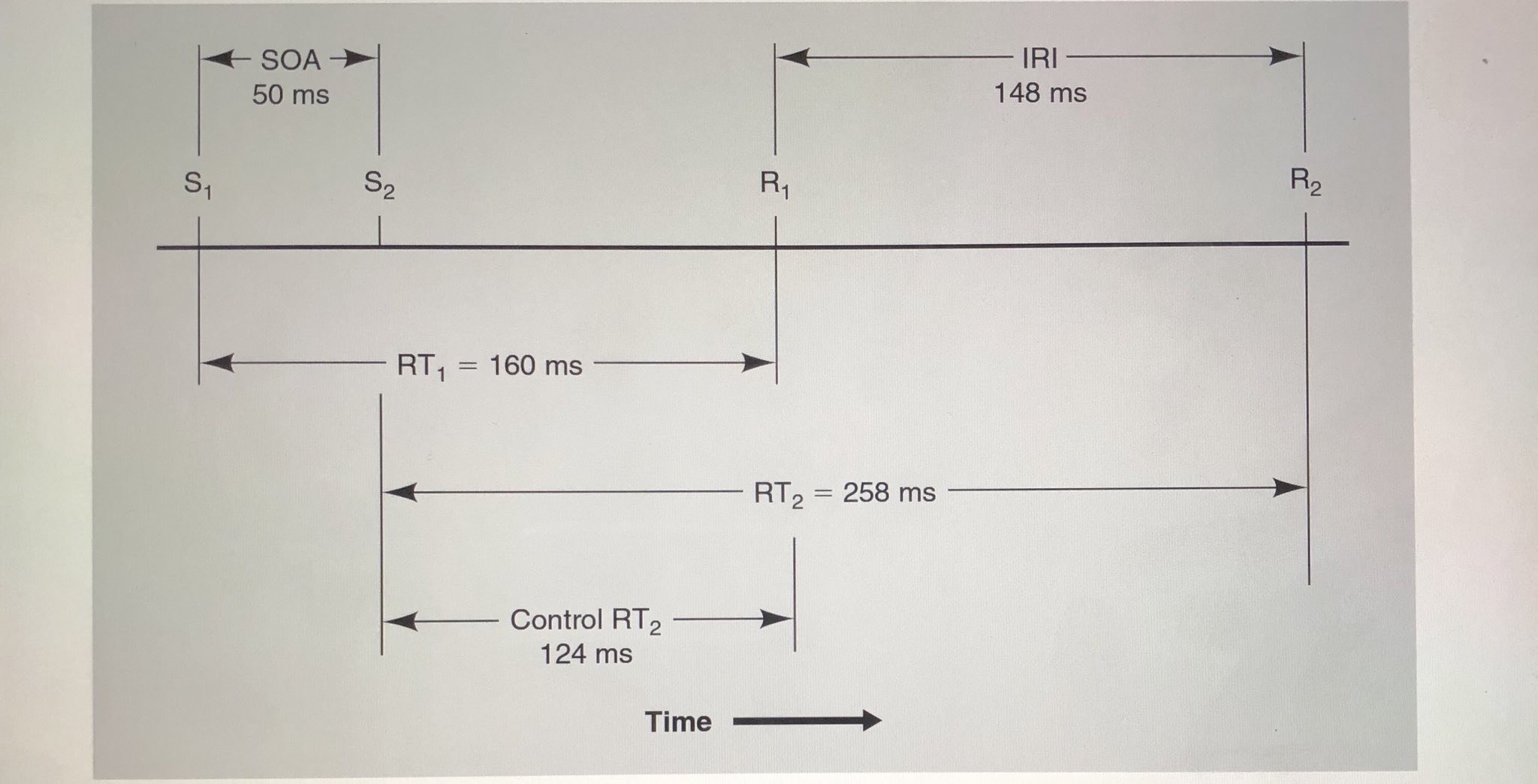
S1 (stimulus 1), RT1 (reaction time for stimulus 1), S2 (stimulus 2), RT2 (reaction time), SOA (stimulus onset asynchrony or the interstimulus interval)
58
New cards
In the double stimulation paradigm, what is SOA?
stimulus onset asynchrony or the interstimulus interval, time between S1 and S2
59
New cards
What does the double stimulation paradigm show?
the reaction time to just S2 is shorter than it compared to being presented with S1 and then S2
60
New cards
What is the psychological refractory period?
the delay in a person’s reaction time to the second of two closely spaced stimuli, compared with reaction time to the second stimulus when presented alone
61
New cards
What causes the psychological refractory period?
a bottleneck occurs in the movement programming stage of information processing (S1 response-programming is first and then S2)
62
New cards
What time period will produce the psychological refractory period?
SOA’s between 50 and 300 ms will produce the psychological refractory period
63
New cards
Where do the greatest delays in reaction time occur (SOA time period)?
at the shortest range of SOAs so those closer to 50ms
64
New cards
If the SOA is less than 50ms what will happen?
patient will group the two stimuli together
65
New cards
What will happen if the SOA stimulus interval is longer?
the brain will be able to process the two stimuli separately
66
New cards
What is a fake in sport?
when a player misleads the defensive player into thinking they are doing a certain shot, but then they do not
67
New cards
How is a fake in sport related to the double stimulation paradigm?
the offensive player sees the fake (S1) and they start programming a movement for that but then by the time the see the real shot (S2) they don’t have time to correct themselves
68
New cards
What is the point of the psychological refractory period?
it may have a protective feature because it ensure that a response to a dangerous stimulus is produced without interfere from other conflicting signals
69
New cards
What is a summary of attention during information processing?
countless stimuli enter during stimulus identification and are parallel processed, then response is selected and but response programming or action is serial
70
New cards
How does the demand for attention throughout information processing change?
demand for attention increases in a linear fashion as you go through the steps of information processing
71
New cards
What is an internal focus of attention?
focus attention monitoring the ongoing movement or what’s going in your body
72
New cards
What is an external focus of attention?
focus of attention on target, such as an object being struck or the intended effect that the action will have on the environment
73
New cards
Which type of focus (internal or external) will result in more skilled performance?
external focus results in more skilled performance than internal focus attention (most of the time)
74
New cards
What is the constrained action hypothesis?
internal focus might cause one to control movement, which could interfere with automatic/unconscious control
75
New cards
What is arousal?
the level of excitement produced under stress
76
New cards
What is the inverted-U principle?
represents a view of the relationship between arousal and performance, increasing arousal level generally enhances performance but only to a certain point
77
New cards
What is the A variation of the inverted-U principle?
optimal level of arousal is near the shorter end, which would best be used in fine motor tasks
78
New cards
What is the B variation of the inverted-U principle?
optimal level of arousal is average, meaning that something will not as influenced by high or low arousal
79
New cards
What is the C variation of the inverted-U principle?
optimal level of arousal is hear the higher end, which is best suited for gross motor tasks
80
New cards
What is perceptual narrowing?
tendency for the perceptual field to shrink under stress with high arousal
81
New cards
Why is perceptual narrowing important?
because it allows the person to devote more attention to those sources of stimuli that are immediately most likely and relevant
82
New cards
What is choking under pressure?
a scenario in which a performer changes a normal routine or fails to adapt to a changing situation, resulting in failed performance
83
New cards
What causes choking under pressure?
it may occur when there is a change in one’s attention focus from external to internal
84
New cards
What do the examples of the automaton duck and the “the Writer” show?
show that if someone is able to create technology to mimic things in nature, then maybe that can tell us somethings about how the real thing works
85
New cards
What are the parts in a closed-loop system?
executive, effector and comparator
86
New cards
What does an executive do in a closed-loop system?
make decisions (stimulus identification, response selection, movement programming)
87
New cards
What does the effector do in a closed-loop system?
does the work, which is usually the muscle
88
New cards
What is the comparator in an closed-loop system?
compares feedback from the current state of the system and then compares it to the desired state (difference is the error)
89
New cards
What is the difference between a closed-loop system and an open-loop system?
a closed-loop system has time to use feedback, and an open-loop system does not
90
New cards
What movement times are considered to be under open-loop control?
movements that completed in less than 200ms are considered to rapid and under open-loop control
91
New cards
What movement times are considered to be under closed-loop control?
movements completed in greater than 200ms are considered slow and under closed-loop control
92
New cards
What are the different types of feedback?
proprioception, exteroception, and exproprioception
93
New cards
What is proprioception?
information about body position and movement, relative to the body
94
New cards
What is exteroception?
information about the external environment
95
New cards
What is exproprioception?
information about body position and movement, relative to the environment
96
New cards
What are some sources of feedback information for motor control?
vision, audition, vestibular apparatus, joint receptors, tendon organs, muscle spindles and cutaneous receptors
97
New cards
What is audition?
the sense of hearing
98
New cards
What is the vestibular apparatus?
semicircular canals filled with fluid in the inner ear, that provide information about head position relative to gravity, rotary and linear acceleration of the head and helps with balance and visual tracking
99
New cards
What are joint receptors?
located within the joint capsule, that provide information about joint position (extreme ranges of motion)
100
New cards
What are golgi tendon organs?
located at the junction between muscle and tendon, and provide information about tendon/muscle tension and can elicit an inhibitory response
 Note
Note  Flashcards (45)