Models of Memory 1.1 Cognitive Processing
 Call Kai
 Learn
Learn Practice Test
 Spaced Repetition
 Match
Match Flashcards
 Knowt Play
1/18

There's no tags or description
Looks like no tags are added yet.
Name | Mastery | Learn | Test | Matching | Spaced | Call with Kai |
|---|
No analytics yet
Send a link to your students to track their progress
19 Terms
Cognitive Approach Core Beliefs
1. Human beings are information processors and mental processes guide our behaviour
2. The mind can be studied scientifically
3. Cognitive approaches are influenced by social and cultural factors
What is a Model?
Not an exact copy, rather a representation which helps us understand how something works
Multi-Store Model; Atkinson and Shiffrin (1968) Main Assumptions
1. Memory consists of a number of separate locations in which information is stored
2. Memory processes are sequential.
3. Each memory store operates in a single, uniform way.
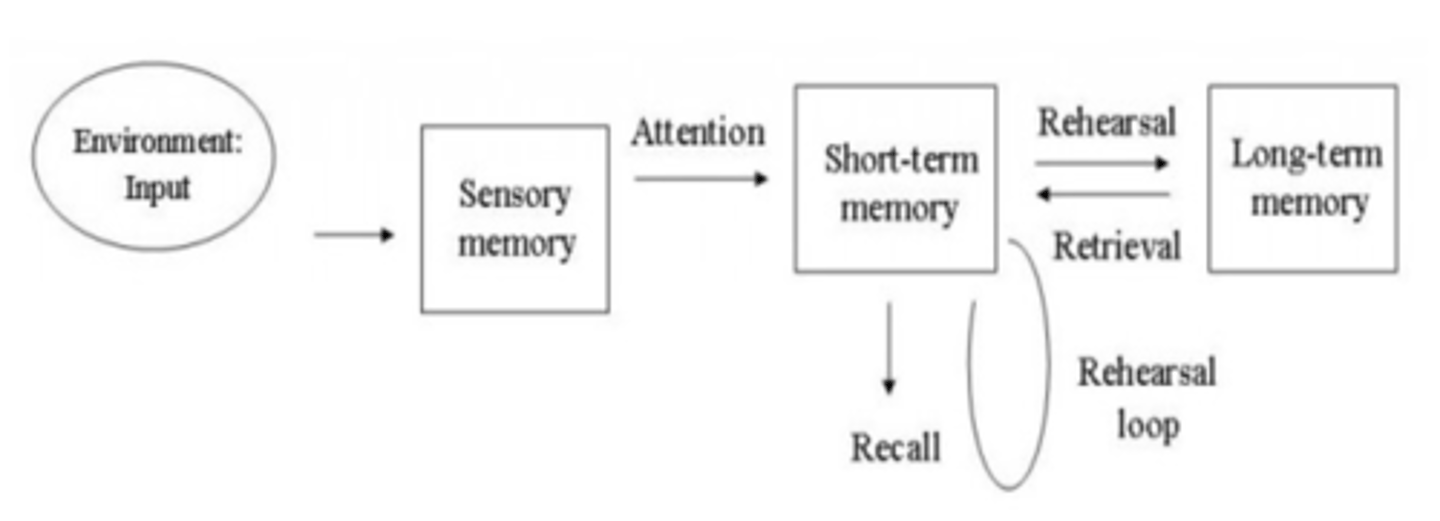
Sensory memory
The most important stores in the model are the visual store (iconic memory) and the auditory store (echoic memory). Information in the sensory store stays here for a few seconds, and only a very small amount of the information will continue into the STM store.
Encoding
Information converted into a code that can be stored
Capacity
There is a limit to how much can be stored within memory
Duration
How long information can be stored within memory?
Murdock (1962) Aim
To see if the length of a list of words and/or the pace at which the words were read would affect the serial position curve.
Murdock (1962) Research Method
Independent samples design
IV: Time interval between words (3, 6, or 9 seconds)
Whether each word was read once or twice in succession
DV: Number of words recalled by participants after listening to the word lists
Participants: 103 psychology students
Task: Examine how word list length and reading pace affect memory recall. Participants were randomly assigned to six conditions based on the number of words and the pace of reading. They then listened to 80 lists of words and had 1.5 minutes to recall them afterwards.
Murdock (1962) Findings
The likelihood of recalling a word depends on its position in a list, known as the serial position effect. The enhanced recall of initial words is called the primary effect, while the recall of words at the end is termed the recency effect.
Working Memory Model; Baddely and Hitch (1974) New model claims
Short term memory is not one dimensional and has layers and different processes. For this reason the STM was renamed Working Memory because of its ability to hold information while simultaneously processing it.
Visuo-Spatial Sketch Pad
Much information stored is visual
Allows storage and processing of visual information and spatial information, helps you visualise a mental picture.
Phonological loop
Inner voice
Printed words → repeat (until attention is drawn elsewhere)
Articulation allows us to retain verbal information (Operates like a loop)
Inner ear
Receives auditory information and stores it in acoustic code
Episodic Buffer
Acts as a backup store, communicating with both long-term and components of the working memory.
Links together every piece of information from other elements of working memory with further information relating to time and order.
Process enables memories to be prepared for episodic long-term memory storage
Central Executive
The boss, which decides what the slave systems pay attention to (attention control). It has limited capacity, therefore relies on slaves for more information.
Warrington and Shalice (1972) Aim
To study how patient KF's brain damage affected his working and long-term memory
Warrington and Shalice (1972) Procedure
Research Method: Longitudinal study
Tested his ability to learn verbal, visual information, etc throughout his recovery.
Warrington and Shalice (1972) Findings
KF's impairments were largely for verbal information; his visual information was working fine, hence his difficulty memorising letters and numbers presented orally. More specifically, he could remember non-verbal sounds, meaning his problems were with auditory verbal memories.
Warrington and Shalice (1972) Conclusion
Proves Baddely and Hitch's theory that there are separate working memory components for visual and verbal information. This research supports the theory that working memory is much more complex than suggested by the original multi-store model.

