AP Psych Unit 4: Social and Personality
 Call Kai
 Learn
Learn Practice Test
 Spaced Repetition
 Match
Match Flashcards
 Knowt Play
1/96

There's no tags or description
Looks like no tags are added yet.
Name | Mastery | Learn | Test | Matching | Spaced | Call with Kai |
|---|
No analytics yet
Send a link to your students to track their progress
97 Terms
Displacement
Redirect impulse to something less bad
Reaction Formation
Acting opposite
Rationalization
Justification of our behaviors or attitude/feelings
Sublimation
Redirect to positive
Repression
No conscious awareness
Regression
Revert to child-like behavior
Projection
Accuse someone else of your feelings/ behavior
Ego
Conscious mind- has to satisfy ID and superego
ID
Primitive part of mind that seeks pleasure/ impulsive
Superego
Part of mind that is always seeking perfection/ following rules
Reciprocal Determinism

Self Actualizing Tendency
Everyone is innately motivated to become their best self
Unconditional positive regard
Showing complete support and acceptance of someone no matter what they say or do
Humanistic Theory
Free will, self actualizing theory, unconditional positive regard
Projective tests
present ambiguous stimuli (ink blots, pictures) hoping that people would project their own unconscious conflicts, aspects of their personality into their interpretations
self concept
description and evaluation of oneself
self-efficiency
perception of capabilities
self esteem
degree to which self concept is perceived to be positive
openness to experience
high:open low:close minded
conscientiousness
high:organized, schedule low:procrastinating, messy
extraversion
high:likes people, likes attention, extrovert low:prefers solitude, dislike small talk, introvert
agreeableness
high:interest in other people, empathy, helpful low:little interest in others, manipulative, belittle and insult people
emotional stability
high: stressed, mood shifts, anxious, upset easily low:low stress relaxed, rarely sad, emotionally stable
objective tests
personality tests with no interpretations, standardized
personality inventories
objective personality test used to measure an individuals traits, feelings, etc
factor analysis
a statistical data reduction method used to identify underlying. unobserved factors that explain the correlations among a large set of observed variables
drive-reduction theory
need —> drive —→ behavior
homeostasis
the body’s tendency to maintain a steady, balanced internal state
arousal theory
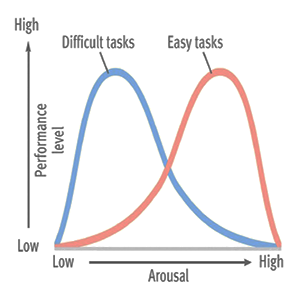
human beings will do whatever it takes to achieve their optimum level of arousal
Yerkes-dodson law
Lewin’s motivational conflicts
people navigate decision making when facing competing psychological forces, creating tension that drives behavior
avoidance-avoidance
two undesirable options
approach-approach
two desirable options
approach-avoidance
option with good and bad to it
instinct
automatic behaviors performed in response to specific stimuli
incentive theory
behavior is motivated by the desire to attain rewards and avoid punishments
self-determination theory
people can become self-determined when their needs for competence, relatedness, and autonomy are fulfilled
intrinsic motivation
drive to engage in something for internal satisfaction
extrinsic motivation
drive to engage in something for external rewards or to avoid punishment
psychodynamic
Originating from Freud, this view highlights the role of the unconscious mind, early childhood experiences, and interpersonal relationships in shaping behavior
Humanistic
Emphasizes personal growth, self-actualization, free will, and the innate drive to reach one's full potential.
Social Cognitive
Concentrates on how people mentally process information, including thinking, memory, problem-solving, and language.
Trait
ocuses on identifying, measuring, and describing stable, enduring personality characteristics—such as extroversion or conscientiousness—that drive behavior
social cognitive theory
there is no inherent personality and our behaviors largely rest on our environment and what we learn through observing others
personality inventories
intended to evaluate different personality traits by asking specific questions that assess different behaviors or characteristics, standardized test offer limited choices and are objective
TAT
projective test of looking at pictures
Attribution theory
the explanations individuals create for the causes of behaviors. They help people understand and predict others and your own action
Dispositional Attribution
assign the cause of behavior to inherent qualities, traits, or characteristics of the individual. -If a colleague consistently meets deadlines, we might attribute the behavior to strong work ethics
Situational attribution
external, assign the cause of behavior to external factors or circumstances beyond the individuals control -someone is late bc of traffic
fundamental attribution error
underestimate situation, overestimate character
actor-observer bias
we overestimate/include our situation, not others
self-serving bias
we own our successful behaviors, blame situation on bad things
locus of control
how much control we think we have over life events/outcomes
internal locus of control
outcomes within your control determined by your hard work or decisions
external locus of control
outcomes outside your control- determined by “fate” and not of your hard work/decisions
mere exposure effect
individuals tend to develop a preference for things because they are familiar with them. repeated exposure to a stimulus increases likelihood of a particular evaluation of a stimulus
self fulfilling prophecy
an individuals expectations about another person or situation influence their behavior toward that situation or person
-expectation leads to fulfillment
social comparison
people determine their own social and personal worth based on how they stack up against others
relative deprivation
subjective feeling of discontent and resentment arising from the belief that one lacks resources or opportunities compared to other in a similar situation
stereotype
is a generalized belief about a particular group of people. These beliefs can be positive or negative and often arise from overgeneralizing traits or behaviors observed in a few individuals within a group. Assuming all teenagers are rebellious can lead to unfair treatment of individual teens who do not fit this stereotype, affecting their self-esteem and social interactions.
FALSE ASSUMPTIONS
prejudice
ATTITUDE
is a preconceived opinion or attitude about an individual or group, typically based on stereotypes and often without a factual basis. It is usually negative and involves an emotional response. Racial prejudice can result in social exclusion and unequal opportunities for people of certain ethnic backgrounds, impacting their educational and employment prospects.
discrimination
BEHAVIOR
the behavior or actions, often negative, directed towards an individual or group based on prejudice. It involves treating people unfairly because of their membership in a particular group. Gender discrimination in the workplace can result in unequal pay and limited career advancement opportunities for women, affecting their economic status and job satisfaction.
just-world phenomenon
the cognitive bias that leads individuals to believe that the world is fair and that people get what they deserve. This belief can justify existing social inequalities. Believing that homeless individuals are solely responsible for their situation can reduce societal support for policies aimed at addressing homelessness.
out-group homogeneity bias
the tendency to view members of an out-group as more similar to each other than members of one's in-group. This bias can contribute to stereotyping. A person might perceive all members of a rival sports team as aggressive, despite variations in individual behavior and personality within the team.
in group bias
the preference for and favoritism towards one's own group over out-groups. This bias can enhance group cohesion but also foster prejudice and discrimination against out-groups. Employees may favor colleagues from their own department when collaborating on projects, leading to exclusion or undervaluation of input from other departments.
Ethnocentrism
the belief in the inherent superiority of one's own ethnic group or culture. It involves judging other cultures by the standards of one's own. Ethnocentrism can manifest in international business, where managers impose their own cultural norms on foreign employees, leading to workplace tension and reduced productivity.
Belief perserverance
the tendency to maintain a belief even after the evidence supporting it has been discredited. It highlights the difficulty individuals face in changing their beliefs, even when confronted with contradictory information.
cognitive dissonance
the tendency to search for, interpret, and remember information that confirms one's preexisting beliefs while ignoring or dismissing contradictory evidence. During an election, a voter might only read news sources that support their favored candidate and dismiss articles from opposing viewpoints, reinforcing their political beliefs and reducing exposure to diverse information.
when our thoughts and actions conflict, or when. wehave two opposing thought processes. this state is uncomfortable, so we seek to end it by changing our thoughts or behaviors to be better aligned
central route to persausion
Involves careful and thoughtful consideration of the true merits of the information presented.
peripheral route to persuasion
Involves less cognitive effort and is influenced by superficial cues, such as the attractiveness or credibility of the source. This route is used when the audience is either unmotivated or unable to process the message deeply, leading to temporary attitude changes. A consumer being swayed to buy a product because a celebrity endorses it, regardless of the product’s merits.
Halo effect
s a cognitive bias where the perception of one positive trait (e.g., attractiveness) influences the perception of other unrelated traits (e.g., intelligence or kindness). An attractive person may be perceived as more intelligent or competent by their peers or employer
foot in the door technique
is a persuasion strategy that involves getting a person to agree to a small initial request, followed by a larger request.
door in the face technique
- is a persuasion strategy that involves making a large, unreasonable request that is likely to be refused, followed by a smaller, more reasonable request. This technique leverages the principle of reciprocity
conformity
the tendency of individuals to adjust their behavior, attitudes, or beliefs to align with those of a group or social norms
persuasion
- involves changing someone’s attitudes, beliefs, or behaviors through argument, reasoning, or appeal
obedience
involves following orders or directives from an authority figure. influenced by social structures
social influence theory
examines how individuals' thoughts, feelings, and behaviors are shaped by the presence, opinions, and actions of others. This theory encompasses various forms of social influence, including conformity, compliance, and obedience. In a workplace, an employee might change their work habits to match those of their colleagues, believing that this will lead to better acceptance and integration within the team.
social norms
the implicit or explicit rules that govern the behavior of individuals within a group or society.
normative social influence
occurs when individuals conform to a group’s expectations to gain social approval or avoid social disapproval.
informational social influence
occurs when individuals conform to the behavior of others because they believe those others have accurate knowledge and that conforming will help them make correct decisions. This type of influence is based on the desire to be right. During an emergency, people might look to others' reactions to determine the appropriate course of action. If everyone starts evacuating a building, an individual is likely to follow, assuming that the group’s behavior is based on accurate information about a potential danger.
individualism
is a cultural orientation that emphasizes personal goals, autonomy, and individual rights
collectivism
- is a cultural orientation that emphasizes group goals, interdependence, and the importance of social harmony
multiculturalism
is a societal approach that values and promotes the coexistence of diverse cultural groups
group polarization
refers to the tendency for group discussions to amplify the initial leanings of group members, leading to more extreme positions
groupthink
When the desire for group harmony overrides common sense/dissenting opinions.
diffusion of responsibility
occurs when individuals in a group feel less personally accountable for their actions because responsibility is shared among all members.
social loafing
- is the tendency for individuals to exert less effort when working in a group compared to when working alone.
deindividuation
is a psychological state where individuals lose self-awareness and personal accountability in groups, leading to behavior that is uncharacteristic and often uninhibited.
social facilitation
refers to the tendency for people to perform tasks better when they are in the presence of others
false consensus effect
s a cognitive bias where individuals overestimate the extent to which their beliefs, attitudes, and behaviors are shared by others
superordinate goals
are objectives that require cooperation between groups or individuals, transcending individual differences and promoting unity.
social trap
occur when individuals or groups pursue short-term gains that ultimately lead to negative long-term consequences for the group as a whole
industrial organizational psychology
apply psychological principles and research methods to the workplace to improve productivity, work quality, and the well-being of employees
altruism
a form of prosocial behavior where an individual acts to benefit others without expecting any personal gain or reward
social reciprocity norm
a social rule that encourages individuals to repay, in kind, what another person has provided
social responsibility norm
a societal expectation that individuals and organizations should help those in need and contribute to the collective welfare without expecting personal gain.
bystander effect
a social phenomenon where individuals are less likely to offer help in an emergency situation when other people are present

