4.2 dna and protein synthesis
 Call Kai
 Learn
Learn Practice Test
 Spaced Repetition
 Match
Match Flashcards
 Knowt Play
1/16

There's no tags or description
Looks like no tags are added yet.
Name | Mastery | Learn | Test | Matching | Spaced | Call with Kai |
|---|
No analytics yet
Send a link to your students to track their progress
17 Terms
what is the first station of protein synthesis and where it happens
transcription, in the nucleus
what is transcription
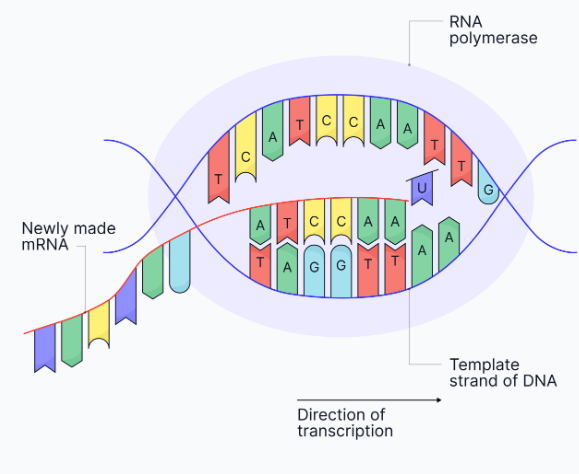
process of making pre-mRNA using part of the DNA as template
explain process of DNA unwinding in transcription
-The enzyme DNA helicase breaks hydrogen bonds between complementary DNA bases, separating the strands.
-This exposes the template strand which is used to make mRNA.
-only 1 DNA strand acts as the template strand
how do free RNA nucleotides bind to the template DNA strand in transcription
-Free RNA nucleotides align with complementary bases on the template strand using base pairing rules:
A → U (uracil, instead of thymine).
T → A.
C → G.
G → C
how does RNA polymerase join nucleotides together
-The enzyme RNA polymerase moves along the template strand, joining adjacent RNA nucleotides on the new strand via phosphodiester bonds, forming pre-mRNA (in eukaryotes) or mRNA (in prokaryotes).
-The formation of phosphodiester bonds is an example of a condensation reaction and requires ATP
why is there no splicing in prokaryotic cells
pre-mRNA is not produced
explain process of splicing
In eukaryotes, pre-mRNA contains introns (non-coding regions) and exons (coding regions).
Splicing removes introns, leaving only exons to form mature mRNA
how does mRNA leave the nucleus and where it goes
-through nuclear pores
-goes to the ribosomes in cytoplasm
where does translation happen
ribosomes in cytoplasm
what is the second step of protein synthesis
translation
what does mRNA attach to once it leaves the nucleus
it attaches to a ribosome
what happens in translation briefly
mRNA sequence is used to assemble a polypeptide at the ribosome. It involves mRNA, ribosomes, tRNA, and amino acids.
what happens when mRNA molecule attaches to ribosome in translation
-The mRNA molecule attaches to a ribosome.
-The ribosome reads the mRNA codons (triplets of bases) one at a time.
how does tRNA deliver amino acids in translation
-tRNA molecules, each carrying a specific amino acid, bind to the ribosome.
-The anticodon on the tRNA will bind to a complementary codon on the mRNA.
how is peptide bond formed in translation
-The ribosome catalyses the formation of a peptide bond between adjacent amino acids, forming a polypeptide chain.
-This requires energy from ATP.
-The first tRNA detaches, and the ribosome moves to the next codon.
when does a process of protein synthesis (translation) stop
when stop codon is reached
what happens to the polypeptide after translation
polypeptide chain is released, it undergoes further modifications to become a fully functional protein.

