psych #3
0.0(0)
 Studied by 0 people
 Call Kai
 Learn
Learn Practice Test
 Spaced Repetition
 Match
Match Flashcards
 Knowt Play
Card Sorting
1/227

Earn XP
Description and Tags
Last updated 6:50 PM on 12/6/22
Name | Mastery | Learn | Test | Matching | Spaced | Call with Kai |
|---|
No analytics yet
Send a link to your students to track their progress
228 Terms
1
New cards
First impressions
initial judgement of someone's character/personality
we form schemas of others automatically and spontaneously
• made quickly (milliseconds to minutes), from very little information
we form schemas of others automatically and spontaneously
• made quickly (milliseconds to minutes), from very little information
2
New cards
First impression sources
physical appearance, what people say, how they say it, body language and especially from faces
3
New cards
impression formation
study by Willis and Todorov, 2006
- Photographs of faces shown to participants at various durations
- Asked to judge standing on a trait
- Correlated these ratings with another group of participants who had no time constraints to rate faces on same traits
shows that we just need a fraction of a second to make a judgement of a face
- Photographs of faces shown to participants at various durations
- Asked to judge standing on a trait
- Correlated these ratings with another group of participants who had no time constraints to rate faces on same traits
shows that we just need a fraction of a second to make a judgement of a face
4
New cards
when forming impressions of others what do we care most about
evolutionary history we need to make certain assumptions abt someone:
turstworthiness/warmth (good or bad intentions)
competence/ dominance (ability to enact intentions)
turstworthiness/warmth (good or bad intentions)
competence/ dominance (ability to enact intentions)
5
New cards
first impressions tend to be enduring, why (pri
primacy effect
we tend to process information that comes to us earlier as weighing into our judgment more than later judgements
early asch studies:
here's a person named jack
- first group say good things and then bad to describe him and second group do the opposite.
first group rates jack higher in terms of likeness
information presented earlier is more important than information presented later
we tend to process information that comes to us earlier as weighing into our judgment more than later judgements
early asch studies:
here's a person named jack
- first group say good things and then bad to describe him and second group do the opposite.
first group rates jack higher in terms of likeness
information presented earlier is more important than information presented later
6
New cards
why impressions stick over time: confirmation bias
someone called sam, you have the impression that shes a good worker, you see that she's in the office, she wears smart looking clothes but ignore other information
attend to the information that supports initial impression, other information is ignored
attend to the information that supports initial impression, other information is ignored
7
New cards
how accurate are we in early impressions
NOT accurate!
- we are tracking emotional expressions and using these to judge character
- emotional expression are momentary; they change
- But it is useful to us to read emotions in face:
signals what’s up with another person (approach/avoid)
- we are tracking emotional expressions and using these to judge character
- emotional expression are momentary; they change
- But it is useful to us to read emotions in face:
signals what’s up with another person (approach/avoid)
8
New cards
when inferring character from other sources
Still not very accurate
- Some accuracy in terms of what people are generally like
(E.g., Extroversion - Big five traits, has a lot of behaviourism to it)
- Somewhat accurate when using behavioral cues as a source
- Some accuracy in terms of what people are generally like
(E.g., Extroversion - Big five traits, has a lot of behaviourism to it)
- Somewhat accurate when using behavioral cues as a source
9
New cards
updated impressions
the more we get to know someone the more accurate we are
(e.g., Kenny & Acitelli, 2001; Malloy & Albright, 1990)
• when motivated to be accurate in our impressions, we’re more likely to be accurate (i.e roommates, or date)
(e.g., Kenny & Acitelli, 2001; Malloy & Albright, 1990)
• when motivated to be accurate in our impressions, we’re more likely to be accurate (i.e roommates, or date)
10
New cards
factors that limit accuracy in early impressions
confirmation bias
• others may be managing their impression (impression management, shaping personality and trying to be someone they're not)
• we use heuristics when making judgements
- transference of traits from known people to new person (shayans nose on frat guy)
- false consensus (we think other people are similar to us, if you have liberal views and see someone similar to u u believe they also have liberal views)
- Stereotypes: beliefs about characteristics of individuals based on membership to some social category
• others may be managing their impression (impression management, shaping personality and trying to be someone they're not)
• we use heuristics when making judgements
- transference of traits from known people to new person (shayans nose on frat guy)
- false consensus (we think other people are similar to us, if you have liberal views and see someone similar to u u believe they also have liberal views)
- Stereotypes: beliefs about characteristics of individuals based on membership to some social category
11
New cards
attributions
inferences we make about the causes of behaviour
12
New cards
attribution theory
When making sense of other’s behavior we can attribute (explain) their behavior to either:
Dispositions:
internal factors such as traits, values, attitudes, beliefs, skills, intentions (jumped bc they're crazy)
Situations:
external factors such as events, weather, aspects of a context,circumstances, other people’s actions, accidents, chance (jumped bc lost a bet)
Dispositions:
internal factors such as traits, values, attitudes, beliefs, skills, intentions (jumped bc they're crazy)
Situations:
external factors such as events, weather, aspects of a context,circumstances, other people’s actions, accidents, chance (jumped bc lost a bet)
13
New cards
fundamental attribution error (FAE)
In general, when people try to figure out the cause of another person’s behavior, in Western, Individualistic cultures, people tend to:
• overestimate the impact of internal/dispositional influences (jerk, bad drivers)
• underestimate the impact of external/situational influences (rushing to hospital, sleep deprived)
• overestimate the impact of internal/dispositional influences (jerk, bad drivers)
• underestimate the impact of external/situational influences (rushing to hospital, sleep deprived)
14
New cards
Collectivistic/interdependent cultures
China, japan, latin america, eastern europe
Tend to value interdependence, cooperation, social harmony to a greater extent (paying attention to the context more)
People from collectivistic/interdependent cultures tend to
commit the FAE much less, if at all
Such people do consider internal factors, but they also consider situational factors
Tend to value interdependence, cooperation, social harmony to a greater extent (paying attention to the context more)
People from collectivistic/interdependent cultures tend to
commit the FAE much less, if at all
Such people do consider internal factors, but they also consider situational factors
15
New cards
Individualistic/Independent cultures
us, canada, western europe
Tend to value independence, autonomy, self-reliance to a greater extent
Tend to value independence, autonomy, self-reliance to a greater extent
16
New cards
self-serving attributions
on average, positive self esteem
our successes -> internal explanations
our failures -> external explanations
our successes -> internal explanations
our failures -> external explanations
17
New cards
stereotypes
beliefs, schemas, or associations that link whole groups of people with certain traits or characteristics
• automatic associations/mental representations
• can be positive or negative, but just associations and not judgements
- sometimes accurate, sometimes based on a kernel of truth, sometimes inaccurate based on assumptions
LEARNED from personal experiences, family and culture
• PERPETUATED by the many experiences we have in life as
we grow up, also by the media (news, tv, film)
• automatic associations/mental representations
• can be positive or negative, but just associations and not judgements
- sometimes accurate, sometimes based on a kernel of truth, sometimes inaccurate based on assumptions
LEARNED from personal experiences, family and culture
• PERPETUATED by the many experiences we have in life as
we grow up, also by the media (news, tv, film)
18
New cards
prejudice
Attitudes or affective responses toward or about a group and its individual members
• Valenced judgements: evaluative - positive to negative, but negative is usually what we mean when we say prejudice; it tends to get a lot more attention
• Valenced judgements: evaluative - positive to negative, but negative is usually what we mean when we say prejudice; it tends to get a lot more attention
19
New cards
discrimination
behaviors directed against people because of their group membership;
differential treatment
....not hiring someone, excluding someone from activities,
saying/doing unkind things to people, paying someone less for same work
differential treatment
....not hiring someone, excluding someone from activities,
saying/doing unkind things to people, paying someone less for same work
20
New cards
social categorization
Humans categorize people into different groups based on a shared characteristic(s) or common attributes
- race, gender, age, height
- student organizations, sports teams
- shared beliefs/cause (Political Party; Dog vs Cat person)
- Personal preferences, hobbies
classifying people -> stereotyping
Leads us to divide people into in/out groups
• Our identities are partly/largely derived from various groups we belong to
- race, gender, age, height
- student organizations, sports teams
- shared beliefs/cause (Political Party; Dog vs Cat person)
- Personal preferences, hobbies
classifying people -> stereotyping
Leads us to divide people into in/out groups
• Our identities are partly/largely derived from various groups we belong to
21
New cards
categorizing is adaptive
- saves time and mental energy
- simplifies our environment
- often is accurate
- simplifies our environment
- often is accurate
22
New cards
in groups vs out-groups
- All the groups we belong to = in-groups
• All other groups we don’t belong to = out-groups
• All other groups we don’t belong to = out-groups
23
New cards
costs to social categorization
often stereotypes are negative and/or not accurate and
can drive prejudice and discrimination
• in/out-group division can lead to “Us vs Them” mentality
and increase prejudice
• can lead us to process information about outgroups
differently
➢ Overestimating group differences: “They are not like us”
➢ Out-group homogeneity effect: “They are all alike; we are unique and diverse”
can drive prejudice and discrimination
• in/out-group division can lead to “Us vs Them” mentality
and increase prejudice
• can lead us to process information about outgroups
differently
➢ Overestimating group differences: “They are not like us”
➢ Out-group homogeneity effect: “They are all alike; we are unique and diverse”
24
New cards
Robber's cave study
Sought to examine how prejudice and discrimination might develop, and also how it might be reduced
Two groups: Eagles & Rattlers
1. Bonding phase
2. Competition phase
3. Reconciliation phase
working together towards something better for both groups reduce discrimination
conflict towards limited resources can lead to prejudice
Reducing prejudice and discrimination
• Contact hypothesis: but contact alone isn’t enough
Mutual interdependence was required
- Working together towards a common superordinate goal
Two groups: Eagles & Rattlers
1. Bonding phase
2. Competition phase
3. Reconciliation phase
working together towards something better for both groups reduce discrimination
conflict towards limited resources can lead to prejudice
Reducing prejudice and discrimination
• Contact hypothesis: but contact alone isn’t enough
Mutual interdependence was required
- Working together towards a common superordinate goal
25
New cards
realistic conflict theory
Prejudice and conflict arise from competition for scarce resources among groups
- Resources such as water ways, access to fish, land rights, valued objects
- Economic perspective; lots of evidence to support this theory
- Resources such as water ways, access to fish, land rights, valued objects
- Economic perspective; lots of evidence to support this theory
26
New cards
social identity theory
A person’s self-concept and self-esteem derives from status and accomplishments of various groups to which the person belongs
• We want our groups to be the best, to be of high status, so we show favoritism to members of our group versus members of other groups
• Prejudice and conflict arise from in-group favoritism and/or
from out-group derogation
• We want our groups to be the best, to be of high status, so we show favoritism to members of our group versus members of other groups
• Prejudice and conflict arise from in-group favoritism and/or
from out-group derogation
27
New cards
attitude
positive/negative/mixed reaction to, or orientation towards, a person,a group, object or idea
like, dislike, love,mixed feelings, against
like, dislike, love,mixed feelings, against
28
New cards
explicit attitude
easy to report, conscious of it, can be updated with new info
Measurement:
• commonly measured via self-report questionnaires using Likert scales
• but people might be unwilling or unable to tell the truth
Measurement:
• commonly measured via self-report questionnaires using Likert scales
• but people might be unwilling or unable to tell the truth
29
New cards
implicit attitude
quick, automatic, unconscious/not aware of it, difficult to update
Measurement: indirectly via
• facial expressions (e.g. EMG; less common)
• body language (e.g., distance from someone/thing)
• Implicit Association Tests (IAT; very common; uses reaction times)
Measurement: indirectly via
• facial expressions (e.g. EMG; less common)
• body language (e.g., distance from someone/thing)
• Implicit Association Tests (IAT; very common; uses reaction times)
30
New cards
Implicit Association Test: (IAT)
Categorization task that uses reaction times based on decision rules to assess strength of associations between concepts and positivity/negativity
Faster responses are thought to reflect stronger associations, thereby presumably revealing implicit bias (automatic unconscious preferences/prejudice)
Faster responses are thought to reflect stronger associations, thereby presumably revealing implicit bias (automatic unconscious preferences/prejudice)
31
New cards
link between attitudes and behaviour
Attitudes can have consequences on behavior
• But attitudes don’t often predict behavior
• Eg. Abstract attitudes
• But attitudes don’t often predict behavior
• Eg. Abstract attitudes
32
New cards
When are attitudes most likely to predict behavior?
When they are about specific issues
- So they tend to generate specific behaviors
• When they are strong attitudes
- When we are certain about them (i.e., attitude strength)
and they apply to situations with which we have experience
(personal link)
- So they tend to generate specific behaviors
• When they are strong attitudes
- When we are certain about them (i.e., attitude strength)
and they apply to situations with which we have experience
(personal link)
33
New cards
persuasion
changing people's attitudes as a means to change their behaviour
34
New cards
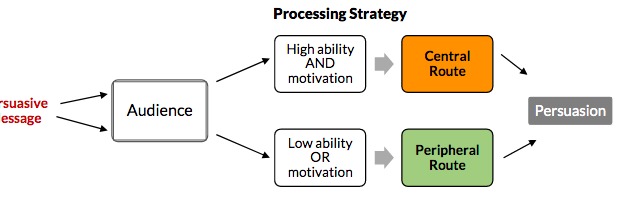
elaboration likelihood model
Dual process theory of persuasion
Central: scrutinizing the content of the message; strengths & weaknesses of arguments, listener, can understand what is being talked about AND have motivation
Peripheral: attending to relatively superficial cues; low effect processing, low ability, simple minded -> credibility of who is talking
Central: scrutinizing the content of the message; strengths & weaknesses of arguments, listener, can understand what is being talked about AND have motivation
Peripheral: attending to relatively superficial cues; low effect processing, low ability, simple minded -> credibility of who is talking
35
New cards
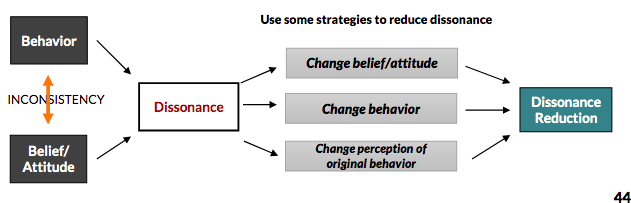
Cognitive Dissonance theory
Based on idea that we strongly desire cognitive consistency, or the
mental state in which beliefs, attitudes, and behaviors are compatible
• When there is a discrepancy between beliefs, attitudes and behaviors we
feel dissonance (inner tension)
• Larger discrepancy -> greater dissonance
- we are motivated to reduce it
think recycling is important, don't recycle much
to reduce the dissonance, you can
1. change belief (recycling isn't important)
2. change behaviour (recycle)
3. change perception of of behaviour (but I recycle once a month)
mental state in which beliefs, attitudes, and behaviors are compatible
• When there is a discrepancy between beliefs, attitudes and behaviors we
feel dissonance (inner tension)
• Larger discrepancy -> greater dissonance
- we are motivated to reduce it
think recycling is important, don't recycle much
to reduce the dissonance, you can
1. change belief (recycling isn't important)
2. change behaviour (recycle)
3. change perception of of behaviour (but I recycle once a month)
36
New cards
cognitive dissonance: original study (festinger, 1957)
1. boring task for one hour
2. asked to tell next participant the task was enjoyable (to lie) 3. how much they liked the task for $1, $20, or no money
behaviour: told someone it was enjoyable
attitude: didn't enjoy it
^discrepency, inner tension according to cognitive dissonance theory. and since u can't change behaviour u change ur attitude. cannot account for behaviour with contextual (why lie for one dollar and say it was good).
$1 people had insufficient justification to tell someone it was enjoyable
$20 could justify action so still said it wasn't enjoyable, bc attitude didn't need to be ajusted
2. asked to tell next participant the task was enjoyable (to lie) 3. how much they liked the task for $1, $20, or no money
behaviour: told someone it was enjoyable
attitude: didn't enjoy it
^discrepency, inner tension according to cognitive dissonance theory. and since u can't change behaviour u change ur attitude. cannot account for behaviour with contextual (why lie for one dollar and say it was good).
$1 people had insufficient justification to tell someone it was enjoyable
$20 could justify action so still said it wasn't enjoyable, bc attitude didn't need to be ajusted
37
New cards
social influence
the way that people are affected by the real and imagined presence of others
38
New cards
social influence as automatic
reflex-like behaviours
automatic mimicry
- "chameleon effect"
social function: eases social interactions
automatic mimicry
- "chameleon effect"
social function: eases social interactions
39
New cards
social norms
- commonly shared beliefs about appropriate actions
• unwritten social rules; might/might not be aware of them
• vary across context, culture, and time
• violating social norms often results in awkwardness, hostility, or ostracism
-> wearing clothes
-> lining up for stuff
-> public displays of affection
-> masks during pandemic
people in collectivistic cultures tend to conform more to social norms, compared to those in individualistic cultures
• unwritten social rules; might/might not be aware of them
• vary across context, culture, and time
• violating social norms often results in awkwardness, hostility, or ostracism
-> wearing clothes
-> lining up for stuff
-> public displays of affection
-> masks during pandemic
people in collectivistic cultures tend to conform more to social norms, compared to those in individualistic cultures
40
New cards
3 main ways we yield to more explicit forms of social influence
conformity
compliance
obedience
compliance
obedience
41
New cards
conformity
changing our perceptions, opinions, or behavior in ways that
are consistent with group norms
are consistent with group norms
42
New cards
compliance
changing out behaviour in response to direct requests
43
New cards
obedience
changing our behaviour in response to commands by perceived authority figures
44
New cards
asch's conformity study
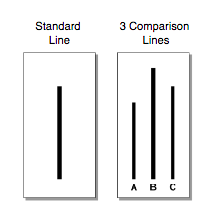
Will people conform their answers to the group?
• 5 confederates, 1 participant
• 3 Trials: In trials 1 and 2, all confederates give correct answers.
In trial 3, all confederates give wrong answer
• Pilot study (control): how easy is this task --- very easy
overall 35% conformed with the error
75% conformed at least once
25% of participants never conformed
• 5 confederates, 1 participant
• 3 Trials: In trials 1 and 2, all confederates give correct answers.
In trial 3, all confederates give wrong answer
• Pilot study (control): how easy is this task --- very easy
overall 35% conformed with the error
75% conformed at least once
25% of participants never conformed
45
New cards
why do we conform according to asch's conformity study
informational influence: we need to be correct; we seek information
normative influence: we fear social ostracism, judgement, social exclusion
normative influence: we fear social ostracism, judgement, social exclusion
46
New cards
the stanley milgram experiement
to what extent would people comply with requests/ directives from a perceived authority figure to harm another person
Most predicted that participants would stop around
150 volts, and fewer than 1% would go all the way to max shock
all 40 participants: at least 300 v
26/40 participants: all the way
factors to consider: Participants were agitated and
uncomfortable, some very distressed
• Many wanted to stop
• Encouragement by experimenter
• Told: no responsibility
Part 5: obedience Milgram
15
Most predicted that participants would stop around
150 volts, and fewer than 1% would go all the way to max shock
all 40 participants: at least 300 v
26/40 participants: all the way
factors to consider: Participants were agitated and
uncomfortable, some very distressed
• Many wanted to stop
• Encouragement by experimenter
• Told: no responsibility
Part 5: obedience Milgram
15
47
New cards
the stanley milgram experiement
factors that push around this obedience to authority effect
study off campus(|v), must place learners hand on shock plate (|v), person is an assistant (^|)
idea of credibility and,
study off campus(|v), must place learners hand on shock plate (|v), person is an assistant (^|)
idea of credibility and,
48
New cards
aggression
behaviour initended to harm another individual
49
New cards
extreme aggression
violence
various forms: physical, verbal, emotional, direct/indirect
various forms: physical, verbal, emotional, direct/indirect
50
New cards
instrumental aggression
goal is to achieve somethings (social, emotional, physical)
harmful behaviour has a purpose to it
harmful behaviour has a purpose to it
51
New cards
hostile aggression
Motivated by hostility
• Goal is to cause harm someone
• Emotional, impulsive, in the heat-of- the-moment aggression (e.g., jealousy, road rage)
• Can also be calm and cool (e.g., revenge)
• Goal is to cause harm someone
• Emotional, impulsive, in the heat-of- the-moment aggression (e.g., jealousy, road rage)
• Can also be calm and cool (e.g., revenge)
52
New cards
environmental factors of aggression
evidence from correlational and experimental studies proves that heat and hot weather have a positive correlation with aggression
also:
- crowding
- social provocation: insults or social rejection
also:
- crowding
- social provocation: insults or social rejection
53
New cards
social learning in relation to aggression
we learn to be aggressive via behaviour modeling
we learn to be more/less aggressive via rewards and punishments
we learn to be more/less aggressive via rewards and punishments
54
New cards
the bobo doll studies (bandura, 1960)
randomly assigned young children to different experimental conditions
IV: modelled behaviour (filmed aggressive adults -> children imitated aggressive behaviours, filmed non-aggressive adults (control) -> kids novel aggressive behaviour)
DV: aggressive acts (how kids reacted)
IV: modelled behaviour (filmed aggressive adults -> children imitated aggressive behaviours, filmed non-aggressive adults (control) -> kids novel aggressive behaviour)
DV: aggressive acts (how kids reacted)
55
New cards
the bobo doll studies (results)
Watching modelled aggression lead to more aggression in these
children compared to controls
- both imitated and novel acts of aggression
2. Iterations of the BOBO Doll study also showed that modelled
aggression led to more aggression when it was rewarded,
and less aggression when it was punished
children compared to controls
- both imitated and novel acts of aggression
2. Iterations of the BOBO Doll study also showed that modelled
aggression led to more aggression when it was rewarded,
and less aggression when it was punished
56
New cards
prosocial behaviour
actions intended to benefit others such as helping, comforting, sharing, cooperating
57
New cards
what motivates prosocial behaviour
egoism?
altruism?
altruism?
58
New cards
egoism (in relation to prosocial behaviour)
motivation to increase one’s own welfare; self-interest
- to be seen in a positive light
- to feel good about yourself
- to get something tangible
- to be seen in a positive light
- to feel good about yourself
- to get something tangible
59
New cards
altruism (in relation to prosocial behaviour)
behaviors intended to benefit another without expectations
of anything in return
motivation to increase another person’s welfare
- concern for other(s)
of anything in return
motivation to increase another person’s welfare
- concern for other(s)
60
New cards
debate about altruism
is pure/true altruism actually possible?
It often FEELS GOOD to help, comfort, share, cooperate, etc
• We might be denying egoistic motivations
• There is a COST to helping and not helping
It often FEELS GOOD to help, comfort, share, cooperate, etc
• We might be denying egoistic motivations
• There is a COST to helping and not helping
61
New cards
evolutionary theory
Altruistic/prosocial behaviors have reproductive advantages
• Helping kin helps our genes survive
so why help strangers and non-kin
• Helping kin helps our genes survive
so why help strangers and non-kin
62
New cards
reciprocal altruism
Actions that benefit others, despite some immediate risk or cost, that may be repaid in kind in the long run
63
New cards
reciprocity norm (give and take rule)
Rule of social interactions: If someone helps us, we should help in return
• Short-term relationships: reciprocation is expected right away or soon
• Lasting relationships: no score keeping, reciprocation is expected over the long-run
• People can get (very) dissatisfied when there is no reciprocation in return
• Short-term relationships: reciprocation is expected right away or soon
• Lasting relationships: no score keeping, reciprocation is expected over the long-run
• People can get (very) dissatisfied when there is no reciprocation in return
64
New cards
(AB)using norm of reciprocity STUDY
Observational study
• Hare Krishna’s in airports in 1960’s and 1970’s
• Airport patrons were given unwanted flowers, and often ended up giving $1 or $2 donations (often begrudgingly)
• Hare Krishna’s in airports in 1960’s and 1970’s
• Airport patrons were given unwanted flowers, and often ended up giving $1 or $2 donations (often begrudgingly)
65
New cards
the story of kitty genovese
Attacked twice by same male attacker in New York:
First, stabbed outside of her apartment
Second, raped, stabbed again, murdered in a nearby building
• 37 alleged witnesses heard screams
• Police were called eventually, but too late to save her
BYSTANDER EFFECT
First, stabbed outside of her apartment
Second, raped, stabbed again, murdered in a nearby building
• 37 alleged witnesses heard screams
• Police were called eventually, but too late to save her
BYSTANDER EFFECT
66
New cards
bystander effect
the presence of others inhibits helping
67
New cards
Two of the main explanations for the bystander effect:
1. diffusion of responsibility
2. pluralistic ignorance
2. pluralistic ignorance
68
New cards
diffusion of responsibility study (bystander effect)
study: one of the participants has a seizure next door
IV: group size (alone, +1 other person, +4 other people)
DV: time to help
people will help less, more slowly to an emergency the more bystanders there are. (alone= 1 min, +1 = 2 min, +4 = 3 minutes)
IV: group size (alone, +1 other person, +4 other people)
DV: time to help
people will help less, more slowly to an emergency the more bystanders there are. (alone= 1 min, +1 = 2 min, +4 = 3 minutes)
69
New cards
pluralistic ignorance (bystander effect)
The tendency to misinterpret social cues and rely on the overt
reactions of others in ambiguous situation which leads to inaction
reactions of others in ambiguous situation which leads to inaction
70
New cards
interpersonal attraction
positive orientation towards someone; liking
not necessarily romantic/sexual
not necessarily romantic/sexual
71
New cards
familiarity
we tend to like people who are known to us
72
New cards
mere exposure effect
the more you see a novel stimulus, the more you like it; easier to cognitively process familiar stimuli
73
New cards
similarity
we tend to like similar others: attitudes, values, interests
74
New cards
reciprocity
we like those who like us; very validating
75
New cards
physical attractiveness
rewarding visible and immediate stimulus (halo effect)
76
New cards
halo effect
belief that attractive people possess a bunch of other positive qualities -> intelligent, happier, better personalities
77
New cards
attachment theory
Human infants develop intensely strong emotional bonds with caretakers as a survival strategy
• Infants rely on caretakers for sense of security and to meet their needs
- Children develop internal working models of how relationship should/do function
• Internal working models give rise in attachments styles
(i.e., secure, anxious, avoidant)
• Infants rely on caretakers for sense of security and to meet their needs
- Children develop internal working models of how relationship should/do function
• Internal working models give rise in attachments styles
(i.e., secure, anxious, avoidant)
78
New cards
attachment styles
how one typically interacts with a close other
79
New cards
adult attachment theory
Adults continue to develop attachment bonds with close others throughout life
• One has attachment styles for romantic partners and close others
secure (~55%)
anxious/ambivalent (~20%)
avoidant (~25%)
• One has attachment styles for romantic partners and close others
secure (~55%)
anxious/ambivalent (~20%)
avoidant (~25%)
80
New cards
secure (~55%) attachment style
Trusting, more relaxed
• feels worthy of love/affection
• comfortable with intimacy
• believes others are responsive
positive view of self and others
• feels worthy of love/affection
• comfortable with intimacy
• believes others are responsive
positive view of self and others
81
New cards
anxious/ambivalent (~20%) adult attachment theory
strong desire for closeness but fears rejection
• vigilant towards relationship threats
• needy, jealous, clingy
• dependent on others approval to feel good about self
negative view of self, positive of others
• vigilant towards relationship threats
• needy, jealous, clingy
• dependent on others approval to feel good about self
negative view of self, positive of others
82
New cards
avoidant (~25%) adult attachment theory
avoids and is uncomfortable with intimacy
• distrusting of others
• self-reliant, confident
positive view of self, negative of others
there's dismissive avoidant and then fearful avoidant
• distrusting of others
• self-reliant, confident
positive view of self, negative of others
there's dismissive avoidant and then fearful avoidant
83
New cards
fearful avoidant
distrusting of others
want closeness but fear rejection
negative view of self and others
want closeness but fear rejection
negative view of self and others
84
New cards
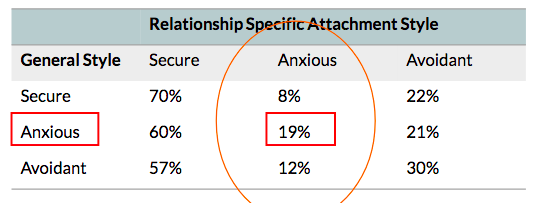
(relationships) general vs specific attachment
Study 1:
• participants currently in relationships rated themselves on:
- general attachment
- listed 10 most impactful relationships and rated them in terms of attachment
everyone has secure relationships, those with anxious attachment just tend to have more anxious attachment style relationships than the other two and vice versa
• participants currently in relationships rated themselves on:
- general attachment
- listed 10 most impactful relationships and rated them in terms of attachment
everyone has secure relationships, those with anxious attachment just tend to have more anxious attachment style relationships than the other two and vice versa
85
New cards
personality
stable way of thinking, feeling, and acting i.e stable cognitions, emotions and behaviours
but what counts? intelligence? athletic ability? sexual orientation?
but what counts? intelligence? athletic ability? sexual orientation?
86
New cards
reinfication
occurs when abstract constructs are treated as if they are real or tangible
“Extraversion” is not like your liver or your occipital cortex
It is not located in one place in the brain, cannot be directly measured, is not objectively defined (we can disagree on the shape of extraversion—what it is, what counts, how to measure it)
“Extraversion” is not like your liver or your occipital cortex
It is not located in one place in the brain, cannot be directly measured, is not objectively defined (we can disagree on the shape of extraversion—what it is, what counts, how to measure it)
87
New cards
phrenology (historical approaches - bumps)
Judging character by reading “bumps” on the head
Gall argued that skull bumps were a sign of specific brain enlargements
Gall argued that skull bumps were a sign of specific brain enlargements
88
New cards
Psychograph
a machine meant to measure bumps on the head and give ratings for each of the 35 personality categories from the brain map (last slide)
89
New cards
historical approaches - blots
In contrast to objective tests, which are often obvious about what is being studied, projective tests were used to uncover hidden thought processes...
Example: Rorschach Ink blot
Example: Draw a Person, Person-House-Tree
Example: Thematic Apperception Test
Example: Rorschach Ink blot
Example: Draw a Person, Person-House-Tree
Example: Thematic Apperception Test
90
New cards
Rorschach Ink blot
how do people compare to norms, is there a common pattern?
just show a person an inc blot
just show a person an inc blot
91
New cards
draw a person test
tells people to draw a person and gives points (has a head would be a point, proportion of neck to arms would be another)
formulate of the bottom can calculate mental age
loose correlation with age and development but some people are better artists than others -> larger head would be more narcissistic , but of course this isn't accurate
or draw a person, house, tree
formulate of the bottom can calculate mental age
loose correlation with age and development but some people are better artists than others -> larger head would be more narcissistic , but of course this isn't accurate
or draw a person, house, tree
92
New cards
Thematic Apperception Test
actually shows a story and asks person to tell the story of what is going on can be revealing of what they think about the world
jealous response from jealous men
jealous response from jealous men
93
New cards
Body type theories
fluid types (galen)
body somatotypes (sheldon)
body somatotypes (sheldon)
94
New cards
fluid types (galen) body type theories
temperament related to
four bodily fluids
◦ Sanguine: excess of blood = vigor and athleticism
◦ Choleric: excess of urine = easily angered
◦ Melancholic: excess of feces = depressed or sad
◦ Phlegmatic: excess of mucus = tired or lazy
four bodily fluids
◦ Sanguine: excess of blood = vigor and athleticism
◦ Choleric: excess of urine = easily angered
◦ Melancholic: excess of feces = depressed or sad
◦ Phlegmatic: excess of mucus = tired or lazy
95
New cards
body somatotypes (sheldon) body type theories
Endomorph: overweight = jolly, extraverted, slow
◦ Mesomorph: muscular = athletic, aggressive
◦ Ectomorph: skinny = thinking, withdrawn, fearful
◦ Mesomorph: muscular = athletic, aggressive
◦ Ectomorph: skinny = thinking, withdrawn, fearful
96
New cards
freud's three levels of awareness
1. The conscious mind is what you are presently aware of, what you are thinking about right now
2. The preconscious mind is stored in your memory that
you are not presently aware of but can gain access to
3. The unconscious mind is the part of our mind of which we cannot become aware
◦ It contains, however, the primary motivations for all of our actions and feelings – our biological instinctual drives (such as for food and sex) and repressed unacceptable thoughts, memories, and feelings, especially unresolved conflicts from our early childhood experience
2. The preconscious mind is stored in your memory that
you are not presently aware of but can gain access to
3. The unconscious mind is the part of our mind of which we cannot become aware
◦ It contains, however, the primary motivations for all of our actions and feelings – our biological instinctual drives (such as for food and sex) and repressed unacceptable thoughts, memories, and feelings, especially unresolved conflicts from our early childhood experience
97
New cards
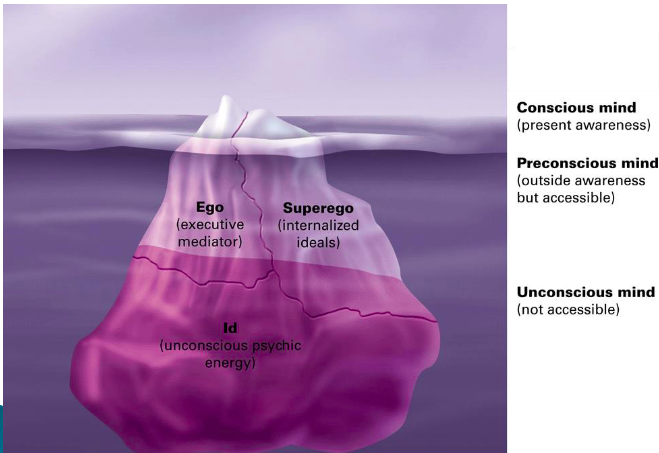
freud's three part personality structure
ID (unconscious psychic energy)
Ego (executive mediator)
Superego (internalized ideals)
Ego (executive mediator)
Superego (internalized ideals)
98
New cards
Freud's ID
Is the “original personality”, the only part present at birth and the part the other two parts of our personality grow out of
◦ Is entirely unconscious
◦ Includes our biological instinctual drives, the primitive parts of our personality located in our unconscious
Life instincts for survival, reproduction, and pleasure
Death instincts, destructive and aggressive drives detrimental to survival
◦ Operates on a pleasure principle; that is, it demands immediate gratification for these drives without the concern for the consequences of this gratification
◦ Is entirely unconscious
◦ Includes our biological instinctual drives, the primitive parts of our personality located in our unconscious
Life instincts for survival, reproduction, and pleasure
Death instincts, destructive and aggressive drives detrimental to survival
◦ Operates on a pleasure principle; that is, it demands immediate gratification for these drives without the concern for the consequences of this gratification
99
New cards
freud's ego
Starts developing during the first year or so of life to find realistic and socially-acceptable outlets for the id’s needs
◦ Operates on the reality principle, finding gratification for instinctual drives within the constraints of reality (the norms and laws of society)
◦ Part of the ego is unconscious (tied to the id; dark purple part of glacier) and part of the ego is preconscious and conscious (tied to the external world; light purple and white parts of glacier)
◦ Operates on the reality principle, finding gratification for instinctual drives within the constraints of reality (the norms and laws of society)
◦ Part of the ego is unconscious (tied to the id; dark purple part of glacier) and part of the ego is preconscious and conscious (tied to the external world; light purple and white parts of glacier)
100
New cards
superego
Represents one’s conscience and idealized standards of behavior in their culture
◦ Operates on a morality principle, threatening to overwhelm us with guilt and shame
◦ The demands of the superego and the id will come into conflict and the ego will have to resolve this turmoil within the constraints of reality
◦ To prevent being overcome with anxiety because of trying to satisfy the id and superego demands, the ego uses what Freud called defense mechanisms, processes that distort reality and protect us from anxiety
◦ Operates on a morality principle, threatening to overwhelm us with guilt and shame
◦ The demands of the superego and the id will come into conflict and the ego will have to resolve this turmoil within the constraints of reality
◦ To prevent being overcome with anxiety because of trying to satisfy the id and superego demands, the ego uses what Freud called defense mechanisms, processes that distort reality and protect us from anxiety
 Note
Note  Flashcards (26)