Plant Anatomy, Transport, & Nutrition
 Studied by 1 person
 Call Kai
 Learn
Learn Practice Test
 Spaced Repetition
 Match
Match Flashcards
 Knowt Play
1/118

There's no tags or description
Looks like no tags are added yet.
Name | Mastery | Learn | Test | Matching | Spaced | Call with Kai |
|---|
No analytics yet
Send a link to your students to track their progress
119 Terms
What are the two main parts of a typical flowering plant?
The shoot system and the root system
What is the shoot system of a plant?
The above-ground part of the plant
What is the root system of a plant?
The underground part of a plant
What are the main parts of the shoot system?
Leaves, Stem, Buds, Flowers and fruit
What does the root system consist of?
The roots
What does the stem do? List 3 things.
Transport
Supports leaves and positions them to collect sunlight
Positions flowers and fruit for pollination and dispersal
What do buds do?
Produce new branches, leaves, flowers
What is the terminal (apical) bud?
The bud at the tip of the stem
What is the axillary bud?
The bud found along the stem that is responsible for branching
What are the flowers and fruits responsible for?
Sexual reproduction
What is a node?
A point on a stem where leaves, buds, and branches are attached
What is the internode?
The segment of a plant's stem between two nodes
List 3 functions of the roots?
Anchors and supports the plant
Absorbs water and minerals
[Some] Stores food
[Some] Asexually reproduces with buds
What are the lateral roots?
Branches that grow from the primary root
What are the two types of plants?
Monocotyledons, Dicotyledons
What are 3 differences between monocots and dicots? List them.
Monocots have a single cotyledon, dicots have two cotyledons
Monocots have long, narrow leaves, dicots have broad leaves
Monocots have parallel veins, dicots have a network of veins
Monocots have scattered vascular bundles, dicots have a ring of vascular bundles
Monocot flowers petals are in multiples of three, dicot flower petals are in multiples of five or four
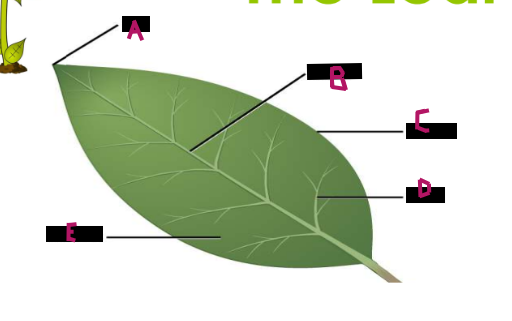
Label part A.
The tip/apex
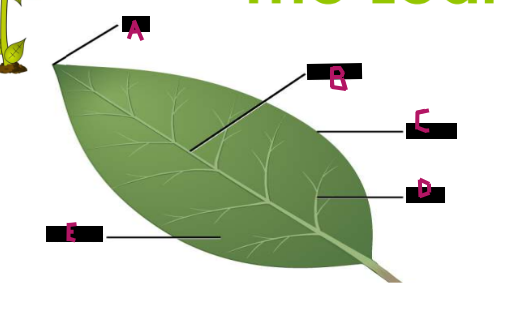
Label part B.
Midrib
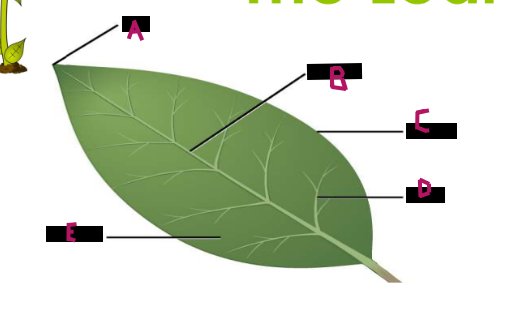
Label part C.
Margin
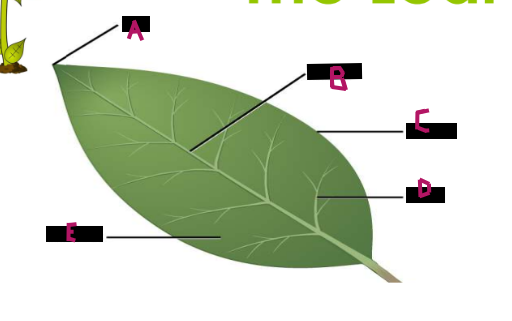
Label part D.
Vein
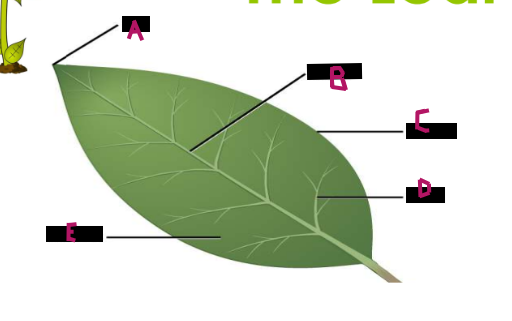
Label part E.
Lamina
What do leaves do?
Produce food by photosynthesis and are the main site of water loss during transpiration
The leaf blade is attached to the stem by the ______.
petiole
What does the epidermis do?
Protect the plant from damage and excessive water loss
In leaves, what covers the upper epidermis, and why?
The waxy cuticle reflects heat to reduce water loss
Why does the epidermis not have chloroplasts?
To make them transparent so that light could penetrate the leaf for photosynthesis
What is the purpose of the mesophyll layers?
To carry out photosynthesis with chloroplasts and to strengthen the leaf when turgid
What are the two mesophyll layers and what are their differences?
The palisade mesophyll layer has elongated cells while the spongy mesophyll layer has rounded cells with air spaces between them
Where is the xylem and phloem located in the leaf?
The xylem and phloem vessels are in vascular bundles. The xylem is located in the upper half of the vascular bundle; the phloem is located on the lower half of the vascular bundle.
What are the stomata?
Pores in the epidermis surrounded by guard cells.
Why do guard cells have chloroplasts?
In order to make food and energy to open and close
What are 5 adaptations of leaves for photosynthesis?
Leaves have a broad surface (providing a large surface area for absorption of light and carbon dioxide)
Epidermal cells are transparent (allowing light penetration)
Leaves are thin (providing a short diffusion distance for gases)
The palisade mesophyll cells have more chloroplasts than spongy mesophyll cells (because it is nearer to the upper surface of the leaf)
The vascular system transports substances to and from the leaf (that are needed for photosynthesis)
Air spaces in the spongy mesophyll provide a large surace area for gas diffusion
Stomata allow for gas exchange between the inside of the leaf and the environment
Stomata is mostly on the lower epidermis rather than upper epidermis (To reduce water loss since most of the stomata are on the cooler, underside of the leaf)
Learn how the guard cells can open and close.
Okay 👍🏽
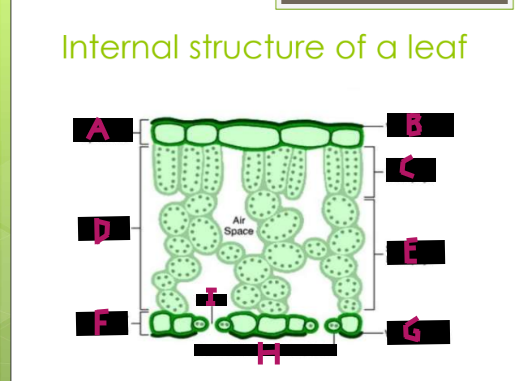
What is part A?
Upper Epidermis
What is part B?
Waxy cuticle

What is part C?
Palisade mesophyll layer
What is part D?
Mesophyll layer
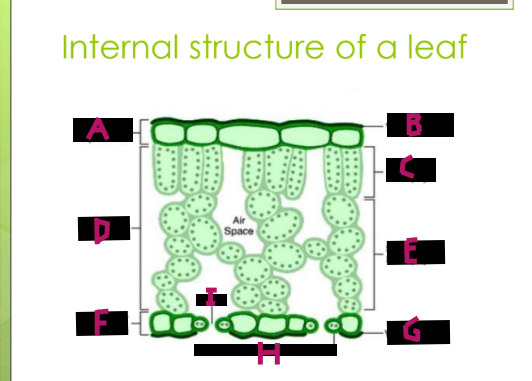
What is part E?
Spongy mesophyll layer
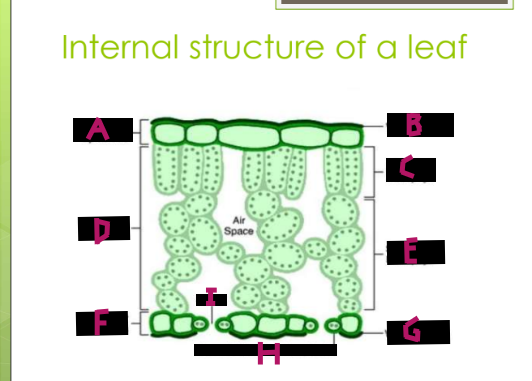
What is part F?
Lower epidermis
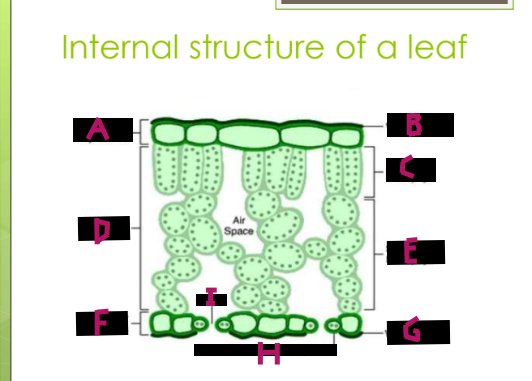
What is part G?
Waxy Cuticle
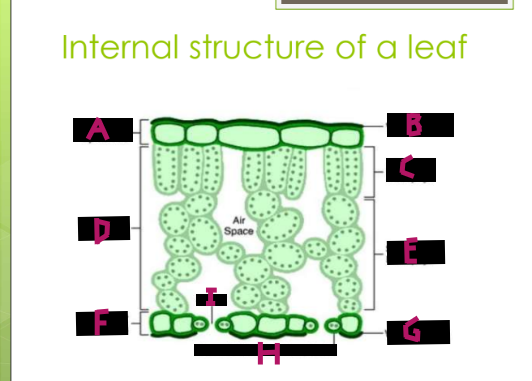
What is part H?
Guard Cell (with chloroplasts)
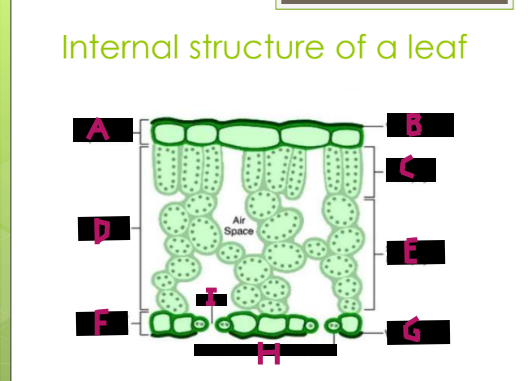
What is part I?
Stoma
What are the three plant tissue systems?
Dermal tissue (protection), Vascular tissue (transport), Ground tissue (storage)
Describe the dermal tissue
The plant’s outer covering made of a single layer of cells
What dermal tissue is in the leaves?
Cuticle (waxy coating), Guard cells, Epidermis
What dermal tissue is in the roots?
Root hairs
Epidermis
What is the purpose of vascular tissue?
Transports substances
What are the subsystems of the vascular tissue?
Xylem, phloem
What does the xylem transport?
Water and mineral salts
What direction do substances move in the xylem and what is their path?
Upwards only from the roots to the leaves
Describe the structure of the xylem vessels.
They are made of hollow, dead cells joined end to end to form a tube. The cell walls are made of cellulose with spirals of lignin.
What does lignin do for xylem vessels?
Provides support and makes the vessels waterproof
What does the phloem transport?
Transports glucose
What direction do substances move in the phloem and what is their path?
Upwards and downwards, from the leaves to all parts of the stem
Where is the phloem and the xylem located in vascular bundles in the stem?
The phloem is located towards the outside and the xylem is located towards the inside of the stem
What is the other term for phloem vessels?
Sieve tubes
Describe (4-5 details) the structure of the phloem vessels.
The vessels consist of living, elongated cells joined end to end to form a tube. The end walls (sieve plates) contain pores. The phloem vessels do not have a nucleus but have strands of cytoplasm. They are supported by companion cells.
What is the cambium?
A layer of cells located between the xylem and phloem that divides to produce the xylem and the phloem
Describe the ground tissue.
The cells between dermal and vascular tissue that are used for storage
What are the three types of ground tissue?
Parenchyma, Collenchyma, Sclerenchyma
Describe the parenchyma.
Ground tissue with thin cell walls and large vacuoles
Describe the collenchyma.
Ground tissue with strong, flexible cell walls
Describe the sclerenchyma.
Ground tissue with extremely thick, rigid cell walls
Describe the epidermis of the stem.
The outermost layer of the stem that is generally covered with cuticle
What is the hypodermis of the stem and what does it do?
A thick wall that contains sclerenchyma tissue used to strengthen the stem
Describe what ground tissue is in the stem.
Ground tissue can be found in the internal hypodermal tissue, where parenchyma found here. The parenchyma has (mainly starch) food reserves
Where is the cortex?
The outer region of the parenchyma
What does the cortex store?
Photosynthetic products (sugar and water)
Where is the pith?
The inner area of the parenchyma
What are the two types of roots?
Tap roots (dicots), fibrous roots (monocots)
Where does cell division take place in roots?
In the root tip
How is the root tip protected as it pushes through the soil?
By the root cap
What is the area above the root tip?
The zone of elongation
What is the area above the zone of elongation, and what happens in this zone?
The zone of maturation is where cells differentiate into specialised cells (root hair cells are located here)
How are xylem and phloem arranged in monocot roots?
Vascular bundles are arranged in a ring, and the pith is in the center of this ring
How are xylem and phloem arranged in dicot roots?
The xylem is towards the centre in an x-shape surrounded by the phloem (no pith)
What is the stele?
The central part of the root that contains vascular tissue
What is translocation?
The movement of materials from leaves to other tissues throughout the plant
What vessel carries out translocation?
Phloem
What is transpiration?
The removal of water from leaves
List three uses of transpiration in plants.
Creates a negative gradient in the plant which keeps water moving through the xylem
Allows for evaporative cooling
Support photosynthesis by keeping cells of the spongy mesophyll moist
How does the sun contribute to transpiration in the plant?
The negative gradient is created by heat energy from the sun that pulls water upward when the stoma is opened
What are the 4 forces that cause water to move? Explain them.
Cohesion - H-bonding to other water
Adhesion - H-bonding to walls of xylem
Capillary Action - Passive movement of water through a narrow tube against gravity
Transpiration pull - Suction pressure from leaves
What is turgor pressure?
The force exerted by fluid in a cell that presses the cell membrane against the cell wall (causes the living plant tissue to rigid)
What is the proper term for cells in a plant that is wilting?
Flaccid
What are 3 factors that affect transpiration?
Temperature, Humidity, Wind, Light
What effect does temperature have the rate of transpiration?
It increases the rate of transpiration because the kinetic energy of water molecules cause faster diffusion
What effect does the wind have on transpiration?
It increases the rate of transpiration because it removes water molecules as they pass out of the leaf, maintaining a high concentration gradient for diffusion
How does humidity affect the rate of transpiration?
It decreases the rate of transpiration because the concentration of water molecules outside of the leaf lowers the concentration gradient for diffusion
How does the light intensity affect the rate of diffusion?
It increases the rate of transpiration because the stomata open in light, which allows the water vapour to diffuse out of the leaf, through the stomata
What measures transpiration rates?
Potometer
What does the xylem do?
Transport water and mineral salts around the plant
What does the phloem do?
Transport glucose around the plant
What direction does the xylem go?
Upwards only (From the roots to leaves)
What direction does the phloem go?
Upwards and downwards (From the roots to all parts of the stem)
What is the difference between the cell wall of the xylem and the phloem?
In the xylem, the cell walls are very hard, and in the phloem, the cell walls are relatively soft.
What tissues is the xylem made of?
Dead complex permanent tissue
What tissues is the phloem made of?
Living complex permanent tissue
What four things do plants need to make their own food?
Water, Light Energy, Carbon dioxide, Chlorophyll
 Note
Note  Flashcards (23)