IB Biology HL: C3.2 - defence against disease
 Call Kai
 Learn
Learn Practice Test
 Spaced Repetition
 Match
Match Flashcards
 Knowt Play
1/36

There's no tags or description
Looks like no tags are added yet.
Name | Mastery | Learn | Test | Matching | Spaced | Call with Kai |
|---|
No analytics yet
Send a link to your students to track their progress
37 Terms
pathogens
disease causing organisms or agent which can infect humans
how do pathogens cause disease
enter the body (broken skin, respiratory track)
multiplication; reproduce rapidly ( binary fission/viruses into cells)
primary defence definition
non-specific, first line of defence that prevents pathogens from entering the body, consisting primarily of the skin and mucous membranes
primary defenses of immune systems
mucous and skin; physical and chemical barrier to pathogens
saliva, ph difference on skin/vagina, nasal hairs,
skin as a primary defence
physical barrier:
keratin
cell shedding: makes it hard for pathogens to attach
Chemical barrier
sebum: low ph
sweat: low ph
mucus membrane as a primary defence
goblet cell which produce mucus. contains lysosomes, antibacteria enzymes (hydrolyses cell walls)
cilliated epitheal cells which sweep mucus upwards, out of lungs
disease
a disruption to the normal function of the body, often caused by harmfull microorganisms
blood clotting definition
physical process which seals cuts to prevent blood loss and pathogen entry
blood clotting process
broken skin, collagen is exposed
platelets adhere to collagen, forms a platelet plug
platelets release clotting factors
cascade happens
fibrinogen is converted to fibrin by thrombin
traps erythrocytes, forming a stable clot
innate immune system
part of the immune system which rapidly reacts to broad categories to pathogens, and which doesn’t change during an organism’s life. Only phagocytes are needed to be known
innate immunity
The first line of defence against pathogens including physical barriers and non-specific defence mechanisms which respond rapidly.
adaptive immune system
A specialised response to infection mediated by lymphocytes, resulting in immunological memory. Response is much slower
why are adaptive immune system responses stronger and longer lastinf
specificity ( very specific )
memory ( “remebers” pathogens it encounters, leading to a faster and stronger response in case of repeat,)
phagocytes
main type of innate immune cell, which can perform phagocytosis, and capable of amoeboid movement
phagocytosis definition
Phagocytosis is the process by which any foreign material, including pathogens, is engulfed ingested and digested, resulting in its elimination.
pseudopodia
Literally ‘false feet’, pseudopodia are temporary arm-like projections or extensions used for movement and feeding.
phagocytosis process
pathogen is recognised by phagocytes: receptor molecules on plasma membranes recognise and bind to the pathogen
pseudopodia are formed and encircle target organism. both protrusions seal, and form a vesicle called phagosome
phagosome undergoes maturation
phagosome fuses with lysosomes, forming phagolysosomes, which contain digestive enzymes
the enzymes digest bacterial components, which are then released in the cell.
amoeboid movement
A type of locomotion that involves the protrusion of pseudopodia. Movement of phagocytes, nothing more about it needs to be known
lymphocytes
type of white blood cell. Can be divided into T-lymphocytes or B-lymphocytes
adaptive vs innate immune system
rapid response vs slow response
both protect body against pathogens
stays the same vs adapts and improves over time
involves phagocytes vs involves lymphocites
more general vs more specialised
the lymphatic system
A system comprising the lymph, lymphoid organs and tissues, and lymphatic vessels. The lymphatic system plays an important role in the immune response of the body.
T-lymphocytes
Type of white blood cell, lymphocyte, that is made in the bone marrow and matures in the thymus. Also known as T-cells. Can be helper T-cells or cytotoxic T-cells. Both play essential roles in the adaptive immune system.
T-lymphocyte maturation in thymus
any immature T-lymphocyte which reacts with proteins present in the body are killed by the thymus glands as they will cause autoimmune responses.
B-lymphocytes
Type of white blood cell that is made and matures in the bone marrow, the lymph and are responsible for producing antibodies. Also known as a B-cell. There are a lot of them, and each make a specific type of antibody
antigen
A foreign substance which elicits an immune response; can be a toxin, allergen or part of a pathogen.
self antigens
Antigens that exist on the cells of our own bodies and that help the immune system to identify and tolerate these cells.
B-lymphocytes immune response
recognises antigen by receptor, produces antibodies → leads to humoral immunity
humoral immunity
A type of adaptive immune response mediated by antibodies secreted from plasma cells.
Helper T-lymphocytes
“help” the immune system by activation other components
cytotoxic/killer T-lymphocytes
kill infected cells (viral infection or cancer response). Cell mediated immunity
why can there be reactions to blood donated from another group
blood can have A, B, or Rh antigens, and if own body doesn’t have these types immune system will react by producing antibodies to the antigen that they don’t have.
antibodies
a globular protein called an immunoglobulin. 4 polypeptide chain held by disulphide bridges and forming a Y shaped molecule. top of the '“arms” contain an antigen binding site. Can be free, or on the surface membrane of B-cells.
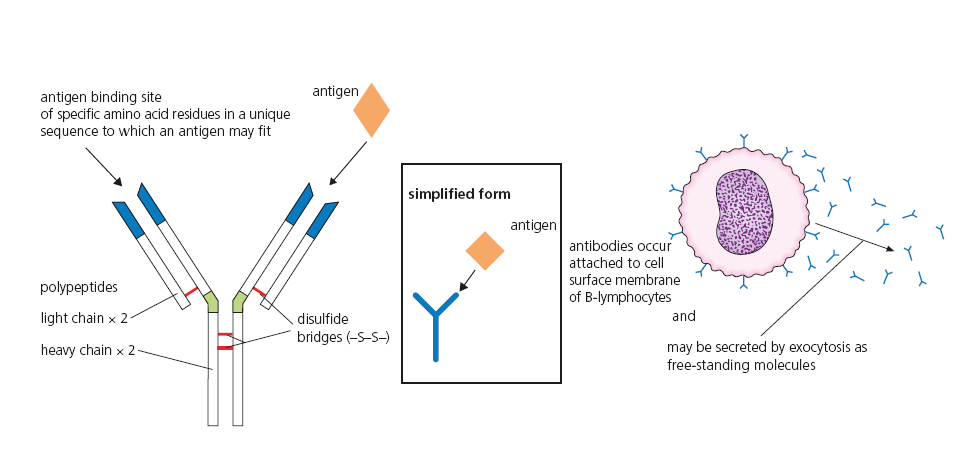
agglutination
process by in which how antibodies which attack to antigens, causing them to stick together, making them easier to get phagocise.
immune system complement proteins
will bind to any pathogens which have antibodies, making small holes and causing lysis
How do we recognise self from non self ?
cells are recognised by glycoproteins called and major histocompatibility complex (MHC). Lympocytes can recognise them, and so leave our cells alone
How are B-cells activated
B-cells need to come into contact with the antigen
Activated T-cells for that antigen need to come into contact with B-cells
only then are proper antibodies produced
Whole immune system process
B-cell in lymph detects antigen using it’s antibodies on it’s surface: they become antigen specific
macrophages perform phagocytosis, secrete citokines which activates rest of immune system. digest
macrophages present the antigen externally on an MHC on their cell membrane
this is antigen presentation
if helper T-cells detect their corresponding antigen on an MHC antigen, they realise shit gets serious and activates
if an antigen specific b cell meets an activated T-cell, it realises again shit gets serious and become activated
first the B-cells perform mitosis to be present in sufficient quantities
then produce specific antibodies
at the end, some T-cells and B-cells that used to be activated are now memory cells: whole immune process occurs again can occur much more quickly. Immune

