Behaviour - LEARNING
 Call Kai
 Learn
Learn Practice Test
 Spaced Repetition
 Match
Match Flashcards
 Knowt Play
1/86

There's no tags or description
Looks like no tags are added yet.
Name | Mastery | Learn | Test | Matching | Spaced | Call with Kai |
|---|
No analytics yet
Send a link to your students to track their progress
87 Terms
what does the insect nervous system consist of?
central nervous system, visceral (stomodaeal) nervous system, and peripheral nervous system
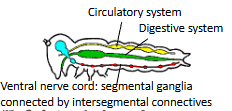
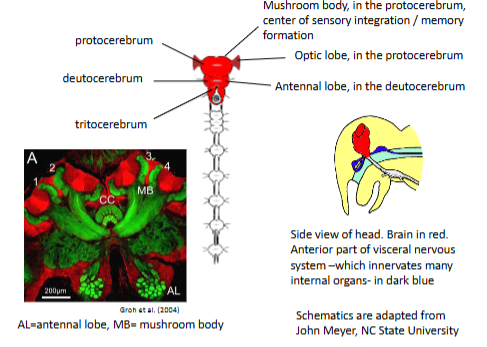
what does the insect brain consist of?
protocerebrum containing mushroom body and optic lobe, deutocerebrum containing antennal lobe, and tritocerebrum
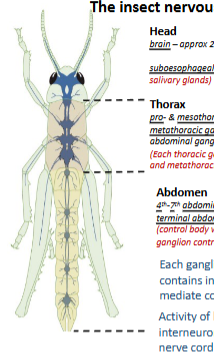
describe the nervous system of a grasshopper.
head contains brain and suboesophageal ganglion.
thorax contains pro- and meso-thoracic ganglia, and metathoracic ganglion
abdomen contains 4th-7th abdominal ganglia and terminal abdominal ganglion
what is the role of the grasshopper brain?
complex sense organ
what is the role of the grasshopper suboesophageal ganglion?
controls mouthparts and salivary glands
what is the role of the grasshopper prothoracic and mesothoracic ganglia?
each controls one pair of legs/wings
what is the role of the grasshopper metathoracic ganglion?
controls legs/wings and is fused to the first 3 abdominal ganglia
what is the role of the grasshopper 4th-7th abdominal ganglia?
control body wall muscles involved in respiration and steering
what is the role of the grasshopper terminal abdominal ganglion?
made up of 4 fused ganglia, that controls muscles of the reproductive organ
what do grasshopper ganglia receive information from?
receive sensory endings and contains interneurones and motor neurones that mediate complex limb reflexes, coordinated by interneurones running between them along the ventral nerve cord.
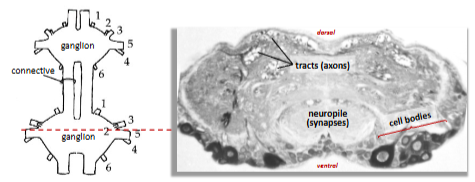
how are the insect ganglia organised?
cell bodies of motor neurones and interneurones are on the outside of the ganglia, the synaptic regions (neuropile) lie in the centre, unmyelinated axons run in tracts within the ganglia and in connectives running between them.
what is the role of vertebrate motor neurones?
each muscle is supplied by many motor neurones creating a motor pool. each motor neurone contracts many muscle fibres constituting a motor unit. each muscle fibre is innervated by only a single motor neurone. when the motor neurone fires and releases acetylcholine, an action potential is generated in the muscle membrane and the muscle fibre contracts maximally.
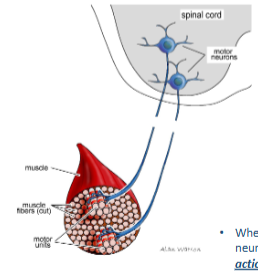
how do vertebrates control the strength of muscle contraction / what is the size principle of muscle activation model?
as vertebrate muscle fibres respond with action potentials when they are stimulated, their contraction is all or nothing. when making movements that use only small forces, small motor neurones are recruited. as the force exerted by the muscle increases, progressively larger motor neurones are recruited.
what is the role of invertebrate motor neurones?
each muscle is supplied by a very small number of motor neurones, which are either fast or slow. each motor neurone supplies most of the muscle fibres within the muscle. when they release glutamate they dont generate an action potential, but an excitatory post synaptic potential.
what is the role of fast motor neurones in invertebrates?
release a lot of transmitter with each action potential, produce large muscle contraction, and induce large EPSPs
what is the role of slow motor neurones in invertebrates?
release a little transmitter with each action potential, produce small muscle contractions, and induce small EPSPs
what is the role of inhibitory motor neurones in invertebrates?
supply muscle fibres alongside regular motor neurones, they release GABA which produces an inhibitory postsynaptic potential in muscle fibres. each inhibitory neurone has an axon that branches axons into several nerves and contracts many muscles. their main role is to end contraction rapidly to prevent overlap with contraction of antagonist muscles.
what is the role of the invertebrates muscle membrane?
acts like an additional level of neurones as excitatory and inhibitory effects are integrated here
what is the role of modulatory motor / dorsal unpaired median neurones in invertebrates?
send axons to many muscles on both sides of the body, they contain the neurotransmitter octopamine, do not generate EPSPs or IPSPs in muscles and do not cause contraction. instead, octopamine acts on the cellular components within the muscle and on the motor neurone axons.
what is the effect of the octopamine neurotransmitter in invertebrates?
increases the amount of glutamate released at the synapse, increasing muscle twitch. increases how fast the muscle relaxes, important in rhythmic activity. increases muscle ATP production from carbohydrates, and mobilises lipids for energy production.
what motor neurones are required for the locust extensor tibiae muscle to work?
the slow extensor, fast extensor, common inhibitor, and modulator
what is the role of the slow extensor motor neurone in locusts?
used mainly for walking, increasing spike frequency gradually increasing the force generated in many muscle fibres
what is the role of the fast extensor motor neurone in locusts?
used in jumping and kicking, and activates all muscle fibres.
what is the role of the common inhibitor motor neurone in locusts?
ensures that each contraction ends quickly
what is the role of the modulator motor neurone in locusts?
increases the effect of the excitors and optimises energy availibility
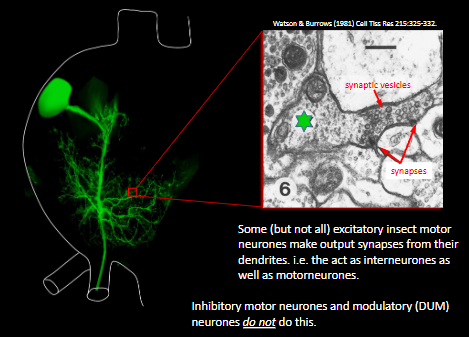
how can insect motor neurones act as interneurones?
by making output synapses from their dendrites
what does fine control of vertebrate muscles rely on?
sequential recruitment from large pool of excitatory motor neurones, each supplying a small number of muscle fibres.
what does fine control of invertebrate muscles rely on?
small numbers of excitatory and inhibitory motor neurones cause postsynaptic potentials at the muscle membrane, that interact to control the level of depolarisation of the muscle membrane and hence the force generated in invertebrates.
what is the overall function of inhibitory motor neurones in insects?
contact many muscles and the IPSPs help to make relaxation rapid so that activity between antagonistic muscles does not overlap.
what is the function of modulatory neurones in insects?
influence both axonal and muscle metabolism to influence contraction and the cellular processes underlying this.
what is reflexive movement?
stereotyped responses to specific stimuli
what is rhythmic movement?
timing and spatial organisation is largely controlled autonomously by spinal cord or brainstem
what is voluntary movement?
conscious control of movement by the brain
what initiates voluntary movements?
desire to accomplish a specific goal
what is the function of high motor control?
strategy/goal of movement
what areas of the brain are involved in high motor control?
association of neocortex, basal ganglia, and cerebellum
what is the function of middle motor control?
tactics - muscle contractions required to achieve strategic goal
what areas of the brain are involved in middle motor control?
motor cortex and cerebellum
what is the function of low motor control?
execution - activation of motor neurone and interneurone pools that generate the movement
what areas of the brain are involved in low motor control?
brainstem and spinal cord
what information about body positioning in egocentric space is providing by the cerebral neocortex?
vision, audition, somatic sensation, and proprioception
what sensory information is involved in high motor control?
mental image of the body in egocentric space
what sensory information is involved in middle motor control?
memory and sensory information from past movements
what sensory information is involved in low motor control?
maintenance of posture and muscle length and tension before and after voluntary movements.
what is a ballistic movement?
one that cannot be altered once initiated, as it has no sensory feedback
what are motor outputs?
neural commands that act on muscles causing them to generate movement
what is sensorimotor transformation?
sensory stimuli being converted into motor commands
what does sensorimotor transformation depend on?
extrinsic location about the world around us and intrinsic information about our body
what is kinematic information?
position, velocity, and acceleration of the hand, joint angle, lengths of muscles
what is kinetic information?
the forces generated or experienced by the body
how do sensorimotor transformations generate movement to a desired location?
target is localised in egocentric space, plan of movement and initial location of endpoint and endpoint trajectory created, inverse kinematic transformation - the joint trajectories to achieve path are determined, inverse dynamic transformation - joint torques or muscle activities to achieve joint trajectory are determined
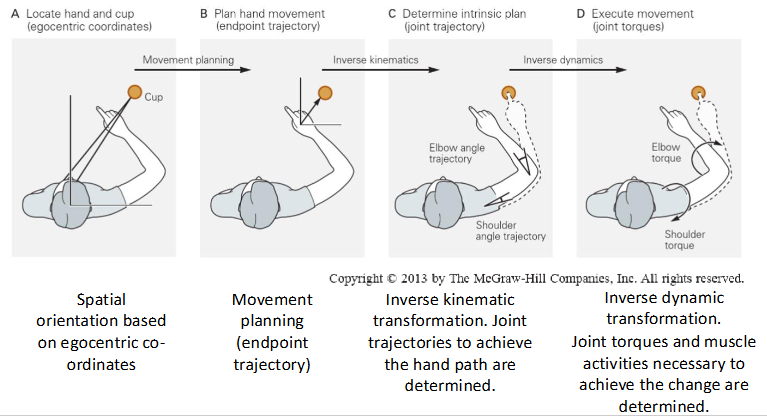
how do mammals plan and control movements?
sensory perception → sensory motor transformation → neuronal circuit → muscle contraction → motor output
what is the role of the motor cortex?
different aspects of motor control are localised to different regions of the cerebral cortex
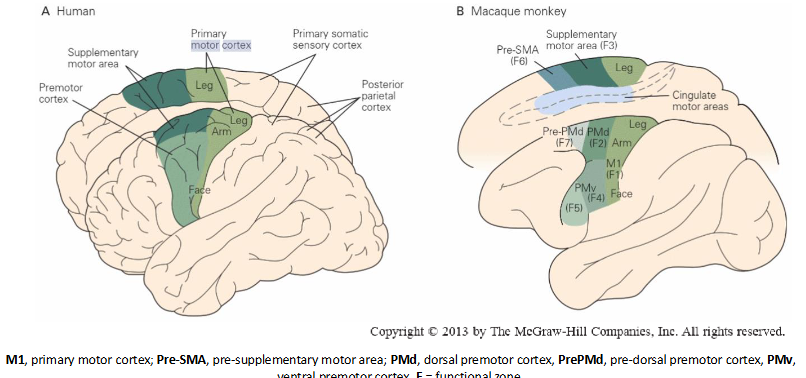
how is a motor response elicited?
by stimulation of the primary motor cortex
how is the primary motor cortex organised?
organised somatotopically, spatial arrangement of motor responses in which adjacent muscles are controlled by adjacent regions of the primary motor cortex.
what are internal models?
neural circuits that compute sensorimotor transformations
what are the two forms of internal models?
forward model representing the relationship between actions and their consequences, and inverse model that calculates the motor outputs from sensory outputs
how does a forward model work?
estimates future sensory inputs based on motor outputs, anticipates how the motor system will change as a result of the motor command. a copy of descending motor command acting on the sensorimotor system is passed on to a forward model that acts as a neural stimulator
how does an inverse model work?
determines the motor commands that are needed to produce the movements required to achieve the desired consequence.
what is the speed-accuracy trade off?
a limited ability to move rapidly and accurately at the same time.
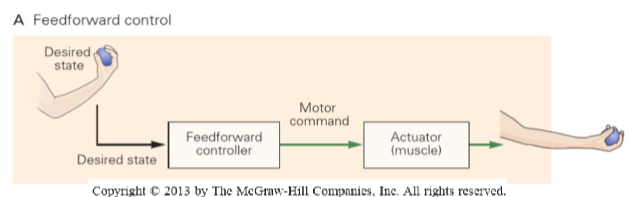
what is feedforward control?
generation of motor commands based on the desired state, the movement is not monitored for errors, sensory information to detect imminent perturbations and initiate pro-active strategies based on prior experience.
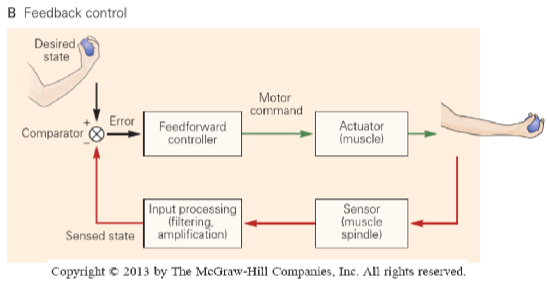
what is feedback control?
error correcting system, desired and sensed states are compared at the comparator, generating an error signal, which helps shape the motor command. monitoring sensory information to act directly on the limb itself.
how can motor systems adapt?
learning new motor skills through environmental interactions, sensorimotor control systems must constantly adapt over a lifetime, evolution can hard wire some motor behaviours, but they must adapt to new and varying environments.
what is sensory neuropathy?
damage to the sensory nerves, selectively damaging large diameter sensory fibres in peripheral nerves and dorsal roots that carry proprioceptive information.
what is locomotion?
using rhythmic and alternating movements of the body or appendages, controlled autonomically at relatively low levels of the CNS without the intervention by higher centres
where is the motor output for locomotion primarily produced?
by the neuronal system in the spinal cord
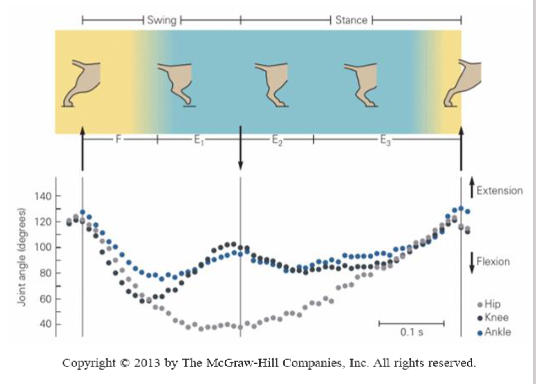
describe the step cycle?
flexors and extensors inhibit each other reciprocally, giving rise to alternating stepping movements, flexion and first extension, occurring when the foot is off the ground, and second extension and third extension, occurring when the foot makes contact with the ground
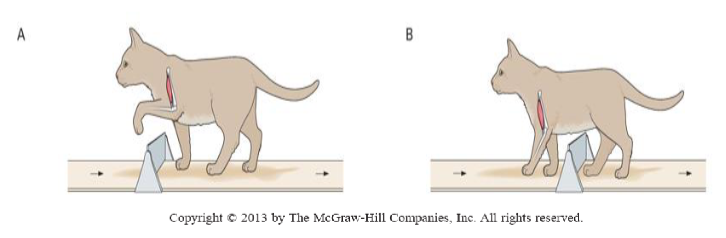
what is the stumbling corrective reaction?
sensory receptors in the skin influence walking by detecting obstacles and adjusting stepping to avoid them.
what types of preparations are used to study the neural control of stepping?
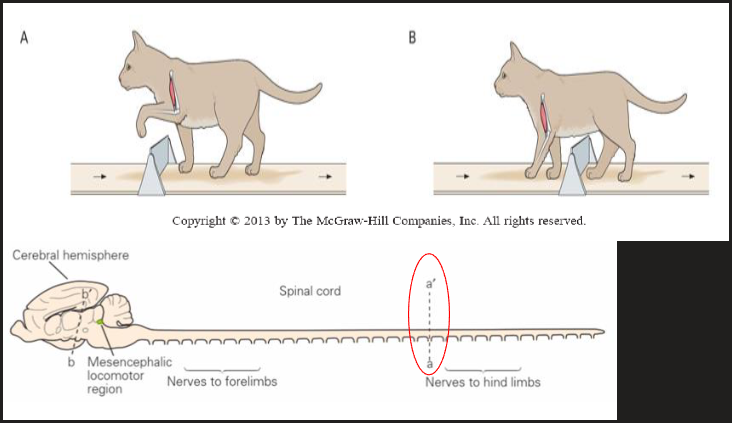
spinal preparation - the surgical severing of the spinal cord typically transected at the lower thoracic level, and isolating the spinal segments that control the hind limb musculature from the rest of the CNS.
what are acute spinal preparations?
adrenergic drugs such as L-dopa or nialamide are administered immediately after the transection, elevation of noradrenaline occurs in the spinal cord, spontaneous generation of locomotor activity occurs 30 minutes after administration
what are chronic spinal preparations?
transection of the spinal cord, studied for weeks or months, locomotor activity can return within a few weeks of cord transection, locomotor function returns spontaneously in kittens, but daily training is required to restore function in adult cats.
what are decerebrate preparations?
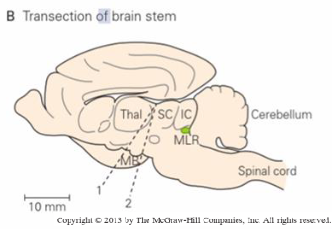
brainstem is completely transected at the level of the midbrain, disconnects rostral brain centres, spinal centres, and allows investigation into the role of the cerebellum and the brainstem in controlling locomotion.
describe pre-mammillary decerebrate prepartions.
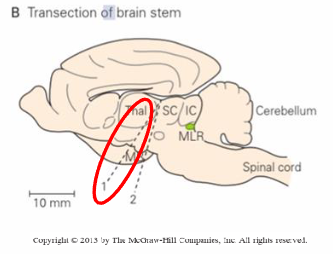
brainstem transected from the rostral margin of the superior colliculi to a point immediately rostral to the mammillary bodies, brainstem centres remain connected to spinal cord, leads to spontaneous stepping.
describe post-mammillary decerebrate preparation.
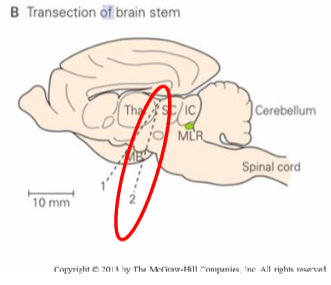
transection made caudal to the mammillary bodies, no spontaneous stepping, electrical stimulation of the mesencephalic locomotor region is required to evoke walking.
what are Thomas Graham Brown’s four conclusions about mammalian motor control?
supraspinal commands are not necessary for producing the basic motor pattern for stepping.
the rhythmicity of stepping is produced by neural circuits contained entirely within the spinal cord.
the spinal circuits can be modulated by tonic descending signals from the brain.
the spinal pattern generating networks do not require sensory inputs but are strongly regulated by input from limbic proprioceptors.
what does communication of the cerebral cortex with brainstem and motor neurone of spinal cord allow?
control of movements, muscle tone, spinal reflexes, spinal autonomic functions, and modulation of sensory information to higher centres.
how can the brain communicate with motor neurones of the spinal cord?
medial pathways, lateral pathways, and corticospinal pathways
what are the functions of corticospinal pathways?
control of voluntary, discrete, and skilled movements of distal limbs
where are the terminations of corticospinal neurones?
55% cervical, 20% thoracic, 25% lumbosacral
what is hereditary/familial spastic paraparesis?
inherited degenerative autosomal dominant disorder, causing progressive weakness of the legs, spastic paraparesis, increased muscle tone, and marked stiffness in gait.
what causes hereditary/familial spastic paraparesis?
degeneration of lateral corticospinal tract
what is the consequence of acute lesions of the spinal cord?
occlusion of the anterior spinal artery and trauma
what is the consequence of chronic compression of spinal cord and emerging nerve roots?
infection and tumours of the spine, meninges, and nerve roots, and prolapsed intervertebral discs.
what is the consequence of focal lesions of the spinal cord and root nerves?
destroys function at the segmental level, and disrupts descending motor tracts
what do injuries to spinal cord result in?
loss of sensation, loss of movements, loss of autonomic function
how can walking be improved after spinal cord injury?
rehabilitative training, by partially supporting body weight whilst completing repetitive weight supported stepping on a treadmill.
what is improvement of walking after spinal cord injury thought to depend on?
synaptic plasticity in local spinal circuits, and successful transmission of at least some motor commands through preserved descending pathways.

