Episodic Long-Term Memory
 Call Kai
 Learn
Learn Practice Test
 Spaced Repetition
 Match
Match Flashcards
 Knowt Play
1/55

Earn XP
Description and Tags
Chapter 6 of Psych 270
Name | Mastery | Learn | Test | Matching | Spaced | Call with Kai |
|---|
No analytics yet
Send a link to your students to track their progress
56 Terms
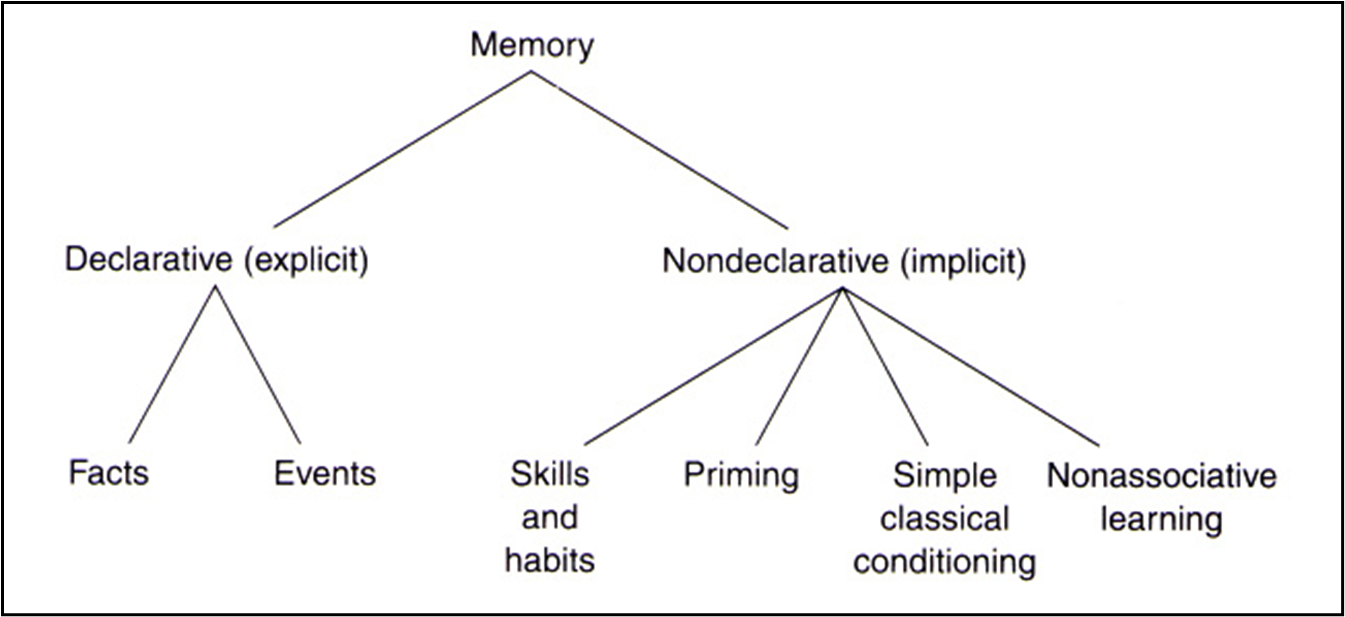
What is this
Squire’s taxonomy of long-term memories
What is explicit memory
Long-term memory knowledge that can be retrieved and then reflected on consciously (aka declarative memory)
What is implicit memory
Knowledge that can influence thought and behavior without any necessary involvement of conscious awareness (aka non-declarative memory)
What is episodic memory
autobiographical; stores personally experienced events (e.g., the events your experienced at a fun party
What is semantic memory
Stores general world knowledge, like concepts and categories (e.g., knowing that the capital city of Saskatchewan is Regina)
What are the preliminary issues
Mnemonics, the ebbinghaus tradition and metamemory
What is a mnemonic
An active, strategic learning device or method
What are the strengths of mnemonics
The material to be remembered is practiced repeatedly
The material is integrated into an existing memory framework
The mnemonic provides a way to retrieve the material
What is method of loci
Uses known locations as cues for memory items (based on visual imagery)
What are the steps of using method of loci
Choose a known set of locations
Forms a mental image of each thing you want to remember and place it in a location
What is the peg-word technique
A pre-memorized set of words serves as a sequence of mental “pegs” onto which the to-be-remembered material can be “hung”
What are the mnemonic principles
Provide a structure for learning
Form durable and distinctive memory traces (by means of visual images and rhymes)
Guide retrieval by providing effective cues for recalling the information
What is the three-step sequence for learning and memory
Encoding, retention, retrieval
Who is Herman Ebbinghaus
Founder of scientific research on memory
Studied his own memory (used himself as the only participant in his studies and studied memory using nonsense syllables)
Used the relearning task and savings score
What were Ebbinghaus results
Forgetting curve (aka retention curve)
Evidence of overlearning (more frequently repeated list = twice the savings score and longer lists were remembered better)
What is distributed practice
Study time is spread out over many, shorter sessions
What is massed practice
Study time is grouped together into one long session
What is metamemory
Knowledge about one’s own memory, including how it works and how it fails to work
What is metacognition
Knowledge about one’s own cognitive system and its functioning
What is isolation effect
Better memory for information that is distinct from the information around it (having one word in red when everything else is black)
What are the important principles of storage
Rehearsal, organization, imagery
What is rehearsal
A deliberate recycling of short-term memories contents
A deliberate recycling or practicing of information in the short-term store
What is Rundus (1971)
Participants learned 20 item lists of words (got 5 seconds/word)
People were told to rehearse words aloud, but could rehearse any words that they wanted
What are the two kinds of rehearsal
Maintenance rehearsal and elaborative rehearsal
What is maintenance rehearsal
A low-level, repetitive information recycling (holding the number for the pizza restaurant in memory until you dial it)
What is elaborative rehearsal
A more complex rehearsal using the meaning of the information to store and remember
What did Craik and Lockhart study (1972)
The two different kinds of rehearsal and depth of processing
What is depth of processing
Memory is determined not by how long information stays in the system, but by how the person processes it
What is shallow processing
Leads to poor long-term memory traces (used in maintenance rehearsal)
What is deep processing
Leads to strong long-term memory traces (used in elaborative rehearsal)
What is organization
The structuring or restructuring of information as it is being stored in memory
What is bower et al. (1969) study
People got 4 trails to learn 112 words
Two conditions: organized condition & control
Organized: got organized lists with headers
Control: same physical structure of lists, but randomized words
What is subjective organization
Organization developed by a person for structuring and remembering information
Organization developed by the participant for structuring and remembering a list of items without experimenter-supplied categories
What is imagery
The mental picturing of a stimulus that affects later recall or recognition
What did Paviio do (1971)
Reviewed studies on mental imagery and found a beneficial effects for memory
What is Schnoor & Atkinson (1969) paired associate task
List of words pairs are presented to a person
After the first presentation, the first word (the stimulus) should act as a cue for the second to-be-produced (the paired associate response)
What is dual coding hypothesis
Words that denote concrete objects, as opposed to abstract words, can be encoded into memory twice (once verbally and again as an image)
Concrete words can be stored twice in long-term memory, once as a word and again as a picture
Abstract words are only stored once
What is encoding specificity
Each item is encoded into a richer memory representation that includes the context it was in during encoding (extra information that was present during encoding of an item is also stored)
Anything present during learning a target can serve as an effective cue for later remembering that target
State-dependent learning
What is decay
The older a memory trace is, the more likely it has been forgotten
How do you study interference in long-term memory
Paired associate learning
What is paired associate learning
A list of stimulus terms is paired, item by item, with a list of response terms (after learning, the stimulus terms are used as cues for the response terms)
Often used to study proactive and retroactive interference
What is retrieval failure (aka forgetting)
When a memory is lost in the system, as opposed to from the system
What is tip of the tongue states
When a person is temporarily unable to remember some shred of information (e.g., a name) that they know is stored in long-term memory
What is availability
The memory trace exists; it was encoded into long-term memory
-Once encoded, information stays in long-term indefinitely
What is accessibility
Degree to which the memory trace can be retrieved from memory
-Information is in long-term memory, but may or may not be accessed
Why does retrieval failure happen
Occurs when the information is available, but not accessible
What do retrieval cues do
Help restore the original learning context
What is amnesia
Loss of memory or memory abilities due to brain damage or disease
What is retrograde amnesia
Loss of memory of events before the injury
What is ribot’s law
Temporal gradient in retrograde amnesia
What is anterograde amnesia
Loss of memory of events after the injury
What is dissociation
A disruption in one component of cognition but no impairment of another
What is double dissociation
Finding reciprocal patterns of disruption
-In one patient, A is disrupted but B is not
-In another patient, B is disrupted but A is not
What happened to patient K.C.
Episodic memory processes were disrupted, but semantic memory processes were intact
What happened to patient H.M.
Unable to transfer new information to long-term memory, but able to retrieve already stored memories from long-term memory
What is repetition priming
A previous encounter with information facilitates later processing on the same information, even unconsciously

