Test 3
 Studied by 1 person
 Call Kai
 Learn
Learn Practice Test
 Spaced Repetition
 Match
Match Flashcards
 Knowt Play
1/225

Earn XP
Description and Tags
Modules
Name | Mastery | Learn | Test | Matching | Spaced | Call with Kai |
|---|
No analytics yet
Send a link to your students to track their progress
226 Terms
figure-ground perception
the organization of the visual field into objects (the figures) that stand out from their surroundings (the ground)
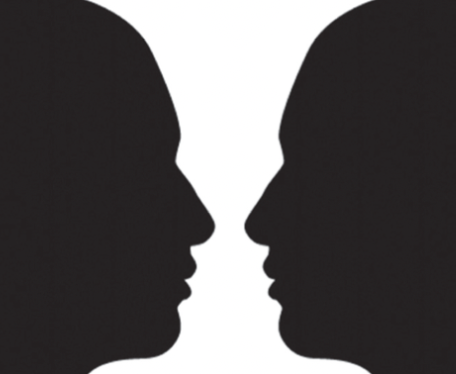
ex of reversible figure & ground
optical illusions - goblet vs. two faces
gestalt
a meaning pattern/configuration, forming a “whole” that is more than the sum of its parts
three principles of grouping
proximity, continuity, closure
proximity
we group nearby objects together
example of proximity
we see three columns rather than seeing 6 individual lines
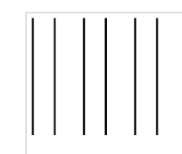
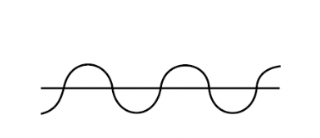
continuity
we perceive smooth, continuing patterns rather than discontinuous ones
example of continuity
we see two continuous lines (one curvy, one straight) instead of seeing a series of alternating semicircles
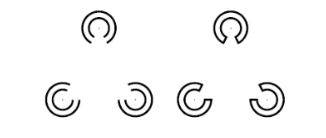
closure
we fill in gaps to see a complete, whole object
example of closure
we assume that the circles on the le are complete but partially blocked by the (illusory) triangle
depth perception
the ability to see objects in three dimensions, although the images that strike the retina are two-dimensional; allows us to judge distance
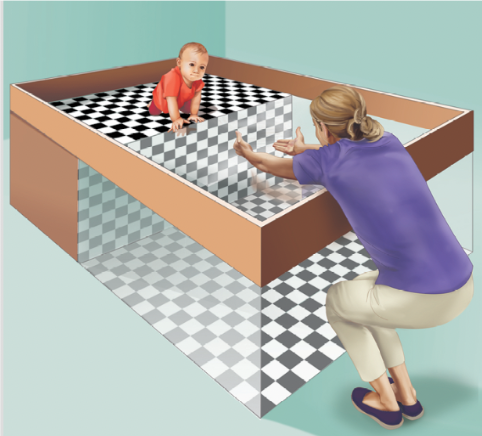
visual cliff
test of depth perception;
a model of a cliff with a “drop-off ” area that was actually covered by sturdy glass. They placed 6- to 14- month-old infants on the edge of the “cliff” and had one of the parents coax the infants to lean over the glass or crawl out onto it Most infants refused to do so, indicating that they could perceive depth.
binocular clues
a depth cue, such as retinal disparity, that depends on the use of two eyes
retinal disparity
a binocular cue for perceiving depth;
humans have two eyes in front of our head. the two eyes have slightly different views - the more different the views are, the closer the object must be
_______ _______ is used in 3d movies to create the illusion of depth, as each eye gets a different view of “close” objects
retinal disparity
how do we perceive depth from a 2D image?
by using monocular (only needing one eye) cues
monocular cues
a depth cue, such as interposition or linear perspective, available to either eye alone
examples of monocular cues
relative height, relative size, relative motion, linear perspective, interposition
interposition
when one object appears to block the view of another, we assume taht the blocking object is in a position between our eyes and the blocked object

this picture is an example of the monocular cue
interposition; the left deer is in front of the right deer
relative size
if we assume two objects are similar in size, most people interpret the smaller object as the one that is farther away

this picture is an example of the monocular cue
relative size; the smaller flowers are farther away
linear perspective
parallel lines appear to meet in the distance; the sharper the angle of convergence, the greater the perceived distance
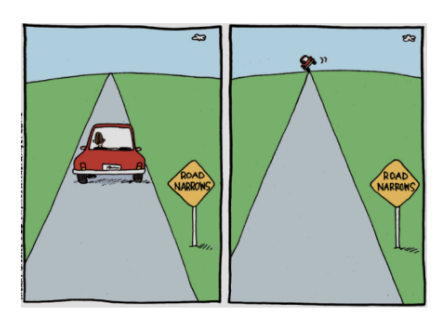
this picture is an example of the monocular cue
linear perspective, the two lines of the road seem to meet in the distance
relative height
we tend to perceive the higher part of a scene as farther away

this picture is an example of which monocular cue
relative height;
this scene can look like layers of buildings, with the highest part of the picture as the sky
perceptual constancy
our ability to see objects as appearing the same even under different lighting conditions, at different distances and angles
perceptual constancy is a
top-down process
examples of perceptual constancy
color and brightness constancy, shape and size constancy
relative luminance
the amount of light an object reflects relative to its surroundings
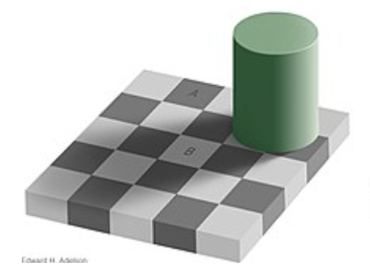
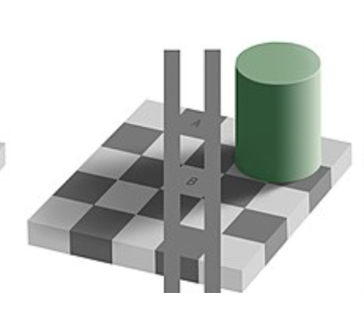
the squares A and B are exactly the same shade of gray.
why does B look lighter?
comparisons (context) control our perceptions!
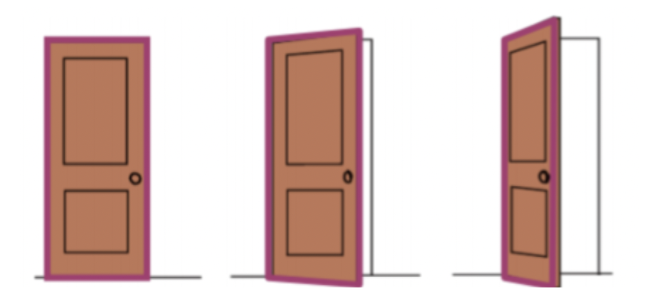
shape constancy
the ability to perceive objects as having a constant shape despite receiving different sensory images
_____________ ________________ helps us see the door as a rectangle as it opens. because of this, we may think the red shapes on screen are also rectangles
shape constancy
visual interpretation: restored vision, sensory restriction
Experience shapes our visual perception.
what does “experience shapes our visual perception” mean?
we must practice our perception skills during a critical period of development, or these skills may not develop
perceptual adaptation
After our sensory information is distorted, such as by a new pair of glasses or by delayed audio on a television, humans may at first be disoriented but can learn to adjust and function
This man could learn eventually to fly an airplane wearing these unusual goggles, but here, at first, he is disoriented by having his world turned upside down
this is an example of
perceptual adaptation
hearing in psychology
how do we take a sensation based on sound waves and turn it into perceptions of music, people, and actions?
hype music when working out, sad music when depressed
how do we distinguish among thousands of pitches and voices?
the _________ of a soundwave determines the wave’s ________
frequency; pitch
a soundwave with short wavelength has ________ frequency, creating high-pitch sounds
high
a soundwave with long wavelengths has ___ frequency, creating low-pitched sounds
low
Waves vary in ___________ (the distance between successive peaks).
wavelength
_________________ the number of complete wavelengths that can pass a point in a given time, depends on the wavelength
frequency
The shorter the wavelength, the __________ the frequency.
higher
wavelength determines the ____ of sound
pitch
a soundwave’s amplitude corresponds to our perception of ________
volume
a soundwave with high amplitude has ________ volume
loud
a soundwave with low amplitude has ______ volume
quiet
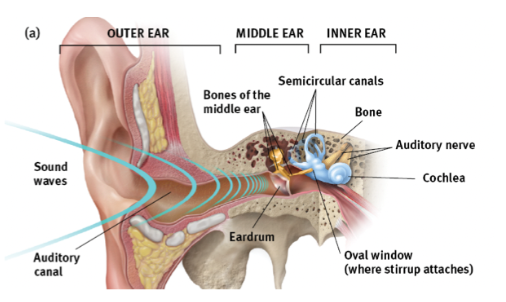
how sound waves reach the ear
The outer ear funnels sound waves to the eardrum.
The bones of the middle ear amplify and relay the eardrum’s vibrations through the oval window into the fluid-filled cochlea.
The cochlear fluid’s resulting pressure changes cause the basilar membrane to ripple, bending the hair cells on its surface.
Hair cell movements trigger impulses at the nerve cells’ base, whose fibers converge to form the auditory nerve.
That nerve sends neural messages to the thalamus and on to the auditory cortex.
conduction hearing loss
when the middle ear isn’t conducting sound well to the cochlea
sensorineural hearing loss
when the receptor cells aren’t sending messages through the auditory nerves
causes of hearing loss
preventing hearing loss
exposure to sounds that are too loud to talk over can cause damage to the inner ear, especially the hair cells
structures of the middle and inner ear can also be damaged by disease
prevention methods include:
limiting exposure to noises over 85 decibels
treating ear infections
interaural timing differences
sounds usually reach one of our ears sooner and with more clarity than they reach the other ear
interaural intensity
refers to the fact that a sound coming from the right side of your body is more intense at your right ear than at your left ear, and vice versa for sounds from the left, because of the attenuation of the sound wave as it passes through your head.
true or false: people who lose all hearing in one ear often have a hard time locating sounds
true
associative learning - behaviorism
Classical Conditioning (Pavlov’s dogs): learning to link two stimuli in a way that helps us anticipate an event to which we have a reaction
Something outside of us that we associate with
Operant Conditioning (Skinner): changing behavior choices in response to consequences
Changing behavior (behavior modification) in the world
classical conditioning
a type of associative learning - behaviorism
Pavlov’s dogs - learning to link two stimuli in a way that helps us anticipate an event to which we have a reaction
something outside of us that we associate with
operant conditioning
a type of associative learning - behaviorism
Skinner - changing behavior choices in response to consequences
changing behavior (behavior modification) in the world
cognitive learning
acquiring new behaviors and information through observation and information, rather than by direct experience
how classical conditioning works
Process: after repeated exposure to two stimuli occurring in sequence, we associate those stimuli with each other
Result: our natural response to one stimulus can now be triggered by the new, predictive stimulus
example of classical conditioning
stimulus 1: hear thunder —> response: cover ears to avoid sound
after repetition
stimulus 2: see lightning —> response: cover ears to avoid sound
here, our response to thunder becomes associated with lightning
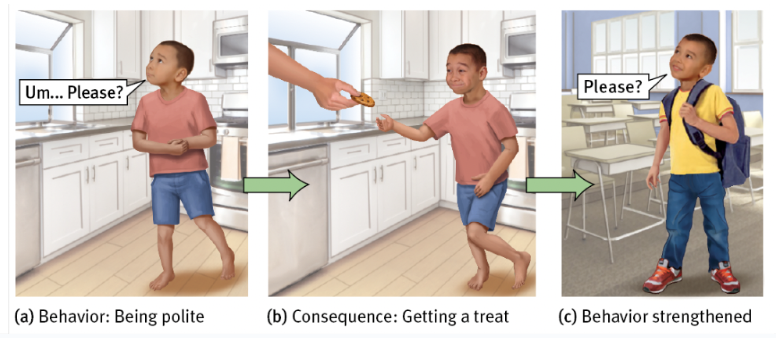
example of operative conditioning
child associates his “response” (behavior) with consequences
child learns to repeat behaviors (saying “please”) which were followed by desirable results (cookie)
child learns to avoir behaviors (yelling “gimme!”) which were followed by undesirable results (scolding or loss of dessert)
cognitive learning
refers to acquiring new behaviors and information mentally, rather than by direct experience
cognitive learning occurs by:
1) observing events and the behavior of others
2) using language to acquire information about events experienced by others
Before classical conditioning —> a neutral response to a neutral stimulus (NS)
a stimulus that does not trigger a response
ex. a dog hears bell ring but has no response
—> Neutral Stimulus (NS) = bell ringing
—> Neutral Response (NR) = dog has no response
unconditioned stimulus
a stimulus which triggers a response naturally, before/without any conditioning
ex.
unconditioned stimulus (US) = yummy dog food
unconditioned response (UR) = dog salivates
during classical conditioning
the bell (NS) is repeatedly presented with the food (US)
NS = ring the bell
US = present the food
UR = dog salivates
after classical conditioning
the dog begins to salivate after hearing the bell ring
—> the NS becomes the Conditioned Stimulus (CS)
Conditioned (formerly neutral) Stimulus = bell rings
Conditioned Response = dog salivates
the UR and the CR are the same response, triggered by different events - the difference is
whether conditioning was necessary for the response to happen
the NS and the CS are the same stimulus - the difference is
whether the stimulus triggers the conditioned response
Find the US, UR, NS, CS, CR
Your romantic partner always uses the same shampoo. soon, the smell of that shampoo makes you feel happy
US = romantic partner
UR = feeling happy
NS = the shampoo smell
CS = the shampoo smell
CR = feeling happy
Find the US, UR, NS, CS, CR
the door to your house squeaks loudly when you open it. soon, your dog begins wagging its tail when the door squeaks
US = you coming home
UR = dog wagging tail
NS = door squeaking
CS = door squeaking
CR = dog wagging its tail
Find the US, UR, NS, CS, CR
the nurse says, “this won’t hurt a bit” just before stabbing you with a needle. the next time you hear “this won’t hurt”, you cringe in fear
US = getting stabbed by needle
UR = cringing in fear
NS = hearing “this won’t hurt a bit”
CS = hearing “this won’t hurt a bit”
CR = cringing in fear
Find the US, UR, NS, CS, CR
You have a meal at a fast food restaurant that causes food poisoning. The next time you see a sign for that restaurant, you feel nauseated
US = bad food
UR = nausea
NS = restaurant
CS = seeing restaurant
CR = nausea
generalization
the tendency to have conditioned responses triggered by related stimuli
MORE stuff makes you drool
ex of generalization
Pavlov conditioned dogs to drool when rubbed; they then also drooled when scratched
discrimination
the ability to only respond to a specific stimuli, preventing generalization
LESS stuff makes you drool
ex of discrimination
Pavlov conditioned dogs to drool at bells of a certain pitch; slightly different pitches did not trigger drooling
operant conditioning
involves adjusting to the consequences of our behaviors
how operant conditioning works:
an act of chosen behavior (a “response”) is followed by a reward or punitive feedback from the environment
result: reinforced behavior is more likely to be tried again
ex. of operant conditioning
we may smile more at work after this repeatedly gets us bigger tips
we learn how to ride a bike using the strategies that don’t make us crash
Skinner: the Operant Chamber
in operant conditioning research, a chamber (also known as a Skinner box) containing a bar or key that an animal can manipulate to obtain a food or water reinforcer; attached devices record the animal’s rate of bar pressing or key pecking
reinforcement
feedback from the environment that makes behavior more likely to be done again
positive (+) reinforcement
the reward is adding something desirable
example of positive reinforcement
getting a cupcake after putting on seat belt
negative (-) reinforcement
the reward is ending something unpleasant
key words: “until” or “as soon as”
ex of negative reinforcement
car beeps annoyingly until you put the seatbelt on
punishments
have the opposite effects of reinforcement. these consequences make the target behavior less likely to occur in the future
positive (+) punishment
you ADD something unpleasant/aversive
ex of positive punishment
spanking child
negative (-) punishment
you take away something pleasant/desired
ex of negative punishment
taking teenager’s phone away
“you’re playing video games instead of practicing the piano, so i am justified in yelling at you” is an example of
positive punishment (parents are giving something bad)
“you’re avoiding practicing, so I’m turning off your game” is an example of
negative punishment (parents are taking away something good)
“i will stop staring at you as soon as i see that you are practicing” is an example of
negative reinforcement (parents are TAKING AWAY something BAD)
“after you practice, we’ll play a game!” is an example of
positive reinforcement (parents are GIVING something GOOD)
reinforcement vs. punishment:
police pulling drivers over and giving prizes for buckling up
positive reinforcement
reinforcement vs. punishment:
suspending a basketball player for committing a flagrant foul
negative punishment
reinforcement vs. punishment:
a soccer player rolls her eyes at a teammate who delivered a bad pass
positive punishment
reinforcement vs. punishment:
a child snaps her fingers until her teacher calls on her
negative reinforcement
 Note
Note  Flashcards (46)