Neural Integration and Reflexes: Synaptic Potentials, Summation, and Spinal Reflexes
 Call Kai
 Learn
Learn Practice Test
 Spaced Repetition
 Match
Match Flashcards
 Knowt Play
1/48

There's no tags or description
Looks like no tags are added yet.
Name | Mastery | Learn | Test | Matching | Spaced | Call with Kai |
|---|
No analytics yet
Send a link to your students to track their progress
49 Terms
What is synaptic delay?
The slowing of nerve signal transmission due to the presence of synapses.
Why do we use synapses despite the delay they cause?
They allow for information processing, storage, and decision-making in the nervous system.
What is Neural Integration?
The process by which the nervous system processes information through synaptic connections.
What is an excitatory postsynaptic potential (EPSP)?
A graded depolarization of the postsynaptic membrane, often produced by neurotransmitters like glutamate and aspartate.
What is an inhibitory postsynaptic potential (IPSP)?
A graded hyperpolarization of the postsynaptic membrane, often produced by neurotransmitters like glycine and GABA.
What determines a neuron's response to inputs?
The net input of excitatory and inhibitory postsynaptic potentials (EPSPs and IPSPs).
What is summation in the context of neural integration?
The process of adding up postsynaptic potentials to determine the net effect on the neuron.
What are the two types of summation?
Temporal summation and spatial summation.
What is temporal summation?
Occurs when a single synapse generates EPSPs rapidly enough that each one adds to the previous, potentially reaching action potential threshold.
What is spatial summation?
Occurs when EPSPs from multiple different synapses add up to reach threshold at the axon hillock.
What is facilitation in neural processing?
The process by which one neuron enhances the effect of another, leading to a stronger action potential.
What role does calcium play in presynaptic facilitation?
Calcium is needed to stimulate exocytosis of neurotransmitters like ACh, leading to prolonged repolarization.
What is presynaptic facilitation?
When a facilitator neuron secretes a chemical that enhances the effect of another neuron, resulting in a greater stimulus in the postsynaptic cell.
How do certain drugs affect facilitation?
Drugs like nicotine and caffeine can enhance EPSPs and lower the threshold for action potentials, making the nervous system more excitable.
What is the effect of caffeine on the nervous system?
Caffeine lowers the threshold for action potentials and increases the release of ACh, making the nervous system more alert.
What happens when EPSPs override IPSPs?
The threshold may be reached, triggering an action potential.
What happens when IPSPs dominate?
They inhibit the neuron from firing.
What is the trigger zone in a neuron?
The area where summation occurs and the decision to fire an action potential is made.
What is the relationship between EPSPs and action potentials?
EPSPs must reach a certain threshold to trigger an action potential in the neuron.
What is the role of neurotransmitters in postsynaptic potentials?
Neurotransmitters like glutamate, aspartate, glycine, and GABA produce EPSPs and IPSPs that influence neuronal firing.
What is the significance of the balance between EPSPs and IPSPs?
It enables the nervous system to make decisions based on the net input of excitatory and inhibitory signals.
How does the body learn to respond to stimuli like a hot stove?
Through a learned system that is stored in the nervous system, balancing EPSPs and IPSPs.
What is the effect of simultaneous input from multiple presynaptic neurons?
It is required for the postsynaptic neuron to fire during spatial summation.
What is the effect of combining cigarettes and coffee on the CNS?
It has a dramatic effect due to the different ways nicotine and caffeine stimulate the CNS.
What is presynaptic inhibition?
It occurs when one presynaptic neuron suppresses another, reducing or halting unwanted synaptic transmission.
What neurotransmitter is released during presynaptic inhibition?
GABA, which prevents voltage-gated calcium channels from opening.
How is information relayed in the nervous system?
In the form of action potentials.
What effects can neurotransmitters have at a synapse?
They may have excitatory or inhibitory effects.
What are neuromodulators?
Chemicals that alter the rate of neurotransmitter release or the response of a postsynaptic neuron.
What are sensory receptors responsible for?
Monitoring specific conditions in the body or external environment and relaying stimuli to the CNS.
What is the difference between sensation and perception?
Sensation is the arriving information, while perception is the conscious awareness of that sensation.
What are somatic senses?
General senses felt with the body, including touch, pressure, pain, temperature, and proprioception.
What are reflexes?
Rapid, automatic responses to specific stimuli, serving as basic building blocks of neural function.
What is a reflex arc?
The wiring of a single reflex, beginning at a receptor and ending at a peripheral effector.
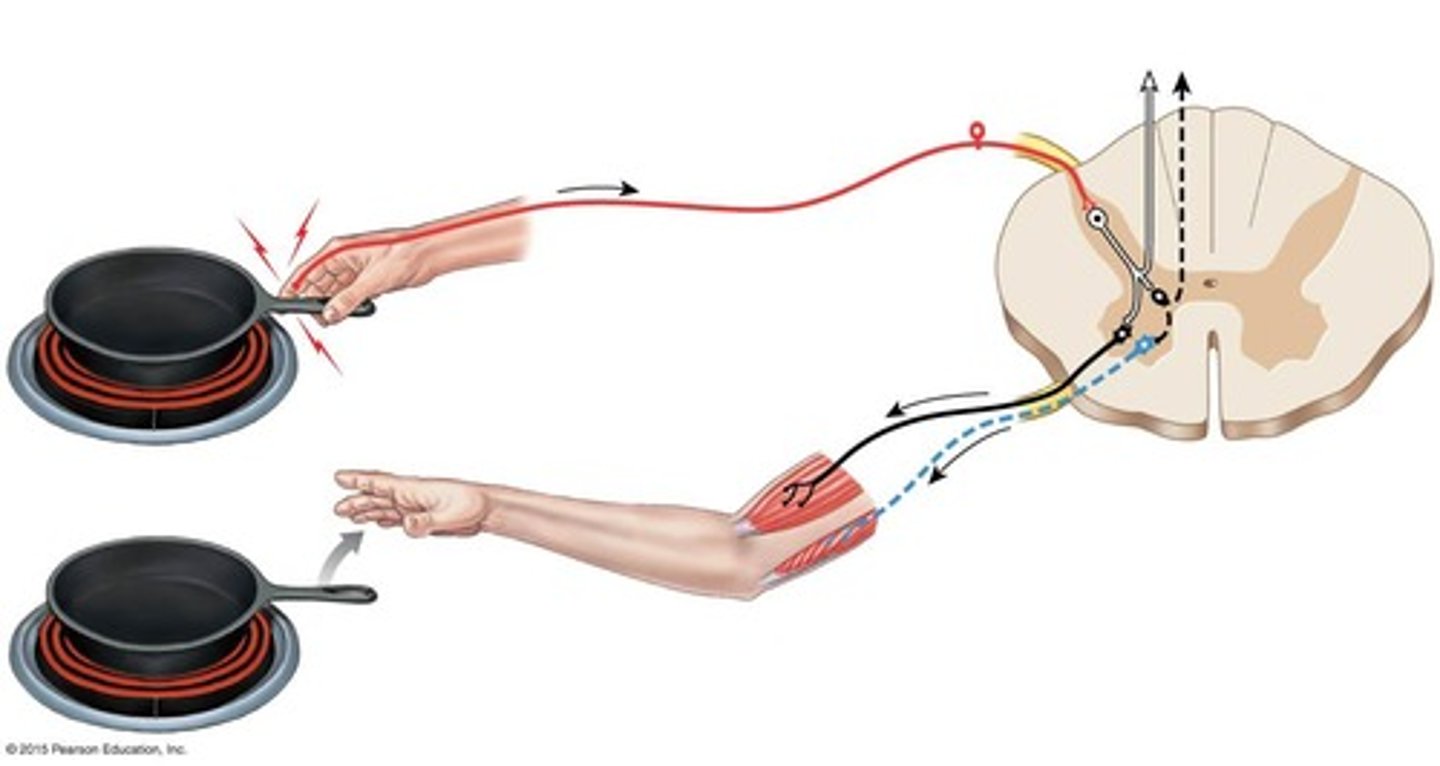
What is the typical response of a reflex arc?
It generally opposes the original stimulus (negative feedback).
What are innate reflexes?
Primitive reflexes formed before birth.
What are acquired reflexes?
Rapid, automatic responses that are learned motor patterns.
What are somatic reflexes?
Involuntary control of the nervous system, including superficial and stretch reflexes.
What is a monosynaptic reflex?
A reflex where the sensory neuron synapses directly onto the motor neuron.
What is a polysynaptic reflex?
A reflex that involves at least one interneuron between the sensory neuron and the motor neuron.
What is the purpose of the tendon reflex?
To prevent skeletal muscles from developing too much tension and tearing or breaking tendons.
What is a withdrawal reflex?
A reflex that moves a body part away from a painful stimulus.
What is reciprocal inhibition?
The inhibition of the stretch reflex of an antagonistic muscle to allow a flexor reflex to work.
What are ipsilateral reflex arcs?
Reflex arcs that occur on the same side of the body as the stimulus.
What are crossed extensor reflexes?
Reflexes that involve a contralateral reflex arc and occur on the opposite side of the stimulus.
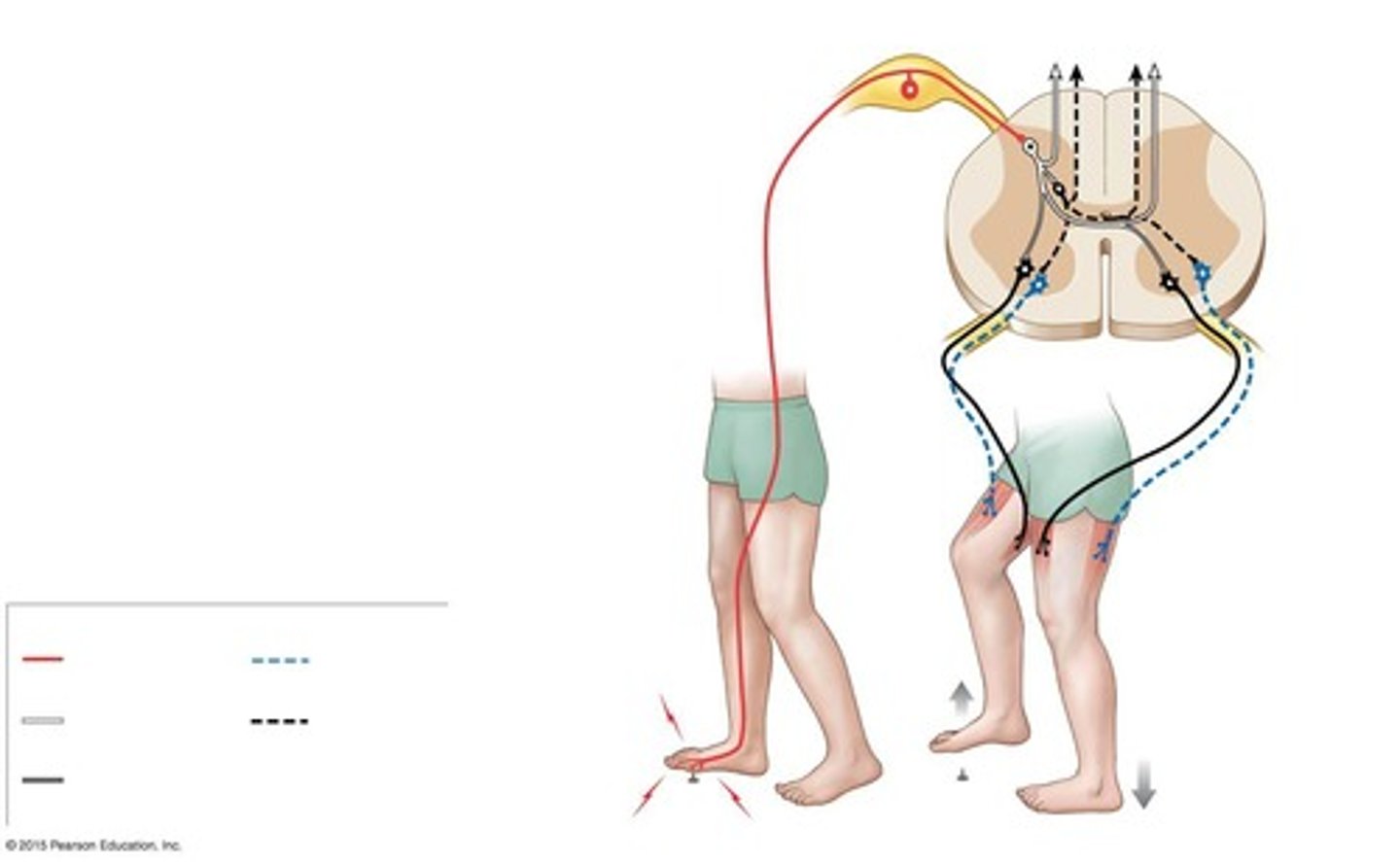
What is the role of interneurons in reflexes?
They can control more than one muscle group and produce either excitatory or inhibitory postsynaptic potentials (EPSPs or IPSPs).
What is the time frame for completing a monosynaptic reflex?
Typically completed in 20-40 milliseconds.
What is the receptor involved in stretch reflexes?
The muscle spindle.
What is the significance of the frequency of action potentials in sensory information?
It indicates the intensity of the stimulus; higher frequency corresponds to stronger stimuli.

