unit 6 hipp analysis
 Studied by 9 people
 Call Kai
 Learn
Learn Practice Test
 Spaced Repetition
 Match
Match Flashcards
 Knowt Play
1/4

There's no tags or description
Looks like no tags are added yet.
Name | Mastery | Learn | Test | Matching | Spaced | Call with Kai |
|---|
No analytics yet
Send a link to your students to track their progress
5 Terms
To every one applying to rent land upon shares, the following conditions must be read, and agreed to….. The croppers are to have half of the cotton, corn, and fodder (and peas and pumpkins and potatoes if any are planted) if the following conditions are complied with, but-if not-they are to have only two-fifths (2/5).
Nothing can be sold from their (sharecroppers’) crops until my rent is all paid, and all amounts they owe me are paid in full.
All must work under my direction……..Work of every description, particularly the work on fences and ditches, to be done to my satisfaction, and must be done over until I am satisfied that it is done as it should be.
- Sharecropping Contract, 1882 (Modified)
1. What is the Historical Circumstance of this document?
Reconstruction ended, many African Americans were farmers
2. Who is the Intended Audience of this document?
Sharecroppers
3. What is the Point of View of the document?
Benefits the land owner
4. What is the Purpose of this document?
To explain the rules for leasing land
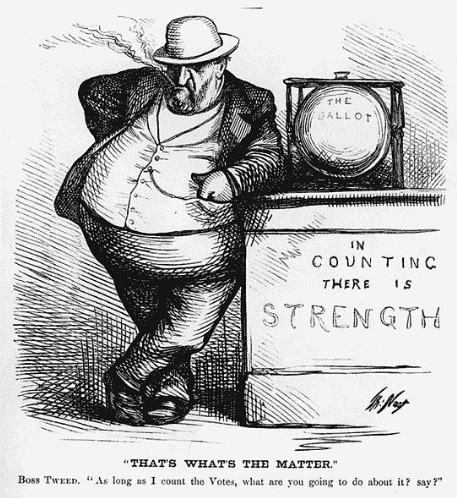
“Thats what’s the matter” - boss tweed picture
Document Analysis Questions
1. What issue is the political cartoon bringing attention to?
No secret ballot, political machines could count ballots
2. What ultimately fixed this issue?
Secret ballot - introduced during the Progressive Era
HIPP Analysis
1. What is the Historical Circumstance of this cartoon?
Political machines held significant power in the latter half of the 19th century
2. Who is the Intended Audience of this cartoon?
American public
3. What is the Point of View of the cartoon?
Negative towards political machines and Boss Tweed
4. What is the Purpose of this cartoon?
To bring attention to lack of democracy in certain areas
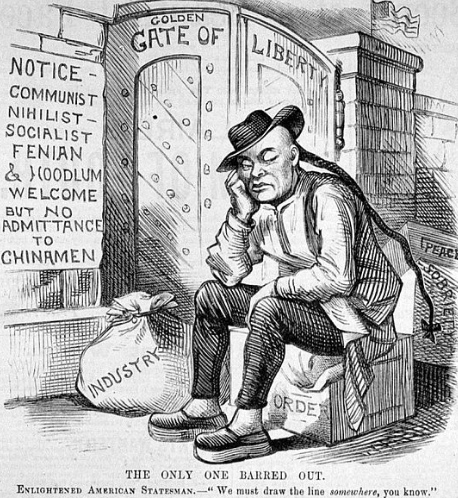
the only one barred out
1. How would nativists view the cartoon?
Oppose the message - this cartoon portrays Chinese immigration as positive
2. What are character traits that the Chinese offer according to the cartoonist?
Order, Sobriety, industry, peace
3. What were reasons that the Chinese were specifically barred from immigrating to America?
Poor economy of the 1870s, belief that they were “taking” jobs, nativism
4. What are other examples of nativism in US History? (Potential synthesis point)
Know-Nothing Party (1840s and 1850s)
HIPP Analysis
1. What is the Historical Circumstance of this cartoon?
Anti-Chinese settlement out west; Chinese worked on RRs and in mines, were accused of “taking” jobs
2. Who is the Intended Audience of this cartoon?
American public - those that support the plight of Chinese immigrants
3. What is the Point of View of the cartoon?
Positive towards Chinese immigrants; negative towards the Chinese Exclusion Act - unfair against Chinese
4. What is the Purpose of this cartoon?
To portray Chinese immigrants as deserving to come to the US as anyone
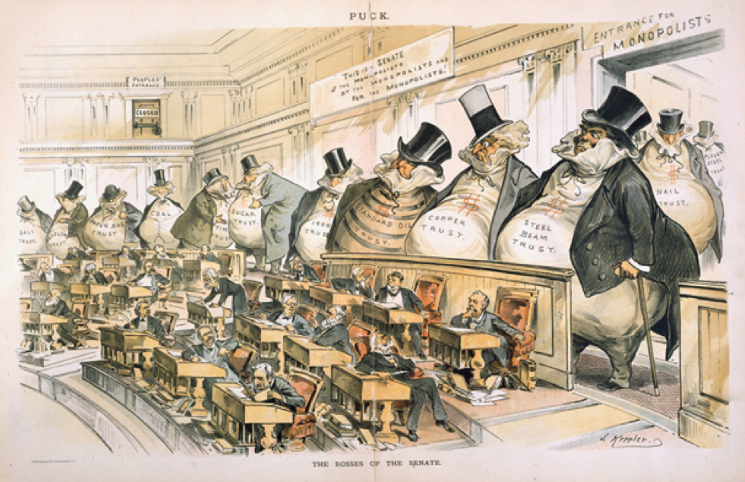
the bosses of the senate
1. What is the Historical Circumstance of this document?
Trusts became increasingly powerful in the late 19th century (The Gilded Age); Senators were elected by state legislatures then
2. Who is the Intended Audience of this document?
American public- PUCK Magazine - satirical magazine
3. What is the Point of View of the document?
The senate is filled with corruption, they are influenced by trusts
4. What is the Purpose of this document?
To critique the policy of electing senators, to expose the trouble with having senators NOT accountable to voters
“You come to us and tell us that the great cities are in favor of the gold standard. I tell you that the great cities rest upon these broad and fertile prairies. Burn down your cities and leave our farms, and your cities will spring up again as if by magic. But destroy our farms and the grass will grow in the streets of every city in the country….
Having behind us the commercial interests and the laboring interests and all the toiling masses, we shall answer their demands for a gold standard by saying to them, you shall not press down upon the brow of labor this crown of thorns. You shall not crucify mankind upon a cross of gold.”
- William Jennings Bryan, 1896
1. What is the Historical Circumstance of this document?
Panic of 1893 - worst panic to date; debates over leaving gold standard - Populists favored Free Silver, 16:1
2. Who is the Intended Audience of this document?
Democratic convention, AMerican people that support his view
3. What is the Point of View of the document?
Negative towards the Gold Standard and cities, positive towards farmers
4. What is the Purpose of this document?
To gain support for the introduction of Free Silver, influences the Democratic Party
 Note
Note  Flashcards (82)