migration, identity and sovereignty
 Call Kai
 Learn
Learn Practice Test
 Spaced Repetition
 Match
Match Flashcards
 Knowt Play
1/49

There's no tags or description
Looks like no tags are added yet.
Name | Mastery | Learn | Test | Matching | Spaced | Call with Kai |
|---|
No analytics yet
Send a link to your students to track their progress
50 Terms
core-periphery model
core is urban and periphery is rural
rural-urban migration of labour means that there are higher paying jobs and transport links in the core
periphery areas provide raw materials to core
investment in core leads to disparity and polarisation increasing which means that periphery areas become ghost towns with no schools or services, ageing population, leads to cycle of decline
backwash - flows of capital, labour and investment from periphery to core. leads to economic polarisation
global systems encourage core-periphery modek
rural areas - LIC - agribusinesses are run commercially on a large scale. uses chemicals and technology so less labour is required. leads to a seasonal economy and poverty traps unless rural to urban migration happens
export processing zones - investment from TNCs due to low/no tax, which leads to rural-urban migration
rural-urban migration in China
between 150-250 million Chinese have moved within china since 1975
net losers are central provinces whereas coastal, eastern areas are gainers
by 2020, 60% of population lived in cities
cheap labour force attracts FDI and so migration enabled economic growth
rural-urban migration in Spain
led to Celtiberian highlands have been abandoned
600 villages with less than 100 people and average age of 57
high rural unemployment led to young people migrating
schools have been shut and low birth rate means no recovery
international migration in EU Schengen area
in 1995, free movement of labour has led to migration from eastern and southern europe
allows labour to move where demand is
has led to a growth of nationalist movements and racism and hostility towards migrants has become more common
migration definition
movement of people across a specified boundary, national or international, to establish a new permanent place of residence. permanent migrants are defined by UN as lasting more than a year, any shorter is called circulatory movement
refugee definition
a protected legal status and under international law all countries have a duty to protect refugees. they have fled their country to escape conflict or persecution
42.5 million global refugees in June 2025
asylum seeker definition
a person who is seeking refuge status and international protection. however their claims have not yet bee evaluated and are still being processed
not all asylum seekers will be recognised as refugees. if they are not recognised then are considered illegal migrants as they don’t have a legitimate reason to stay
8.4 million asylum seekers in June 2025
complexities of migration
post-colonial migrants - people moving to the UK from former colonies
diaspora - small communities from world choosing to relocate in another place. share similar culture or are from the same ethnic background
main reason for migration is employment
other factors - poverty in their local area, lack of employment, low commodity, poor access to markets, internal political issues, democracy
26 million people were forced to leave their homes in 2020
migrants tend to be the richer people from their country (payment to traffickers can be between £1000-£3000 per journey)
in 2015, 20,000 people died as a result of unsafe boats
labour flows refer to economic migrants and:
families that join initial migrants, this eventually leads to extended family joining and so will lead to a community of people sharing culture
conflict could be gangs, political persecution, terrorist organisations e.g. Rohingya forced to leave Myanmar for religious reasons, 1 million people went to Bangladesh
European migrant crisis (2015-2019)
mainly from MENA (Middle East, North Africa)
2 million people tried to get into Europe by sea or overland through Turkey
in 2016, over 1 million arrived in boats
mainly arrive in Italy and Greece
lots of people from various country seeking to migrate for lots of reasons
issues with refugees
lack of documents to show status - no passports, IDs
political reasons - the EU official line is for asylum seekers to claim status in the first country but this was leading to resentment in Italy and Greece. so the EU decided to share the number of migrants (Germany took the highest number of 1.7 million)
ethical debate - in 2015 a Syrian refugee set of a bomb in Paris and so there was much discussion about whether passport checks needs to be re-instated across the Schengen area
schengen area
freedom of capital and labour flows understanding that people are economic assets and can choose to be hired by European businesses. this will lead to high economic growth.
use of social media
(whatsapp) station of the forced wanderers. 100,000 members. acted as a place to set up a journey/payment for migrants to travel to Europe.
core-periphery model - Friedmann
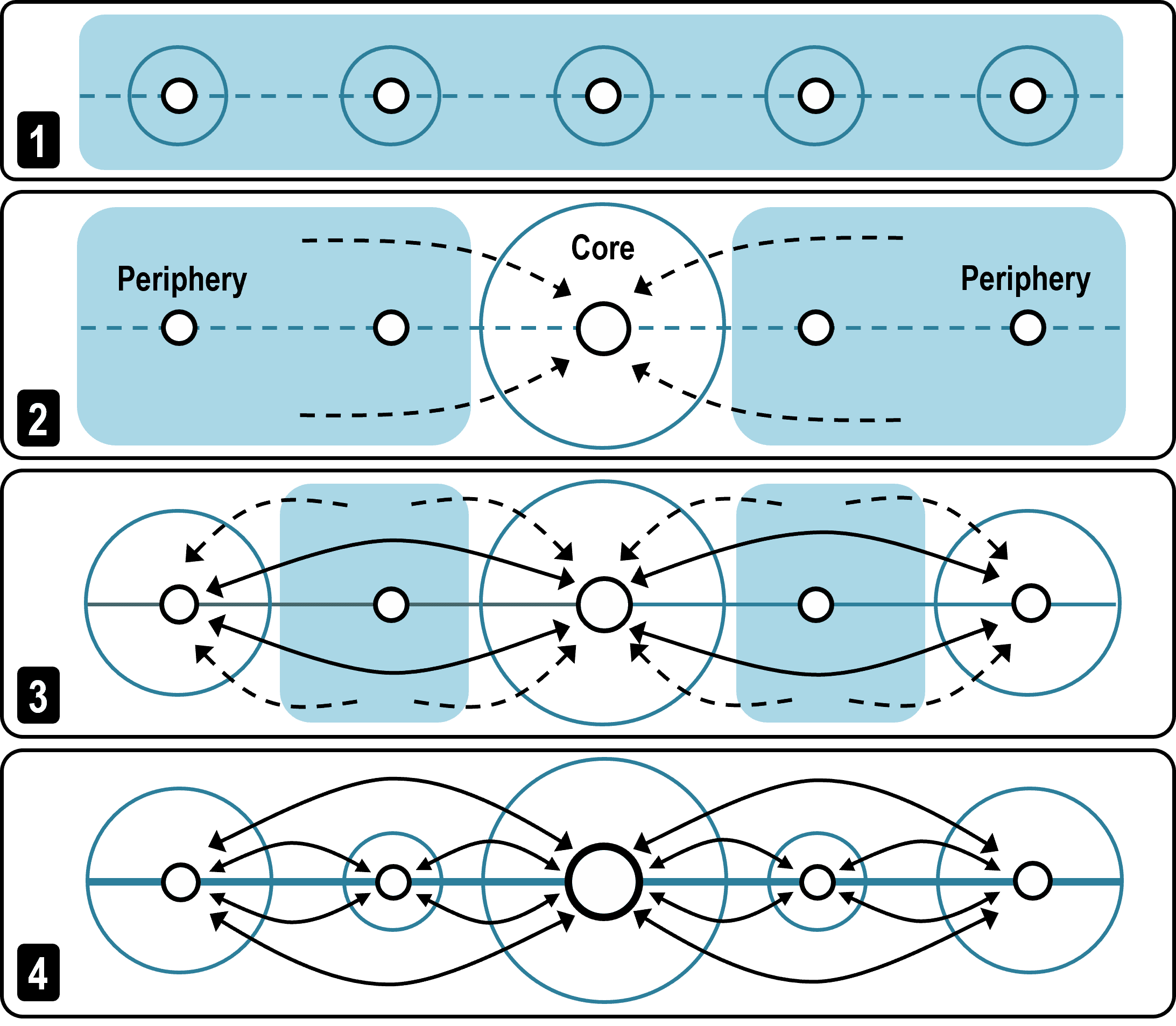
a strong economic core developed fuelled by the in-migration of people (workers and investors) from the peripheral regions of a state
in economic theory additional core regions form as part of the development process over time. the growth of these cores is fuelled by flows of raw materials and workers from neighbouring areas
trickle down effect - creation of wealth in other areas
negative externalities - people and the environment suffer from the core e.g pollution, depression, wealth disparity
the economic rational for permitting free movement of people
the core-periphery model of economic development depends on a process called backwash. migrants labour flows become focused on core regions at varying geographic scales. within the eu, this movement takes place at both the national and international level. the latter has been encouraged by the Schengen Agreement since 1985. the majority of the EU’s 27 members are now Schengen countries
migration is viewed by Neo-liberal economic theory as an efficient way of making sure that economic output of a territory is optimised
impacts of migration
migration has become a major issue for global community. it is being accelerated by technology, shrinking world, access to internet, political agreements to encourage freedom of movement, more available capital to migrate
the biggest challenge is managing migration in HICs due to the high number of people
migration can change a country due to ethnic and cultural reasons
French and Irish migrants are an example of cultural diversity
assimilation is people changing and adapting to the majority culture
Mexico - US migration
highly unequal spatial distribution
migrants are a vital part of the economy as migrants will work long hours with low pay. high unemployment
terrorist attacks has led to heightened security
youthful migration helps offset ageing population
cultural changes has influenced food, music and language
social and economic factors
social positive
creation of a multiethnic society increases understanding and tolerance of other cultures
there is less pressure on resources such as food and social services such as healthcare
influx of new or revitalised services
social negative
aspects of cultural identity are lost in second generations
increased pressure on services
segregated ethnic areas are created and schools can become dominated by migrant children
economic positive
migrants encourage language learning which can lead to international work
host country gains skilled labour
remittances can be sent home to improve education and health services
economic negative
loss of young workforce especially the skilled workers
loss of labour could lead to reduced investment
much of the money earned in host country is sent back as remittances
different stakeholders opinions
migrants keep NHS going as nurses/doctors
migrants do unwanted jobs
local children and parents no longer speak english
“country doesn’t feel English”
migrants can send remittances back to their families
North America
North America was home to a heterogenous mix of indigenous people. however today, 328 million people occupy the same territory. the majority are descendants of a global mix that includes Italians, Greeks, Scandinavians, Irish etc. American culture has become a melting pot that is broadly inclusive and dynamic as it welcomes migrants and modifies with each culture. this means that America lacks a definitive national identity
nation state definition
a nation state has sovereignty whereas a nation does not. sovereignty is the ability to self-govern. e.g. England, Scotland, Wales, and Northern Ireland are nations but make up the nation state of the UK
national borders definition
formed by natural landscapes like rivers or mountains e.g. pyrenees between France and Spain
the division of Africa
there are 54 countries but over 2000 ethnic group and over 3000 languages spoken.
14 countries had a conference in Berlin to divide up the continent.
at the time 80% was under indigenous control but was divided by geometric boundaries with no account for tribal or linguistic boundaries. African people had no say in the partitioning of their homelands
Rwanda
was run by Tutsi, Hutu and Twa people
Germany took control and the Belgium after ww1
Belgium favoured the Tutsi minority and created ethnicity cards to differentiate the Hutu majority
Hutus killed Tutsi after it gained independence
president of Rwanda was killed when their planes were shot down which led to genocide of 800,000, Hutus fled
Ukraine and Crimea
Crimea was part of Russian empire
Germany occupied for part of ww2 but when Russia got it back Stalin exiled the entire population of Crimean Tatars to Uzbekistan for collaborating with Germans
in 1954 Crimea was transferred to Ukraine
break up of USSR led to Crimean Tatars returning
Ukraine agreed to extend Russia’s lease on Sevastopol (a dock) for cheaper gas
in 2014 Russia seized control of Crimea who voted to join Russia. 850,000 Ukrainians fled Crimea
Taiwan
has been independent but china still claims sovereignty and regards it as a rebel provinces, insists that other nations should not have official formal relations
top producer of computer chips
female president, Tsai Ing-wen is pursuing sovereignty and formal independence but risks antagonising China
nationalism
the belief that the interests of your nation is more important than any other nation
colonialism and neo-colonialism
european powers exerting power and influence on other countries (1500-1900s)
neo-colonialism is global powers exerting power and influence on other nations through unfair trade deals and subjugation (keeping others down by forcing through necessities) e.g. Cost-Rica, Ecuador bananas and gold in Africa.
as well as cultural influence (McDonalds) through americanisation (ww1 onwards)
Zimbabwe used to be called Rhodesia named after Evil Rhodes, this is an example of Neo-colonialism
British empire
1/3 of land mass in world owned
¼ of global population
“vehicle of diffusion of British values, laws and culture”
generated wealth through extraction of resources from colonies
founded on communications - telegraph and under sea cables
strong navy created power and influence
many former colonies decided to be part of the commonwealth (trade/sport)
why did the colonial period end
after ww2 uk was bankrupt after fighting ww1/2 and was no longer a superpower. uk had little power and influence
growing resistance in old colonies e.g. Ghandi in India protested for independence which came in 1947
global shift meant raw materials were no longer needed for manufacturing so colonies were less important
French Revolution and other examples of nationalism
helped establish nationalism as a force across Europe removed the absolute power of the French monarchy and replaced it with a federal state ruled by the people with a new legal system
Theodor Herzl wrote the Der Judenstaat which was influential for the zionist movement
Simon Boliviar won independence for latin America
vietnam and disintegrating empires
was a French colony
vietnam, cambodia and Laos were known as French indochina
agricultural lands were converted to plantations for rubber, coffee, tea, rice and tabacco for exports to colonial powers
severe wealth inequality
gained independence in 1954 after French military was defeated
vietnam was split into the north with Vietnamese nationalists supported by communist china and the south who were independant non-communist support by US. war ensued and over 4 million people died. south was defeated in 1975
differences in ideology between communist north and independent non-communist south caused conflict
South Sudan and disintegrating colonies
at Berlin conference in 1884-5 Sudan was divided into northern and southern territories based on ethnic characteristics
Britain and Egypt modernised the mainly Arab north leaving the black African south to tribal communities
people in the south felt left out of Sudans development
Britains divide and rule policy pitted the sudanese people against each other rather than the colonial ruler
led to a 4 year civil war, one of Africa’s longest conflicts. tens of thousands have been forced to flee. food supplies were cut off which led to a famine affecting over 1 million people
Washington consensus
reduce national budgets deficits
redirect spending from politically popular areas toward neglected fields with high economic returns
reform the tax system
liberalise the financial sector with the goal of market determine interest rates
adopt a competitive single exchange rate
reduce trade restrictions
abolish barriers to foreign direct investment
privatise state owned enterprises
abolish policies that restrict competition
provide secure, affordable property rights
has led to government spending being reduced and as a result taxation is lower now compared their lack of financial regulations with low income tax and low corporation tax. this is designed to attract wealthy individuals and TNCs to register themselves in these tax havens.
reasons to/not to relocate to tax havens
part of a TNC relocates to reduce the tax bill
TNCs choose to domicile in tax havens to reduce tax bill
TNCs look at the rate and whether there is similar political system to origin country, level of development, conflict, locality of resources, laws and regulation, average labour costs and diplomatic relations/trust
brand authenticity, corporate responsibility, public perception and their current ability to declare profits in low-tax states
TNCs sometimes look to the national government for support during a financial crisis or when their overseas assets become threatened by conflict or nationalism e.g. Repsol assets were seized by Argentina
TNCs use the strategy of transfer pricing to reduce their tax burden. this involves routing profits through subsidiary companies owned by the parent company. these will be based in a low-tax state such as Ireland or possibly a tax haven like the Cayman Islands or Seychelles or Monaco. wealthy expatriates try to limit their personal tax liability by migrating to tax havens
examples of tax havens
ireland - accused of giving tax breaks, tax rates are 12% which could undermine Europe
French banks - 5 French banks have 16 branches in the Cayman Islands. 2014 profits were $45 million. discrepancy between profits and activity suggest abuse of tax haven
uk - control 1/3 of tax havens
IGOs
the League of Nations was established after ww1 however it failed to stop the expansionism of Japan and Germany in the 1930s and failed to prevent ww2.
after ww2 the UN was established to prevent violations of human rights. the tools include economic sanctions, arms/trade embargoes and freezing assets however they have no hard power methods
IMF and world bank promote Neo-liberalism and the Washington consensus. aims are to support post war reconstruction in developed countries and loan money for large development projects in developing nations. global interest rates rocketed in 1980s which made loan repayments unaffordable. as debt increased this prevented development and led to structural adjustment programmes with conditions being introduced
most countries are part of financial IGOs. WTO members accounted for 96.4% of world trade. however there has been an increase in regional trade blocs due to economies of scale and comparative advantage
water in Tanzania
water services had fallen into disrepair but were still delivering safe water to some of the poorest household
the world bank insisted that Tanzania should privatise their water services in exchange for a $140 million loan.
this meant that water bills were introduced and therefore the poorest households could not pay their bills and lost access to clean water. this meant girls began missing school to collect water
now countries often seek support from emerging superpowers like China and India
global commons
resources that are located outside of national borders which affect everyone on earth e.g. atmosphere, Antarctica, oceans, space
timeline of environmental protocols
1970 - first ever earth day which aims at raising awareness of and support for environmental protection
1972 - the creation of the UN environmental programme which is responsible for co-ordinating responses to environmental issues
1987 - montreal protocol which phased out CFCs and other chemicals that deplete the ozone layer. was the first global treaty to receive 197 signatories and to have achieved global ratification
1992 - riot earth summit, which produced the first framework on climate change and sustainability
1997 - kyoto protocol, which adopted legally binding goals to reduce greenhouse gas emissions
2015 - Paris agreement, which aims to limit global warming to below 2 degrees ideally below 1.5 above pre-industrial levels. wasn’t successful because countries could choose their own targets, weren’t legally bound and wouldn’t pay poorest countries
managing antarctica
1959 antarctic treaty system was signed by 54 nations which agreed to strict rules that meant its only to be used for scientific research, no military actions, no territorial claims and no exploitation of any resource until 2041
environmental policies
CITES - aims to ensure international trade in plants and animals does not threaten their survival. protects over 35,000 species. adopted by 181 countries. enforcement has not been strict enough and rising wealth in china, Indonesia and south Korea has increased illegal trade
water convention - aims to protect the quantity, quality and sustainable use of trans-boundary rivers by promoting co-operation. only 42 nations signed it and dams lead to over-exploitation of rivers and lakes
UNCLOS - signed by 157 countries defining the rights and responsibilities of nations in using oceans. aims to settle disputes and allow conservation however led to increased tensions
MEA - assess consequences of ecosystems changes and actions needed to conserve and use ecosystems sustainable by appraising them and the services they provide up to 1.5% of habitats are cleared annually. extinction rates 100x faster. a financial value is calculated for threatened biomes and species, thereby strengthening rationale for preservation. 70% of world’s known species risk extinction.
national borders
national borders are less significant as ideas spread across the world through news, media, investment.
prized uk assets are owned by foreign investors e.g. football teams
since 2016 there was a shift towards nationalism. concerns about the threats to our national identity. most familiar brands are owned by foreign investors e.g. Cadbury owned by Kraft since 2010
sovereign wealth fund
government gives funds to investors to invest in companies in other countries
china and qatar however this is controversial as governments may have agendas e.g. spyware in teslas
factors that reinforce national identity
education
symbols and flags
religion
institutions
music/art
history
political parties
sports
differences of national identity from early 20th century and 21st century
religious beliefs
20th - generally widespread with high levels of anglican or Catholic Church attendance
21st - largely secular but some minority faiths are prospering
food
20th - locally sourced seasonal food. native herbs preferred to foreign spices
21st - global varied tastes in food, strong spices are used widely in cooking
identity
20th - strong sense of local belonging, regional accents, patriotic, would fight for their country
21st - less willing to fight for their country. strong support for national sports teams
roots of vocabulary
20th - celtic, saxon, scandinavian, latin, greek, French
21st - additional Indian, Jamaican and American influences
how globalisation challenges national identity - westernisation and americanisation
soft power from TNCs as they sell their products and promote western values
they spread western values to improve market share and increase profits
most successful firms are experts and designing and advertising their products (apple, Disney will actively hire people from other cultures to boost their brand)
e.g. McDonalds has 37,000 restaurants in 100 countries. fast food sponsors sports evens and have connections to leading and popular tv programmes, e.g. friends, Minecraft
Disney parks are the americanisation of the American dream
apple products spend westernisation through social media showing western ideas, fashion and news
national identities can change through time and the actions of TNCs
how globalisation challenges national identity - property markets
2015 Russian rouble was dropping so oligarchs bought houses and flats in premium addresses in London as an investment. there was never an intention of living there, instead it was a business deal to make profits from an investment
brits invest in property in said, south France
cultural landscape - distinctive character of a place changes as migrants move in
ethnoscape - ethnic groups take a particular element of their culture and bring it to the place they relocated to e.g. Irish bars and pubs
consequences of disunity within nations and states
disunity - division that exists within states
nationalism - British nation - nation. Scottish nationalism - state
secession - an act of separation for part of a state to create a new independent nation
catalonia spain - in 1979 new democratic government of Spain granted autonomy and recognised it as a separate nationality but didn’t give independence. Catalonia held a referendum and 90% voted for independence. government in Madrid said this was illegal and did not allow independence
Scotland - in 2014 chose to remain in the UK. Scots resent the way their nation is controlled by English politicians
failed states
countries that have lost political control of their country and are unable to fulfil basic responsibilities
post colonial period led to a power vacuum which led to civil wars
Libya, Rwanda, Democratic Republic of Congo