Lab Quiz 2 Membrane Transport Mechanisms: Chemistry of Water
 Call Kai
 Learn
Learn Practice Test
 Spaced Repetition
 Match
Match Flashcards
 Knowt Play
1/27

There's no tags or description
Looks like no tags are added yet.
Name | Mastery | Learn | Test | Matching | Spaced | Call with Kai |
|---|
No analytics yet
Send a link to your students to track their progress
28 Terms
Which of the following would require an input of energy?
osmosis |
vesicular transport |
diffusion |
filtration |
vesicular transport
Active processes ________.
move fats and respiratory gases through cell membranes |
require a hydrostatic pressure gradient |
move substances against (up) a concentration and/or electrical gradient |
include osmosis |
move substances against (up) a concentration and/or electrical gradient
Which of the following is NOT a passive process?
filtration |
facilitated diffusion |
vesicular transport |
osmosis |
vesicular transport
When the solutes are evenly distributed throughout a solution, we say the solution has reached _______.
velocity |
equilibrium |
diffusion |
permeability |
equilibrium
Which of the following does NOT describe the plasma membrane?
semipermeable |
differentially permeable |
impermeable |
selectively permeable |
impermeable
Which of the following requires a membrane-bound carrier for transport?
simple diffusion |
facilitated diffusion |
osmosis |
filtration |
facilitated diffusion
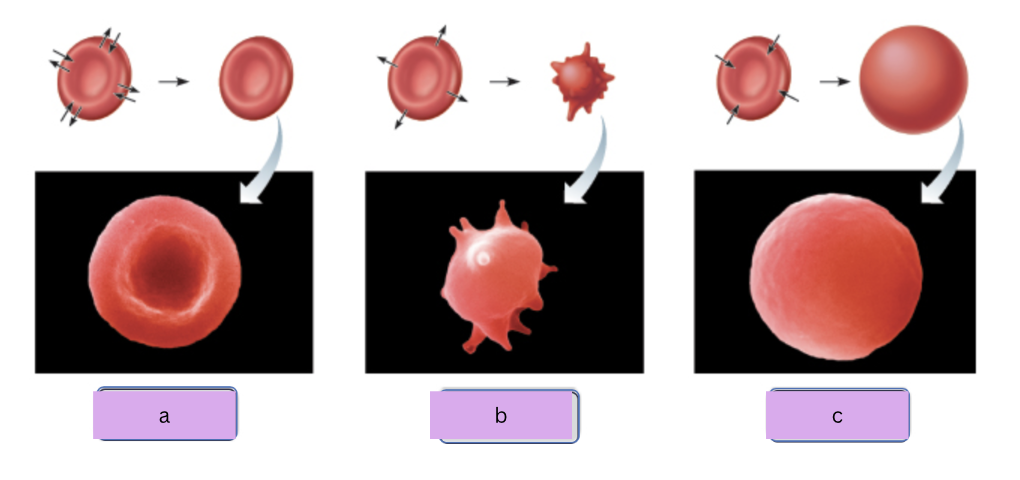
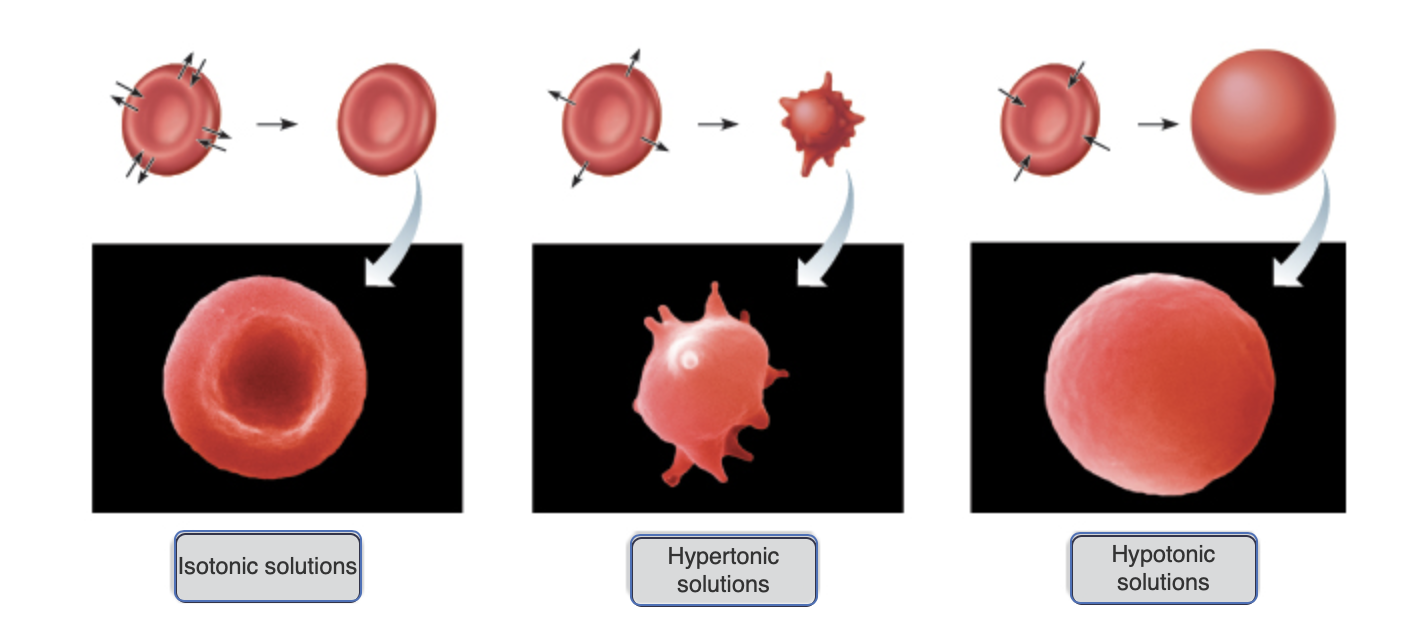
A solution that contains fewer solutes than the cell is ________ to the cell.
hypotonic |
isotonic |
hypertonic |
intravenous |
Ringer's lactate |
hypotonic
What part of the plasma membrane is hydrophobic?
phospholipid "heads" |
phospholipid "tails" |
sugar groups |
proteins |
phospholipid "tails"
In __________ processes, the cell provides energy in the form of ATP to power the transport process.
active |
passive |
active
Diffusion is the movement of solutes from an area of _____ concentration to an area of _____ concentration.
higher, lower
Diffusion and osmosis are ? processes.
passive
Osmosis is the movement of a solvent from an area of ? solute concentration to an area of ? solute concentration across a selectively permeable membrane.
lower, higher
Which of the following is true about the rate of diffusion through a selectively permeable membrane?
The size of the molecules has no effect on the rate of diffusion through the membrane. |
Larger molecules diffuse faster than smaller molecules through a membrane. |
Smaller molecules diffuse faster than larger molecules through a membrane. |
All molecules diffuse at the same rate through the membrane. |
Smaller molecules diffuse faster than larger molecules through a membrane.
Sort the following substances based upon their ability to diffuse across a typical dialysis membrane.
permeable
water
ion
glucose
impermeable
glycogen
protein
The following image shows a dialysis sac filled with a 40% glucose solution in a beaker of distilled water. Drag and drop the labels to predict the movement of the molecules, if any, across the dialysis membrane. Water molecules are in Group 1 and glucose molecules are in Group 2.
After the glucose and water have diffused across the dialysis membrane and reached equilibrium, the dialysis sac will be heavier compared to its initial weight because of the movement of water into the dialysis sac. Because of its smaller molecular weight, more water molecules than glucose molecules will be able to cross the sac during the course of the experiment.
What are two types of endocytosis?
cellular secretion and solute pumping |
active transport and phagocytosis |
solute pumping and active transport |
phagocytosis and pinocytosis |
pinocytosis and passive transport |
phagocytosis and pinocytosis
Drinking too much plain water in a short period of time can result in water intoxication. As a result, blood plasma will become hypotonic. What effect do you think this would have on blood cells?
Cells may be lysed. |
Cells will not change. |
Cells will be plasmolyzed. |
Cells will be crenated. |
Cells may be lysed. Hypotonic solutions have a higher water concentration than the cell, meaning water will move into the cell by osmosis. This will rupture the plasma membrane.
Two important passive processes for membrane transport are ________.
exocytosis and phagocytosis |
facilitated diffusion and active transport |
pinocytosis and receptor-mediated endocytosis |
diffusion and filtration |
diffusion and filtration
A cell is isotonic to the surrounding 4% dextrose solution. If the cell is moved to a 6% dextrose solution, predict how the cell responds.
The cell will bloat. |
The cell will shrink. |
The cell will not change in size or shape. |
The cell will rupture. |
The cell will lyse. |
The cell will shrink.
Which of the following statements about osmosis is FALSE?
Water moves toward the solution with the lowest concentration of solutes. |
It is specific for the movement of water. |
It is a type of diffusion. |
It is passive. |
Water moves toward the solution with the lowest concentration of solutes.
A Hypertonic solution:_______.
will induce cell swelling |
will induce no net movement of water |
will induce cell bursting |
will induce cell shrinkage |
will induce cell shrinkage
If a membrane is impermeable to solutes, which of the following is true?
Water and solutes will move until equilibrium is reached. |
Water will move toward the more concentrated solutes. |
Water will move away from the concentrated solutes. |
Osmosis will not occur. |
Water will move toward the more concentrated solutes.
Osmotic pressure is measured in units of _______.
mm Hg |
mM/min |
mM/sec |
ml/min |
mm Hg
A solution surrounding a cell is hypertonic if __________.
it contains more nonpenetrating solute particles than the interior of the cell |
it contains the same amount of nonpenetrating solute particles as the interior of the cell |
it contains fewer nonpenetrating solute particles than the interior of the cell |
it contains more non-penetrating solute particles than the interior of the cell
In comparing simple diffusion to facilitated diffusion, you note that ________.
both require a concentration gradient |
both require ATP |
both can move substances up, as well as down, a concentration gradient |
both require a specific carrier or protein channel |
both require a concentration gradient
A passive process, __________ is the movement of solute molecules from an area of greater concentration to an area of lesser concentration.
diffusion |
osmosis |
diffusion
A(n) ________ in molecular size and a(n) ________ in temperature result in an increased rate of diffusion.
decrease, decrease |
increase, increase |
decrease, increase |
increase, decrease |
decrease, increase
Explore top notes

