AGGRESSION Paper 3
 Studied by 0 people
 Call Kai
 Learn
Learn Practice Test
 Spaced Repetition
 Match
Match Flashcards
 Knowt Play
1/28

There's no tags or description
Looks like no tags are added yet.
Name | Mastery | Learn | Test | Matching | Spaced | Call with Kai |
|---|
No analytics yet
Send a link to your students to track their progress
29 Terms
1) What is the Limbic system? + What can overactivity or dysfunction lead to?
2) What is the Hippocampus' role in Aggression + What happens if its impaired?
1) Network of subcortical structures (like amygdala, hippocampus n hypothalamus) in the brain, involved w regulating emotional behaviour,
> Overactivity or dysfunction can result in exaggerated aggressive responses
2) Plays a crucial modulatory role. Provides contextual memory; helps determine whether an aggressive response is appropriate based on previous experiences stored in LTM.
> If impaired, individual cannot compare current situations with previous experiences, leading to inappropriate aggressive responses
3) What is the Amygdala's role
> What does it evaluate + What can increased Amygdala levels lead to
4) What is the Hypothalamus role
5) How do the subcortical structures interact w each other? (How people get angry, the steps)
3) Key for emotional processing; detects and responds to threat
> It evaluates the emotional significance of sensory input and triggers an appropriate, unconscious response. Increased Amygdala lvls = increased aggression
4) Regulates the Autonomic Nervous System (ANS), activating the sympathetic 'fight or flight' response that accompanies aggression
5) > Proactive stimuli (like someone ignoring you)
> Amygdala interprets this as threat and generates the emotional state of anger.
> Hippocampus recalls the context and can lower the threshold for an aggressive response.
> The Hypothalamus is activated, which orchestrates the physiological (ANS) and behavioural components of the aggressive act.
1) How is __________________ implicated in aggression
- Serotonin > What to normal lvls show, what do low lvls show
- Testosterone > What to normal lvls show, what do high lvls show
1) - Serotonin: NT has inhibitory effects in prefrontal cortex, slowing down neuronal activity.
> Normal lvls in prefrontal cortex = greater self-control + ability to regulate impulsive emotions
> Low lvls = less control of emotions + behaviours, as brains mechanisms for inhibiting them are weakened
- Testosterone: has an activational effect, can influence the sensitivity of neural circuits
> So high testosterone = more prone to act aggressively as when a threat is perceived neural response is heightened
Evaluations for Neural influences of Aggression (3 pros + counter 1 con)
+ Wong et al > Kulver-Bucy syndrome
+ Gospic
+ Objectivity
+ Wong et al; found using fMRI, criminals w/ violent tendencies had reduced connectivity between amygdala + prefrontal cortex, means their brains couldn't control their aggressive impulses
> Kulver-Bucy syndrome; taming effects found in Monkeys by destroying amygdala
+ Gospic et al; ppts subjected to mild provocation, when they acted aggressively fMRI scans showed heightened response in Amygdala
- Can be biologically reductionist, ignoring environmental and social influences
+ Supports psychology being a science, uses objective resources e.g. brain scans and controlled lab studies > increases validity of findings
COUNTER: Lab studies use artificial stimuli which lack eco validity
- Reductionist as ignore
Evaluations for Hormonal influences of Aggression (3 pros 1 con)
+ Berman [briefly eval; 2 con 1 pro]
+ Dabbs et al > Dabbs et al
+ Beeman [1 pro]
+ Berman et al; gave ppts either a placebo or a dose of a drug that enhances serotonin. Ppts then played lab game where shocks were given or given in response to provocation
> Serotonin group gave less shocks > implicating Sero in aggression
[+ lab so controlled, - small sample limits generalisability - artificial so lacks eco valid ]
- Hormonal explanations are reductionist, as they ignore the role of social, cognitive, and environmental factors in aggressive behaviour
+ Dabbs et al; measured testosterone in saliva of 690 male prisoners, found higher lvls in violent offenders > Dabbs found in 2 unis, frat members w high testosterone described as 'boisterous/macho'
+ Beeman; castrated mice, found aggressiveness reduced. Later injected them w/ testosterone which re-established aggressiveness > implicates Teste in agg [+ IRL app, castrating animals used to domesticate and make them more manageable]
1) What is the MAOA gene + its other name
> What does it do?
> What can a build up of NT's cause
> What causes aggression considering the MAOA gene
> What do people w MAOA have which desensitises the normal effects
1) MAOA gene ('Warrior gene') regulates enzyme MAO-A in the brain which breaks down excess neurotransmitters (e.g. Serotonin).
> A build up of NT's can cause people to be excessively aggressive
> Deficiency in the enzyme MAO-A is caused by the low activity variant, MAOA-L, this low activity variant linked to aggressive behaviour.
>> Ppl w MAOA gene have excess serotonin which makes brain desensitised to Serotonin, meaning Sero doesn't have normal calming effect
Evaluations for Genetic factors in Aggression (2 pros 1 con)
+ Coccaro et al > Waldman + counter
+ Brunner
- Caspi et al
+ Coccaro et al; Studied Male MZ and DZ twins. Found physical aggression concordance rates are 50% for MZ and 19% for DZ
> Waldman et al; similarities w adopted child and bio parent is 41%, similar to twin studies
COUNTER: 'equal environments assumption' made, DZ twins can be treated by others differently than MZ (e.g. parents praising MZ equally)
+ Brunner et al studied 28 men from large Dutch families who were involved w/ violent criminal behaviours. > These men had abnormally low lvls of enzyme MAO-A and the MAOA-L variant.
- Caspi et al; 1,000's of men and women in longitudinal (26 years) study > found that MAOA-L + maltreatment in childhood predicted later aggression, whereas MAOA-L w/o maltreatment did NOT lead to increased aggression. This interactionist evidence suggests aggression is polygenic and shaped by both genes and environment
1) What's an Ethological explanation
> What does this suggest the main func of aggression is? + Who observed this + what they found
2) What is ritualistic aggression
> What did Lorenz find (1st type of ritualistic behaviour)
> What else did he find at the end of aggressive encounters (2nd type)
>> Why is this adaptive?
1) An explanation that seeks to understand the innate behaviours of animals by studying them in their natural environments
> This explanation suggest the main function of aggression is adaptive, Lorenz observed intra-species aggression doesn't lead to serious injury, defeated animals are rarely killed but forced to established territory else where which ensures spread of a species, which reduces competition
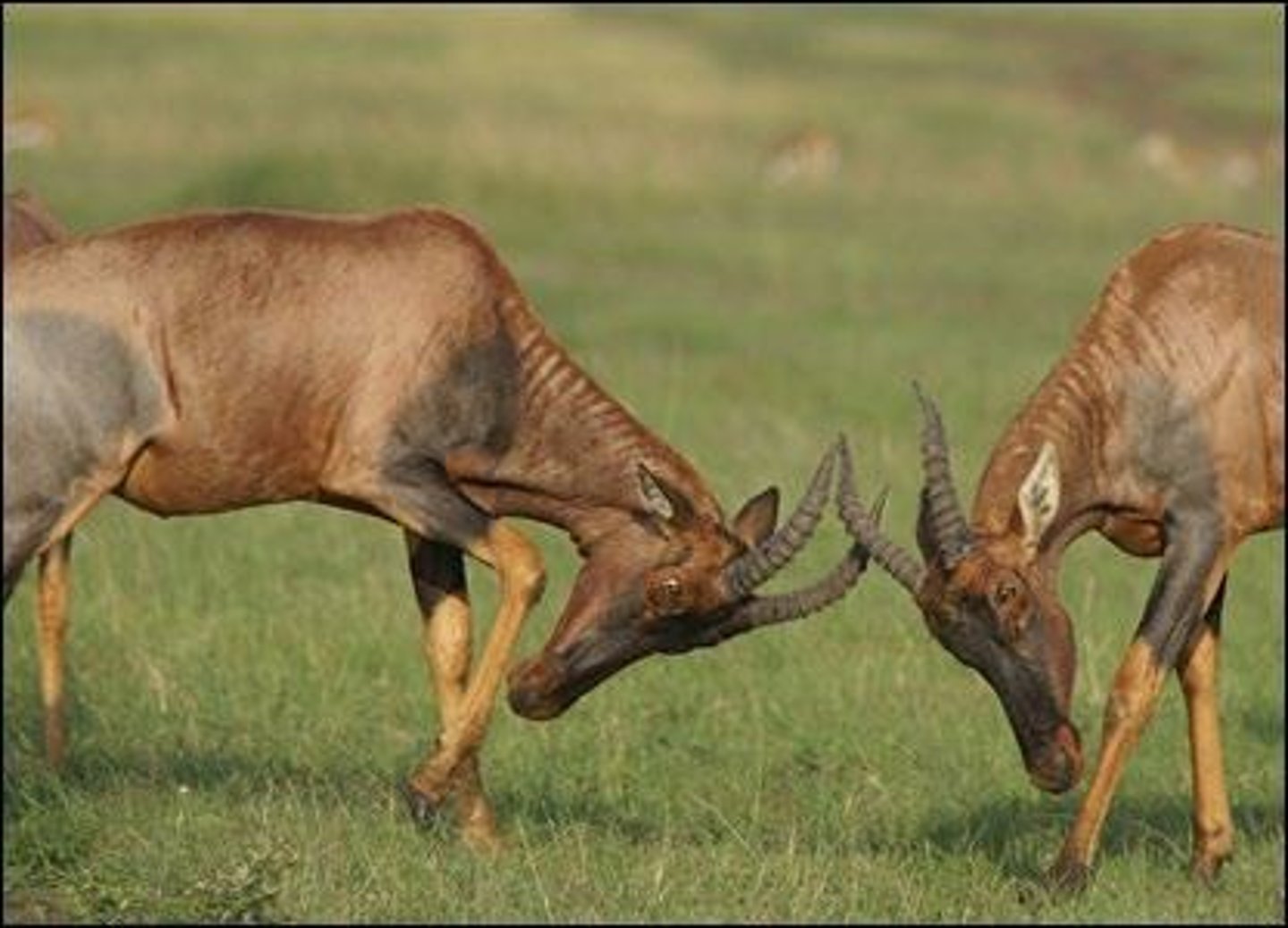
2) What is ritualistic aggression
> What did Lorenz find (1st type of ritualistic behaviour)
> What else did he find at the end of aggressive encounters (2nd type)
>> Why is this adaptive?
2) A series of behaviours carried out in a set order.
> Most aggressive encounters consisted of ritualistic Threat Displays e.g. displaying claws and threatening facial expressions
> Ritualistic Appeasement gestures, which indicate acceptance of defeat and inhibit aggressive behaviours, e.g. a wolf exposing it's neck to the victor
>> This is adaptive as if every aggressive encounter ended w the death of one of the combatants that could threaten the existence of the species.
1) What is an innate releasing mechanism (IRM) and fixed action patterns (FAP)?
2) What are the 6 main features of FAP according to Lea?
1) IRM is innate physiological process e.g. a network of neurons in brain.
> Once activated by a 'Sign stimuli' triggers IRM which releases a specific sequence of behaviours called FAP.
2) - Stereotyped; unchanging sequence of behaviours
- Universal; same behaviour found in every species
- Unaffected by learning; the same regardless of experience
- Ballistic; once triggered cannot be altered
- Single-purpose; behaviour only occurs in a specific situation
- Response to sign stimuli
Evaluation of Ethological explanations of aggression (2 pros 2 cons)
+ Pettit et al
+ Tinbergen
- Goodall; Gombe Chimp war
- Kungsan tribe > Draper
+ Pettit et al; aggression helped children achieve social dominance in playgrounds, supporting ethological explanations because it shows aggression can serve adaptive functions.
+ Tinbergen; found in Male Sticklebacks (who are highly territorial when another male enters their territory) when using a model fish that had a red spot the Stickleback would aggressively display and even attack it, the FAP were Universal and Ballistic
- Goodall's w/ Gombe Chimp War; 4yr war between 2 groups of Chimpanzees. One group (Kasakela) slaughtered members of another (Kahama).
> Violence was persistent even when other chimps showed appeasement gestures, conflicting w/ ethological explanations
- Kungsan tribe; young children when angry are ignored so they don't learn aggression = results
> Draper found Adults in the tribe had low lvl of aggression, shows aggression is learnt
1) What is aggression viewed as in evolutionary explanations
2) How can sexual competition cause aggression (evolutionary explanations)?
3) What is Intra-sexual, and what is Inter-sexual
1) Aggression viewed as survival which helped w gaining resources e.g. aggression needed to intimidate competition and to deter other males.
2) Ancestral males seeking females needed to be aggressive. The main motivation was status e.g. best hunter/fighter etc.
> Aggression was used to ward off rivals, evidence of sexual dimorphism between males n females show evidence of attractive features (which are distinction w/ male and female bodies)
3) Intra-sexual: within the SAME sex (M vs M or F vs F)
Inter-sexual: within different sexes (e.g. Male vs Female)
3) What is Mate retention?
> What does Shackelford et al suggest Mate retention behaviours are a result of?
> What are the two behaviours displayed w/ this? + give examples
4) What are the 2 behaviours that result from Mate retention
5) What are the benefits of Aggression w/ war?
3) Mate retention: ppl use aggression to keep their mate
> Result of "cuckoldry" which occurs when a woman deceives her partner in to investing in another males offspring.
>> cuckhold men loose investments and reproductive opportunity so to prevent spouse from cheating they use retention strategies.
4) - Guarding Behaviours; male vigilance on partners behaviour, e.g. keeping tabs on their whereabouts
- Negative Inducements; issuing threats of dire consequences for infidelity e.g. 'I'll kms if you leave me'
5) Allows for the gain of land/resources and power which helps attract mates.
> Bravery/ resources viewed as attractive and continued through natural selection
Evaluation for Evolutionary explanations for aggression
+ Wilson and Daly
+ Shackelford
- Feminist critics
- Hard determinisim
+ Wilson and Daly; women who reported mate retention strategies in their partners were 2x as likely to have suffered physical violence, 73% requiring medical assistance > supports mate retention behaviours implicit in aggression
+ Shackelford; showed direct guarding and negative inducements used by males in all relationships (homo or hetro) > suggests risk of cuckoldry are strong predictors
- Many feminist critics say it justifies male violence/aggression saying it's just adaptive presenting abusers as having no choice (can be socially sensitive) + Risks generalising all men as aggressive, some men won't want to seek help when experiencing DV due to how they are painted as aggressors
- Hard determinism view, suggests genes specify how we will behave fails to acknowledges genes only predispose but don't dictate what individuals choose to do
1) Who formulated the Frustration-aggression hypothesis + what is it?
> What does this create?
>> What does this remove + what is this called?
2) What 3 reasons does the F-A hypothesis recognise as why aggression is not always expressed directly against the source of frustration
1) Dollard et al formulated it; A theory that argues that anger, hostility and violence are always the outcome when we are prevented from achieving goals
> This creates an aggressive drive which leads to aggressive thoughts/behaviours which leads to a violent fantasy or outburst
>> This is removes negative emotion and is called Catharsis
2) 1. The cause of frustration may be abstract e.g. an economic situation
2. The cause may risk punishment e.g. a teacher giving a bad grade
3. The cause may be unavailable at the time e.g. the teacher left the room before you realised the grade achieved
Evaluate the Frustration-aggression hypothesis
+ Geen; University men given puzzles. 1 was impossible to solve; 2 they ran out of time; 3; confederate insulted the ppts. All ppts then had opportunity to give confederates shocks. All groups gave more intense shocks than non-frustrated group > supports F-A hypothesis
- Berkowitz; ppts were given electric shocks by a confederate creating anger and frustration. The ppts had opportunity to give fake shocks to confederate, the number of shocks was greater when there were 2 guns (average 6.07 Vs 4.67) > Suggests aggression is not caused by frustration alone; aggressive cues play part
- Bushman found ppts who vented their anger by repeatedly hitting a punching bag became more aggressive, whereas doing nothing was more effective in reducing aggression> shows Catharsis assumption if F-A hypothesis may not be valid
1) How did Bandura use SLT to explain aggression (w conditioning)
> How does observational learning account for aggressive behaviour + What is it called
> What is the opposite of this?
1) Through mechanisms like operant conditioning, a child who angrily snatches a toy off another child will learn that aggressive behaviour is rewarding
> Vicarious reinforcement is how observational learning occurs; a child observes behaviour of models and if their behaviour is rewarded the child learns that aggression can be effective in getting what they want
> Vicarious punishment, if models use of aggression is punished an observing child is less likely to imitate behaviour.
1) What did Bandura say the 4 cognitive conditions for learning were?
2) How is aggression maintained within a child?
1) Attention: observer must pay attention to models aggression
Retention: observer needs to recall the aggressive actions to form symbolic mental representation (SMR) of his behaviour is performed
Reproduction: observer must be able to transform SMR into physical action (involves individuals ability to do this)
Motivation: observer needs a reason to imitate behaviour which will depend on their expectations
2) Self-efficacy (the extent which we believe our actions will achieve a desired goal) increases for the child with every successful outcome
Evaluate SLT in expanding aggression
+ Bandura, Bobo doll exp; young children observed adult models assaulting a Bobo doll, they were then taken in to a different room w toys and a Bobo doll, w/o instruction they imitated the aggression of the adult physically and verbally
> In controlled environments so cause and effect can be suggested however lack ecological validity as was a doll >> COUNTER: Bandura brought a real clown and children still hit clown
+ Irl application; can promote more non-aggressive models to children to reduce aggression + explains implementation of thighs like Watershed
- Environmentally deterministic; ignores the possible biological explanation so doesn't provide a complete explanation of aggression
1) What is De-individualisation?
> What distinction does Zimbardo make?
>> What conditions promote aggression in the latter?
1) Psychological state where an individual looses their personal identity and adopts the identity of a social group when in large crowds (according to Le bon) or wearing a uniform
> A distinction is made between Individuated behaviour which is rational and normative and De - individuated behaviour which is impulsive and irrational
>> The conditions of de - individuation which promotes aggression is mainly anonymity (e.g. masks, uniforms, disguises) and drugs
1) What are the 2 types of self-awareness and how can the reduction of them lead to aggression?
1) Private self-awareness: how we pay attention to our own feelings and behaviour, REDUCED when part of a crowd, attention is focused outwards so we pay less attention to our own beliefs, leads to us being less thoughtful, promoting de-individuated state
Public self-awareness: how much we care about what others think, this is REDUCED in crowds as we are just one individual in a crowd so are anonymous + less likely to be judged so we become less accountable for aggression
Evaluate de-individuation as an explanation of aggression
+ Dodd
+ Douglas and McGarty, COUNTER: Gergen et al. 'deviance in dark'
- Downing et al
+ Dodd; 229 undergrads answered Q: "if you could do anything w assurance you wouldn't be detected what would you do?" > 36% of responses involved anti-social behaviour, 26% were actual criminal acts only 9% were pro-social things. Supports link between anonymity and de-individuation and aggression
+ Douglas and McGarty; found most aggressive messages online were sent by those who chose to hide their irl identities, supports link..
COUNTER: Gergen et al. 'deviance in dark'; 8 strangers placed in a dark room for an hour and told to do what they wanted + they would never meet each other started kissing and touching. Even in a second trial when told they would see each other at the end the kissed and touched but less > shows de-individuation doesn't always lead to aggression
- Downing et al; ppts wore Nurse uniforms, anonymity actually led to less aggression, not more > shows that situational cues and social norms may be more important than de-individuation itself.
1) What is the Importation Model of prison aggression?
2) What is the Deprivation Model of prison aggression?
> What can be factors of this + how do these lead to aggression?
1) A dispositional explanation; Prisoners import their criminal subculture, norms, attitudes from the outside. in to prisons. Aggression inside reflects their life before prison to gain power/status.
2) A situational explanation; Aggression is caused by the stressful, depriving conditions of the prison environment itself (loss of freedom, goods, autonomy, sexual intimacy). Unpredictable regimes increase frustration > violence becomes adaptive.
> Stressful conditions e.g. overcrowding, high temperatures, and lack of meaningful activity. These deprivations increase frustration and make violence an adaptive response
Evaluate the Importation (Dispositional) Model (1 pro 2 con)
+ Camp & Ganes
+ Camp & Ganes; Randomly allocated 561 male inmates to low/high security prisons. After 2 years, no significant diff in aggression rates (33% vs 36%). > support that inmate characteristics matter more than prison environment.
- DiIulio; Proposed Administrative Control Model (ACM) - poor leadership, unofficial rules, distant staff increase violence. > Suggests institutional factors are key
- Model is deterministic (aggression inevitable due to imported traits) Could lead to prisoners accepting aggression as it is innate and unchangble
Evaluate the Deprivation (Situational) Model (1 pro, 1 con).
+ Currington et al
+ Camp and Gaes
- Hensley et al
+ Currington et al; Analysis of 35 prison homicides found motives linked to deprivations (disputes over drugs, possessions, personal boundaries). Supports model
+ Camp & Gaes; Studied US prisons and found that prisoners in overcrowded or poorly managed facilities showed higher levels of violence than those in less stressful conditions > provides irl app which we can use to lower aggression in all institutions (e.g. schools)
- Hensley et al; no link between allowing conjugal visits (reducing deprivation) and reduced aggression. Contradicts a key prediction of the model.
1) How does Social Learning Theory (SLT) apply to media violence? (Bandura)
2) What is Desensitisation? (Define psychological + physiological effects of it)
3) What is Disinhibition?
4) What is Cognitive Priming? (Huesmann)
> How are these triggered
1) Bandura et al (Bobo doll film): Children who watched a film of an adult beating the doll imitated the aggression. Shows observation, imitation, and vicarious reinforcement operate via media models.
2) Reduced sensitivity to violence after repeated exposure.
- Physiological: Lowered arousal (heart rate, sweating).
- Psychological: Weaker negative attitudes, less empathy, seeing aggression as acceptable.
3) Loosening of social/moral restraints against aggression. Media can make aggression seem normative + justified (especially if rewarded and consequences minimised).
4) Violent media provides aggressive "scripts" stored in memory. These are automatically triggered (primed) by cues in real situations, making an aggressive response more likely.
1) How can general TV viewing influence aggression? (Robertson et al)
3) How strong is the effect of TV/film violence? (Jank & Comstock)
4) 2 Reasons why computer games have a STRONGER effect than TV/film?
1) Robertson et al (longitudinal): Time spent watching TV in childhood/adolescence predicted aggressive convictions by age 26. Link may be indirect via reduced social interaction + poorer education.
3) Jank & Comstock (meta-analysis): Found a positive correlation but estimated TV/film violence accounts for only 1-10% of the variance in child aggression > suggests a relatively minor role.
4) 1. Player takes an ACTIVE role (not passive).
2. Games are directly rewarding (operant conditioning - rewards for violence).
Evaluate research on violent COMPUTER GAMES (2 pros 1 con)
+ Bartholomew and Anderson + COUNTER
+ Anderson et al (meta analysis)
+ Bartholomew & Anderson (TCRTT study): Ppts who played Mortal Kombat gave louder white noise blasts than those playing a golf game. Shows a causal effect in a controlled lab setting.
COUNTER: unrealistic measures of aggression (white noise, fake shocks) which lack external validity - can't be generalised to real-world violence.
+ Anderson et al; meta-analysis, 136 studies. Violent game exposure increased aggression across all measures (behaviour, thoughts, feelings). Effect was stronger in higher-quality studies
- Many studies on violent video games use short-term lab experiments with children or adults performing tasks immediately after playing. NOT reflective of irl gaming (long-term effects)
Evaluate (3 pros 1 con)
> Desensitisation explanation (Krahé et al)
> Disinhibition explanation (Berkowitz and Alioto)
> Cognitive Priming (Fischer et al)
+ Krahé et al: Habitual violent media users showed lower physiological arousal to violent clips + gave louder unprovoked aggression. Demonstrates the desensitisation link.
+ Berkowitz & Alioto: Ppts who saw aggression as vengeance gave longer, stronger fake electric shocks. Shows justified violence removes inhibitions.
+ Fischer et al (song lyrics): Men who heard lyrics derogatory to women recalled more negative qualities about women + behaved more aggressively towards a female confederate. Shows priming by media cues.
- Studies linking TV/film violence to aggression (e.g., Robertson et al.) are mostly correlational.
Aggressive individuals may seek out violent media, rather than media causing aggression.
 Note
Note  Flashcards (35)