Fisheries management - introduction
 Studied by 0 people
 Call Kai
 Learn
Learn Practice Test
 Spaced Repetition
 Match
Match Flashcards
 Knowt Play
1/37

There's no tags or description
Looks like no tags are added yet.
Name | Mastery | Learn | Test | Matching | Spaced | Call with Kai |
|---|
No analytics yet
Send a link to your students to track their progress
38 Terms
what makes up fisheries management?
Data collection + analysis
Planning + making decisions/allocating resources
Forming + enforcing regulations
the body of fisheries management controls behaviors of the fishery’s ____________ with ______________ actions
stakeholders with management
the main goal of fisheries management is to ensure the continued productivity (_______________) of resources
sustainability
“fishery” as an activity
harvesting fish (wild capture or aquaculture)
“fishery” as a unit
a combination of people, species, location, fishing gear, boats, and purpose as determined by an authority that is engaged in raising or harvesting fish
“fishery” as a combination of fish and fishers
in the same region, fishing for the same species, using similar gear
a fisheries management authority is a body that makes decisions on how a fishery is operated, and is responsible for:
gathering and assessing statistics, monitoring, consulting with fishers/stakeholders, allocating resources, and regulating access
primary fisheries management authorities
NOAA (US)
Fisheries and Oceans Canada (Canada)
ICCAT (international tuna mgmt)
fisheries management authority in VA
Marine Resources Commission
“fish stock” can describe…
a species or a population
“fish stock” as a discrete unit
an individual, self-sustaining population isolated from other stocks
stock assessment
scientific evaluation on the state of a resource (eg fish stock abundance) that can be simple or complex, but is usually very expensive
3 main factors in a stock assessment
stock size, potential yield, and exploitation status (over/under)
why are stock assessments usually performed?
to advise a management authority
biological objectives of fisheries management
conservation, stock rebuilding, protect rare species (and their ecosystem services)
economic objectives of fisheries management
maximize income/profits, minimize variability in income and catch, and lower prices
social objectives of fisheries management
provide food security, maximize employment, provide recreational value, support well being
political objectives of fisheries management
increase government income (taxes) and maintain consensus (votes from fishers)
how do managers reach objectives?
they set clear and measurable goals (sales, production, employment)
indicators
quantitative variables used to monitor success of objectives
targets
specific values managers want to indicators to be (MSY)
a management strategy (blueprint) includes
harvest strategies and rules to control it
a management strategy dictates
monitoring plan/setup, management actions, enforcement
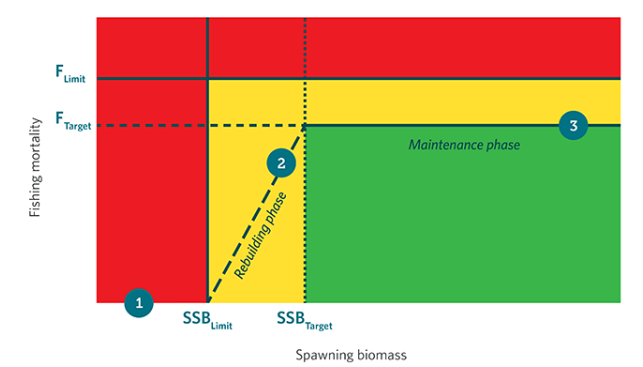
what do managers do if SSB is below SSBlimit
suspend the fishery and institute a scientific monitoring quota until the limit is reached/exceeded
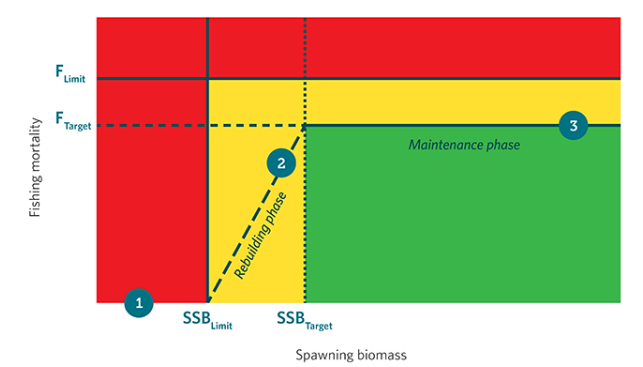
what do managers do if SSB is between SSBlimit and SSBtarget
reduce fishing mortality (rebuilding phase)
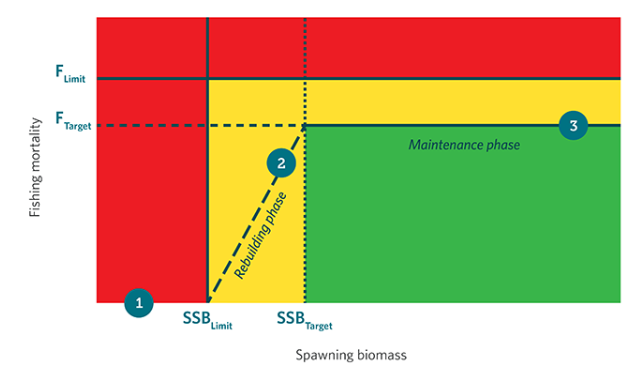
what do managers do if SSB is greater than/equal to SSBtarget
fish at target mortality rate Ftarget
HCR
Harvest Control Rule — dictates how to maintain a sustainable fishery
regulations imposed on a fishery to implement a management strategy to control fishing mortality when stock size gets too low include:
input — effort control (number of boats)
output — catch control (total allowable catch)
technical measures (mesh size, closure of fishery, seasonal closure to support reproduction)
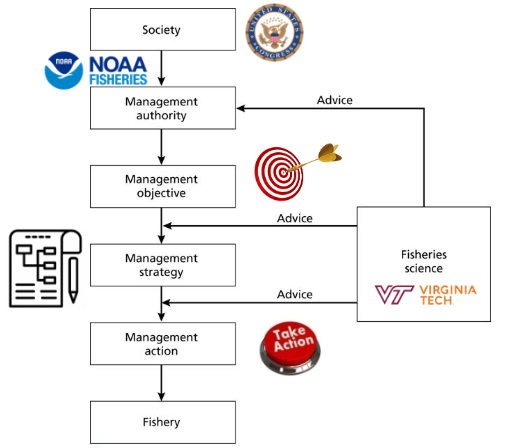
the fisheries management cycle
society/politics set objectives
managers define strategy
scientists advise managers
phases of fisheries history
aboriginal phase: low exploitation (fishing for personal food)
colonial phase: systematic exploitation (trading fish)
industrialization: higher connectivity to transport products, seafood distribution capacity with tin cans, and demand for fertilizer
global period: intense and global exploitation leading to exhaustion and crashes of fisheries
historical pattern of exploitation (without management)
boom and bust:
development → fully exploited → overexploited → collapse → recovery
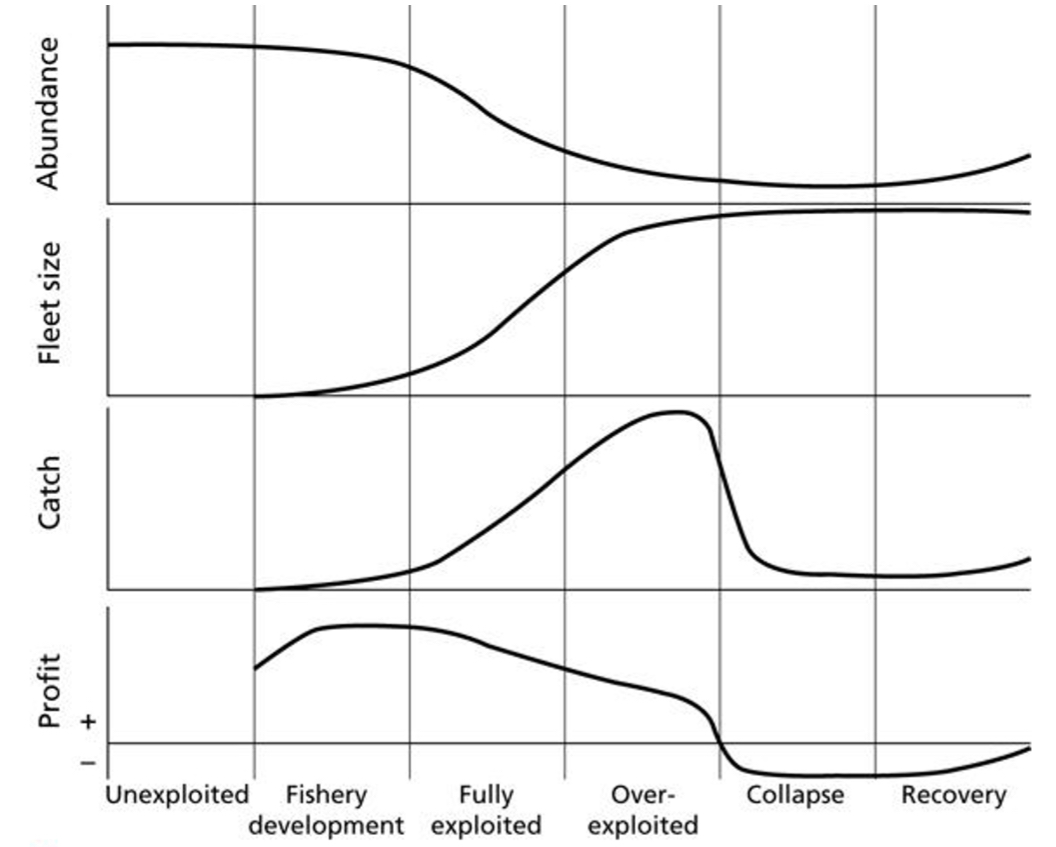
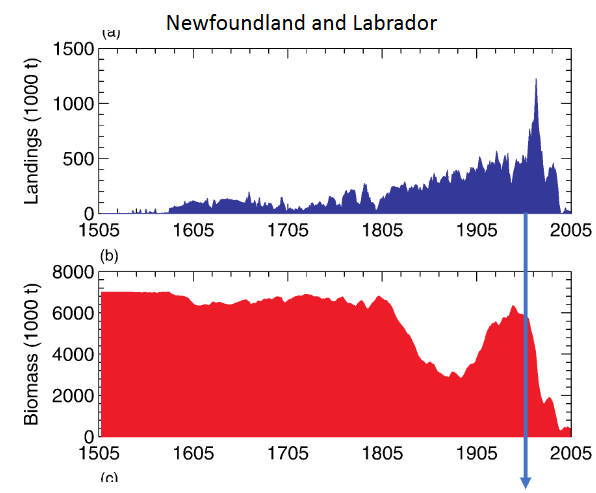
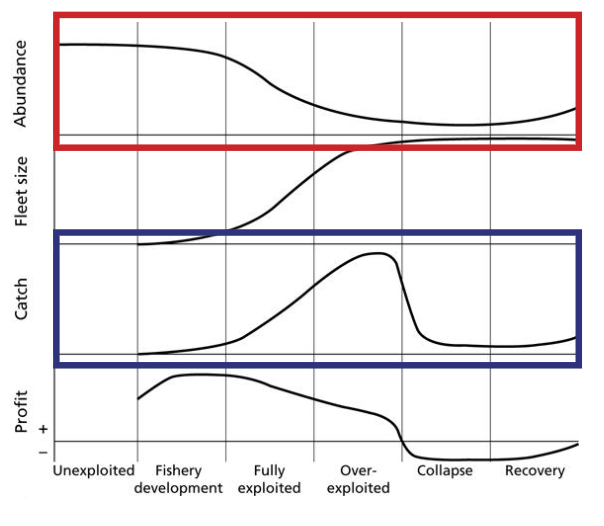
how did the abundance and catch size of Northern Cod respond to the increase in fishing mortality from the aboriginal to global phase of fishing?
Abundance decreased then recovered during the industrial phase, but crashed during the global period when the fishery collapsed.
Catch peaked as the fishery was over-exploited but crashed when it collapsed.
fishery science in the mid 19th century
some concern about the variability of populations and catch size
fishery science in the late 19th century
declared stocks inexhaustible and problems were left unexplained, but declines were evident to fishers
fishery science in the early 20th century
progress in understanding recruitment and predicting catch
fishery science WW1-70s
experiments on impact of fishing on stocks and development of fisheries models to recover populations
fishery science in the late 20th century
Internation cooperation in research and management, but predictive models were uncertain and fisheries collapsed. The science became more interdisciplinary (multiple different objectives)
fishery science in the 21st century
increase of conservation and ecology; focus more on the system as a whole instead of individual species
 Note
Note  Flashcards (74)