Business Edexcel GCSE Theme 2.3-2.5
 Call Kai
 Learn
Learn Practice Test
 Spaced Repetition
 Match
Match Flashcards
 Knowt Play
1/166

There's no tags or description
Looks like no tags are added yet.
Name | Mastery | Learn | Test | Matching | Spaced | Call with Kai |
|---|
No analytics yet
Send a link to your students to track their progress
167 Terms
What are the impacts of different types of production processes (job, batch & flow)?
•Productivity
•Costs
•Prices
How do the production processes have impacts on productivity?
- different production processes cause productivity to increase or decrease.
How can businesses aim to increase productivity?
•Recruit appropriate staff: who are motivated to work hard, as they enjoy their role
•Invest in training: staff who are more competent in their job will work quicker and are less likely to make mistakes
•Improve working practices: new ways of working can result in workers becoming more efficient when they complete tasks.
•Invest in new machinery/technology: machines may replace workers on production lines/new tech can help staff complete their roles more efficiently. Any investment in technology/machinery will have a negative impact on costs in the short term, but may prove to be cost effective in the long run.
•The use of appropriate financial and non-financial methods of motivation: may encourage staff to work harder as they feel their roles are interesting and they're being rewarded appropriately by a business.
How do the production processes have impacts on costs?
•Businesses will aim to keep costs to a minimum, as this will impact positively on profits. Minimising costs of raw materials and stock, as well as carefully controlling salaries and other costs, will help to ensure that a business operates efficiently.
- if a business is more efficient in its production process, its average cost is low. If a firm has a high average unit cost, this means they're more inefficient.
- when productivity is high, the average cost is lower & the productivity is affected by production processes
How do the production processes have impacts on prices ?
•Business will have more flexibility to lower its prices and compete more effectively with rivals if it has high levels of productivity and low unit costs. Alternatively in this situation, a business may choose to charge the same price as its competitors, as it will benefit from a higher profit margin on each item sold because of the lower unit costs.
What are the impacts of technology on production?
•Cost:tech is expensive. Businesses must consider whether it's worth investing in tech or whether a new piece of tech is likely to be developed which may prove to be a better investment in the future. Businesses must also think abt whether tech is likely to be used to its full potential or left idle for a period of time
•Productivity:use of tech & machinery in production can result in large volumes of stock being produced & cost efficiently which can reduce the cost of making each product. This gives a business the opportunity to charge lower prices or make higher profits. Machines & tech don't need to take breaks or holidays which can also increase output. However, machinery will need to be regularly serviced to reduce risk of it breaking down in future.
•Quality:tech & use of machinery can help ensure that a consistent standard of quality can be delivered to customers every time as machinery & tech will not experience human error.
•Flexibility:use of machinery & tech may result in some inflexibility. However, advancements in these areas has resulted in the ability for tech/machinery to be programmed so that many of the specific requirements of customers can be met successfully
What is stock management?
•The process of managing the goods a business uses for production or sales
•Overall objective of stock management is to make sure that a business has the right quantity of stock available at the right time & at the right quality.
What different types & quantities does stock include?
•Raw materials or component parts: bought into a business in order to make a product
•Part finished products: that are being made on the production line.
•Finished goods: which are ready to be sold to customers.
What decisions do businesses make when regarding how much stock to hold?
•Holding too much stock can result in businesses having to reduce prices to sell unwanted stock to free up space in a warehouse or on a sales floor
•Holding too little stock can result in missed sales.
•(A balance must be made between the cost of holding stock & ensuring enough stock is available to satisfy customer demand)
What are the key terms linked to bar gate stock graph?
•Maximum stock level
•Buffer stock level
•Re-order level
•Lead time
What is the maximum stock level?
•The max level of stock a business can or wishes to hold. This level may be based on the amount of space that is available to hold stock, how easy it is for the business to gain additional stock from suppliers when needed & the type of good that is sold.A business that sells products with a short shelf life will not want to hold too much stock, as there's danger that it may become out of date & need to be thrown away if not sold.
What is buffer stock level?
•Minimum stock level
•The lowest amount of stock that the business will hold. It is a safety net in case there is a surge in demand
What is the re-order level?
•The level at which new stock should be ordered by the business
What is lead time?
•Time interval between ordering and receiving the order. Lead time determines when an order must be placed so that it arrives in time to prevent the stock level falling below the minimum stock level. If a supplier is based overseas, the lead time will be longer than if a supplier was based in the UK.
What is (JIT) stock control?
A method of stock control by which a small quantity of new stock is scheduled to arrive just as old stock runs out, minimising waste
What are the advantages of JIT stock control?
•Lower costs of storing, insuring & managing stock.
•Cash isn't tied up in stock & is available to use elsewhere in the business
•Stock is less likely to be damaged or stolen
•Stock will not become out of date or obsolete.
What are the disadvantages of JIT stock control?
•Late deliveries result in production schedule being delayed.
•Lack of flexibility to meet unexpected orders to correct mistakes on the production line
•More deliveries have a negative impact on costs & the environment.
•Increased administration costs from processing & organising a large number of deliveries.
•Businesses may not be able able to benefit from any discounts given from suppliers for buying in bulk.
What is a supplier?
•A supplier is a business that provides raw materials, component parts, finished goods or services to another business in return for payment.
What is procurement?
•The process by which suppliers are chosen.
•This includes deciding the stock that's needed & how its ordered, as well as the process of receiving & managing the goods arrival for a price that's fair to both the business & the supplier.
Why is having the right suppliers essential to business?
•A failure to procurement can lead to a failure of a business, as the right amount & quality of stock will not be available to run the business successfully. This will impact on the reputation of the firm & the level of customer service provided, as well as the costs.
What are the 5 factors that affect the relationship between a business & its suppliers & the efficient procurement of stock?
•Quality
•Delivery
•Availability
•Cost
•Trust
How does quality affect the relationship between a business & its supplier?
•Quality: businesses must balance quality & pricing decisions when choosing suppliers. Businesses require suppliers to provide consistent quality in the products they supply.
How does delivery affect the relationship between a business and its supplier?
•Delivery: having stock arrive when it is expected is very important for all businesses but particularly those that operate a JIT method of stock control. If supplier is unreliable, it will affect ability of business to supply products to its own customers.
->Speed of delivery: suppliers located near to their customers will have a shorter lead time & will be able to respond more quickly to last minute orders.
->Costs of transportation: will be lower if suppliers are located near to their customers.
How does availability affect the relationship between a business & its supplier?
•Availability: suppliers must be able to deliver stocks at the right time, in the right quantities & at the right quality. If demand is unpredictable & more stock is needed, suppliers should have the spare capacity to cope with rush orders successfully.
How does cost affect the relationship between a business & its supplier?
•Cost: every business will have a budget to work within in terms of how much they can spend on supplies. Cheaper prices from suppliers will result in a business having lower costs, which may enable lower prices to be passed onto customers. However, lower prices may have a knock on effect on quality.
How does trust affect the relationship between a business & its suppliers?
•Trust: businesses should try & maintain a strong, positive relationship with their suppliers, built on openness & trust. If trust exists, suppliers are more likely to offer businesses trade credit & prioritise any last minute orders that are required. Suppliers should be able to trust business that they will make payments on time.
What is logistics?
•Logistics involves moving goods & services from one part of a supply chain to another.
•A supply chain includes all the businesses that are involved in producing a good or supplying a service from the start of the production process to selling the product to the final customer.
Why is effectively managing the logistics process vital for a business to be successful?
•As the right supplies will be ordered & delivered to the right place on time.
What can effectively managing the logistics lead to?
•Lower unit costs: staff won't be idle as products will be available to use in the production process or sell directly on to customers. Successfully negotiating supplier contracts can reduce costs if favourable prices can be agreed & positive supplier relationships maintained.
•Reputation: businesses will have a reputation of always having stock available when needed which will positively impact sales & their brand image.
•Customer satisfaction :a supplier that is reliable could be more expensive than another supplier. However, knowing that a suppler is reliable will ensure that customers are happy as stock will arrive when expected. This will encourage brand loyalty, repeat business & new customers to try the business due to positive recommendations.
What is quality?
•Quality can be defined as meeting the needs & expectations of customers.
•Businesses can set quality targets to ensure that customer expectations are met.
What is quality control?
•Quality control is one method of managing quality. It is where all products or a sample of products are checked at the end of the production line by trained inspectors to ensure that they meet the correct quality standards.
What are the advantages of quality control?
•Trained inspectors complete the quality checks
•Production line workers do not have added work of monitoring quality standards.
•100% quality checks will result in faulty products not reaching the customer.
What are the disadvantages of quality control?
•Large amounts of waste can be generated as products aren't checked until they are completed.
•Some faulty products may reach the customer, unless all products are checked.
• Does not encourage workers to be responsible for quality.
•Increased costs of paying the salaries of quality inspectors.
What is quality assurance?
•Quality assurance is one method of managing quality. Quality assurance aims to develop a quality culture throughout an organisation through workers being responsible from checking the level of quality of their own at each stage of production.
What are the advantages of quality assurance?
•Any quality problems can be sorted out quickly & efficiently
•Focuses on the prevention of quality issues rather than the detection, as with quality control
•Staff may be more engaged with their job role & develop ideas for improvement.
•Costs can be reduced, as there is less wastage and/or reworking of products.
What are the disadvantages of quality assurance?
•Staff training and a skilled workforce is required so labour costs may be increased
•Staff must be engaged with the process for it to be successful.
•Staff may feel more pressure in their role which may be demotivational.
•Reworking may lengthen the production process
What are the benefits of a business consistently producing high quality products?
•Less errors & waste: this will reduce costs, as staff will not be repeating work already carried out, less is being thrown away & there will be less time & resource sorting out complaints or problems if faulty products are returned.
•Lower wage bill:if quality is built into the business operation, there will be no need to pay additional staff to manage quality.
•Additional sales:a reputation for excellent quality can be gained which will encourage customers to return & recommend the business to others.
•Improved image and reputation: a business may be percieved as reliable, as customers will recieve consistent experiences each time: this will increase brand loyalty
•Easier to launch new products: the strong reputation of the business will encourage customers to try new products that are from the same brand.
•Higher prices can be charges: as customers will trust the brand & its products.
•Retailers may not be more willing to stock products: this will make it easier for a business to access its target market which may increase sales.
•Easier to attract & retain new staff: new employees will be keen to work for a business that has a reputation for producing high quality products.
•ALL OF THESE ADVANTAGES MAY RESULT IN A BUSINESS GAINING A COMPETITIVE ADVANTAGE
What is the sales process?
•The sales process includes all the stages before, during & after a purchase is made.
What are the stages of the sales process?
•Product knowledge
•Speed & efficiency of service
•Customer engagement
•Responses to customer feedback
•Post-sales services
What is product knowledge?
•Employees must be trained to have strong knowledge of the features & benefits of the products a business sells in order to inspire & give confidence to customers to make a purchase. Information on packaging, signage in store & details on websites must be accurate & clear so customers are able to make informed choices when choosing between different products.
What is the speed & efficiency of service?
•Customers expect to be served quickly, products to be delivered when expected & any problems resolved in an appropriate way by the business.
What is customer engagement?
•Businesses should aim to build positive relationships through staff being polite & genuinely interested in meeting customer needs, as well as websites being easy to navigate & use. The use of email & the popularity of social media allows businesses to engage regularly with their customers.
What is responses to customer feedback in the sales process?
•Customer feedback can be gained verbally, through customer service surveys & mystery shoppers. The increased use of social media, as well as the option to leave a review for a product bought online, means that customer feedback is very public. It's vital that businesses respond in a positive way to customer feedback.
What are post-sales service?
•Showing customers how to use products will help a business gain a good reputation & encourage repeat business. A business that provides guarantees, warranties & help lines to assist customers if products ae not working properly is also likely to gain positive reviews.
What are businesses likely to see an increase in when providing good customer services?
•Customer satisfaction: customers will be happy with the purchase(s) they've made & may recommend the businesses to other which will increase sales & market share.
•Customer loyalty: customers are more likely to return & repeat buy the products of a business if hey prove to be reliable & meet their expectations, as customers will trust the products & value the brand
•Spend: returning customers may be tempted to buy other products from the same business.
•Their ability to differentiate themselves from rivals: good customer service may act as a unique selling point & a way to differentiate one business from another. This can give a business a competitive advantage.
•Profitability:if customer service is good, there'll be less costs associated with resolving customer service queries, dealing with complaints & processing refunds. This will increase profits. Business may gain god reputation for providing good customer service, which will attract more applicants if a job vacancy arises & help a business retain its staff. This will increase productivity which will lower unit costs & together with the increase in sales, through having a strong reputation for customer service in the market, will lead to higher profits.
What is gross profit?
•The profit that the business makes after the direct costs of production or supplying the services of a business, otherwise known as cost of sales, are deducted from the sales revenue.
•Gross profit= sales revenue-cost of sales
What is net profit?
•Net profit is a key measure of business performance and is the value of profit the business makes after other operating expenses & interest are deducted from gross profit
•Net profit= gross profit-other operating expenses & interest
What is gross profit margin?
•A measure of a firm's profitability by looking at the relationship between gross profit and sales revenue.
How do you calculate gross profit margin?

How can businesses improve gross profit margin?
•Change the price: if the selling price can be raised without demand falling significantly, the business may be able to generate more sales revenue from the same amount or a slightly lower sales volume; equally, a business may be able to lower the selling price which may increase demand at a greater rate than the fall in price. This will result in an increase in sales revenue.
•Negotiate cheaper prices with suppliers or change suppliers: this will lower the cost of sales figure; as long as there's no difference in terms of quality, the change shouldn't negatively impact sales revenue.
How do u calculate net profit margin?

How do businesses improve net profit margin?
•Increase its gross profit: this can be achieved through increasing sales revenue and/or reducing the cost of sales
•Lower its operating expenses: a review of the operating expenses of the business can take place to determine whether any can be reduced.
What is average rate of return?
•Looks at the total accounting return for a project to see if it meets the target return
•Calculating the average rate of return will help managers make investment decisions.

What is market data?
•Market data includes a business's internal data, such as data on sales figures, market spend & primary market research
•Market data is generally available through secondary market research & includes population information, such as age distribution, income levels & employment & unemployment info, as well as whether a specific market is growing or in decline.

What is a limitation of market research data?
Market research data may be biased; for example, a sample size may be too small and therefore unrepresentative of the whole population, leading to incorrect decisions.
What is a limitation of financial forecasts like break-even and cash flow forecasting?
The further ahead the business looks, the more uncertain the figures will be, raising questions about their realism.
Why might some financial data be unhelpful in decision making?
Some financial data may be out of date, making it not useful for current decision making.
Why is it important to compare financial data to previous figures or competitors?
Comparisons help understand business performance; looking at one figure in isolation makes it difficult to identify trends.
What skill must managers have to effectively use data in decision making?
Managers must have the right skills to analyze data; having lots of data does not guarantee correct decisions.
What is the organisational structure?
• A level of management and division of responsibilities within an organisation (it will show who each employee reports to, who reports to them & their responsibilities)
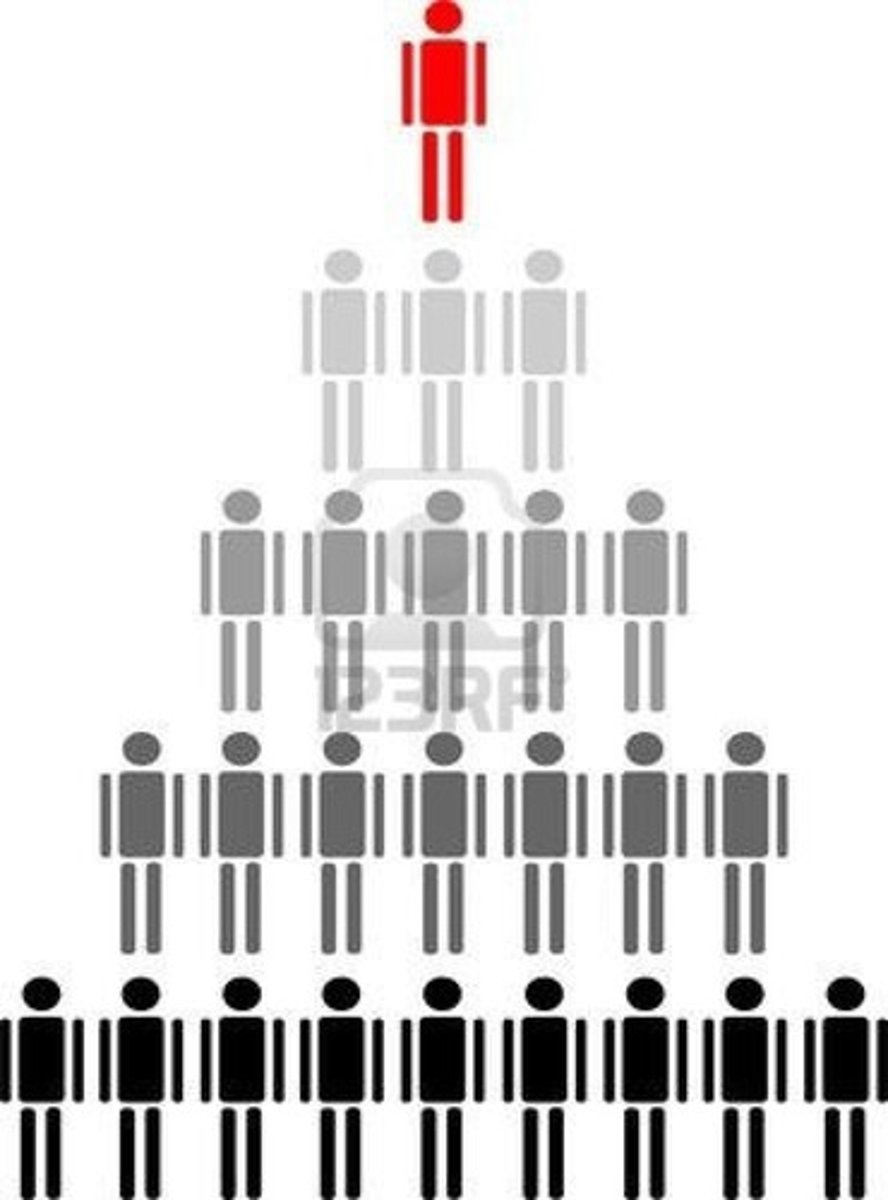
What is the structure of the hierarchical organisational structure?
Within a tall, hierarchical structure there'll be:
•A long chain of command
•Narrow spans of control
What are the advantages of a hierarchical organisational structure?
•More promotional opportunities
•Fewer staff at each level means that communication between a line manager & his/her subordinates will be easier.
•Managers are able to manage their subordinates work easily due to narrow spans of control
What are the disadvantages of hierarchical organisational structure?
•Communication between the top of the organisation & the bottom may be difficult
•Decision making may be slow
•Lack of flexibility
•Increased costs of paying management salaries.
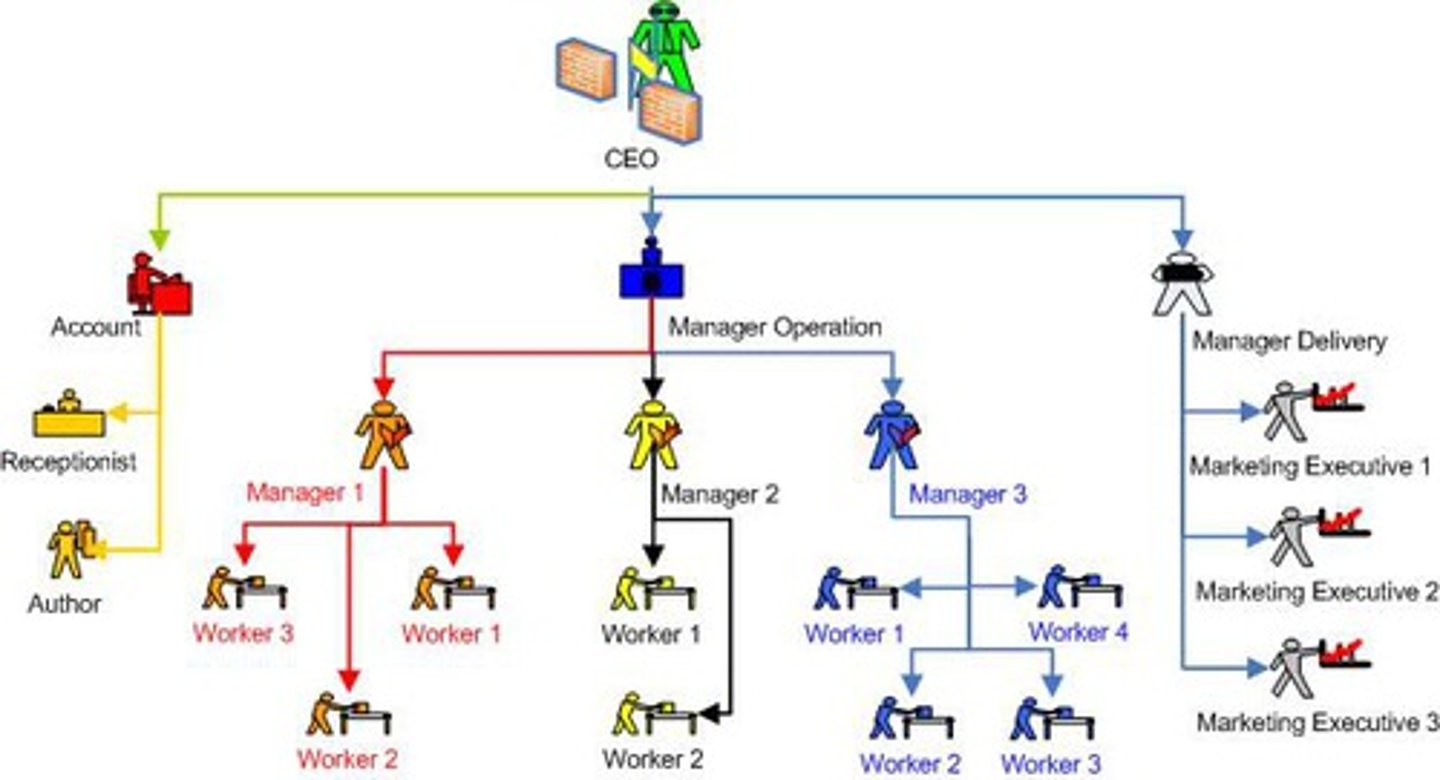
What is the flat organisational structure?
Within a flat organisational structure there'll be:
•A short chain of command
•Wide spans of control
What are the advantages of a flat organisational structure?
•More flexible structure
•Communication from the top to the bottom of the organisation is easier
•Decision making is quicker
•Staff ,ay feel motivated by increased challenge in their roles
What are the disadvantages of a flat organisational structure?
•Subordinates may not feel valued by their line managers, who may find it difficult to communicate & make time for them
•Lack of promotional opportunities
•Staff may become overworked & stressed due to increased amounts of delegation
•Lack of management may cause confusion amongst workers/
What is delayering?
•Over time, the organisation structure may change. Additional managerial positions may be added into the hierarchy. Alternatively, a business may decide to remove a layer from the hierarchy to make the organisational structure flatter.
What is a centralised organisation?
Decision making power is held firmly at the top of the hierarchy - central control.
Makes decision-making quicker.
But reduces input of local managers.
What are the advantages of a centralised organisation?
•Senior managers will be experienced in making key decisions
•Decisions will fit in with the overall aims/objectives of the business.
•Uniform & consistent decisions will be made across the business.
•Consistent customer experiences achieved at different location.
What are the disadvantages of a centralised organisation?
•Motivation levels may fall due to lack of authority given to branches/regional offices
•Junior managers or teams in regional branches/ offices may make more effective decisions, as they understand local customer needs more accurately.
What is a decentralised organisation?
•Within a decentralised organisation the authority to make decisions is passed to different areas of the business, such as specific stores or trading locations, as well as junior managers found lower down the hierarchy.
•(Each branch manager will have authority over key decisions that specially affect his/her store)
What are the advantages of a decentralised organisation?
•Reduces the workload on senior management
•Staff retention & labour productivity may increase
•Decisions are made closer to the customer & are more likely to respond effectively to local circumstances.
What are the cons of decentralised organisation?
•Training may be required
•Decisions taken at a local level may not be in the best interest of the business as a whole
•Communication between senior managers & local branches/offices must be strong to be effective.
What factors are involved when thinking what kind of organisational structure is appropriate for a business?
•Stage of a business:a new business will likely have just one person making all the key decisions in the business & have a flat structure with very few layers in the hierarchy. In contract, a large public limited company is likely to havemany layers of management, lots of promotion opportunities & hierarchical organisational structure.
•Nature of business:if business operates in a dynamic market that changes quickly, a flatter organisational structure that has decentralised decision making is likely to be more appropriate, as it will be able to adapt to change more easily.
•The preferred management cycle:managers that prefer to supervise their staff closely will tend to have hierarchical organisational structure, as they'll have narrow spans of control & there'd be limited delegation. A flatter organisational structure will be appropriate for managers who prefer to delegate to subordinates & take a decentralised approach to decision making.
•Skills of workforce:if staff are inexperienced & unskilled, they may need closer supervision & therefore a taller structure with more layers of management would be appropriate, as well as centralised decision making.
•Competition:a business may have the same organisational structure & approach to decision making as its rivals in order to remain competitive.
•Financial situation:a flatter organisational structure means that costs can be reduced as there are less layers of management & salaries to pay.
What are the different ways of communication that can take place within an organisation?
•Downwards: communication that flows from the top levels of the organisation to the bottom level of the hierarchy.
•Upwards: communication that flows from the lower levels of the hierarchy to the more senior levels in the organisation.
•Horizontal: communication that flows between employees at the same level of the hierarchy.
Why do managers need to communicate?
•To pass on aims/objectives of the organisation
•To share information with other members of staff
•To gather feedback from staff.
What is insufficient communication?
•Insufficient communication occurs when there's too little communication within a business or the communication methods are ineffective.
What can insufficient communication lead to?
•Poor motivation
-> as workers believe they aren't valued in a business
->can lead to jobs not being completed at all, as employees aren't aware of tasks required
->alternatively, employees can complete jobs, but not correctly as they don't have all the info required to do so
->leads to inefficiencies
•Lack of opportunity for employees to feedback to their line managers
->managers may not understand or be aware of any problems or suggestions that employees have for improvement in the business
->can cause inefficiencies/ business loses chance to improve
What is excessive information?
•Excessive information occurs when there's too much communication within a business causing an overload
•(With advancements in tech, e.g. email, there's a danger that too much communication can take place within an organisation.This can lead to workers being ineffective or inefficient)
What can excessive communication lead to?
•Expensive communication can mean unnecessary work acknowledging & responding to these communications, as well as difficulties identifying which messages are important
->can slow down output of workers & also decision making
->reducing the motivation of employees who become overwhelmed & anxious with the volume of messages coming through
•Excessive communication can also cause quality issues
->if communication keeps changing the job requirements or contradicts other communications that have been received, may mean work is duplicated.
What is a barrier to communication?
•A barrier to communication is something that prevents the correct message getting through to the intended recipients.
What are the barriers to effective communication?
•Technical language:message might include language that can't be understood clearly by everyone
•Transnational businesses: organisations that operate in more than one country may find time, cultural & language differences key challenges when communicating.
•Noise:staff working in busy, open plan offices with other employees may find it difficult to hear & understand messages.
•Emotion:it is often difficult to understand the tone & emotion of a written message
•Spelling or grammatical errors:can make the meanings of messages difficult to understand
•Breakdowns in tech:can prevent effective communication taking place
•Flat organisational structure:communication between line managers & their subordinates can become difficult as spans of control are wide resulting in more email/written communication being used (email may not be opened)
•Hierarchical organsiational structure:communication from the top of the organisation to bottom can be slow/delayed & messages can easily become distorted as there are many layers of management for communication to pass through.
What is part time employment?
•Part-time employment is where employees work less hours a week than a full-time member of staff.Entitlements such as holidays are reduced in line with the amount of hours worked.
What are the pros to the business of part time employment?
•Employ staff when they're required
•Flexibility to increase hours
•More staff bring in new ideas
What are the pros to the employee of part time employment?
•Employees can fit work around other commitments such as childcare
•Less stress due to a better work life balance
What is full-time employment?
•Full-time employment is where employees work a number of hours equivalent to the normal working week. This is usually 35 hours or more.
What are the pros to a business of full time employment?
•Communication is easier within the business
•Narrower spans of control exist
•Consistency with workload
•Employee skills can develop more quickly
•Staff may be more committed to the business
What are the pros to the employee of full time employment?
•Improves standards of living
•Potentially more opportunities available within the workplace, such as training & promotion
•Feel more involved & part of the organisation.
What are the different ways of working flexibly?
•Work a set number of hours each year:the employee, in conjunction with the employer, decide when the hours are worked to fit in with the needs of the business & the member of staff.
•Zero hours: employees will not be guaranteed any hours of work each week, although they may be offered many hours or none at all
What are the pros to a business of working a set number of hours each year?
•More people are likely to apply for vacancies
•Higher staff retention & lower absenteeism
What are the pros to the employee of working a set number of hours each year?
•Security of regular pay
•Flexible hours can reduce childcare costs
•General well-being improves
What are the pros & cons to a business of zero hours?
•Pros:
->Maximum amount of flexibility
->Staff work only when they are needed
•Cons:
->Low staff retention as staff may seek out jobs that offer more secure hours & pay
What are the pros & cons to the employee of zero hours?
•Pros:
->Some employees enjoy this type of flexibility, such as students
•Cons:
->Pressure to accept inconvenient hours
->Difficult to plan ahead financially
What are permanent contracts of employment?
•Permanent contracts of employment are ongoing until they're either terminated by the employer of the employee. (These may be issued on a full-time or part-time basis.)
What are the pros to a business of permanent contracts?
•Increased motivation & productivity as employees view their job as more of a long-term career
•Higher staff retention; skills are retained in the organisation
What are the pros to the employee of permanent contract?
•High degree of job & financial security
•Skills can develop as many businesses can invest in the training & development of permanent staff.
What is a temporary contract?
•A temporary contract is one that has a specific end date, where the worker is only employed for a certain period of time. Temporary contracts are very common within the retail industry and in other industries with seasonal demand.
What are the pros to a business of temporary contracts?
•Flexibility with staffing to meet fluctuations in workload
•Can evaluate the strengths & weaknesses of an employee before committing to a permanent contract
What are the pros to the employee of temporary contracts?
•Increased flexibility may suit some workers, such as students.
•Ability to work in different organisations & learn new skills.
What is a freelance contract?
•One where a self-employed individual is engaged to carry out a specific piece of work over a defined period of time.A freelance employee may be hired on a daily basis or to complete a specific job.

