BIOL 205 Final Exam Flashcards
 Call Kai
 Learn
Learn Practice Test
 Spaced Repetition
 Match
Match Flashcards
 Knowt Play
1/72

Earn XP
Description and Tags
Name | Mastery | Learn | Test | Matching | Spaced | Call with Kai |
|---|
No analytics yet
Send a link to your students to track their progress
73 Terms
Ecosystem Diversity
The number of different kinds of organisms in one area.
Species Pool
All species in an area that could potentially inhabit or colonize an area.
Stochastic Filter
The random filter which works in the Global Species Pool. Includes dispersion and the organism’s distance to the site.
Physiological Filter
The physical filter which works in the Regional Species Pool. Includes access to resources, pH, and temperature.
Biotic Filter
The physical filter which works in the Local Species Pool. Includes competition, facilitation, and symbioses.
Incumbency
The theory that the organism already existing in an ecosystem has an advantage in that environment.
Alpha Diversity
All of the species in a specific place.
Beta Diversity
The differences or similarities between species in one place vs another.
Gamma Diversity
All of the species in a regional species pool.
Phylogenetic Diversity
Diversity in the physical adaptations of a species pool.
Functional Diversity
Diversity in the purposes/roles of organisms in a species pool.
Life History Diversity
Diversity in the adaptive history of organisms in a species pool.
Nutrient Availability
A determinant on biodiversity which deals with the availability of elements. Availability determines ecosystem productivity.
Productivity
How much plant biomass an environment can produce in a specific amount of time.
Eutrophication
When increased nutrients can disrupt ecosystem dynamics.
Nitrogen Cycle
The nutrient cycle which helps plants grow through elements in the soil absorbed through the roots.
Temperature
A determinant on biodiversity which deals with the amount of heat an organism is facing in a particular environment, and how it adapts.
Too much heat
An organism may experience denaturing (the unfolding of proteins) when this occurs.
Too little heat
An organism may experience the failure of its biochemical pathways when this occurs (inability to reach activation energy).
Connectedness
A determinant for biodiversity which deals with the physical closeness of species pools.
Island Biogeography
The framework for understanding community spatial organization. Closer islands = more species, farther islands = unique adaptations.
MacArthur and Wilson
Studied the insect recolonization of the Florida Keys after they were fumigated. Observed the return of insects to the islands (when/how fast they returned).
Species-Area Curves
Graphs which depict how the amount of area predicts the number of species living there.
Patchiness
The disconnectedness of different environments, especially seen in urban areas.
Impacts of Connectedness
Colonization rate, extinction rate, and the species pool size.
Isolation and Endemism
The theory that isolated areas create unique adaptations in animals.
Connectedness in the Past
Previous physical connections such as Pangea allowed for organisms to coexist and to spread to currently disconnected areas.
Predation/Herbivory
The type of organism interaction which involves a hunter and a hunted. Helps moderate the ratio of hunter/hunted.
Trophic Interactions
The type of organism interaction which involves one organism profiting off of another.
Parasitism
The type of trophic organism interaction in which one organism takes advantage of another. Benefits one organism, harms the host.
Commensalism
The type of trophic organism interaction in which one organism benefits, and the other remains neutral.
Mutualism
The type of trophic organism interaction in which both organisms mutually benefit from the presence of another.
Competition
The type of trophic organism interaction in which two organisms use the same resources as the try to maximize their use of the environment.
Trophic Cascade
A hierarchy of predators which eat other predators. Prey —> Smaller Predator —> Predator.
Predator-Mediated Competition
When predators eat multiple kinds of prey, but generally consume one kind over the others. This reduces the competition for the prey not consumed.
Apparent Competition
When two organisms compete with a third.
Indirect Commensalism
When interactions with a paired organism unintentionally positively impacts another.
Keystone Predation
When the predator makes major changes to an ecosystem/environment.
Direct Organism Interactions
When two organisms specifically interact with each other.
Indirect Organism Interactions
When an interaction between two organisms impacts another neutral organism.
Photoautotrophs
Organisms that consume sunlight for food.
Heterotrophs
Organisms that consume other organisms for food. Causes significant energy loss in the process.
Specialists
Organisms with particular consumption needs.
Generalists
Organisms with non-particular consumption abilities.
Guild
A grouping of organisms that behave similarly in an ecosystem. Can be ranked hierarchically.
Bioaccumulation
When a material becomes more concentrated at higher level guilds as a result of predation. Can create risks in these guilds if the material is harmful/toxic.
Keystone Species
An organism which helps maintain a niche. If this predator is removed, considerable harm will be caused.
Community Change Over Time
Evolution/adaptation, habitat degradation/fragmentation, fire frequency, flooding.
Fire Cycle
Burn removes standing trees;
Small/low vegetation growth;
Fallen trees become habitat;
Growth of younger trees;
Competition with other trees (leaf canopy expansion);
Most competitive trees succeed;
Forest regrowth.
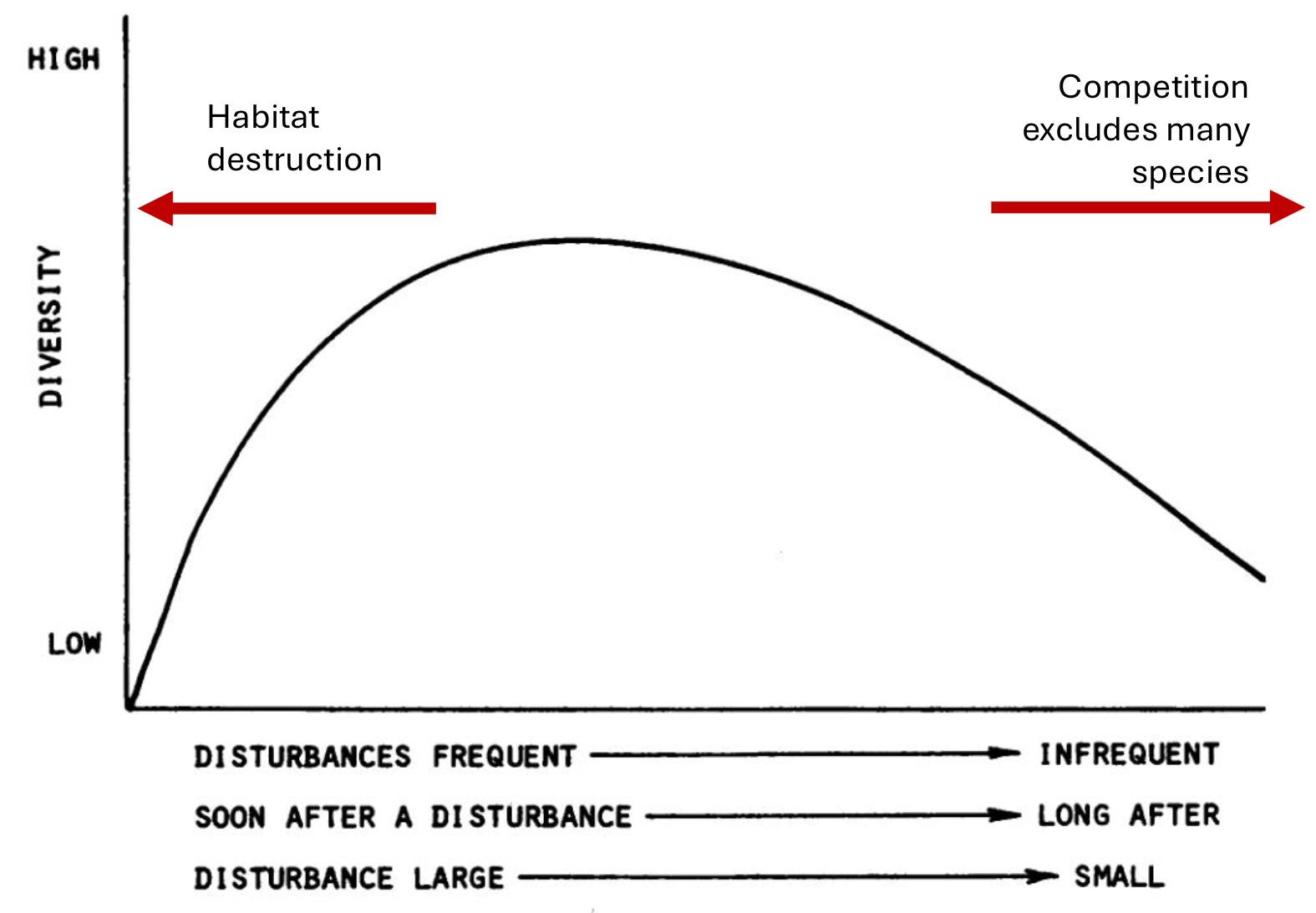
Intermediate Disturbance Hypothesis
The theory which states that species diversity in an organism is most healthy when ecosystem disturbance is neither to rare or too frequent.
Ecozones
A large geographical area which has its own distinct organism diversity.
Pioneer Species
Generalist species which have fast, generally asexual reproduction, and are the first organisms to repopulate an ecosystem.
Point Sources
When waste enters the environment from one specific place. Ex. Water treatment sites pumping out mass amounts of nutrients into the water.
Non-Point Sources
When waste enters the environment over a broad area. Ex. Farming leading to wide-scale nutrient deposits entering the environment.
Habitat Loss
A human impact on climate which results from human creations encroaching on organism niches. Ex. Deforestation, global warming.
Desert Expansion
A human impact on climate which results from desertification, which is the loss of water in previously farmable areas. Ex. Water scarcity in Tehran from overconsumption.
Changing Fire Dynamics
A human impact on climate which results from the prevention of forest fires, leading to drier forests and harsher fires.
Human Impact on Connectivity
Human-modified environments often create more patchiness/fragmentation, humans transport organisms long distances (creating invasive species), pandemics.
Pandemics
A result of increased connectivity which contributes to the spread of diseases.
Harvesting
Human predation which can include hunting, fishing, and foraging. Can lead to extinction of organisms.
Human Impact on Commensalism
Human-adapted wildlife may develop a competitive advantage over species sensitive to human activity. Ex. Raccoons, seed-fed pigeons.
Human Impact on Mutualism
The basis for domestication, where both the human and the organism benefit from the relationship.
Phosphates
Nutrients released from rocks or decomposing organisms, or from human waste (ex. cleaning products). Support biomass growth as a necessary macronutrient required for plant growth.
Nitrogen Fixation
The process by which atmospheric nitrogen/nitrogen from decomposition is transformed into ammonia and then nitrates by specialized microorganisms in the soil/roots, to then be absorbed by plants.
Water Availability
The physical determinant of biodiversity which impacts an organism’s success as a result of hydration.
Lack of Water
Organisms may adapt to this by creating ways to store/produce water. Ex. Desert beetle forms dew on it’s shell, cacti store water.
Uncertain Water Access
Organisms may adapt to this by creating ways to preserve water until access changes. Ex. African Land Fish burrows into mud and changes it’s cells to preserve water over months/years.
More than Enough Water
Organisms may adapt to this by creating ways to pull water from other sources than it’s roots. Ex. Orchids absorb water from the air.
Rain Shadows
A physical phenomenon created by geography which creates a wet side of a mountain and a dry side as a result of moist air from the ocean pooling on one side and dry air pooling on the other side. Ex. India vs Nepal, Vancouver vs Calgary.
Island Endemics
The phenomenon of only certain organisms being found on certain islands. Occurs when organisms develop specific adaptations for that niche.
Ecological Succession
The process by which ecosystem diversity changes over time. Either Primary (first organisms to recolonize) or Secondary (next organisms to recolonize).
PFAS
“Forever chemicals” used to make synthetic materials which can have negative health impacts on humans from their inability to break down. This quality means it is easier for them to make their way into the environment.
PFAS Physiological Impacts
These materials may have an impact on the liver/kidney/thyroid, bodyweight and metabolism, the immune/nervous systems, and development/the reproductive system.