brainstem autonomic
 Call Kai
 Learn
Learn Practice Test
 Spaced Repetition
 Match
Match Flashcards
 Knowt Play
1/53

There's no tags or description
Looks like no tags are added yet.
Name | Mastery | Learn | Test | Matching | Spaced | Call with Kai |
|---|
No analytics yet
Send a link to your students to track their progress
54 Terms
sympathetic
activated in stressful situations to increase energy expenditure
T1-L2
sympathetic IML
acetylcholine, noradrenaline
most sympathetic pre-ganglionic neurons use _____ as do post-ganglionic neurons innervating sweat glands. all other post-ganglionic neurons use ______
parasympathetic
conserves and restores body energy
III, VII, IX, X, S2-S4
parasympathetic CNs and IML
acetylcholine
parasympathetic neurotransmitter
dorsal motor nucleus, heart, external formation, nucleus ambiguus
preganglionic parasympathetics for X except for functions relating to the _____ (____ ___ of ____ ____)
ASA
DMX vessel irrigation
inferior salivatory nuclei, ponto-medullary junction, otic
parasympathetic nuclei for IX + location + what ganglion they innervate
superior salivatory nuclei, pons, pterygopalatine
parasympathetic nuclei for VII + location + what ganglion they innervate
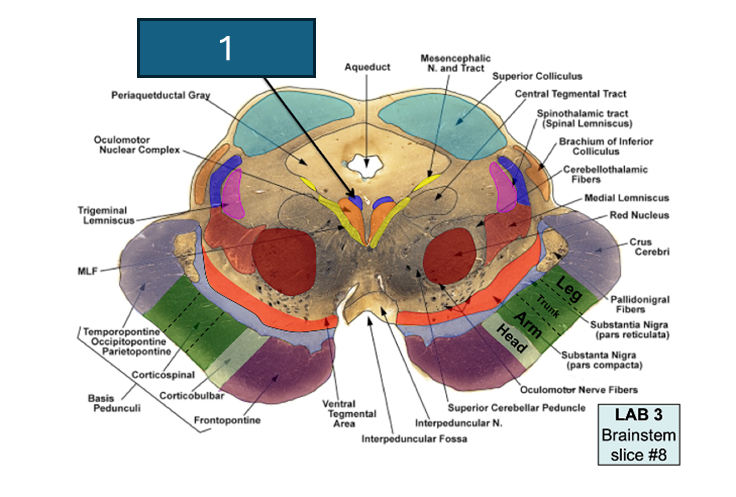
edinger-westphal nucleus, midbrain, ciliary, accommodation, pupillary constriction
parasympathetic nucleus for III + location + what ganglion it innervates - responsible for _____ and _____ ______
basilar paramedian perforators
edinger-westphal blood supply
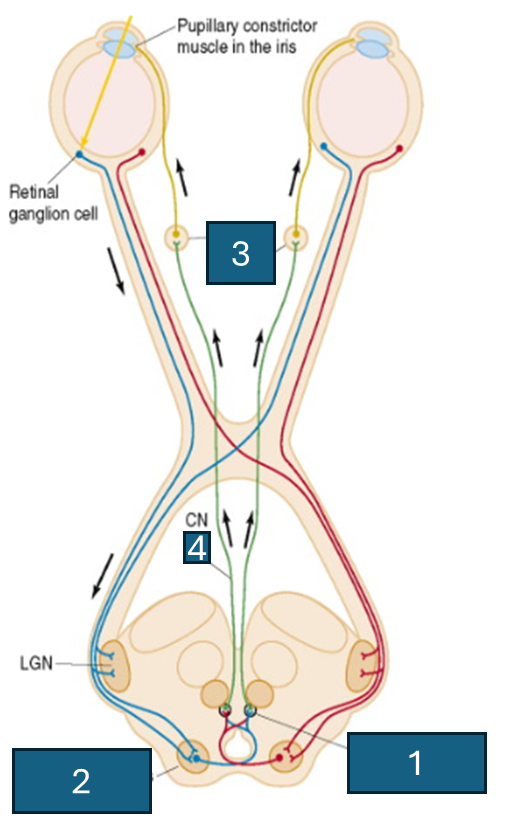
optic tract, LGN, brachium, superior colliculus, pretectal nucleus
branches off of the ____ ___ bypass the ____ and enter the midbrain via the _____ of the _____ _____ to synapse onto the _____ _____ (consensual pupillary light reflex)
pretectal, posterior commissure, edinger-westphal nuclei, ciliary, pupillary constriction
______ neurons send axons through _____ ____ to bilateral ____-______ _____ after receiving bilateral input from optic nerves. Axons of the nuclei innervate the _____ ganglion and promote ____ ______
CN II
no dilation issue, no light reflex in affected eye, intact consensual pupillary light reflex to other - damage to what?
CN III
one eye is dilated more than the other, deficient consensual pupillary light reflex - damage to what?
posterior commissure
pupillary light reflex is not consensual - damage to what?
optic chiasm
no effect on pupillary reflex or dilation - damage to what?
nucleus tractus solitarii
IX and X GVA
carotid body and sinus
IX GVA information location
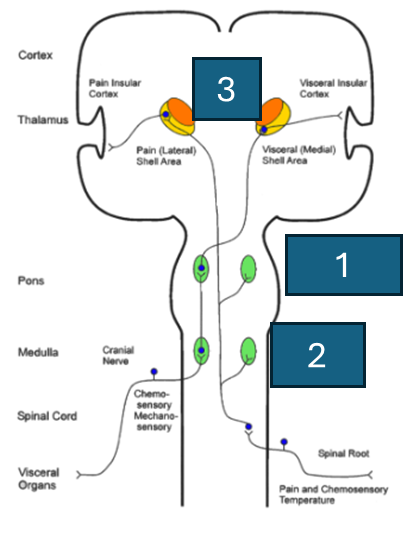
cranial, parabrachial complex, contralateral thalamus
NTS information from ____ nerve afferents synapses onto the NTS and projects up to the pontine _____ _____, which projects to the ______ ______
spinal, VPL thalamus, parabrachial complex
____ nerve afferents send projections directly to ____ _____ but also gives branches to NTS and _____ _____
lateral tegmentum, pons-midbrain, amygdala, hypothalamus, VPM thalamus
parabrachial is in the _____ _____ of the ___-_____ junction and relays visceral information to the ____ and ______, and relays taste information to the ____ _______
local, interneurons, reflex, pattern generators, hypothalamus
3 main levels of autonomic control: ____ via _____ or _____ arcs, autonomic ____ _____ in the reticular formation, and the _______ (head ganglion)
afferent, IX, X, NTS, ventrolateral medulla, vagal, sympathetic
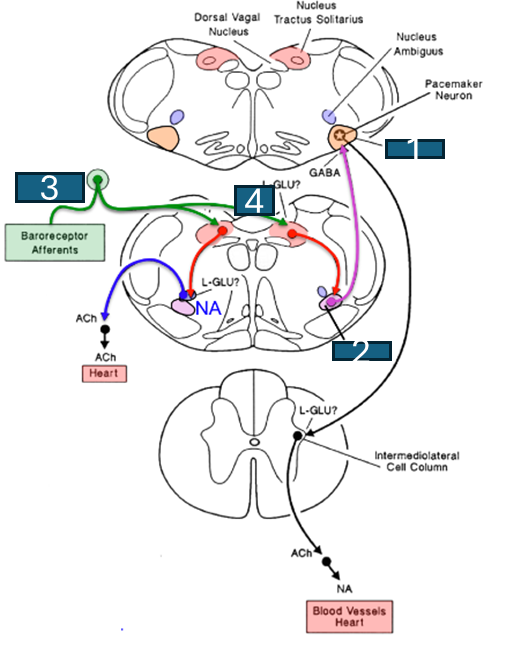
baroreceptor reflex involves an ____ loop (CNs ___ and ___), the ____, connections between it and the _____ ____, and _____ and _____ outflow
aortic, carotid, caudal NTS, external nucleus ambiguus, caudal ventrolateral medulla, slowing, rostral ventrolateral medulla, medullary reticulospinal
baroreceptors in ____ arch and _____ sinus —> ____ _____ in medulla —> excitatory input to _____ _____ ____ and the ____ ______ _____. input to the former causes _____ of heart rate and contraction strength. input to the latter results in inhibitory input to the _____ _____ _____, which sends axons to preganglionic sympathetic neurons in the spinal cord via the _____ ______ pathway
IX, X, caudal NTS, external nucleus ambiguus, parasympathetic
baroreceptor reflex (directly reduce heart rate and contraction): afferents (CNs?) to ____ ____ to _____ _____ ____, which sends preganglionic ______ efferents to heart
caudal ventrolateral medulla, rostral ventrolateral medulla, medullary reticulospinal
baroreceptor reflex (reduce sympathetic tone to heart): caudal NTS to _____ _____ _____, which inhibits the ______ _____ ____ that facilitates sympathetic tone in the heart via connections to sympathetic IML in spinal cord (travels along the _____ ______ pathway)
NTS, primary, essential
prolonged high BP leads to a decrease in sensitivity in the _____, leading to _____ or _____ hypertension
drop, syncope
age leads to increased carotid sinus sensitivity, which leads to slight increases in neck BP causing a ____ in BP, leading to _______
dorsal respiratory column, phrenic nucleus, inspiration
medullary respiratory center - formed by VL NTS and adjacent reticular formation. receives chemosensory and lung mechanosensory input and sends axons to the _____ _____. responsible for ______ and respiration rhythms
ventral respiratory column, forced expiration, intercostals
medullary respiratory center - very sensitive to CO2 - concerned with ______ ____ via ______ (muscle)
medullary respiratory centers
vulnerable during infancy (shaken baby)
lateral funiculus, medullary reticulospinal tract
descending spinal pathways from DRC and VRC run in _____ _____ with _____ _____ ____
apneustic, DRC, lung stretch, over-inflation
pontine respiratory center - drives inspiration by exciting ____. inhibited by input from ____ ____ receptors that serve to prevent ____-_____ of the lungs
pneumotaxic, DRC
pontine respiratory center - controls rate and depth of respiration by inhibiting ____ to end inspiration
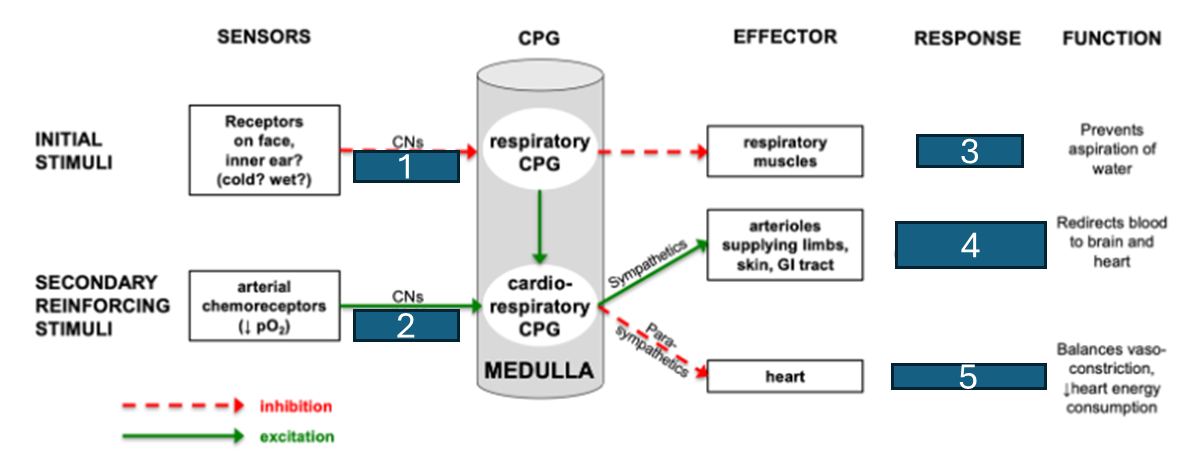
bradycardia, peripheral resistance, apnea, blood, aspiration of water
diving reflex leads to _______, increased _____ _____, and ______. These serve to redirect ____ to brain and heart, prevent ____ ___ __, and balance vasoconstriction
V, VIII, IX, X, respiratory, medulla
diving reflex involves CNs ___, ___?, ___, and ___, and _____ centers in the _____
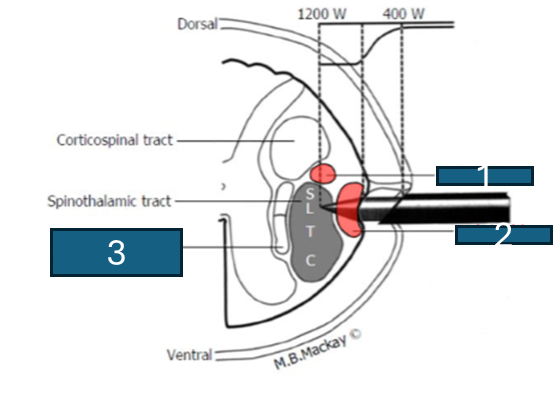
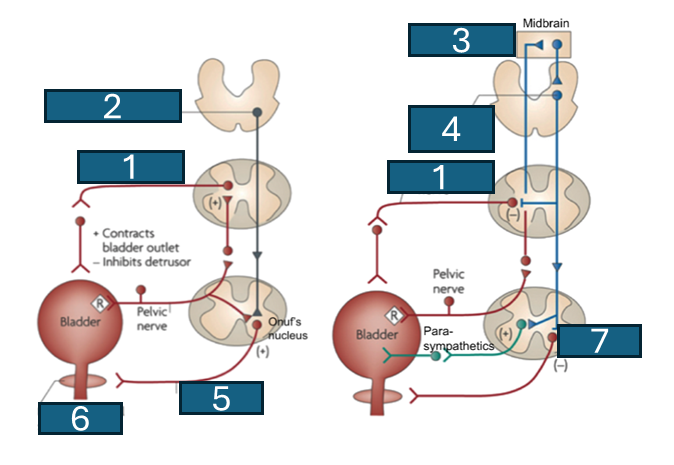
GVA, detrusor, internal sphincter, Onuf’s nucleus, pontine storage area, rostral pons, external sphincter, pudendal nerve
urinary storage: bladder distention activates ____ fibers in ____ _____ nerves —> sympathetic nervous system via interneurons, which inhibits ____ and contracts _____ _____. They also stimulate _____ _____, which is also excited by the _____ ____ ____ in the ____ _____. This contracts the ____ _____ via the ______ ______
pelvic splanchnic, PAG, pontine micturition center, sympathetic, Onuf’s, parasympathetic
urinary elimination: distention of bladder intensifies GVA firing in ____ _____ nerves, which activates an ascending pathway to _____, which relays the signal to the _____ _____ ______. This sends descending inputs to spinal cord that inhibits ______ activity, ____ nucleus, and stimulates ______ neurons in sacral spinal cord
pontine micturition, spinothalamic
descending _____ _____ pathways descending in the lateral funiculus on the outside of the ______ tract
dorsal longitudinal fasciculus
hypothalamus —> GVE nuclei in brainstem. runs in dorsal brainstem tegmentum
hypothalamospinal tract, central tegmental
hypothalamus —> preganglionic sympathetic IML neurons - travels in the ____ _____ tract
hypothalamospinal, Horner’s, ptosis, droopy, miosis, constricted, sweat, flushed, sunken
damage to _____ pathway above T1 can result in _____ syndrome, which results in _____ (____ eyelid), _____ (_____ pupil), inability to _____, _____ skin, and ____ eye
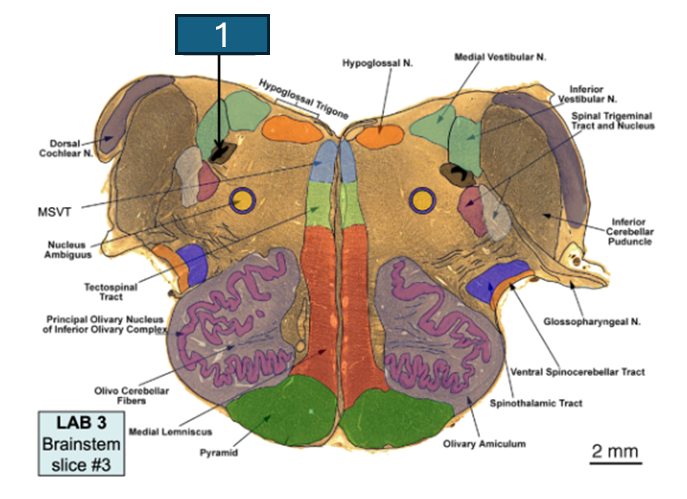
dorsal motor nucleus
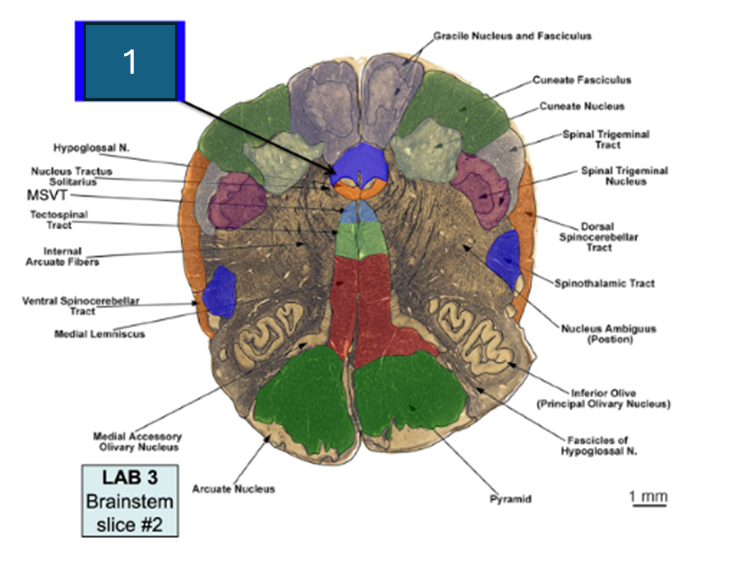
NTS
edinger-westphal nucleus
parabrachial complex, NTS, ventroposterior thalamic complex
edinger-westphal nucleus, pretectal nucleus, ciliary ganglia, III
central tegmental tract, dorsolateral
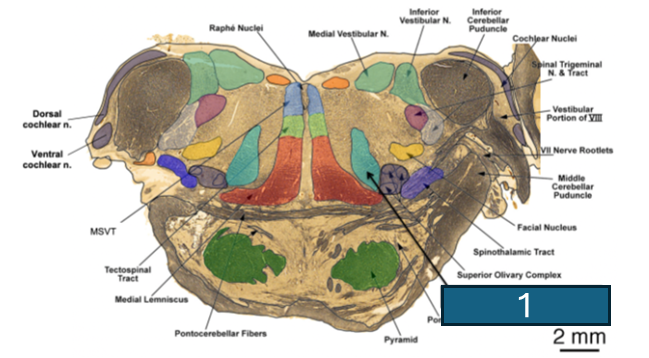
is this a midline or dorsolateral structure?
hypogastric nerve, pontine storage center, PAG, pontine micturition center, pudendal nerve, external urethral sphincter, Onuf’s nucleus
V, VIII, IX, X, apnea, vaso-constriction, bradycardia
RVLM, CVLM, IX, X, NTS
defecation, micturition, diaphragmatic reticulospinal tract