CSAD 125 Exam 1 - D'Angelo
 Call Kai
 Learn
Learn Practice Test
 Spaced Repetition
 Match
Match Flashcards
 Knowt Play
 Podcast
1/145

There's no tags or description
Looks like no tags are added yet.
Name | Mastery | Learn | Test | Matching | Spaced | Call with Kai |
|---|
No analytics yet
Send a link to your students to track their progress
146 Terms
The are the non-medical factors that influence health outcomes. Examples:
- Income and social protection
- Education
- Unemployment and job insecurity
- Working life conditions
- Food _____
- Housing, basic amenities and the environment
- Early childhood ____
- Social inclusion and non-discrimination
- Structural ____
- Access to affordable ___ services of decent quality.
WHO ICF social determinants of health
Income and social protection
- Education
- Unemployment and job insecurity
- Working life conditions
- Food insecurity
- Housing, basic amenities and the environment
- Early childhood development
- Social inclusion and non-discrimination
- Structural conflict
- Access to affordable health services of decent quality.
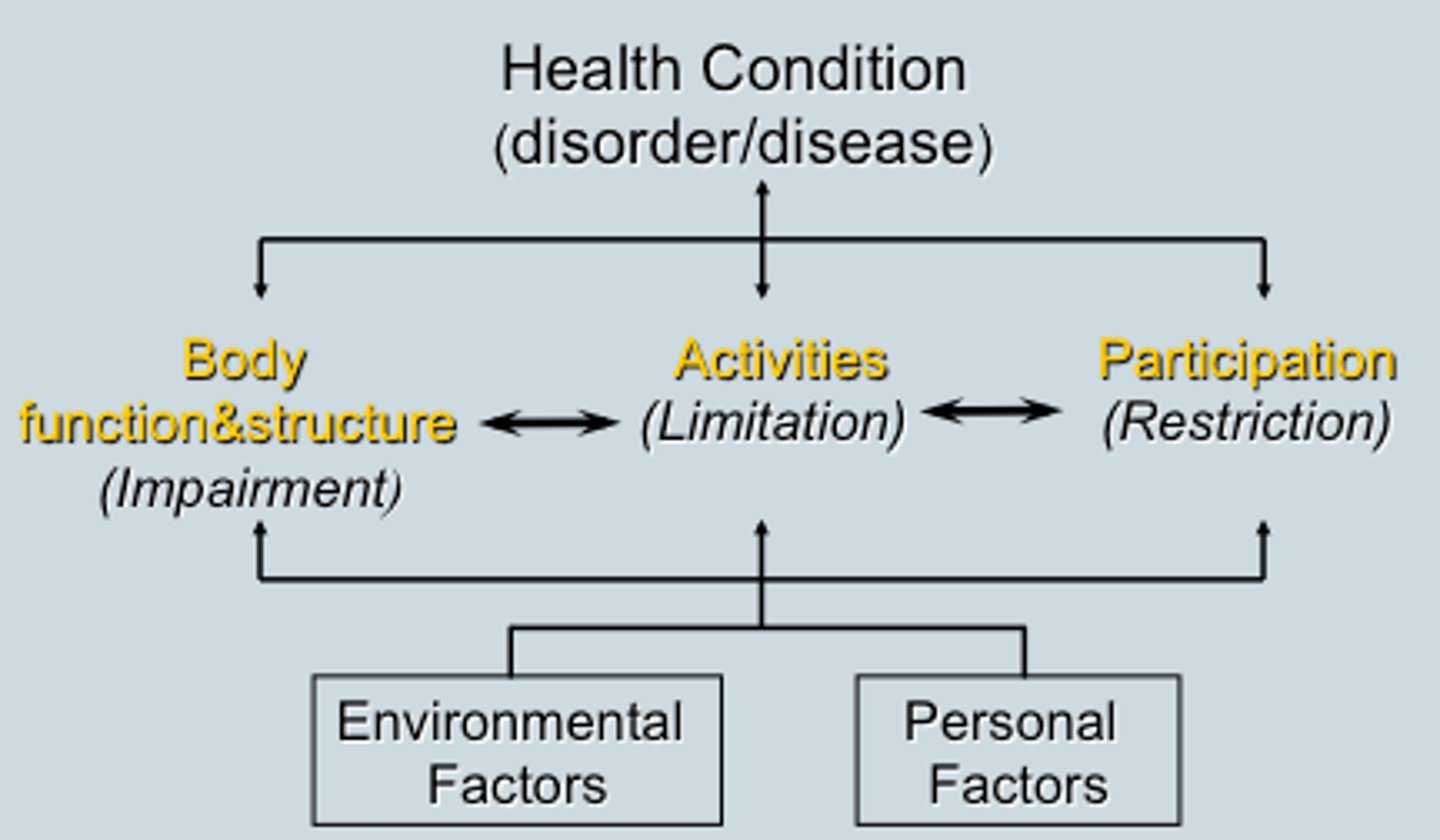
framework that classifies health, functioning, and disability. It uses a bio-psycho-social approach, focusing on how a person lives with their condition, covering body functions, activity, participation, and environmental/personal factors
WHO ICF model
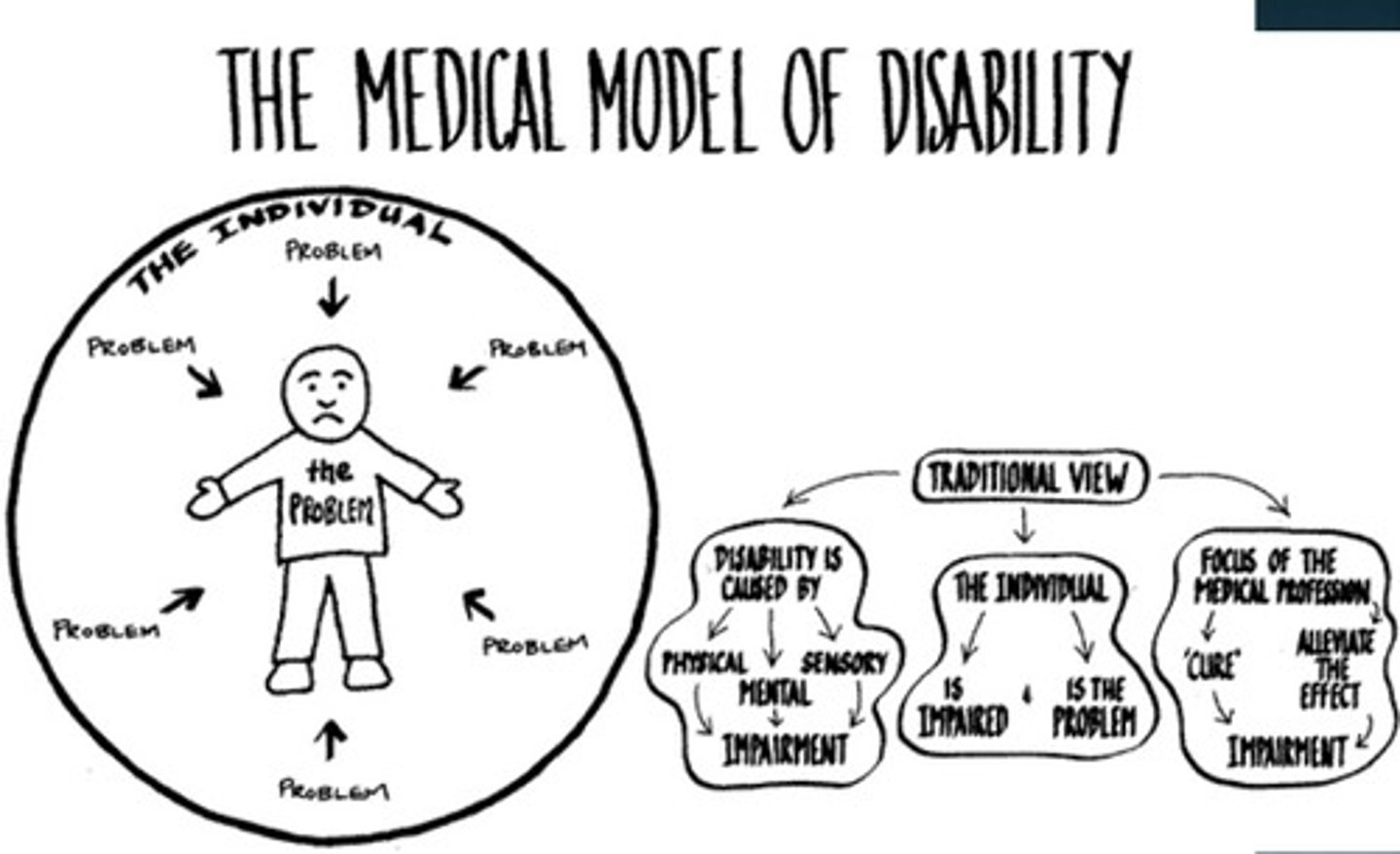
model that sees disability as a problem that the person has
Medical model of disability
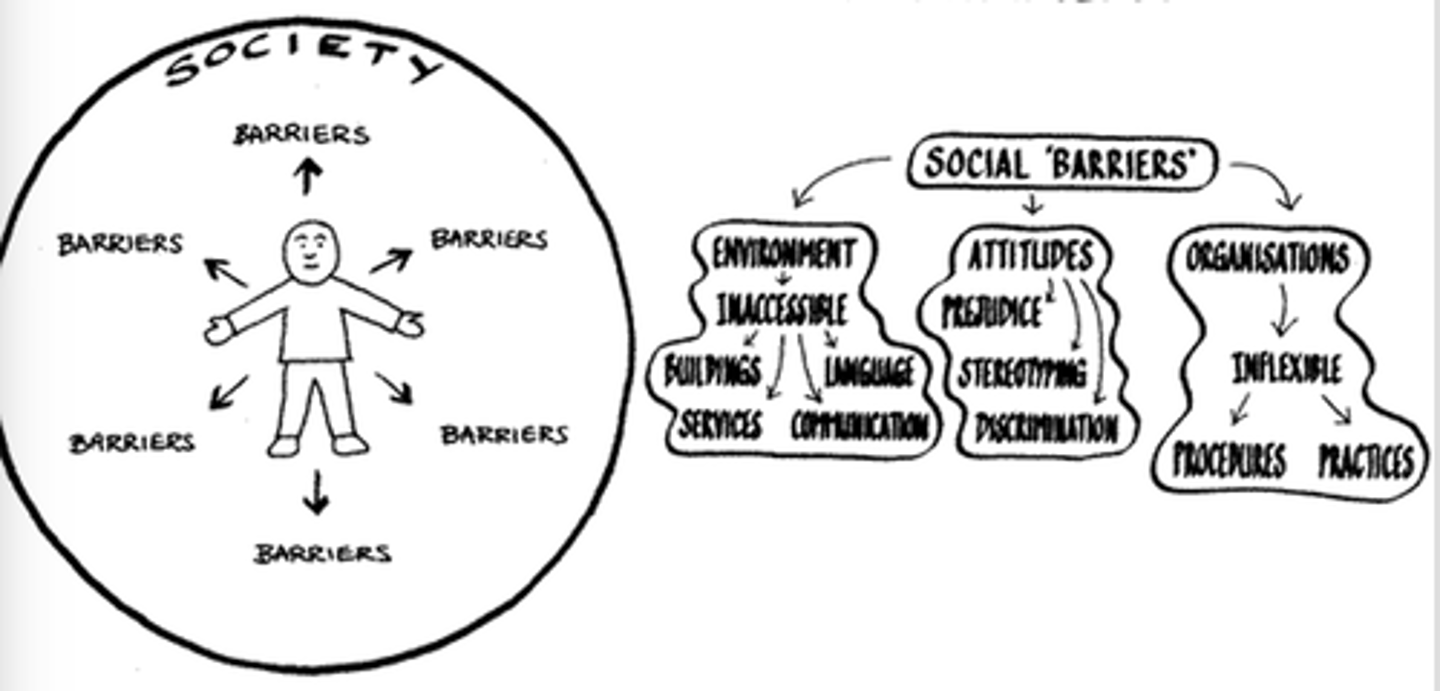
model that sees disability as people who are disabled by environmental, organizational, and attitudinal barriers in society
Social model of disability
which scan is best for bones and hemmorages
CT
which scan shows organ tear/injury most quickly (best for accident victims in hospital)
CT scan
which scan shows brain anatomy
easier to see brain tumors
MRI
which scan uses radioactive tracers that light up in correspondence with areas of disease
-revealing/evaluating several conditions - cancer, heart disease, brain disorders
PET
which exam would be best before surgery to identify exact locations of critical functions to avoid injury
reveals brain FUNCTION
fMRI
which scan measures AMOUNT of blood flow to a specific region of the brain
RCBF
Which scan is best for imaging brain injuries?
why?
DTI bc shows neuro connectivity in brain and very responsive to small changes
- uses a computer that takes data from several X-ray images and converts them into pictures on a monitor.
- uses digital geometry processing to generate a 3D image of the inside of the subject.
- A ___ scan shows organ tear and organ injury more quickly so it may be the best choice for accident victims.
- better for looking at cancer, pneumonia, abnormal chest x-rays, bleeding in the brain (especially from injury).
- shows organ tear and organ injury more quickly -may be the best for accident victims.
- Broken bones and vertebrae are better seen on ___ scan.
- better at visualizing the lungs and organs in the chest cavity between the lungs.
Computerized Tomography (CT SCAN)
- imaging test that helps reveal how your tissues and organs are functioning. A ___ scan uses a radioactive drug (tracer) to show this activity
- useful in revealing or evaluating several conditions, including some cancers, heart disease and brain disorders
Positron Emission Tomography (PET)
- uses a magnetic field and radio waves to create detailed images of the organs and tissues
-creates cross-sectional ___ images
-can also be used to produce 3-D images that may be viewed from many different angles
- Shows tendons + ligaments (CT does not)
- better for looking at the spinal cord
- brain tumor is better seen on ___
magnetic resonance imaging (MRI)
- measures the changes in blood flow that occur when specific parts of your brain are working
- Doctors may use an_____ before surgery to identify the exact locations of critical functions, such as speech and movement so that surgeons can avoid injuring those places while operating.
Functional MRI
- detects electrical activity in your brain using electrodes
- one of the main diagnostic tests for epilepsy. An _____ may also play a role in diagnosing other brain disorders.
Electroencephalography (EEG)
- ____ shows neuro-connectivity in the brain
- ____is very responsive to small changes in connectivity
- Best imaging for brain injuries
diffuse tensor imaging (DTI)
- the study of hereditary improvement of the human race by controlled selective breeding
Eugenics
JFK view on changing disability
- signed Title Part B Public Law 88-164 in 19__
- He and his siblings were advocates for people with disabilities due to their personal experience with their sister's ______
First president in US that signed a bill to give ____to the ____.
- signed Title 1 Part B Public Law 88-164 on 10/31/63.
- He and his siblings were advocates for people with disabilities due to their personal experience with their sister's lobotomy
First president in US that signed a bill to give rights to the disabled.
1980 - Present
"Nothing about me without me."
The Self-Advocacy Movement
Fight for inclusion
The Current Disability Rights Climate
- Many disabled people continue to fight for inclusion both in the ___ world and the ____ world.
- Lawsuits continue to climb with ____ -related lawsuits rising from 2890 cases in 2019 to 3550 cases in 2020.
- Disabled people continue to have inaccessible _____ experiences
The Current Disability Rights Climate
- Many disabled people continue to fight for inclusion both in the physical world and the digital world.
- Lawsuits continue to climb with ADA-related lawsuits rising from 2890 cases in 2019 to 3550 cases in 2020.
- Disabled people continue to have inaccessible voting experiences
Fight for Inclusion pt 2.
- People with disabilities encountered inaccessible COVID-19 ____ as well as vaccine registration forms during 2020 and 2021.
Disabled people and digital accessibility specialists campaign against accessibility overlays that may make websites less accessible even though they're supposed to help.
- White House focuses on inclusive events (___ ____ interpreters and _____ descriptions) as well as a promise commitment to an accessible and inclusive website.
-Basically, the right to be included in the world, classrooms.
- People with disabilities encountered inaccessible COVID-19 websites as well as vaccine registration forms during 2020 and 2021.
- Disabled people and digital accessibility specialists campaign against accessibility overlays that may make websites less accessible even though they're supposed to help.
- White House focuses on inclusive events (sign language interpreters and audio descriptions) as well as a promise commitment to an accessible and inclusive website.
-Basically, the right to be included in the world, classrooms.
Neurodivergence
- Acceptance of ____
- ____ the differences
- Choosing the ____!
- Aren't we all different?
- What is "normal"?
- ASD vs. Autism Spectrum Disorders vs. Autism vs. Autistic vs. those with Autism vs. neurodivergent
- Acceptance of differences
- Owning the differences
- Choosing the terms!
- Aren't we all different?
- What is "normal"?
- ASD vs. Autism Spectrum Disorders vs. Autism vs. Autistic vs. those with Autism vs. neurodivergent
communicates with another neuron
axon terminal
longer/single fiber that conducts nerve impulses away from the neuron to other parts of nervous system, glands, or muscles
axon
projections receiving neural stimuli
dendrites
cell body
contains what
soma
contains the nucleus
Point of contact between one neuron with another neuron's cell body, dendrites or axon
End of the axon (__synaptic terminal) and the membrane of receiving cell (___synaptic terminal) is a small space: "synaptic ____"
- Majority of neural ____is carried out through _____ messaging at the synapse
Synapse
Majority of neural transmission is carried out through chemical messaging at the synapse
spaces between myelin that also aid in signal transmission
nodes of ranvier
concept that neurons can take over functioning for those that die
cells that fire together wire together!!
neuroplasticity
How neuroimaging changed the way we understand brain function and change
→ neuroimaging now allows us to see _____and neurological _____in real time (fMRI, DTI)
→ now we understand that there are connected networks throughout the brain & we can see improvements
allows us to see BEHAVIOR and neurological CONNECTIONS in real time
- White fatty sheath of wrapping as the brain develops; interrupted at intervals by _____ ____ ____(_____rapid electrical impulses)
Aps develop at nodes (called ____ transmission)
- Development of Myelin - Laid down in nervous system as brain develops; Majority of myelin lipid sheaths occurs during first ______years of life
Myelin
nodes of Ranvier (enhance rapid electrical pulses)
salutatory
2 years of life
Ionic Concentration Gradients
- Sodium, potassium, and chloride channels are important to ____function
- ____ -______ ____ is most important to neuron
-Maintains the steep ______ of _____ to potassium
-Provides ______ to a call
Ionic Concentration Gradients
- Sodium, potassium, and chloride channels are important to neuronal function
- Sodium-potassium pump is most important to neuron
-Maintains the steep gradient of sodium to potassium
-Provides energy to a call
- Neurons must exist at a steady ____ , including "rest"
- Electrical forces across a cell membrane must be ______ so the resting/steady state can be maintained in all cells
- Sodium, potassium and chloride ions all carry a particular _______ ____
- Neurons must exist at a steady __state__ , including "rest"
- Electrical forces across a cell membrane must be balanced so the resting/steady state can be maintained in all cells
- Sodium, potassium and chloride ions all carry a particular electrical charge
Chloride ions - ______charge
Sodium & potassium - ______charge
Chloride ions - negative charge
Sodium & potassium - positive charge
Immediate necrotic degeneration of neurons (e.g., anoxia, physical trauma, vascular insult, CVA)
Primary neuronal loss
Degeneration of neurons after hours, days, or weeks after primary insult
Secondary neuronal loss:
axonal regeneration
- In PNS when a _____ nerve is compressed or crushed (but not severed and permanently damaged)
- Injured ___ degenerates and ____ _____ begins to break up
- Sprouting ____ may successfully _____
- In PNS when a _______nerve is compressed or crushed (but not severed and permanently damaged)
- Injured _axon__ degenerates and __mylein__ __sheath_ begins to break up
- Sprouting __axons__ may successfully __grow___
neuroimaging and brain function
Used to be just ____ , now we understand that there are connected _____
Neuroimaging and brain function
Used to be just regions, now we understand that there are connected networks
Network theory history
- Mohr et al.(1978) clarified some of the conflicting ____ studies
- Mesulam (1990) ____ theory (similar to Luria's)
- Damasio (1994) studies the ____ connections, and the important role of ____-_____ connections influence on human reasoning and behavior
- Mohr et al.(1978) clarified some of the conflicting lesion studies
- Mesulam (1990) network theory (similar to Luria's)
- Damasio (1994) studies the subcortical connections, and the important role of cortico-limbic connections influence on human reasoning and behavior
Network theory
- _____ and the _____ signals showing in real time
- Whole brain field of _______
- Many links: Network ____=_____ =Network ____
- van den Heuvel & Sporns (2013) and ____ and _____ that can detect
- fMRI and the BOLD signals showing in real time
- Whole brain field of Connectomics
- Many links: Network Communities=Modules =Network Modules
- van den Heuvel & Sporns (2013) and algorithms and metrics that can detect
Network Theory
graph theory mathematical model with net-works mapped by _____(cities or airports) and ___as their connections (travel routes).
Edges, the structural or functional connections, are identified through ____or other computations involving combined technologies (Cao et al., 2015; Yourganov et al., 2016)
____are nodes that are centrally located with many short paths
graph theory mathematical model with net-works mapped by nodes (cities or airports) and edges as their connections (travel routes).
Edges, the structural or functional connections, are identified through DTI or other computations involving combined technologies (Cao et al., 2015; Yourganov et al., 2016)
Hubs are nodes that are centrally located with many short paths
Nodes: ____
Edges: _____
Hubs: _____
Nodes: groupings
Edges: connections
Hubs: links
Network example
- ______ temporal _____
- Spectrotemporal processing of ______
- Identifying fast and slow by varying ____ _____
- Interconnect ____ for auditory _____ of words with different context
- Assign meaning with _____ , semantic and cognitive connections
- STG
- Spectrotemporal processing of speech
- Identifying fast and slow by varying acoustic cues
- Interconnect nodes for auditory decoding of words with different context
- Assign meaning with lexical, semantic and cognitive connections
Temporal lobe is responsible for the _____of sound - sound → ______impulses → _____gyrus → _____ ______cortex (_____area)
Damage to this process results in ____ _______ _______
Temporal lobe is responsible for the PERCEPTION of sound - sound → electrical impulses → temporal gyrus → auditory association cortex (wernicke’s area)
Damage to this process results in auditory processing disorder!
left superior temporal gyrus (STG) receives and transduces ____ speech input from the ____ ____cortex - _____ and encode the _____ of spoken words and sentences
The network connections to other distributed brain regions, depending on the semantic properties of the spoken words, enable comprehension of the words and sentences
left superior temporal gyrus (STG) receives and transduces acoustic speech input from the primary auditory cortex to perceive and encode the phonemes of spoken words and sentences
The network connections to other distributed brain regions, depending on the semantic properties of the spoken words, enable comprehension of the words and sentences
Tribune Brain
- Sapolsky (2017)
- Not entirely ____ , overlap functions
- Right and left _____ , some more common areas for certain ____ (______ to left and _____to right)
- Human behavior is overlapping: ______ involves analysis, emotion, regulation, cognitive
Triune brain
Sapolsky (2017)
- Not entirely separate, overlap functions
- Right and left lateralization, some more common areas for certain skills (analytical to left and emotional to right)
- Human behavior is overlapping: language involves analysis, emotion, regulation, cognitive
Triune brain levels
Lowest (reptilian)
Second Level (Limbic)
Neocortex
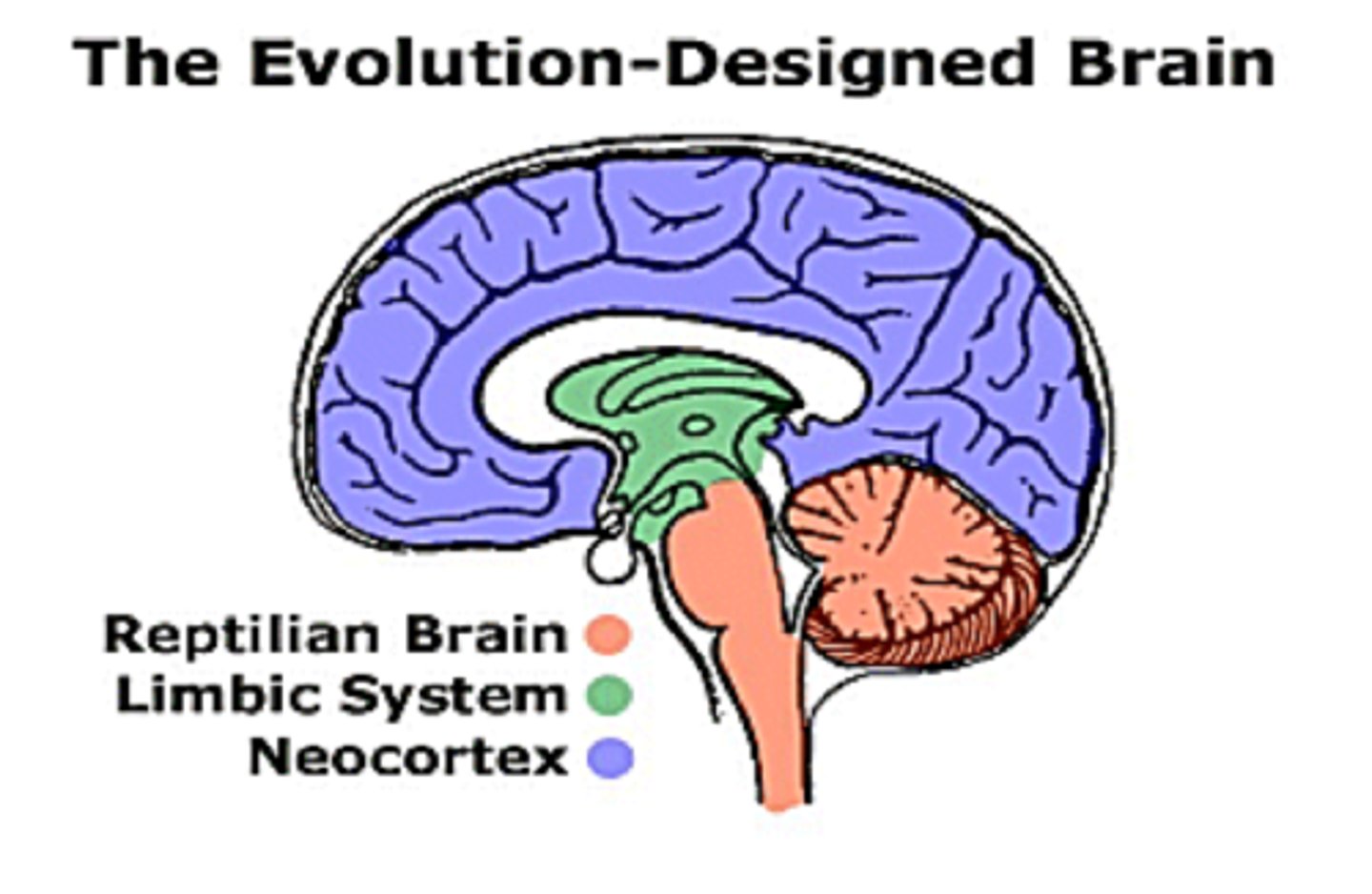
- shared with many other species, automatic functions, temperature regulation
Reptilian brain
what parts of brain make up reptilian brain
Basal ganglia, cerebellum, mid-brain, brainstem
Used to be thought as "lower" level of brain, but recent research of language and cognition reveal the importance of this level with communication and learning, perception, action, cognition, motivation networks
- Emotion connected to ________ _____language
Limbic brain
pragmatics social
what connects the reptilian and limbic, amygdala, and hippocampus together
cingulate gyrus
what level of the brain is declarative knowledge- NEW MEMORY
neocortex
what parts of the brain does limbic include?
___ or _____, _____ responses
______ brain, more evolved
- amygdala and hippocampus, limbic system
- Fight or flight, Survival responses
- emotional brain, more evolved,
highest level, most evolved, gyri and sulci and lobes of brain
Neocortex
Neocortex
3 lobes sensory focused: ____? ______? ______?
- 1 lobe more ____and acting on _____, regulation and _____
- Each lobe has a _____and _____ cortex
-3 lobes sensory focused: temporal? Parietal? Occipital?
- 1 lobe more motor and acting on behavior, regulation and control
- Each lobe has a primary and association cortex
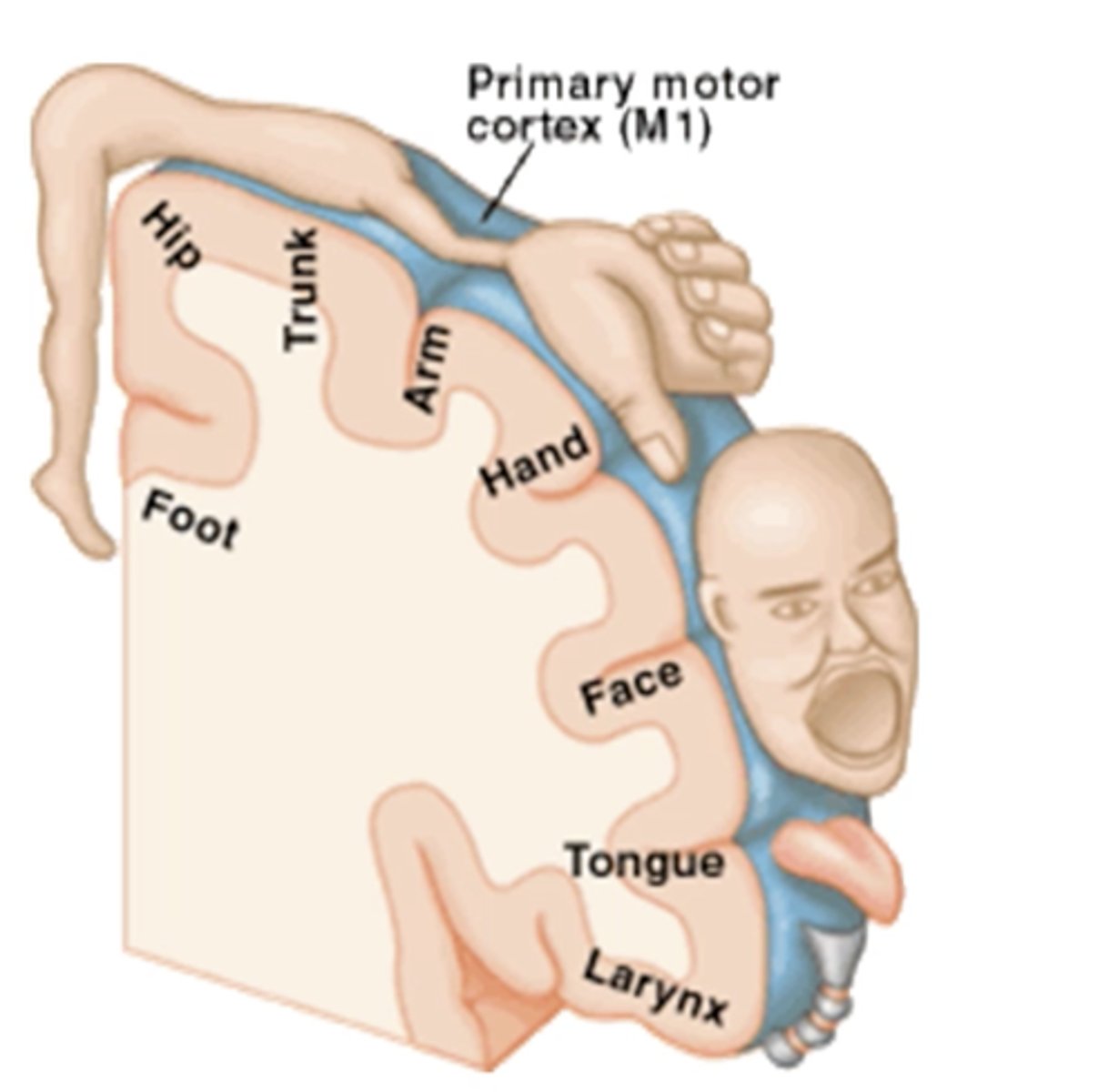
Sensory and motor representations in cortex
Homunculus
Primary areas _____
association areas _____ and _______ with other things
Primary- recieved
Association - understood and connected with other things
primary areas are not set in ____, they _____ with experience
we have _____over how the brain _____
primary areas are not set in STONE, they CHANGE with experience
we have CONTROL over how the brain develops
Primary Sensory Areas
- Receive sense organ input via brain stem ______ (____ station)
- Finely ____
- Discrete organization _______input in specific lobes
- Receive sense organ input via brain stem thalamus (relay station)
- Finely organized
- Discrete organization sensory input in specific lobes
Primary Motor Areas
- Send out ____ signals through the pyramidal tracts to ____ ____and ____ cord
- To activate lower ____ neurons
- To execute ______
- Send out motor signals through the pyramidal tracts to brain stem and spinal cord
- To activate lower motor neurons
- To execute movement
what is
made up of _____ fiber tracts
part of brain processing network
ex: arcuate fascisulus
association areas
made up of axonal fiber tracts
part of brain processing network
ex: arcuate fascisulus
Axonal fiber tract
-Connected between ______ areas
- Into _____ neuronal communication systems
- Creating brain ______ networks
- Example: language association cortex, perisylvian cortex
- Interconnected layers/levels
See upsetting pic or headline, increased blood pressure= same reaction as if you are being chased by a lion
And this can be related to motivation and rehabilitation= risk reward system can influence recovery
- Connected between association areas
- Into complex neuronal communication systems
- Creating brain processing networks
Top down and bottom up
- Communication and cognition arise from _____ input from primary _____ regions and ______regions connections
- Association regions are _____ by the _____triune levels: bodily state as well as _____
- Communication and cognition arise from sensory input from primary cortical regions and association regions connections
- Association regions are modulatd by the lower triune levels: bodily state as well as emotions
Top Down & Bottom Up Cont.
Association network directs _____ behavior by outputs to ____system
- And further _____(_____) by ___-____cognitive regulatory systems (Beckage & Colunga, 2016)
Association network directs voluntary behavior by outputs to motor system
- And further modulation (regulation) by top-down cognitive regulatory systems (Beckage & Colunga, 2016)
ability to predict what sound or word will come next
what processing is this a part of
predictive coding
top down
learning ___ → ____ is better because we are using information we already know
→ language is what type of processing
top→ down
BOTH
what is the primary auditory cortex to STG
acoustic input
what does STG signal
phonemes
words
sentences
Top Down Bottom Up Lang
Other brain regions: _____, meaning
- Other connections: verb ___, subject vs object action, ____info, prosody
- Simultaneously under _____lobe control for sustained attention, working memory and integration of information
- Other brain regions: __semantics___, meaning
- Other connections: verb _tense__, subject vs object action, __pragmatic__info, prosody
- Simultaneously under __frontal___lobe control for sustained attention, working memory and integration of information
Brand new concepts, concepts unrelated to stored info, and less complex stimuli are 1st processed perceptually at bottom levels and are then forwarded to working memory to be encoded and stored in long-term memory
bottom up processing
With elaborate stimuli, such as language,
"... the brain activates higher level or top-level, processes, such as linguistic and word knowledge..." and analyzes the incoming information to see how it "fits". Language is "heard" in relation to guesses based on previously stored linguistic information. Near and Far Transfer aid in this process.
top down
- Brain network activated in humans and primates
- We see others move and we simultaneously imagine we are moving ourselves
- Discovered by accident in research with macaques (Rizzollatti et al., 1996)
- Motor neurons fired both when the monkey did the action and when they observed another monkey doing the action
- Example: you see someone lift a cup of coffee to drink and you understand their intention and imagine it in your brain and your neurons fire the same as the other person
- Inferior frontal gyrus, inferior parietal lobe, and superior temporal sulcus
- Human ability to learn
- Also works with top-down higher behaviors such as empathy, emotion, social communication
Mirror neurons
what part of the brain does mirror neurons involve
human ability to _____
Also works with ___-____higher behaviors such as empathy, emotion, social communication
- Inferior frontal gyrus, inferior parietal lobe, and superior temporal sulcus
- Human ability to learn
- Also works with top-down higher behaviors such as empathy, emotion, social communication
- Arcuate fasciculus, Broca's and Wernicke's classic system
- Now known as complex network, neurons, pathways, systems
- Hickok & Poeppel (2000, 2004, 2006) 2 pathways: ____and _____
Ventral and dorsal stream
- Dorsal ____dominant
- Ventral ____
--examples: aphasia can involve ____streams
- Dorsal __left__dominant
- Ventral __bilateral__
--examples: aphasia can involve __both__streams
--child or adult with speech sound disorders: phonology and perception issues ____stream
--child or adult with motor speech issues: ______stream
--child or adult with speech sound disorders: phonology and perception issues _ventral___stream
--child or adult with motor speech issues: ___dorsal___stream
Genetics
- Many genetic disorders, syndromes with ___ , language, ____-communication issues
- Much new research showing _____ and specific genetic ____ relating to speech, reading, cognitive-communication, processing, language disorders
- ____dictate our early development
- May also _____ risk genes relating to disease or disorder
- Many genetic disorders, syndromes with speech, language, cognitive-communication issues
- Much new research showing phenotypes and specific genetic sequences relating to speech, reading, cognitive-communication, processing, language disorders
- Genes dictate our early development
- May also inherit risk genes relating to disease or disorder
- Experiential and environmental exposure
- Can impact how gene is expressed
Example: twins, living separately adopted
Same genes, both inherited disposition to cancer
One exposed to cigarette smoke in the home, the other not
- Gene is 'turned on" in exposed twin, gets cancer while other does not
Epigenetics
Epigenetics
→______experiences impact ____ of ____generations (ex: people who had ancestors that experienced famines have residual impacts on health)
→ _______exposure can impact how ______are _____(twins example - one raised in a house with smoking & one was not)
→_GENERATIONAL experiences impact __HEALTH__ of __FUTURE__ generations (ex: people who had ancestors that experienced famines have residual impacts on health)
→ environmental exposure can impact how genes are expressed (twins example - one raised in a house with smoking & one was not)
Epigenetics: ASD
-Lots of research in last ___years
- Certain ____
- Studied families with more than one member vs single one with ___
- Higher risk with more than ___
- Cognitive differences noted in ____, and lower overall over time even if not diagnosed with ASD
- Recommendation: monitor those with ___ ASD early and often
- Lots of research in last 25 years
- Certain genes
- Studied families with more than one member vs single one with ASD
- Higher risk with more than one
- Cognitive differences noted in infancy, and lower overall over time even if not diagnosed with ASD
- Recommendation: monitor those wuth multiplex ASD early and often
Epigenetics and ASD
certain ____ may be responsible
More likely for a child to have ASD if their ____ /____ does
____ is helpful
certain genes may be responsible
More likely for a child to have ASD if their sibling/parent does
EI is helpful
DLD and epigenetics
____ variations predicted DLD & and ___ ___ issues (significantly more likely to have ____ issues)
Genetic & environmental
Genetic variations predicted DLD & and mental health issues (significantly more likely to have psychological issues)
Genetic & environmental
Genes and epigenetics in DLD
→ those with DLD and family members who also had this
- Increased deletions and ____(CNVs=copy number variation in DNA sequences)
- Burden and size correlated with severity, but not as much as the ____variants
- Related study: UK, genetic variations not only predicted DLD, but also teenage psychosocial issues
- Those with DLD at ___ with significantly more psychological issues as teens: complex interaction genetic variants that covary and result in dual and increased risk
Example: those with DLD and family members who also had this
- Increased deletions and duplications (CNVs=copy number variation in DNA sequences)
- Burden and size correlated with severity, but not as much as the ASD variants
- Related study: UK, genetic variations not only predicted DLD, but also teenage psychosocial issues
- Those with DLD at 7 with significantly more psychological issues as teens: complex interaction genetic variants that covary and result in dual and increased risk
time we make new neurons
neurogenesis
Early brain development
___-___weeks in utero to ___years considered largest amount of growth/most dynamic
13-27 weeks in utero to 2 years considered largest amount of growth/most dynamic
exposure to ______ most predictive of vocab at age 2
PARENTESE
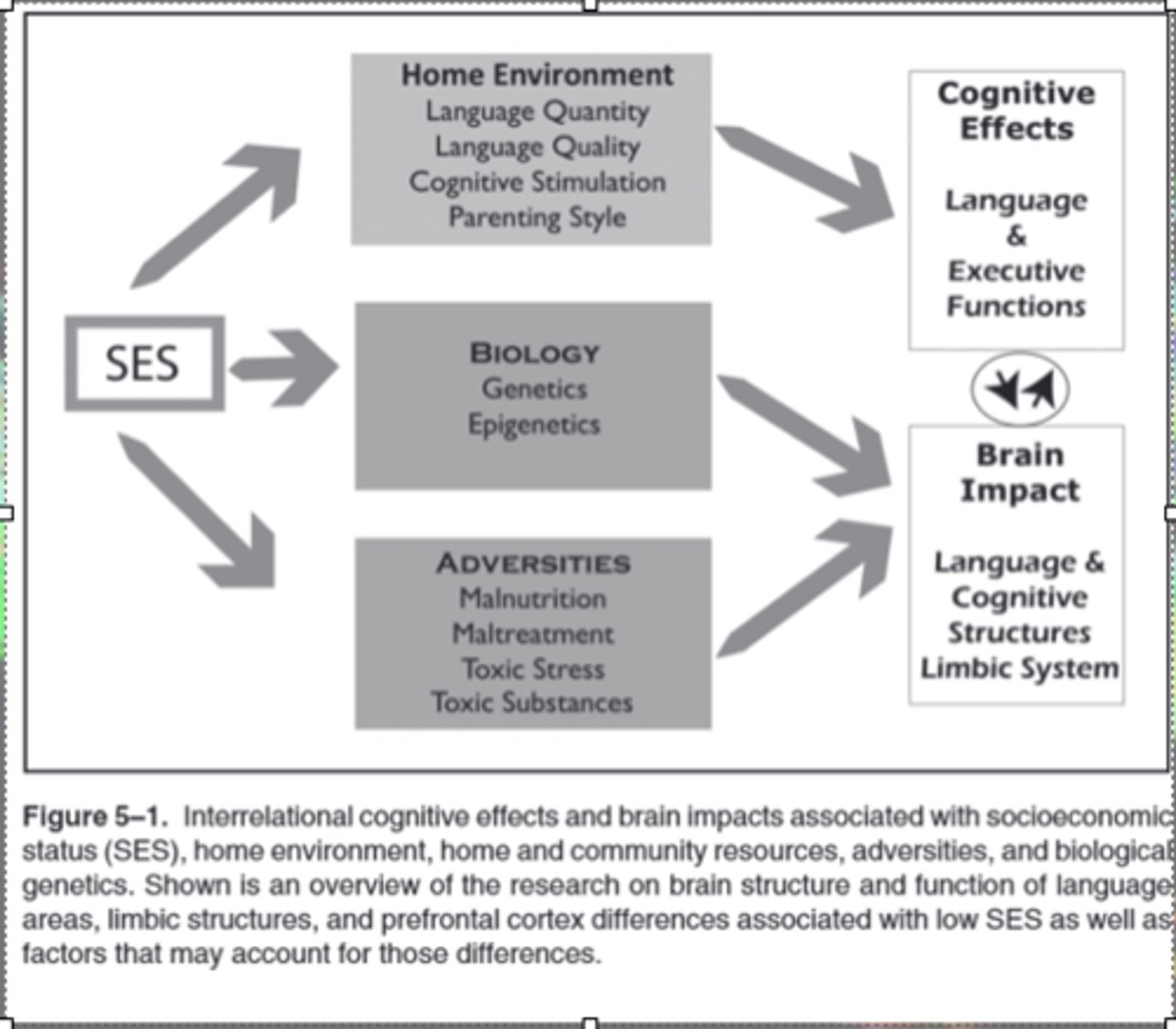
Interrelational cognitive effects and brain impacts associated with socioeconomic status SES, home environment, home and community resources, adversities, and biological genetics
Model of complex interactions
- ___ ____of brain reduced: small differences in family income=large difference in brain ____area
- Surface area of brain reduced: small differences in family income=large difference in brain surface area
-Small changes in higher income less disadvantaged children resulted in less differences
Most impact on _______children
- Biggest differences in areas relating to l____, r____, _____ functions, ____ reasoning
- Small changes in higher income less disadvantaged children resulted in less differences
- Most impact on disadvantaged children
- Biggest differences in areas relating to language, reading, executive functions, spatial reasoning
Areas most impacted by low SES
____system
a_____
h______
_____ lobe: due to chronic stress, chronic cortisol/fight or flight
limbic system, amygdala, hippocampus, temporal lobe: due to chronic stress, chronic cortisol/fight or flight
Drop out effect: ____ size also related to level of education
- Decrease in ___ hemisphere language dominance in disadvantaged children
Drop out effect: Hippocampal size also related to level of education
- Decrease in left hemisphere language dominance in disadvantaged children
T/F There is no research on low SES showing impact on motor or procedural memory
true! maybe whey kids in low SES seem to do better in athletics, vocational skills
- Adolescents in Low SES: reduced ____memory capacity and less ____volume
- Working memory very predictive of later _____
- Adolescents in Low SES: reduced working memory capacity and less PFC volume
- Working memory very predictive of later learning
- Language proficiency directly related to speed of ____/____memory
(___months gaps by ___ years of age between low SES and higher SES)
- Some research suggests language interventions targeting - - WM/processing speed may mitigate
- Language proficiency directly related to speed of processing/working memory (6 months gaps by 2 years of age between low SES and higher SES)
- Some research suggests language interventions targeting - - WM/processing speed may mitigate affect on later reading issues
Children with cognitively stimulating environments =thicker frontal and parietal ____ matter and increased _______
Even if living in poverty: Leisure reading in the home, and quantity and complexity of language in the home, associated with increased _____development
Children with cognitively stimulating environments =thicker frontal and parietal white matter and increased neuroconnectivity
Even if living in poverty: Leisure reading in the home, and quantity and complexity of language in the home, associated with increased brain development
- Higher parental achievement=children with increased _____ activation
- Increased adult speech in the home=increased ____ matter connectivity and left ____ ______development
- Higher parental achievement=children with increased PFC activation
- Increased adult speech in the home=increased white matter connectivity and left arcuate fasciculus development
What 5 concepts are important according to information-processing theory?
Organization
2. Memory
3. Transfer
4. Attention
5. Discrimination
What type of processing plays a big role in information-processing theory
auditory processing
When less complex stimuli and brand new concepts NOT related to stored info go up to the brain which processes them
bottom-up processing

