Exam 3 (#16) - Action potential
 Call Kai
 Learn
Learn Practice Test
 Spaced Repetition
 Match
Match Flashcards
 Knowt Play
1/13

There's no tags or description
Looks like no tags are added yet.
Name | Mastery | Learn | Test | Matching | Spaced | Call with Kai |
|---|
No analytics yet
Send a link to your students to track their progress
14 Terms
Which of these applies to an excitable membrane at rest? (select any that apply)
A) It is polarized
B) No ions are moving
C) Energy is required to maintain resting membrane potential
D) There is a concentration gradient for Na+
E) There is a concentration gradient for K+
A) It is polarized
C) Energy is required to maintain resting membrane potential
D) There is a concentration gradient for Na+
E) There is a concentration gradient for K+
Which of these channels can create a concentration
gradient for ions?
A) Leak channel
B) Voltage gated channel
C) Ligand gated channel
D) All of these
E) None of these
E) None of these
What is depolarization?
When the inside of the cell becomes more positive (allows the positive ions outside of the cell, inside the cell)
What is repolarization?
When membrane potential becomes more negative (but still more positive than resting membrane potential)
What is hyperpolarization?
When the inside of a cell is more negative than resting membrane potential
What is the process of ion movement? (start at rest)
At rest: more positive ions are outside of the cell than inside - polarized
Positive ions move into the cell - depolarized
Positive ions move out - repolarized
Positive ions still move out, past the polarized state that it started at - hyperpolarized
What are the terms in ion movement (+ simple definition)
Depolarization: inside of cell becomes more positive
Repolarization: inside of cell becomes less positive - brings cell back to rest
Hyperpolarization: inside of cell becomes less positive than at rest
A cell at rest with more (+) ions outside than inside is considered relatively _______.
If (+) ions enter the cell, this is then considered _______.
A) hyperpolarized; depolarized
B) Polarized; hyperpolarized
C) Depolarized; hyperpolarized
D) Polarized; depolarized
E) Hyperpolarized; polarized
D) Polarized; depolarized
Explain action potential (AP)
Rapid/extreme/predictable change to membrane potential
Series of depolarization, repolarization, hyperpolarization, then back to rest
APs do not decrease in strength over distance
All or none - APs either happen or they don’t. When a neuron fires, it always fires at the same intensity and speed
APs are conducted along the plasma membrane
Which ion movement do you think is responsible for depolarization?
A) Na+
B) K+
C) Both Na+ and K+
D) Neither of these
A) Na+
Explain the steps/phases of ion movement
Voltage-gated Na+ channels open at threshold (depolarization)
Voltage-gated Na+ channels close, Voltage-gated K+ channels open (peak point, leads to repolarization and hyperpolarization)
Voltage-gated K+ close, leak channels and sodium potassium pump together reestablishes the ion distribution (RMP)
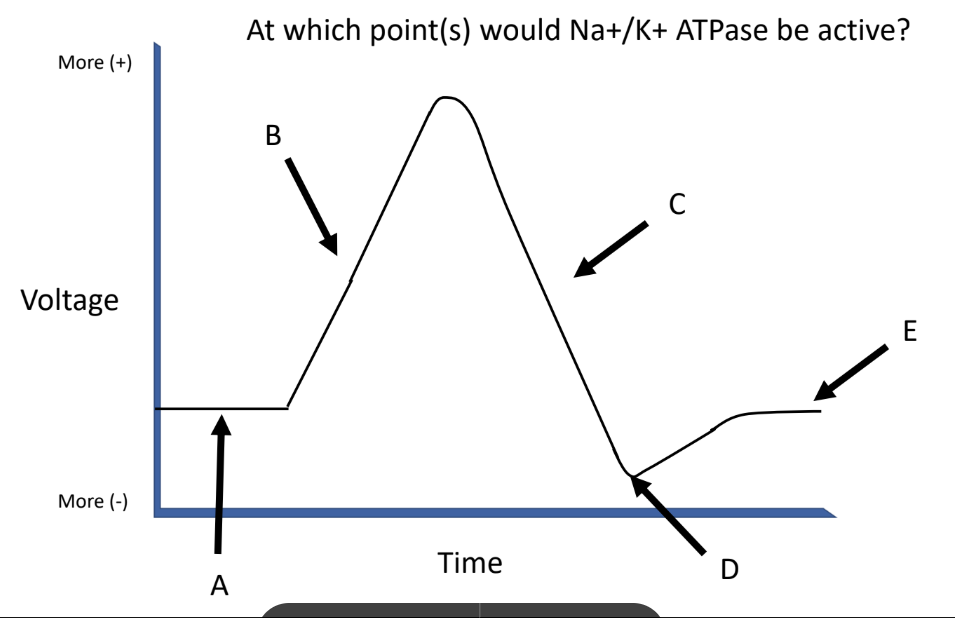
At which point(s) would Na+/K+ ATPase be active?
All points - it never stops, always working in the background
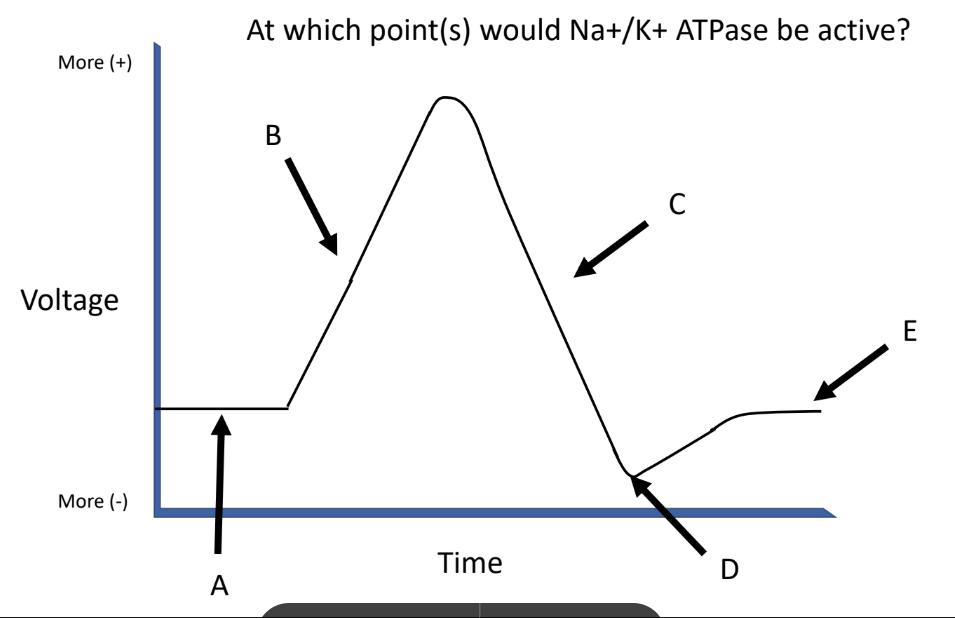
At which point(s) would Na+ movement be primarily responsible for the change in membrane potential?
B
Which ion movement is primarily responsible for repolarization?
A) K+ moving out of the cell
B) Na+ moving out of the cell
C) Na+ moving into the cell
D) K+ moving into the cell
E) None of these options
A) K+ moving out of the cell

