Clinical Psychology and Behavior Change
 Studied by 2 people
 Call Kai
 Learn
Learn Practice Test
 Spaced Repetition
 Match
Match Flashcards
 Knowt Play
1/87

Earn XP
Description and Tags
Final Exam
Name | Mastery | Learn | Test | Matching | Spaced | Call with Kai |
|---|
No analytics yet
Send a link to your students to track their progress
88 Terms
Define transference
When a person unconsciously redirects feelings, desires, and attitudes from part significant relationships onto a new person. Typically onto a therapist
Define countertransference
When a therapist projects their own unresolved feelings, experiences, or biases onto a client, often as a reaction to the client
Define resistance
Natural, often unconscious, opposition to change, insight, or exploring painful thoughts, acting as a self-protective mechanism to avoid anxiety or threat
Describe ID
Entirely unconscious, fundamental drive. Present from birth. The instinctual part of the mind that contains basic drives and desires, operating on the pleasure principle (to seek immediate gratification)
Describe Ego
Partly conscious. The goal is to mediate between the other two portions. Reality principle: Seeks to gratify our primal impulses in realistic ways that will bring long-term pleasure
Describe Superego
Partly conscious. Goal: act, think and feel the way we should according to social rules. Contains our conscience (punishes us with guilt for something morally wrong) and our ego ideal, or how we would ideally like tor be (rewards us with pride when we do something morally right
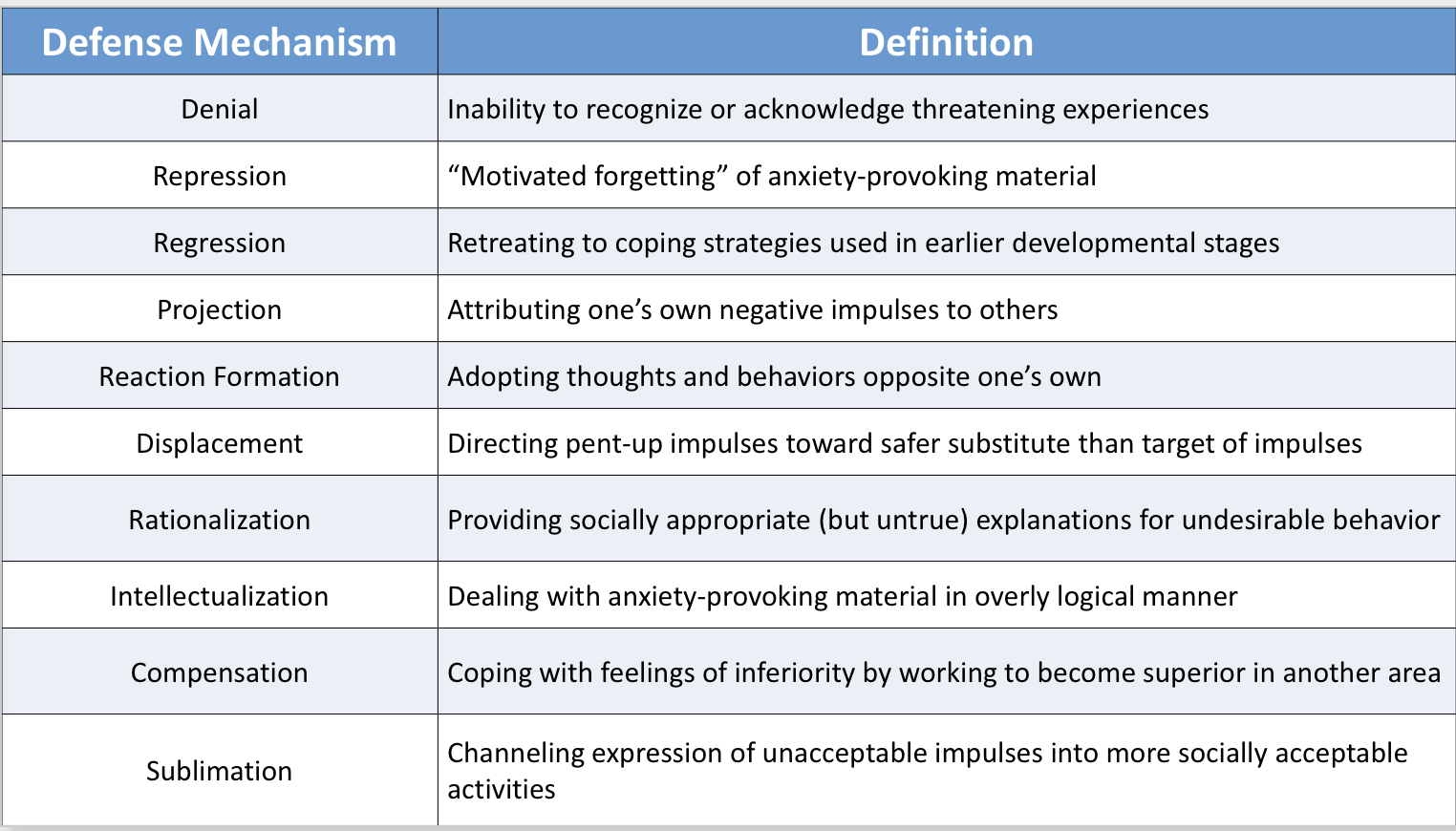
Defense mechanism
Unconscious mental strategies designed to keep anxiety provoking material from reaching consciousness. Overuse can be harmful. The ego uses defense mechanisms to cope with neurotic anxiety.
Types of defense mechanisms
Know general.
What are 3 main features that differentiate psychodynamics from psychoanalysis
Psychodynamics:
Focus on the ego and its adaptive functions. De-emphasizes role of sexual and aggressive id impulses as the main drives of personality development.
Emphasizes the role of our closest early relationships
Highlights the healing aspects of the therapeutic relationship
Tends to be shorter-term and less fre
Psychodynamic therapies: Adlerian
Striving for superiority. Inferiority complexes. Treatment focused on altering “maladaptive lifestyles”. Modeling homework. and social relationships.
Psychodynamic therapies: Jungian/Analytical
Emphasized role of ego. Unconscious material used to create meaning. Collective unconscious: cultural universal symbols
Psychodynamic therapies: Ego psychology
Saw the ego as a force for learning and creativity. Focuses on the present to boost :ego strengths”. Solving current problems. Therapeutic relationship is a source of support
Psychodynamic therapies: Object therapies
Definition is a person of emotional significance. Early emotional attachment of caregiver is particularly important. Ego supper, acceptance, and psychologically “holding” damaged self
Psychodynamic therapies: Relational Therapy
Also emphasizes early relationships (objective and subjective components). Use interpersonal patterns to give insight into client’s “problems of living”. Basis for IPT (Interpersonal psychotherapy)
3 essential therapeutic attitudes of person-centered therapy
Unconditional positive regard: Therapist attitude that expresses caring for and acceptance of the client as a value based person.
Empathy: Therapist’s attempt to appreciate how the world look from the clients point of view
Congruence (Authenticity): Consistency between the way therapists feel and the way they act towards clients
Classic conditioning
Theorized by Ivan Pavlov: Conditioned stimulus makes a conditioned response without an unconditioned stimulus
Operant conditioning
Behaviors increase or decrease in frequency depending on whether they are reinforced or punished (Positive and negative reinforcement/punishment)
Positive Punishment
Adding something unpleasant. Ex: Your student is disruptive in class and you give them a detention
Negative Punishment
Removing something pleasant. Ex: Your child is home after their curfew and you confiscate their phone
Positive Reinforcement
Adding something pleasant. Ex: Your dog sits when told and you give them a treat.
Negative reinforcement
Removing something unpleasant. Ex: Your car keeps beeping and you put your seatbelt on
ABC’s of behaviorism
Antecedent —> Behavior —> Consequence
What comes before, the action, and what happens after
Differentiate between the following types of exposure treatments: In vivo, imaginal. and interoceptive
In vivo: Real life (this is preferred)
Imaginal: Imagined or using virtual reality
Interoceptive: Involves internal physical sensations
Differentiate between flooding and systematic desensitization. Know which is generally preferred in exposure treatment
Flooding: Start with the most fear-prokoving situation, generally not recommended
Systematic desensitization: Gradual exposure to feared stimuli or environment to reduce fear response over time
What is a schema
Organized knowledge that influences how we anticipate, perceive, interpret, and recall information
What is a core belief
Ex: I am worthless
What is an intermediate belief
Ex: I must prove my worth to others
Automatic Negative Thought
Ex: “I can’t do anything right”
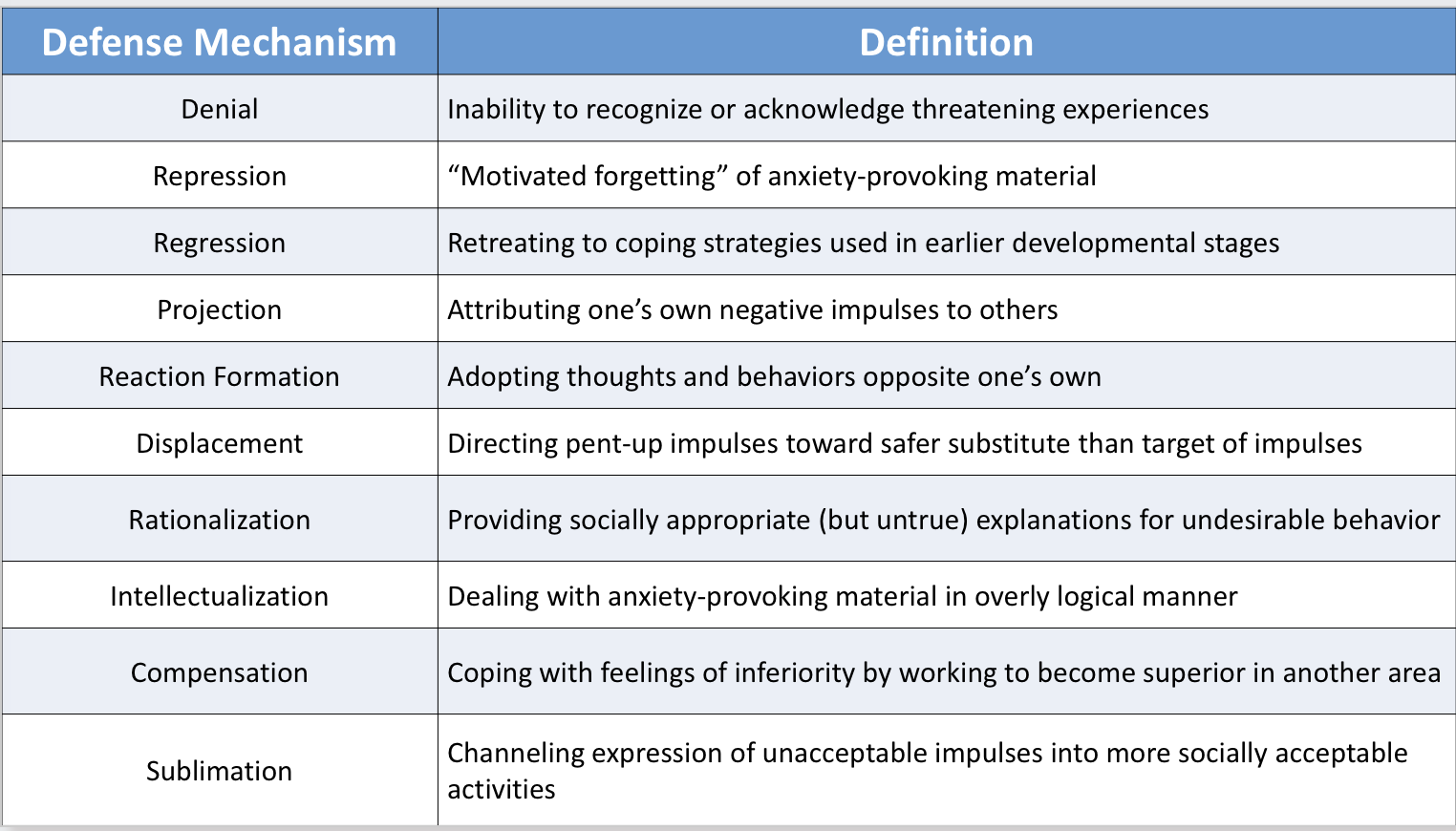
Describe and differentiate between types of cognitive distortions (the one on the slides)
Six pivots of Acceptance and Commitment Therapy
Being present: Sensory experiences in the present moment
Acceptance: Practicing non-judgmental awareness to internal and external events
Values: Defining what is most important
Defusion: Learning to notice the process or thought
Self-As-Context: Contacting the observing self
Committed Action: Taking steps towards valued goals
Identify the condition for which Dialectical Behavior Therapy was developed
An integrated cognitive behavior and acceptance-based approach for individuals with borderline personality disorder
Define the mental health treatment gap
The disparity between the number os people who need mental health services and the availability of and access to those services
Identify the four factors influencing the mental health treatment gap identified by Qin & Hsieh (2020)
High stigma
High out-of-pocket payments due to insufficient public funding
Low availability of mental health resources
Low expected treatment benefits due to slow diffusion of new technologic and practices
Define dissemination and implementation science
Finding ways to more effectively, sustainably, and widely distribute evidence-based interventions in forms that will be integrated and applies in different settings
Challenges to treatment implementation science
Develop a new treatment
Educate clinicians on benefits of new treatment
Prepare and deliver training to clinicians to become competent in new treatment
Monitor treatment delivery to prevent protocol “drift”
Dedicate whether treatment needs cultural adaptations
Measure treatment outcomes and monitor long-term impacts
Therapeutic factors of group therapy
Feedback from therapist and group members. Mutual hope and encouragement. Reduces stigma. Altruism and self-worth. Interpersonal learning. Group cohesiveness
Identify which theoretical orientation is most commonly used in group therapy
Cognitive Behavioral Therapy is used most often. Emphasizes psychoeducation, skill building, and therapist/group member feedback. Applied to a wide verity of psychological concerns
Couples Therapy
Focus on relationship between two partners. Can be used to enhance individual treatment for specific problem. Important to prevent triangulation
Family Therapy
Addresses relationships between at least two generations. Identifies problematic interaction patters that may perpetuate psychological distress in 1+ family members.
Define the three levels of prevention and identify examples of each
Primary: Prevention
Secondary: Screening
Tertiary: Treatment
Define primary level of prevention with examples
Efforts to modify environments or strengthen individuals’ resilience so they are less susceptible to developing mental health problems
Ex: Sex education, drug prevention programs, mental health literacy programs
Define secondary level of prevention with examples
Efforts to intervene with people who are at risk for developing a disorder
Ex: Screening instruments during primary care visits
Define tertiary level of prevention
Efforts to lessen the severity of disorders and reduce their short and long term consequences
Ex: Psychological rehabilitation for psychosis
Piaget’s theory of cognitive development
Children progress through four distinct universal stages, each characterized by unique ways of thinking, understanding, and interacting with the world.
Piaget’s theory of cognitive development: Sensorimotor
Birth - 2 years. Goal: Object permanence. Children learn through senses and motor actions. developing an understanding of cause-and-effect
Piaget’s theory of cognitive development: Pre-operational
2 years - 7 years. Goal: Symbolic thought. Children develop symbolic thought. language, and pretend play.
Piaget’s theory of cognitive development: Concrete Operational
7 years - 12 years. Goal: Concrete operational. Children begin to think logically about concrete events and objects
Piaget’s theory of cognitive development: Formal Operational
12 years and on. Goal: Scientific reasoning. Adolescents develop abstract thought. hypothetical reasoning. and scientific thinking
Role of parents/family in the treatment and prevention of childhood psychopathology
Assessments are comprehensive because of the influence different environments have on child behavior. Parents are better at reporting external behaviors while kids are better at internal. Must gather family history and information about the quality of familial relationships
Types of Assessment Data: Behavior Rating Scales
Standard in most assessment batteries. Ex: CBCL, BASC-3, Conners 3
Types of Assessment Data: Clinical Interviews
Can be structures or unstructured, often convicted with parent present. Ex: MINI KID, SCID
Types of Assessment Data: Intelligence and Achievement
Most referrals for assessment involve school problems. Ex: WISC-V, WJ-IV
Types of Assessment Data: Projective Tests
Generally not recommended given psychometric properties
Types of Assessment Data: Behavioral Observation
Crucial for child assessment!
Explain the importance of a developmental approach to clinical psychology
Children and their behaviors change rapidly.
Define deviancy training
Children in group treatment reward one another’s problematic behavior
What special considerations a psychologist needs to take into account the treatment of older adults
Memory impairment, effects of medical conditions on psychological symptoms and vice vera, internalized stigma and ageism, more grief work, and cohort effects on stigma/openness
What special considerations a psychologist needs to take into account the assessment of older adults
Physical limitations and differentiating chronic health conditions/drug interactions from mental disorders
Define agism
Prejudice or discrimination against a particular age-group and especially the elderly
How to combat common myths related to aging (e.g. inevitability of physical and mental decline)
Focus on proactive healthy habits: regular exercise, balanced nutrition, and continuous mental challenges (puzzles, learning) to maintain physical/cognitive function, alongside staying socially connected to fight loneliness, and emphasizing realistic, positive narratives about aging rather than stereotypes
What is stress?
The negative emotional and physiological process associated with people’s efforts to deal with circumstances that disrupt, or threaten to disrupt their lives.
Describe how we currently understand how stress develops
Stress results from interactions between people and their environments. Perceptions of events as stressful and ability to cope are important
How stress impacts the body, e.g. the immune system (very generally)
Triggers a “fight or flight” response, flooding your system with hormones like cortisol and adrenaline. Leads to mental health issues like anxiety and depression, cognitive problems such as poor focus, and physical symptoms like headaches, digestive issues, and a weakened immune system
Define allostatic load
The cumulative “wear and tear” on your body from chronic or traumatic stress, representing the physiological cost of constantly adapting to challenges, leading to increased risk of illness by disrupting systems like cardiovascular, metabolic, immune, and endocrine functions
Define coping
Cognitive, emotional, and behavioral efforts at modifying, tolerating, or eliminating stressors
Differentiate between the two main types of coping
Problem focused: Confronting, seeking social support. playful problem-solving
Emotion focused: Self-controlling, distancing, positive reappraisal, accepting responsibility, escape/avoidance
Social support types: Appraisal support
Helps person identify resources and coping abilities, expresses confidence in their success
Social support types: Emotional support
Empathic listening and understanding
Social support types: Informational support
Provides information/suggestions
Social support types: Instrumental support
Provides tangible assistance
Three primary ways psychologists can work to increase client adherence
Education, modifying treatment plan, and behavior modification
Identify the four lobes of the brain (on a diagram)
Frontal lobe, parietal lobe, occipital lobe, and temporal lobe
Frontal lobe function
Planning, movement, and personality
Parietal lobe function
Processes sensory information like touch, temperature, and spatial awareness
Temporal lobe function
Deals with hearing, memory, and language comprehension
Occipital lobe function
Interprets visual information, like shapes and colors
Define executive functioning
The brains management system, a set of high-level cognitive skills like planning, organizing, working memory, attention control, and self control that help you set and achieve goals, manage tasks, and adapt to new situations by directing your thoughts and behaviors
Localization view
Discrete brain areas contra; different functions, with no overlap
Globalism view
No one area of the brain is more important than any other area
Define lateralization of function
Discrete brain areas control different functions, no overlap
Left hemisphere function
Language, especially if right handed
Right hemisphere function
Unspoken communication. Ex: Tone of voice, emotional expression, and body language
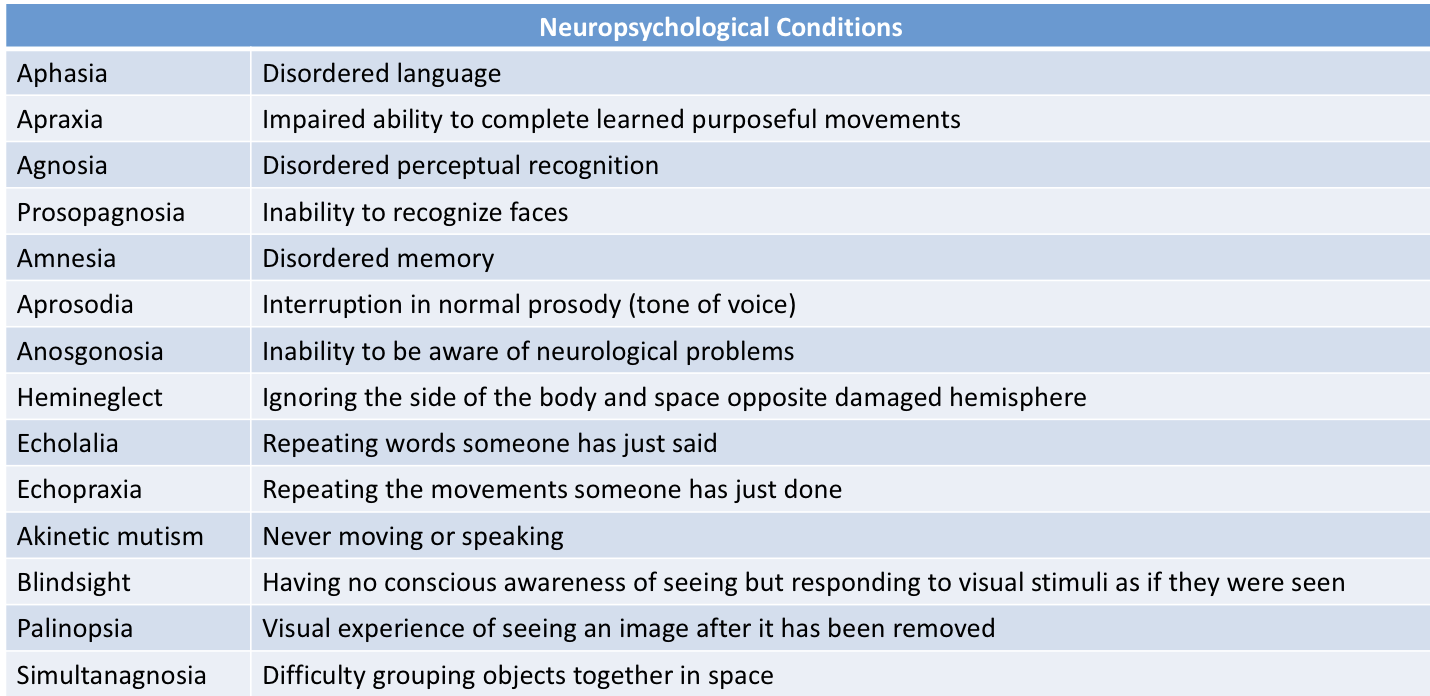
General Neuropsychological Conditions
Know the chart
Broca's aphasia
Expressive. Involves difficulty producing speech, leading to short, effortful sentences but relatively intact comprehension
Wernicke’s aphasia
Receptive. Causes fluent but often meaningless speech, “word salad” with severe comprehension problems, often with little awareness of errors
Describe the “split-brain” procedure for patients who have severe epilepsy and the effects of such procedure
Corpus callosotomy. Surgically surfing the corpus callosum, or the nerve fiber bundle connecting the brain’s hemispheres. This stops seizures from spreading. Has effect like isolating the hemispheres, allowing study of their independent functions but leading to disconnected awareness, where one hemisphere might "see" something the other doesn't report, though severe, immediate side effects often resolve, leaving potential for subtle cognitive differences
Standardized test battery approach
Administers the exact same set of tests to every patient
Individualized test battery approach
Selects tests based on the specific patient’s needs and the referral questions
 Note
Note  Flashcards (27)