N5 Biology control and communication
 Call Kai
 Learn
Learn Practice Test
 Spaced Repetition
 Match
Match Flashcards
 Knowt Play
1/19

There's no tags or description
Looks like no tags are added yet.
Name | Mastery | Learn | Test | Matching | Spaced | Call with Kai |
|---|
No analytics yet
Send a link to your students to track their progress
20 Terms
Function of endocrine glands
release hormones into the bloodstream
What are hormones?
A chemical messenger released into the bloodstream
How are only the target tissues affected by hormones
A target tissue has cells with complementary receptor proteins which are specific to a hormone
What are the three main endocrine glands?
The pancreas
Ovaries (female)
Testes (male)
Describe how the body responds to an increase in glucose
The pancreas responds by releasing the hormone insulin
Receptors in the liver detect the insulin.
In response, the liver starts to convert excess glucose into glycogen.
The blood glucose levels fall.
Describe how the body responds to a decrease in glucose
The pancreas responds by releasing the hormone glucagon.
Receptors in the liver detect the glucagon.
In response the liver starts to convert glycogen back into glucose.
The blood glucose levels rise.
When the glucose is gone, it is time for glucagon!
Describe two responses to a stimulus
A response can be a rapid action from a muscle
Or
a slower response from a gland by the release of a chemical.
Describe the components of the nervous system including the CNS
The nervous system is made up of the central nervous system (CNS) and other nerves.
The CNS consists of the spinal cord and the brain.
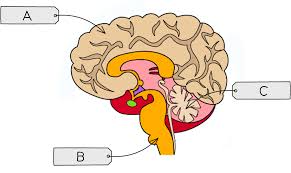
Describe the structure and function of the brain
A- Cerebrum - controls conscious thought and actions, memories and personality
B- Medulla - controls heart rate and breathing rate
C- Cerebellum - controls balance, movement and coordination
State the definition of a target tissue.
The target tissue contains special receptor proteins that will recognise the hormone.
Name and describe the function of neurons
Sensory neuron - Pass information from the senses to the CNS
Inter neuron - Located in the CNS and processes information from the senses that require a response
Motor neuron - enable a response to occur at an effector (a muscle or gland)
State the order of the reflex arc
The receptor detects a stimulus.
The message travels along a sensory neuron.
It is then passed along an interneuron.
The message travels down a motor neuron.
An effector, which is a muscle or a gland, carries out a response.
A reflex response protects the body from harm.
State the function of a reflex
Protects the body from harm
How is information carried across neurons?
An electrical impulse is carried along the nerve fibre and into
the cell body of the neuron by a sensory fibre. The cell body
then sends the impulse out through another nerve fibre called
an axon fibre. When the impulse reaches the end of the axon
there is a small gap between the axon endings of one neuron
and the sensory fibre of the next neuron.
Definition of reflex?
A rapid, automatic and involuntary response to a stimulus that protect the
body from harm.
Function of sensory neuron
Sensory (neuron) - carries/sends message/impulse/signal from sense organ → inter neuron/CNS/spinal cord
carries impulse from sense organ → inter neuron
Function of motor neuron
Motor (neuron) - carries/sends
message/impulse/signal from CNS/Inter neuron/spinal cord> muscle/organ/effector
carries impulse from inter neuron → effector
Function of inter neuron
Inter (neuron) - carries/sends
message/impulse/signal from sensory → motor neuron/within CNS
Carries impulse → motor neuron
Function of the sensory neuron
pass information to the CNS
Name the structures within the body that release hormones
Endocrine glands produce/release hormones

