Marine Zoology & Ecosystems: Marine properties
 Studied by 0 people
 Call Kai
 Learn
Learn Practice Test
 Spaced Repetition
 Match
Match Flashcards
 Knowt Play
1/73

There's no tags or description
Looks like no tags are added yet.
Name | Mastery | Learn | Test | Matching | Spaced | Call with Kai |
|---|
No study sessions yet.
74 Terms
Physiography definition
shape of sea floor- large & small scales features
spatial arrangement of those features: how they're connected/ laid out
Physiography is controlled by
broad geological process
geochemical make up of crust & mantle + heat flow= plate tectonics
Seafloor physiography: First order
underpinning control
Seafloor physiography: Second order
seawater properties and oceanographic processes & substrate properties
Seafloor physiography: Third order
biological interactions
effects of competition, predation, bioturbation, reef building
How does geology control physiography:
Earth crust= geochemically different between continent & ocean
creates different densities
Continental shelf sea:
much shallower than ocean
continent that happens to be flooded due to high sea levels
Reasonable approximation of crust & mantle
Crust= solid, brittle
mantle= viscous fluid
Crust floats on mantle
lighter continental crust floats higher than denser ocean crust
What creates strikingly broad ridges that occur on ocean floor:
results from heat flow from deep in mantel
take form or large-scale convection cells
Where does new oceanic crust originate?
In areas of high mantle heat flow.
Why does the seafloor bulge near mid-ocean ridges?
Because the underlying mantle is warm, causing the crust to expand and rise
What is the rate/type of magma input at mid-ocean ridges?
Relatively slow and steady input of magma.
Where is the youngest and warmest oceanic crust found?
At the mid-ocean ridge.
Where is the oldest and coldest oceanic crust found?
Adjacent to the continents.
How does water depth change with crustal age?
Water depth increases as crust ages because the crust cools, contracts, and becomes denser.
What major seafloor feature is created by hot, buoyant crust at spreading centres?
Ocean ridges
What hydrothermal activity is common at ridges?
Episodic hydrothermal vents.
What covers older seafloor away from the ridge?
Slowly accumulating fine sediment.
What broad, flat seafloor regions are formed by sediment covering old crust?
Abyssal plains.
Subduction:
when subduction occurs between two oceanic plates, string of volcanic islands (island arc) form
Ocean-ocean subduction:
gives rise to deepest ocean trenches
Shallow water hydrothermal environments:
occur on submarine flanks of volcanoes
Shelf sea example: North Sea
can be very shallow, considering area
mean water depth 38m
Seafloor slopes are shallow- steepest along line= 0.4% (2m height change over 500m)
Shelf sea Example: Skagerrak
500m deep channel
Many seafloor habitats in higher temp latitudes are result of global processes
most recent reached peak around 20,000 yrs ago
Shelf Seas:
Shallow but often spatially highly variable & dynamic:
Transition from shelf sea to ocean:
Stark & intricate
Main ocean basins- fundamentally different in terms of depth
Nature of transition between shelf sea (Celtic) and deep ocean (abyssal plain)
Ocean ridges:
Large scale features
Ocean ridges: Example transect from US-Mauritania
ridge flanks not too dissimilar to continental slops- offer a mix of rocks & sediments on sloping topography
sloping topography affects ocean dynamics (potentially transporting nutrients)
Argued= being very long & linear features, provide potential corridor of habitat
The tide: What are intertidal zones?
Coastal areas that are alternately exposed and submerged due to tidal cycles.
The Tide: Why do intertidal zones host diverse communities?
Organisms are specially adapted to repeated wet-dry cycles.
The tide: What types of habitats occur along intertidal coastlines?
Soft-sediment habitats and rocky shores.
The Tide: What coastal environments are strongly influenced by tides in temperate regions?
Estuaries, saltmarshes, and tidal flats.
The tide: Why are flooding and draining important for estuaries and saltmarshes?
They maintain physical structure and ecological balance.
The Tide: How do tidal currents affect larvae?
Strong currents disperse larvae.
The tide: What is the "flushing effect" of tides?
Removal of waste products, pollutants, and excess nutrients.
The tide: When do shorebirds typically feed in tidal environments?
At low tide.
The tide: How do fish and crabs use the tides?
They move in with the rising tide to feed in newly flooded areas.
The tide: How are spawning and larval release timed in many marine organisms?
They are synchronized with tidal cycles.
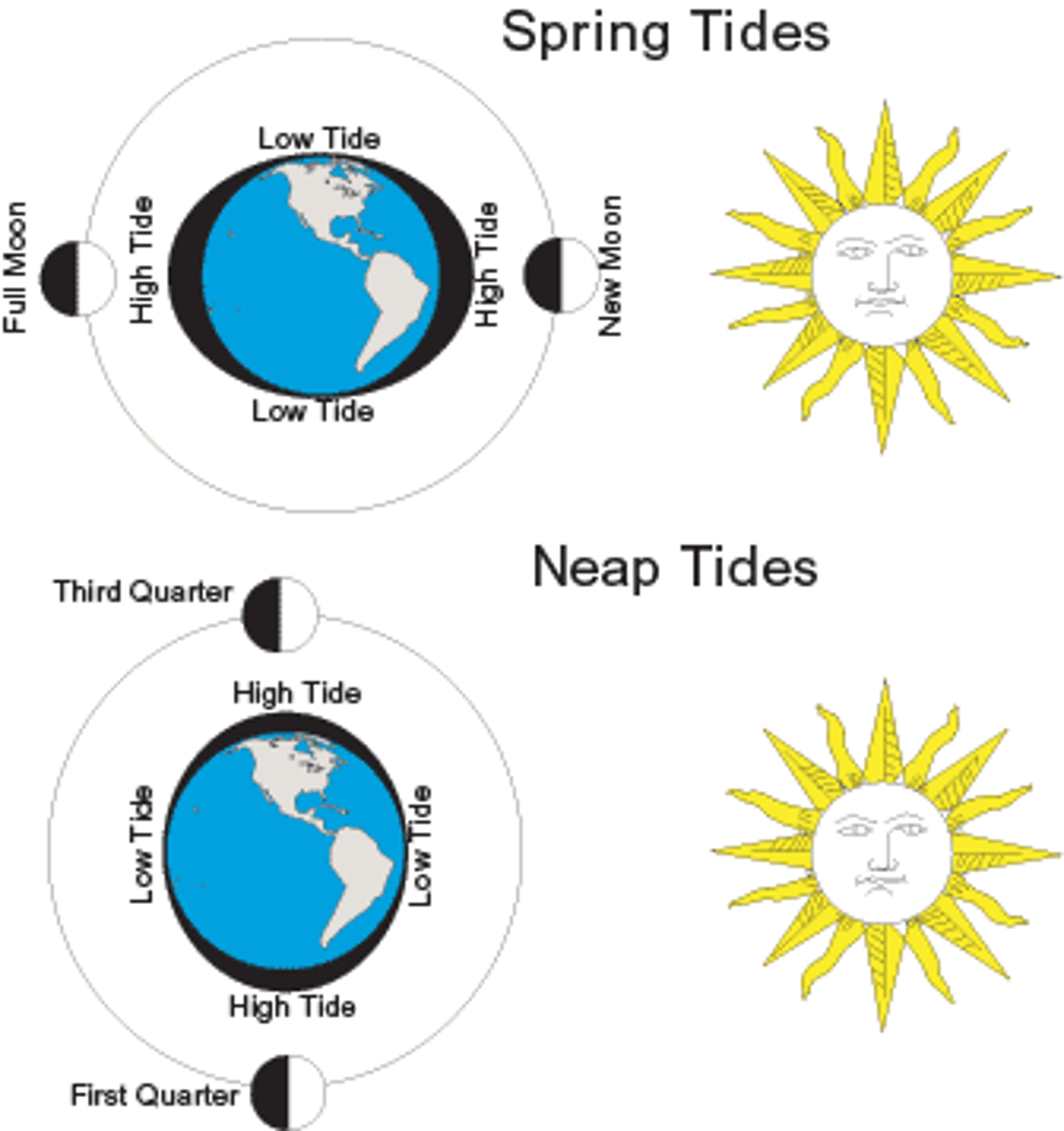
Spring-Neap Tidal cycle: What causes tides on Earth?
The combined gravitational effects of the Moon and the Sun.
Spring-Neap Tidal cycle: Which body has the stronger effect on tides, the Moon or the Sun?
The Moon.
Spring-Neap Tidal cycle: Why does the Moon have a stronger tidal effect than the Sun?
closer to earth than sun
Spring-Neap Tidal cycle: What is the tidal period associated with the Moon
Approximately 25 hours.
Spring-Neap Tidal cycle: What is the tidal period associated with the Sun
Approximately 24 hours.
Spring-Neap Tidal cycle: How strong is the Sun's tidal influence compared to the Moon's
half as strong
Tide generating force diagrams: black arrow
moon's gravitational attraction
Tide generating force diagrams: blue arrow
Centrifugal force acting on the Earth.
Tide generating force diagrams: Red arrow
net tide-generating force.
How many tides does most of the Earth experience per day
2
Semi-diurnal tide.
a tide with two highs and two lows per day
What happens to point P on Earth during one full rotation
it passes through two tidal bulges, producing two high tides
What produces tidal waves in the ocean
The tide-generating force
Why don't shelf seas directly feel the tide-generating force
They are too small relative to the scale of tidal wavelengths
How does tidal motion appear in shelf seas
Like waves travelling across the shelf, causing the ocean level to rise and fall
Coriolis effect
The effect of Earth's rotation on the direction of winds and currents.
Why does water pile up in the eastern Irish Sea
the Coriolis effect deflects moving water to the right in the Northern Hemisphere
Why is the Coriolis effect important
strongly influences weather systems and ocean circulation
How fast is Earth's surface moving at the equator
1670 km/h
Why don't we feel Earth's rotation in everyday life
the land, atmosphere, and oceans move together
How fast is Earth's surface moving near the North Pole
655 km/h
In which direction does the Coriolis effect deflect motion in the Northern Hemisphere
To the right
Which direction do tidal currents flow?
north
Kelvin Waves
wave like this that is strongly controlled by Coriolis & is bounded by coast
How does tidal range change in embayments
Increases with embayments
Funnel-shaped embayments
produces largest tidal ranges
How does the funnel shape affect tidal range
concentrates tidal energy, increasing tidal height toward the head of the embayment
What role does side-friction play in embayments
slows tidal flow and contributes to the buildup of water, enhancing tidal range
What additional effect can increase tidal range in some gulfs
Resonance between the basin shape and the tidal period
Which well-known location shows strong tidal resonance
The Gulf of Maine
Why are sea floor sediments important
fundamental control on marine habitats
How are seafloor sediments typically classified
grain size
What grain size measures are commonly used to label sediments
Mean or median grain size
Why does grain size matter for benthic organisms
influences burrowing ability, stability, oxygenation, and food availability
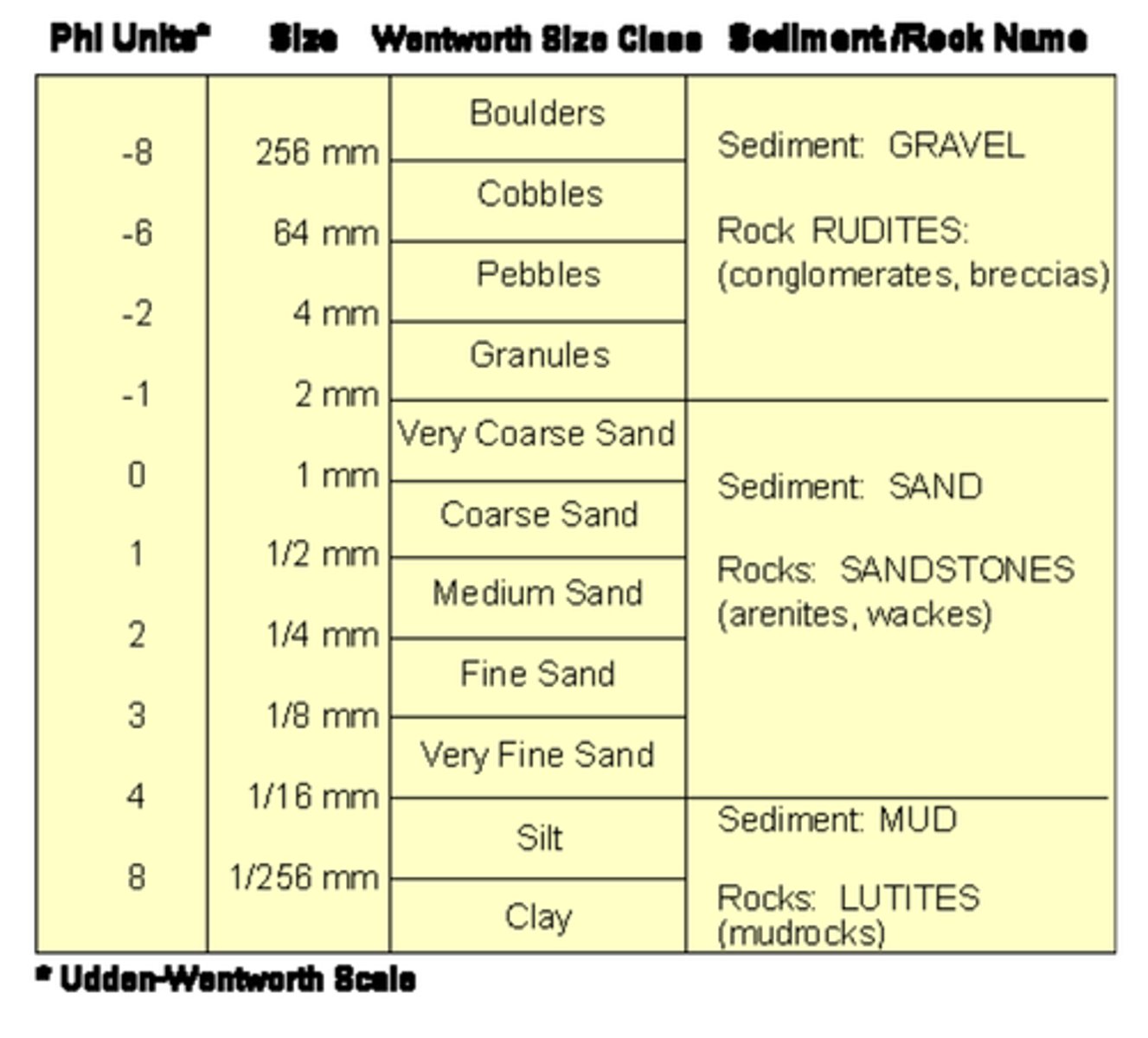
Wentworth Scale
the classification of sediments by size; a boulder is the largest grain size and clay is the smallest grain size in this classification system
Folk scale
captures little of range of sizes present
 Note
Note  Flashcards (26)