BMS 600 - Fundamentals of the nervous system and nervous tissue
 Call Kai
 Learn
Learn Practice Test
 Spaced Repetition
 Match
Match Flashcards
 Knowt Play
1/103

There's no tags or description
Looks like no tags are added yet.
Name | Mastery | Learn | Test | Matching | Spaced | Call with Kai |
|---|
No analytics yet
Send a link to your students to track their progress
104 Terms
What is the nervous system?
Master controlling and communicating system of body
How do cells communicate?
Via electrical and chemical signals that are rapid and specific and usually cause immediate responses
What are the overlapping functions of the nervous system
Sensory input, integration and motor output
What is sensory input?
Information gathered by sensory receptors about internal and external changes
What is integration
Processing and interpretation of sensory input
What is motor output?
Activation of effector organs (muscles and glands) produces a response
What are effector organs?
Muscles and glands
What are the parts of the nervous system?
Central nervous system (CNS) and peripheral nervous system (PNS)
What is the central nervous system?
brain and spinal cord of dorsal body cavity
Integration and control center
Inteprets sensory input and dictates motor output
What is the peripheral nervous system?
portion outside of CNS
Consists of mainly nerves that extend from brain and spinal cord
Spinal nerve
Cranial nerves
What are spinal nerves?
To and from spinal cord
What are cranial nerves?
To and from brain
What are the functional divisions of the PNS
Sensory (afferent) division and motor (efferent) division
What is sensory (afferent) division?
part of the PNS that transmits sensory information toward the central nervous system (brain and spinal cord) from sensory receptors in the body
Has somatic sensory fibers and visceral sensory fibers
What are somatic sensory fibers?
Convey impulses from skin, skeletal muscles and joints to CNS
What are visceral sensory fibers?
Convey impulses from visceral organs to CNS
What is motor (efferent) division?
Transmits impulses from CNS to effector organs
2 divisions
What are the sub divisions in the motor (efferent) division?
Somatic nervous system and autonomic nervous system
What is the somatic nervous system?
A voluntary nervous system that has somatic motor nerve fibers conducting impulses from CNS to skeletal muscles
What is the autonomic nervous system?
An involuntary nervous system that consists of visceral motor nerve fibers and functions to regulate smooth muscle, cardiac muscle and glands through 2 functional subdivisions
What are the subdivisions of the autonomic nervous system?
Sympathetic and parasympathetic
T/F: the sympathetic and parasympathetic division work in opposition of each other
True
What is the sympathetic division?
Mobilizes body systems during activity
What is the parasympathetic division?
Conserves energy and promotes housekeeping functions during rest
What cell types are found in nervous tissue?
Neuroglia (glial cells) and neurons (nerve cells)
What are neuroglia (glial cells)?
Small cells that surround and wrap delicate neurons
what are neurons (nerve cells)?
excitable cells that transmit electrical signals
What are the main neuroglial that support CNS neurons?
astrocytes, microglial cells, ependymal cells, oligodendrocytes
what CNS neuroglial is the most abundant?
astrocytes
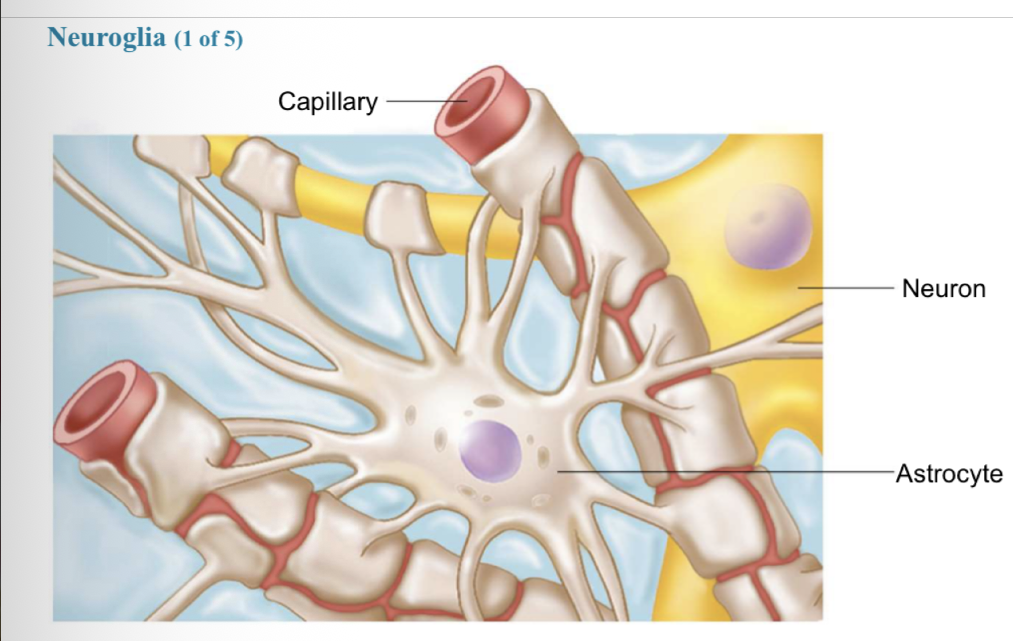
what are astrocytes?
versatile and highly branched neuroglia that cling to neurons, synaptic endings and capillaries
what are the functions of the astrocytes?
support and brace neurons
Play role in exchanges between capillaries and neurons
Guide migration of young neurons
Control chemical environment around neurons
Respond to nerve impulses and neurotransmitters
Influence neuronal functioning
Participate in information processing in brain
What are microglial cells?
small ovoid cells with thorny processes that touch and monitor neurons and can migrate toward injured neurons
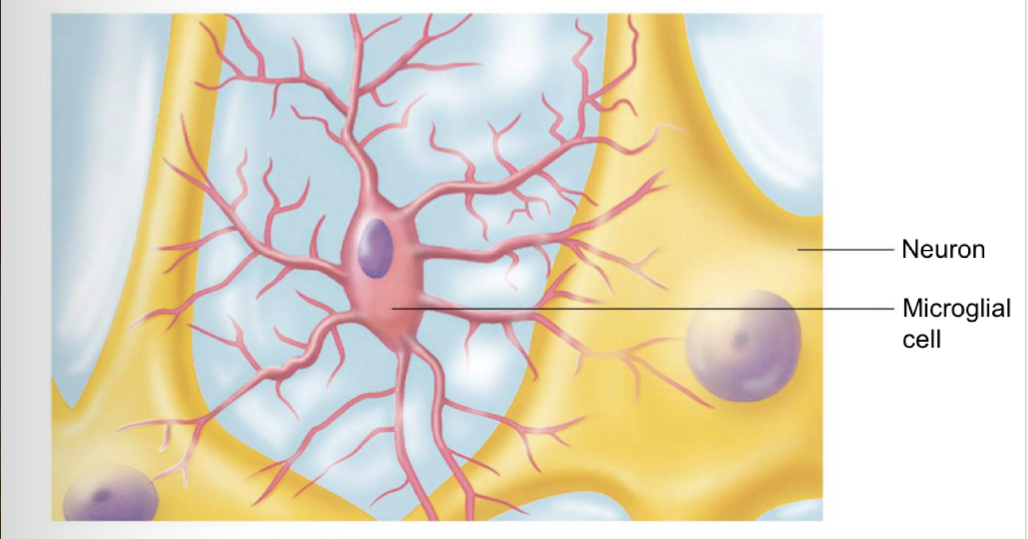
which CNS neuroglia can transform to phagocytize microorganisms and neuronal debris and are also known as defensive cells in the CNS
Microglial cells
what are ependymal cells
line cerebrospinal fluid-filled CNS cavities and forms a permeable barrier between CSF in cavities and tissue fluid bathing CNS cells
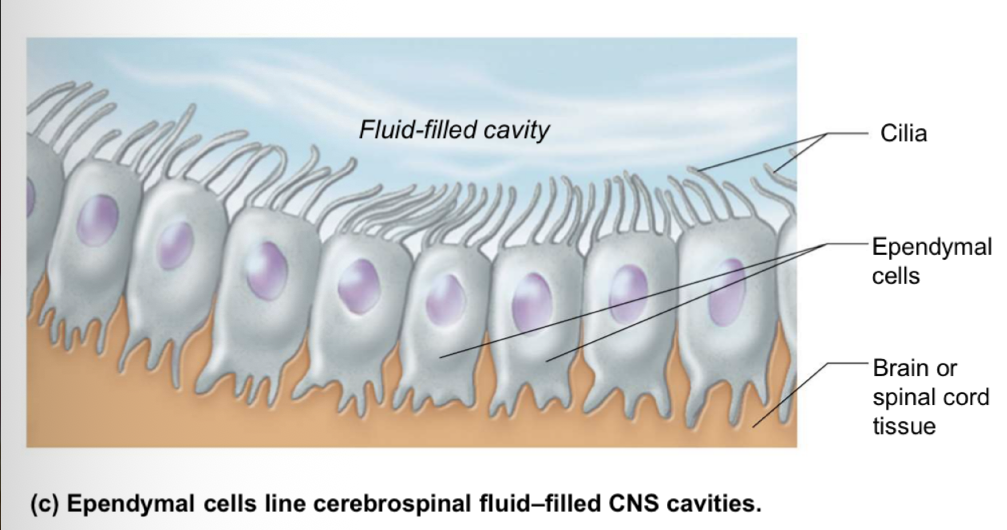
what is the structure of ependymal cells?
Can range in shape from squamous to columnar and may be cilliated
what are oligodendrocytes?
branched cells with processes that wrap CNS nerve fibers forming insulating myelin sheaths in thicker nerve fibers
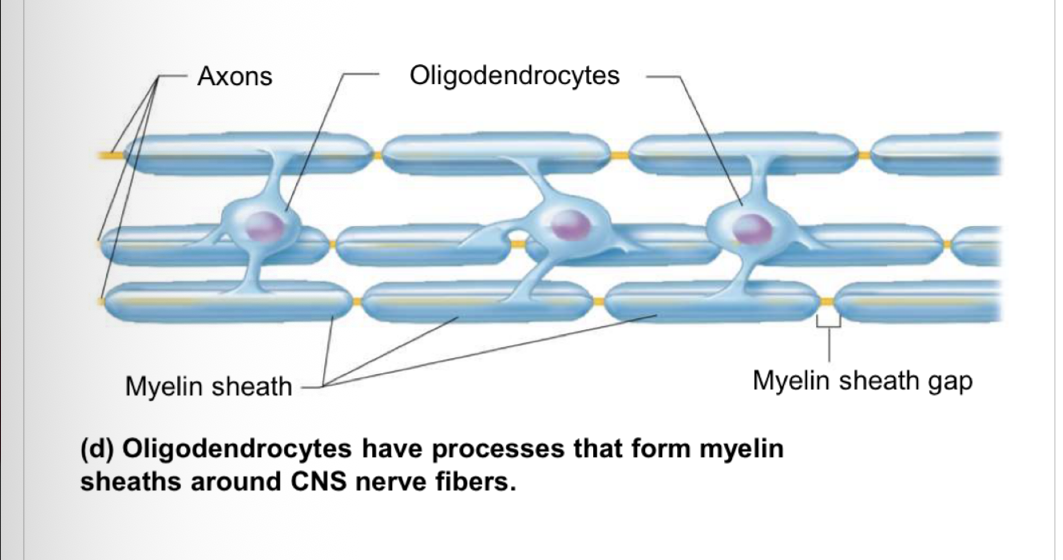
What are the neuroglia of the PNS?
satellite cells and schwann cells
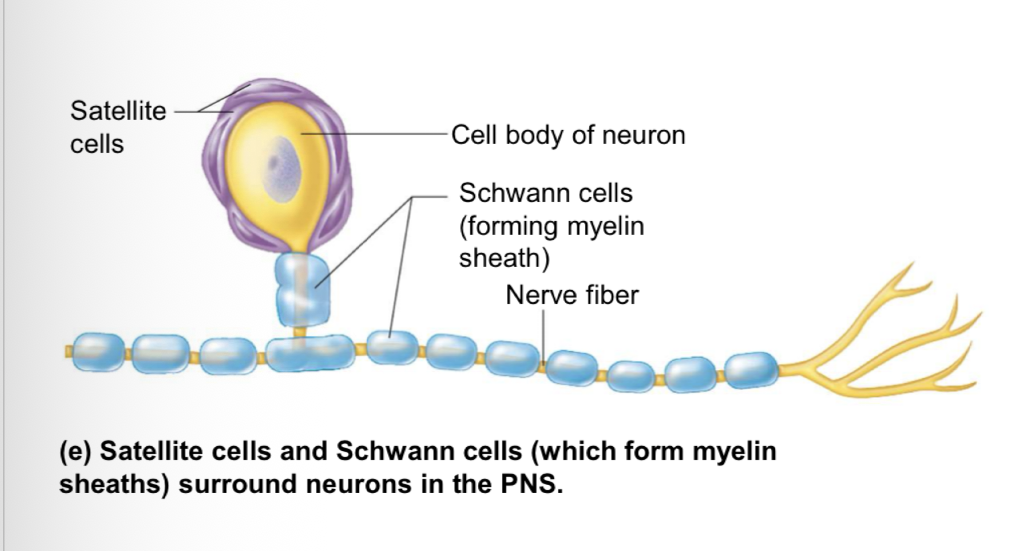
what are satellite cells?
surround neuron cell bodies in PNS and function similar to astrocytes of CNS
what are schwann cells (neurolemmocytes)
surround all peripheral nerve fibers and form myelin sheaths in thicker nerve fibers that are vital to regeneration of damaged peripheral nerve fibers
what PNS neuroglia has a similar function of oligodendrocytes?
schwann cells(neurolemmocytes)
What are neurons?
nerve cells that are structural units of nervous system and are large highly specialized cells that conduct impulses
what are the special characteristics of neurons?
extreme longevity (can last a lifetime)
Amitotic, with few exceptions
High metabolic rate: requires continous supply of oxygen and glucose
What does amitotic mean?
Neurons lose the ability to divide and reproduce via mitosis once they reach maturity
How many cell bodies and processes do neurons have?
every neuron has a cell body and one or more processes
what is the neuron cell body
biosynthetic center and receptive region of neuron it synthesizes proteins membranes chemicals and contain rough ER
what is the structure of cell body?
contains spherical nucleus with nucleous, some contain pigments
what is the receptive region of the cell body?
in most the plasma membrane is part of receptive region that receives input info from other neurons
where are most neuron cell bodies located?
CNS
what are nuclei?
clusters of neuron cell bodies in CNS
what are ganglia?
clusters of neuron cell bodies in PNS
what are neuron processes?
Armlike process that extend from cell body
Neuron processes in CNS
bundles of neuron processes are called tracts and contains both neurons cell bodies and their processes
neuron processes in PNS
bundles of neuron processes are called nerves and the PNS contains chiefly neurons cell bodies processes (whose cell bodies are in CNS)
what are the types of neurons cell processes?
dendrites and axons
what are dendrites?
Receptive regions of a neuron that convey incoming messages toward cell body as graded potentials (short distance signals)
what neuron processes contain same organelles as in cell body?
dendrites
when are finer dendrites seen?
found in many brain areas because they are highly specialized to collect information and contain dendritic spines
what are dendritic spines?
appendages with bulbous or spiky ends
What is the structure of axon?
axon hillock, nerve fibers, axon collaterals, axon terminals/terminal boutons
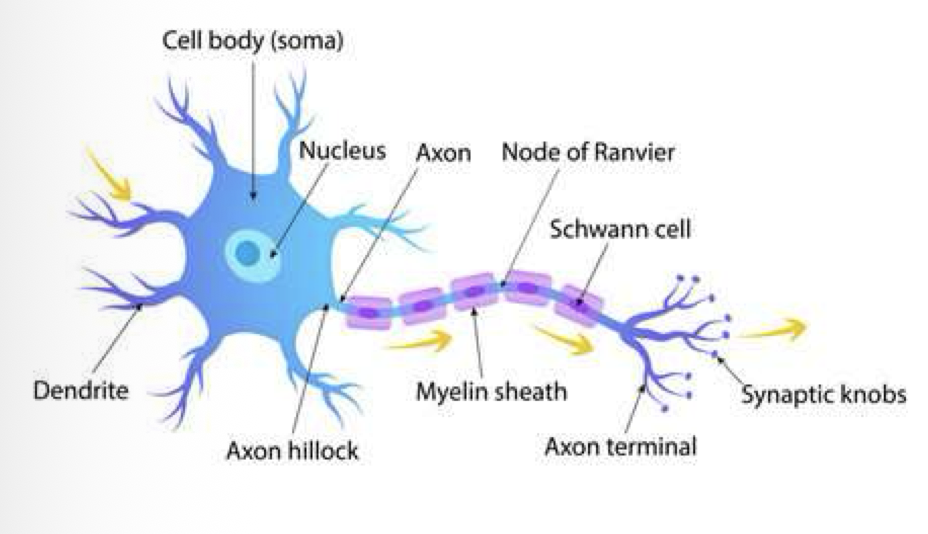
what are axon hillock
each neuron as one axon that starts at cone-shaped area
how long can axons be?
in some neurons axons are short or absent; in others axons can comprise almost the entire length of the cells, some can be over 1 meter long
what are nerve fibers?
long acons
what are axon collaterals?
occasional branches in axons
what are axon terminals/terminal boutons
distal endings and axons can branch profusely at their end
What are the functional characteristics of the axon?
conducting region of neuron
Generates nerve impulses and transmits the along axolemma to axon terminal
Can carry on many conversation with different neurons at the same time
what is the axolemma?
neuron cell membrane
which part of the axon secretes neurotransmitters?
terminal region secretes neurotransmitters , which are released into extracellular space
what is the myelin sheath composed of?
myelin which is a whitish protein-lipid substance
what is the funciton of myelin?
protect and electrically insulate axons and can increase speed of nerve impulse transmission
what are myelinated fibers?
segmented sheath surrounds most long or large-diameter axons
what are nonmyelinated fibers?
do not contain sheath so the conduct impulses more slowly, surrounded by Schwann cells but no coiling
Myelination of a nerve fiber in the PNS
schwann cell envelops an axon
Schwann cell rotates around axon wrapping its plasma membrane loosely around it in successive layers
Schwann cells cytoplasm is forced from between the membranes
Tight membrane wrappings surrounding the axon form the myelin sheath
What are myelin sheaths gap?
gaps between adjacent schwann cells and sites where axon collaterals can emerge
Why are plasma membranes good electrical insulators?
they have less proteins so no channels or carriers
myelin sheaths in tthe CNS
formed by processes of oligodendrocytes, not whole cells
Each cell can wrap up to 60 axons at once
Myelin sheath gap is present
What is white matter?
regions of brain and spinal cord with dense collections of myelinated fibers, usually fiber tracts
what is gray matter?
mostly neuron cell bodies and nonmyelinated fibers
How to classify neurons
neurons are grouped by the direction in which nerve impulses travels relative to CNS
what are the types of neurons?
sensory, motor, internneurons
what are sensory neurons?
transmit impulses from sensory receptors to CNS
Almost all are unipolar
Cell bodies are located in ganglia in PNS
what are motor neurons?
carry impulses from CNS to effectors
Multipolar
Most cell bodies ate located in CNS (except some autonomic neurons)
What ate interneurons (association neuons)?
between motor and sensory neurons
Shuttle signals through CNS pathways
Most are entirely within CNS
What type of neuron makes up 99% of body’s neurons?
internneurons
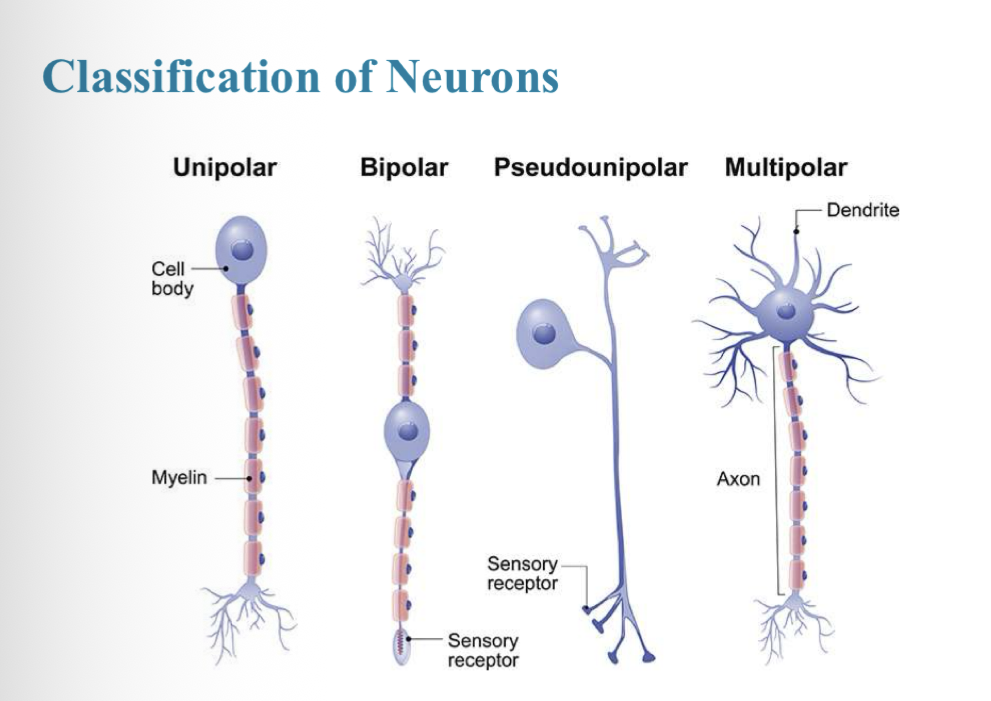
What are the types of structural morphology of neurons?
Unipolar, bipolar, psuedounipolar, multipolar
T/F: unlike most other cells, neurons can rapidly change resting membrane potential
true
what is the role of membrane ion channels?
large proteins serve as selective membrane ion channels, (K+ ion channels only allow K+ to pass through)
what are the types of ion channels?
leakage (nongated) and gated channels
what are leakage (nongated) channels
always open
what are gated channels?
part of the protein changes shaped to open/close the channel
what are the types of gated channels?
chemically gated, voltage-gated or mechanically gated
what are chemically gated (ligand-gated) channels?
open only with binding of a specific chemical (ex. Neurotransmitter)
what are voltage-gated channels?
open and close in response to changes in membrane potential
what are mechanically gated channels?
open and close in response to physical deformation of receptors, as in sensory receptors
How do ions diffuse in gated channels?
in chemical concentration gradients from high to low concentration
Along electrical gradients towards opposite electrical charge
What is a voltmeter?
measures potential (charge) difference across membrane of resting cell
what is the resting membrane potential of a resting neuron?
approximately -70 mV
what does it mean by the membrane is polarized?
different in electrical charges between outside and inside
which side of the membrane is more negative?
cytoplasmic side of membrane is negatively charged relative to the outside
what is the actual voltage difference?
varies from -40mV to -90mV
how are resting membrane potential generated?
differences in ionic compositiion of ICF and ECF and differences in plasma membrane permability?

