Hearing Science Test 2
 Studied by 0 people
 Call Kai
 Learn
Learn Practice Test
 Spaced Repetition
 Match
Match Flashcards
 Knowt Play
1/86

There's no tags or description
Looks like no tags are added yet.
Name | Mastery | Learn | Test | Matching | Spaced | Call with Kai |
|---|
No analytics yet
Send a link to your students to track their progress
87 Terms
What are the main anatomical parts of the outer ear?
Pinna and outer ear canal/eternal auditory meatus
What are the main functions of the outer ear?
- Collect sound
- sound pressure gain (amplifies middle frequencies 1-5 kHz, peaks at 2.5 kHz b/c it's the ear canal's f0)
- sound localization (creates unique spectral cues (HRTF) while brain uses tiny differences in intensity and phase/timing of sound between ears to pinpoint location)
- protection of tympanic membrane (physical barrier and ear canal produces protective cerumen)
What is the head-related transfer function (HRTF)?
Spectral changes to the sound wave due to sound bouncing off parts of the body
What is one main function for the pinna?
- sound localization in the midplane (if sound source is directly in front/behind/above/below you, both ears receive sound at the same time (equidistant))
Does the f0 of the EAC different for children?
- Yes, typically higher since children's ears are smaller and EAC is shorter
Amplification of sound is...
frequency dependent
Name the anatomical structures in the middle ear.
- TM (tympanic membrane)
- three auditory ossicles (malleus, incus, stapes)
- two middle ear/tympanic muscles (tensor tympani, stapedius muscle/tendon)
- ET (Eustachian tube)
What are the two main functions of the middle ear?
sound transmission and protection of hearing
What is acoustic impedance?
is the acoustic resistance to sound traveling in a medium
How does the middle ear help in sound transmission?
- Amplification in the middle frequencies (peaks around 1 kHz)
- three mechanisms for impedance mismatch: Area ratio, Lever system, Buckling of TM
What is the problem with sound transmission in the middle ear?
- the huge difference between the low-impedance air of the ear canal and the high-impedance fluid of the inner ear (cochlea), causing most sound energy (around 99.9%) to reflect away instead of being transmitted
- the middle ear uses three main mechanisms to boost sound pressure (Area ratio, Lever system, Buckling of TM)
- These combined effects boost the sound pressure by about 20-30 dB (over 30 times)
Mechanism 1 to Solve Impedance Mismatch Problem: Area Ratio
The eardrum (tympanic membrane) is much larger than the stapes footplate (which connects to the inner ear), collecting sound over a large area and focusing it onto a small point, increasing pressure.
Mechanism 2 to Solve Impedance Mismatch Problem: Lever Action
The malleus and incus bones act as a lever, providing a mechanical advantage that further amplifies the force of the vibrations transferred to the stapes.
Mechanism 3 to Solve Impedance Mismatch Problem: Buckling of the TM/Eardrum
The eardrum doesn't move like a flat piston; its curved shape adds to the pressure increase.
What mechanism protects hearing in the middle ear?
- Acoustic reflex: After receiving intense sounds, the two middle ear muscles are contracted to to stiffen the ossicular chain and lower the sound transmission in the middle ear, thus providing a protection to the inner ear
How does the tensor tympani muscle help to protect the middle ear?
contracts and increases tension on the tympanic membrane with intense sounds
How does the stapedius muscle help to protect the middle ear?
contracts to stiffen stapes and works with the tensor tympani during high intensity sounds to limit the motion of the ossicles and protect the inner ear
What are the general anatomical parts of the inner ear?
Vestibule (vestibular apparatus) and cochlea
Describe the anatomy of the cochlea.
- embedded in the temporal bone, medial to the middle ear cavity
- coiled shape with about 2.5 turns around a bony, hollow core called modiolus
Parts:
- Three scalae (scala vestibuli, scala media/cochlear duct (Organ of Corti inside), scala tympani)
- Two membranes to separate scalae (Basilar membrane and Reissner's membrane)
- Helicotrema: joint opening at apex of cochlea for scala vestibuli and tympani
Organ of Corti (and its cells)
- Organ center part of the cochlea, containing hair cells, supporting cells, canals, and membranes
- Hair cells: Consists of one row of inner hair cells and 3-5 rows of outer hair cells, 15,000 hair cells in each ear in man, outer and inner hair cells are auditory receptors
- Supporting cells (SC): Structurally and metabolitically support the OHCs and IHCs
Inner vs Outer Hair Cells
- inner hair cells (IHCs) are the primary sensory receptors that transmit sound information to the brain
- outer hair cells (OHCs) act as amplifiers that mechanically boost incoming sounds to improve hearing sensitivity and clarity
helicotrema
the opening that connects the tympanic and vestibular canals at the apex of the cochlea
What is auditory nerve innervation?
- the process where nerve fibers from the inner ear's hair cells convert sound vibrations into electrical signals, which travel via the auditory nerve (Cranial Nerve VIII) to the brainstem and then to the auditory cortex for interpretation as sound
- involves neurons from the spiral ganglion extending to inner and outer hair cells in the cochlea, with 95% innervating inner hair cells, the primary sound receptors, and the rest innervating outer hair cells for amplification.
What is the role of inner and outer hair cells?
- to aid in auditory nerve innervations
- many-to-one (IHC) pattern (Multiple Type I spiral ganglion neurons (SGNs) converge to connect with a single Inner Hair Cell)
- one-to-many (OHC) pattern (A single Type II SGN branches out to connect with multiple Outer Hair Cells)
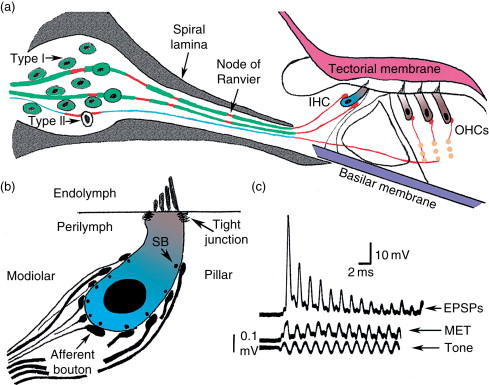
What does it mean for a nerve to "innervate" a hair cell?
- means a nerve fiber forms a functional connection (a synapse) with the hair cell, allowing them to communicate, typically for sensory input where the hair cell converts sound/motion into neurotransmitters, which the nerve then carries as electrical signals to the brain
How does sound transmission work in the cochlea?
- the cochlea converts mechanical vibrations into electrical signals
Steps:
- Middle ear bones (ossicles) amplify sound, pushing fluid in the coiled cochlea (piston motion of stapes), causing the basilar membrane to vibrate at specific spots for different pitches (high at base, low at apex)
- This movement bends hair cells in the Organ of Corti, opening ion channels, creating electrical signals (neurotransmitters) that travel via the auditory nerve to the brain, which interprets pitch and loudness
What is a traveling wave?
- The changing pressure due to the stapes motion is transferred to deformation of the basilar membrane
- The basilar membrane responds by propagating a traveling wave that travels from the base to the apex (wave starts excitement of hearing cells)
- Reissner's membrane's traveling wave less relevant
Explain the basilar membrane response.
- Traveling Wave Formation: Incoming sound vibrations transmitted to the inner ear's fluid generate a traveling wave along the basilar membrane that moves from the base toward the apex.
- Tonotopic Organization: The membrane is structured so that different regions respond maximally to different sound frequencies.The base (near the oval window) is narrow and stiff, resonating with high-frequency sounds.The apex (far end) is wider and more flexible, resonating with low-frequency sounds.
- Mechanical Transduction: The movement of the basilar membrane causes the stereocilia (tiny "hairs") of the sensory hair cells in the Organ of Corti to bend against the tectorial membrane.
- Signal Generation: This bending of the hair cells triggers the opening of ion channels, which depolarizes the cells and generates electrical signals (neurotransmitters) that are transmitted to the auditory nerve and then to the brain.
- Non-linearity and Amplification: The response is highly sensitive and non-linear, especially for low-level sounds near the characteristic frequency (CF) of a specific region. This enhanced sensitivity and frequency discrimination are actively amplified by the outer hair cells, a process known as the "cochlear amplifier".
What graph shows the Basilar membrane's response?
- a Tuning curve of BM response (signal frequency on x-axis, BM displacement on y-axis)
- the highest peak represents the characteristic frequency of that part of the BM
Which kind of tuning curve is better?
- sharper (more concentrated/precise energy response)
- broader tuning curve is bad b/c it reduces the precision and discrimination capability for specific stimuli
What is a characteristic frequency?
- frequency at which neuron is most responsive, garners the highest BM response
The Basilar membrane is __ organized with a roughly __ distribution, meaning it's __ dependent.
tonotopically, logarithmic, frequency
What's a neurotransmitter?
a chemical messenger that nerve cells use to communicate with each other and with other target cells, such as muscle or gland cells
What is the resting state of a neuron?
-70mV
What are stereocilia?
- tiny, hair-like structures on the surface of sensory hair cells in the inner ear that are crucial for hearing and balance
What is the nonlinearity of BM responses at CF?
- a compressive, level-dependent amplification driven by Outer Hair Cells (OHCs), making low-level sounds highly sensitive and sharply tuned (like a bandpass filter) while intense sounds become less sensitive, poorly tuned, and "flatten" (compressive) to extend hearing rang
What does non-linear compression in the basilar membrane mean and how is it presented?
- means its vibration doesn't grow proportionally with sound intensity
- Ex: When the amplitude of an acoustic stimulus increases by 10 dB, the BM responds by a much smaller amount (less than 10 dB, perhaps 1 or 2 dB in a healthy ear)
- *for individuals with hearing loss, the slopes of their BM responses get much steeper (losing non-linear compression)
- represented on a tuning curve
What does the "intensity resolution" for the basilar membrane (BM) mean?
- refers to how the auditory system encodes the differences in sound volume (intensity)
- primarily characterized by a compressive non-linearity in the BM's response to different sound levels, particularly at a specific location's characteristic frequency (CF)
What is the organization of the auditory pathway of the nervous system?
- Auditory neuron (nerve): This is the peripheral part, carrying electrical signals from the cochlea (inner ear) into the brainstem
- Nuclei in auditory brainstem: These are relay stations (like the cochlear nucleus, superior olivary complex, inferior colliculus) that receive signals from the nerve, process basic features (timing, intensity, frequency), and help with sound localization.
- Auditory forebrain: this includes the Medial Geniculate Nucleus (thalamus), which relays sound, and the Auditory Cortex (in the temporal lobe), where sounds are consciously perceived, analyzed, and given meaning.
Name the two types of auditory fibers and their location.
- Type I and Type II
- Extend from the spiral ganglion
- Type I: 90 - 95% of spiral ganglion cells, connected to IHC, many to one (20 fibers to one IHC in human)
Type II: 5 - 10% of spiral ganglion cells, connected to OHC, one to many. (one fiber to 10 OHC in human)
What are 90-95% of spiral ganglion cells? What are they connected to?
- Type I SGNs, which form synapses with the Inner Hair Cells (IHCs) in the cochlea
What are key physiological features of auditory neurons?
1. Spontaneous firing (when there is no NO SOUND & neurons fire themselves) and thresholds
2. tuning curve (frequency selectivity)
3. intensity resolution
4. phase locking up to 5 kHz
Spontaneous firing and thresholds
- there are low, medium, and high spontaneous firing rates (nerve with high rate means its the easiest to get excited)
- Higher spontaneous firing rate is associated with lower threshold
- high: > 18 times/sec, low: < 0.5 times/sec, medium is anything in between
Frequency-threshold curve (FTC)
- tuning curve that shows a nerve's frequency selectivity, plotting the minimum sound level (threshold) needed to trigger a response against different sound frequencies, typically forming a V-shape with a Characteristic Frequency (CF) (best frequency) where sensitivity is highest
- each tuning curve is for a singular auditory neuron
- lowest point/trough is the characteristic frequency (lowest SL needed to excite neuron)
Intensity Resolution of a neuron
- Intensity resolution refers to the smallest detectable change in stimulus intensity that a neuron can reliably encode (seen on rate vs level functions)
- threshold and saturation define the limits of a neuron's operational range:
- threshold: the minimum stimulus intensity required to evoke a response (action potential) from a neuron - the "floor"
- saturation: the maximum response rate a neuron can achieve, no matter how much stronger the stimulus becomes - the "ceiling"
- Dynamic range (the range over which a neuron can effectively discriminate changes in stimulus strength): 20 - 50 dB for most neurons
What is neural phase locking?
- when auditory neurons synchronize their firing to a specific phase of a periodic sound wave
- temporal pattern of the neural firing
- frequency limit of phase locking: up to about 4-5 kHz
What are the four nuclei of the auditory brainstem?
- the Cochlear Nuclei (AVCN, PVCN, DCN; complex response patterns)
- the Superior Olivary Complex (receive bilateral inputs, localize sound)
- the Nuclei of the Lateral Lemniscus
- the Inferior Colliculus (combine the analysis of complex sound and the direction in space simultaneously)
Which structures are part of the auditory forebrain?
- Medial Geniculate Body (MGB): Processes and relays specific detailed auditory information to the auditory cortex
- Auditory cortex: Consists of primary auditory cortex (AI) and secondary auditory cortex (AII)
Physiology of Auditory Cortex
- Response of single neurons: detection of complex features (frequency-modulation detectors, temporal-modulation detectors, auditory attention neurons (respond only to new stimuli)) and binaural hearing (the processing of sound information coming from both ears simultaneously)
Define psychoacoustics
- study of how humans perceive sound and its psychological and physiological effects
What are the 2 main acoustic features of sound and their psychological equivalents?
- frequency → pitch
- intensity → loudness
What are the three main auditory tasks?
- auditory sensitivity (detection) → hear sound
- auditory discrimination → recognize whether sound is different than others
- auditory identification (recognition) → identify sound
What methods are used in psychoacoustic studies?
- Method of limit
- method of constant stimuli (psychometric function)
- scaling method (ratio scale and magnitude scale)
Method of limit
- Ascending (from SL you can't hear→SL you can hear) and descending (from SL you can hear→SL you can't hear); adaptive procedure that alters SL based on whether previous response was correct
- Fixed step size, trail design, reversal design
- Threshold: average over reversals (smallest 4)
- 7 minimum reversals required (3 big, 4 smaller)
- 60 trials (minimum to get 7 reversals generally)
What is threshold?
the lowest intensity level that a person is able to hear a certain percentage of the time
Descending direction for MOL testing usually gives a __ threshold
- lower (than ascending), people are more "liberal" and want to hold on until they really can't hear
Ascending direction for MOL testing usually gives a __ threshold
- higher (than descending), people don't want to raise hand until they are 99% sure they can hear sound
Advantages and Disadvantages of MOL
- Advantages: time efficient
- Disadvantages: don't have much data far from threshold→ not as comprehensive
What are the "Up-Down Rules" in the Method of Limits?
- dictates how the intensity of the tone is adjusted based on the patient's response
- ex; one down - one up rule: if subject gets one correct, SL goes down 1 step (one down), and if they get 1 incorrect, SL goes up 1 step (one up)
- can be more or less strict (one down-two up least, three down-one up most)
Method of Constant Stimuli
- Equal number of stimuli at each level (# of presentations constant (min. 10) and determined by clinician)
- Psychometric function (shows floor, dynamic range, & ceiling; dynamic range is what we're most interested in because if SL changes, perception changes, once you get to ceiling perception no longer changes)
- Threshold: a certain percentage point
Advantages and Disadvantages of MOCS
- Advantages: comprehensive data
- Disadvantages: rime-consuming
Direct Scaling Method
- Directly establishes the correspondence between physical sounds and their perception (Loudness and pitch)
- Ratio scale (Compared to the reference sound; sound is __ times louder than reference sound)
- Magnitude scale (No reference sound provided; play signal directly after)
What is auditory masking?
Interference that one stimulus causes in the perception of another stimulus
What are the two types of maskers?
- Tonal masker: signal and masker are both tones (Masking efficiency is dependent on the intensity level and frequency of the tonal masker; seen on psychoacoustic tuning curve)
- Noise masker
What is masking efficiency and what determines the amount of masking?
- the difficulty that the masker provides the detection of the signal (can calculate: a subject's performance score in quiet-a subject's performance score in noise)
- Depends on the frequency and level of the signal and masker; generally the broader frequency in noise, the more effectively it masks
Does every frequency in the masker have the same masking efficiency?
- No, if each masker frequency gave the same contribution to the masking process, the curves would become flat
- masker that's closer to the signal has more contribution to masking
Perceptually the auditory system plays a role as a __ that filters out noise frequencies far away from the __.
- filter, signal frequency
What can act as maskers?
Various sounds that interfere with perception of target sound
What does the psychoacoustic tuning curve show?
Frequency selectivity
Define auditory filter.
- a theoretical model of the ear's frequency selectivity, acting like a bandpass filter that lets certain frequencies through while blocking others
If sound fall outside of our auditory filter, what does that mean?
- they acoustically exist, but are not perceptually present
Is a wider auditory filter better?
- No, it allows more noise in and more interference
- also causes spectral smearing (formants not accurately represented to BM; amplification does not fix this problem)
- can be caused by hearing damage and natural decrease in auditory function with age
How is auditory filter bandwidth measured?
- Measured by a notch noise method
- Equivalent rectangular bandwidth (ERB)
- For a given signal frequency, the bandwidth of the auditory filter at this frequency for normal-hearing listeners is: ERB (in Hz) = 24.7 (4.37 f (in kHz) + 1); how wide auditory filter is
What factors affect auditory filter bandwidth?
Signal level (higher signal level, broader bandwidth of auditory filter) and hearing status
Define loudness.
Attribute of auditory sensation in terms of which sound can be ordered on a scale from quiet to loud
How is loudness measured?
1. Matching method:
- Reference sound: 1 kHz tone at 40, 50... dB SPL
- Listeners are asked to adjust the level of the target sound to match the loudness of the reference sound
- equal loudness contour
2. Scaling method:
- Reference sound: 1 kHz tone at 40 dB SPL defined as 1 sone
- Listeners are asked to scale the loudness level of the target sound relative to the loudness of the reference sound
- Loudness growth function (Loudness recruitment)
What is loudness recruitment?
- an abnormal phenomenon in sensorineural hearing loss where a small increase in sound intensity leads to a much larger, faster perceived increase in loudness
What is the equal loudness contour?
- a graph that shows how much sound pressure is needed at different frequencies to be perceived as having the same loudness
What factors affect loudness?
- Intensity level
- Frequency (broadband, narrowband); Loudness summation
- Duration
What's a sone?
- a perceptual unit of loudness used to create a linear scale that reflects subjective human judgment
- One sone is defined as the loudness of a 1-kilohertz (kHz) tone presented at 40 dB SPL
- The key feature of the sone scale is its linearity: a sound with a loudness of 2 sones is perceived as exactly twice as loud as a sound of 1 sone; a sound of 4 sones is twice as loud as 2 sones, and so on.
Loudness summation
- the perceptual phenomenon where sounds combined either across both ears (binaural) or across a wider frequency range (spectral) are perceived as significantly louder than the sum of their individual parts
Define pitch.
Attribute of auditory sensation in terms of which sounds may be ordered on a musical scale
How is pitch measured?
1. Matching method:
- Reference sound: a tonal sound
- Listeners are asked to adjust the frequency of the reference sound to match the pitch of the target sound
2. Scaling method
- Reference sound: 1 kHz tone defined to have a pitch at 1000 mel
- Listeners are asked to scale the pitch value of the target sound relative to the pitch of the reference sound - 1 kHz
- Hard to measure due to the complexity of pitch
What is the pitch of complex sounds?
1. Missing fundamentals - complex tones
- Listeners can perceive a pitch for complex tones that do not have any spectral components at the perceived pitch
- Envelope-periodicity theory: periodicity of the complex sound waveform
- Spectral-location theory: spectral distance between tones
2. Pitch of noise - aperiodic sound
- Noise spectrum shows peaks at several frequencies with equal distance
- Support the spectral-location theory
Envelope-periodicity theory
- describes how the brain analyzes sound's slower amplitude changes (envelope) and faster, regular patterns (periodicity) to understand speech, identify instruments, and perceive pitch, recognizing these as distinct but interacting cues for features like timbre, articulation, and fundamental frequency (F0)
Spectral-location theory
- says pitch is identified by where along the cochlea's basilar membrane sound vibrations peak, not just the frequency itself, with high tones activating the base and low tones the apex, letting the brain map location to pitch
LISTEN TO PODCAST FOR AUDITORY SENSITIVITY
yes ma'am 🫡
 Note
Note  Flashcards (169)