Economics Midterm
0.0(0)
Studied by 8 people Call Kai
 Learn
Learn Practice Test
 Spaced Repetition
 Match
Match Flashcards
 Knowt Play
Card Sorting
1/101

Last updated 9:13 PM on 12/15/22
Name | Mastery | Learn | Test | Matching | Spaced | Call with Kai |
|---|
No analytics yet
Send a link to your students to track their progress
102 Terms
1
New cards
Income Effect
the portion of a **change in quantity demanded caused by a change in the consumer's real income** when the price of the product changes
2
New cards
Social Security
federal program of disability and **retirement benefits** that covers most working people
3
New cards
Consumer Sovereignty
role of **consumer as ruler** of the market when determining the types of goods and services produced
4
New cards
Collusion
agreements, usually illegal, among producers to **fix prices, limit output, or divide markets**
5
New cards
Trade-Off
alternatives that must be **given up** when one is chosen rather than another
6
New cards
Value
**worth** of a good or service as determined by the market
7
New cards
Price
**monetary value** of a product as established by supply and demand
8
New cards
Good
tangible economic product that is **useful, relatively scarce, transferable to others**; used to satisfy wants and needs
9
New cards
Consumer Good
**good** intended for final use by **consumers** rather than businesses
10
New cards
Rebate
partial **refund** of the original price of a product
11
New cards
Better Business Bureau
**business-sponsored** nonprofit organization providing information on local companies to consumers
12
New cards
Marginal Utility
**satisfaction or usefulness** obtained from acquiring one more unit of a product
13
New cards
Free Enterprise
market economy in which privately owned businesses have **freedom** to operate for a profit with little government intervention
14
New cards
Inelastic
Demand - when a change in price causes a **small** change in demand
Supply - when a small increase in price causes **little** change in supply
Supply - when a small increase in price causes **little** change in supply
15
New cards
Entrepreneur
**risk-taking** individual in search of profits
16
New cards
Law of Demand
**rule** stating that more will be **demanded** at lower prices and less at higher prices
17
New cards
Paradox of Value
apparent contradiction between the **high value of nonessentials and low value of essentials**
18
New cards
Excess Demand
shortage
19
New cards
Stock
**certificate of ownership** in a corporation; common or preferred stock
20
New cards
Chamber of Commerce
nonprofit organization of local businesses whose purpose is to **promote their interests**
21
New cards
Fixed Income
income that **does not increase** even though prices go up
22
New cards
Economic System
organized way a society provides for the **wants and needs of its people**
23
New cards
Human Capital
sum of people's **skills, abilities, health, and motivation**
24
New cards
Microeconomics
**branch of economic theory** that deals with behavior and decision-making by **small** units such as individuals and firms
25
New cards
Elasticity
a measure of responsiveness that tells us how a **dependent variable such as quantity responds to a change in an independent variable such as price**
26
New cards
Competition
the **struggle** among sellers to attract consumers while lowering costs
27
New cards
Private Property Rights
fundamental feature of capitalism, which allows **individuals to own and control their possessions as they wish**
28
New cards
Depreciation
gradual **wear** on capital goods during production
29
New cards
Product Market
**market** where **goods** and **services** are offered for **sale**
30
New cards
Unit Elastic
Demand - when a change in price causes a **proportional** change in demand
Supply - when a change in price causes a **proportional** change in supply
Supply - when a change in price causes a **proportional** change in supply
31
New cards
Elastic
Demand - when a change in price causes a **large** change in demand
Supply - when a small increase in price leads to a **larger** increase in output and supply
Supply - when a small increase in price leads to a **larger** increase in output and supply
32
New cards
Demand
combination of **desire, ability, and willingness to buy a product**
33
New cards
Excess Supply
surplus
34
New cards
Stockholders/Shareholders
person who owns **shares** in a corporation
35
New cards
Capitalism
economic system in which private **citizens** own and use the factors of production in order to **generate profits**
36
New cards
Diminishing Marginal Utility
**decreasing satisfaction or usefulness**, as additional units of a product are required
37
New cards
Principal
amount **borrowed** when getting a loan or issuing a bond
38
New cards
Income Statement
**report** showing a business's sales, expenses, and profits for a certain period
39
New cards
List the basic economic question
1. **What** goods and services are to be produced? (demand)
2. **How** are these goods and services to be produced? (machinery)
3. For **whom** are they to be produced for? (consumers)
40
New cards
Why does every choice involve an opportunity cost?
because every choice has at least **one other alternative that must be bypassed**
41
New cards
List and define how labor management settles disputes
1. **Negotiation** - effort by a 3rd party to bring labor/management **together to work out their differences** on their own
2. **Mediation** - process of solving a dispute by bringing in a **neutral 3rd party**
3. **Arbitration** - settling differences by allowing a **3rd party to hand down a decision that is final** + binding
42
New cards
List the characteristics of the Physiocrats
1) Agriculture and other natural resources were the true source of wealth
2) opposed favorable balance of trade
3) believed in Laissez-Faire → let the people do as they choose
2) opposed favorable balance of trade
3) believed in Laissez-Faire → let the people do as they choose
43
New cards
List the two types of partnerships
1. **general**
2. **limited** → form of partnership where **1 or more partners are active in the daily running of the business** and where **liability for the partnership’s debt is restricted** to the amount invested in the business
44
New cards
List and define the types of economic systems and give one advantage and one disadvantage of each
1. **Traditional (custom based)** - economic system in which the allocation of resources and other economic activity is the result of **ritual, habit, or custom**; **ADVANTAGE** - little uncertainty, **DISADVANTAGE** - discourages new ideas
2. **Command (planned)** - economic system characterized by a **central authority** that makes most of the major economic decisions; **ADVANTAGE** - little uncertainty; **DISADVANTAGE** - doesn’t meet the wants of consumers
3. **Market-economic system** - based on **supply, demand, and the price system** helps people make decisions and allocate resources; **ADVANTAGE** - can adjust to change; **DISADVANTAGE** - doesn’t provide for the basic needs
45
New cards
List the economic goals
1) Economic Freedom
2) Economic Efficiency
3) Economic Equity
4) Economic Security
5) Full Employment
6) Price Stability
7) Economic Growth
2) Economic Efficiency
3) Economic Equity
4) Economic Security
5) Full Employment
6) Price Stability
7) Economic Growth
46
New cards
List and define the types of mergers
1. **Horizontal** - a combination of **2 or more firms** producing the same kind of product
2. **Vertical** - a combination of **firms** involved in different steps of manufacturing or marketing
47
New cards
List the determinants of demand elasticity
1. **Can** the purchase be delayed?
2. **Are** the adequate substitutes available?
3. **Does** it use a large portion of your income?
48
New cards
What is the difference between demand elasticity and supply elasticity?
the **ability to delay a purchase and the number of substitutes are important for demand** elasticity but not supply elasticity
49
New cards
List the characteristics of a perfect market
1. there should be a **large number of buyers and sellers**
2. **products** should be **identical**
3. buyers and sellers should **act independently**
4. buyers and sellers should be **well-informed**
5. buyers and sellers should be **free to enter, conduct, or get out of a business**
50
New cards
What problems did the program of loan support create?
fairness, high administrative costs, no incentive to work, and large surpluses
51
New cards
Explain the Clayton Antitrust Act
outlawed price discrimination
52
New cards
List the characteristics of a private/free enterprise system
1) Economic Freedom
2) Profit Motive
3) Voluntary Exchange
4) Private Property
5) Competition
2) Profit Motive
3) Voluntary Exchange
4) Private Property
5) Competition
53
New cards
List the advantages of competition
1) lower prices
2) good quality
3) newer products
4) improved services
2) good quality
3) newer products
4) improved services
54
New cards
T or F: All societies face the problem of scarcity.
true
55
New cards
T or F: Financial capital is the money used to buy the tools and equipment used in production.
true
56
New cards
T or F: Productivity applies to all factors of labor.
false
57
New cards
T or F: Adam Smith is considered the Father of Modern Economics.
true
58
New cards
T or F: A durable good is one that lasts less than three years.
false
59
New cards
T or F: With economic freedom, both people and businesses make their own economic choices.
true
60
New cards
T or F: Competition has no effect on prices.
false
61
New cards
T or F: The U.S. Government is the second largest consuming group in the economy after corporations.
false
62
New cards
T or F: The value of the dollar increases during inflation.
false
63
New cards
T or F: The United States is said to have a mixed economy.
true
64
New cards
T or F: At times, multinationals have been known to pay low wages to their employees.
true
65
New cards
T or F: Multinationals produce tax revenues for host country.
true
66
New cards
T or F: Since the late 1980’s the number of conglomerates in the U.S. has declined.
true
67
New cards
T or F: Diversification is one of the main reasons for a conglomerate in the U.S. has declined.
true
68
New cards
T or F: Multinationals are likely to pay taxes in each country where it has operations.
true
69
New cards
T or F: Kenneth I. Chenault is the first African-American to serve as president of a top-100 company.
true
70
New cards
T or F: Chenault was the president and COO of American Express.
true
71
New cards
T or F: Common shareholders are first to receive dividends from a corporation if that corporation turns a profit.
false
72
New cards
T or F: If you own one share of stock of that corporation you are considered an owner of the corporation.
true
73
New cards
T or F: The market demand curve is a curve that shows only the females who are interested in purchasing a product.
false
74
New cards
T or F: The demand schedule is a history that shows various quantities supplied of a particular product at all prices that might prevail in the market at a given time.
false
75
New cards
T or F: When prices go down, quantity demanded goes up.
true
76
New cards
T or F: If the answer is yes to all of the determinants of demand elasticity, then the demand is unit elastic.
false
77
New cards
T or F: In general, if a product is a necessity then the demand will be inelastic.
true
78
New cards
T or F: The shift in the demand curve is right to left when there is an increase in demand.
false
79
New cards
T or F: Jeff Bezos is the founder of Amazon.com.
true
80
New cards
T or F: One reason supply elasticity is different than demand elasticity is because there is no need to worry about substitutes.
true
81
New cards
T or F: When management motivates its workers productivity should increase.
true
82
New cards
T or F: If the price of an item drops, producers may offer less for sale.
true
83
New cards
T or F: Employee hourly wages are considered a fixed cost.
false
84
New cards
T or F: Rent is considered a variable cost.
false
85
New cards
T or F: Richard Sears partnered with Alva C. Roebuck to form Sears and Roebuck.
true
86
New cards
T or F: Low prices are signals for producers to produce less and for buyers to buy more.
true
87
New cards
T or F: High prices are signals for producers to produce more and buyers to buy less.
true
88
New cards
T or F: Milton Friedman is well-known economist with a column in Time Magazine.
false
89
New cards
T or F: Prices help buyers and sellers allocate resources between markets.
true
90
New cards
T or F: Prices are a result of competition between buyers and sellers.
true
91
New cards
T or F: Minimum wage is considered a price floor.
true
92
New cards
T or F: Laissez-faire is a French term meaning “allow them to do.”
false
93
New cards
T or F: Economists group industries into three different market structures.
false
94
New cards
T or F: Most firms and industries in the United States fall in the category of imperfect competition.
true
95
New cards
T or F: If a seller can differentiate a product in the mind of the buyer, the firm may be able to raise the price above its competitors’ prices.
true
96
New cards
T or F: The government support of the Internet is an example of indirect disclosure.
true
97
New cards
T or F: Toys “R” Us violated anti-trust laws and as a result was sued by Mattel and Hasbro.
false
98
New cards
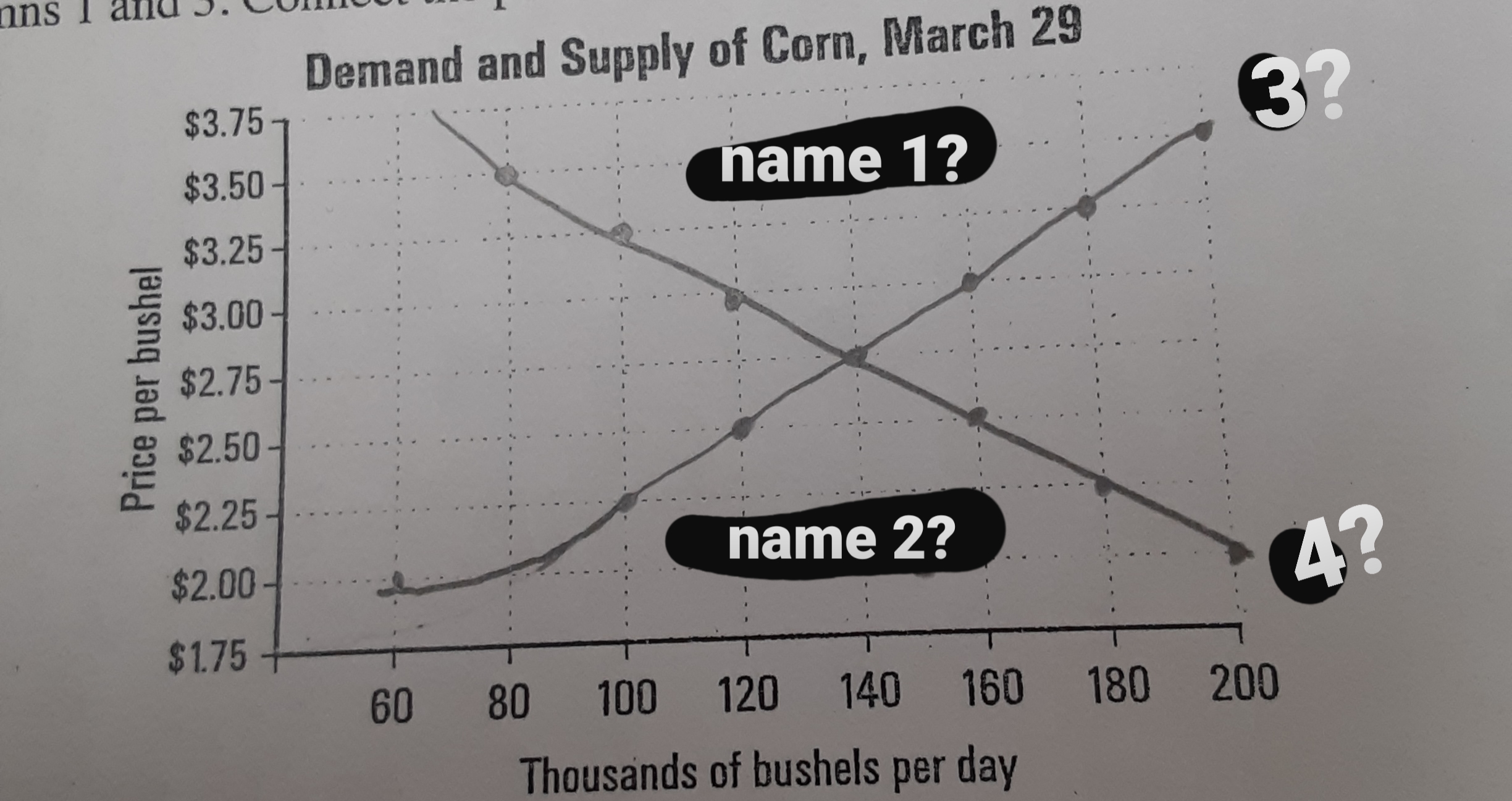
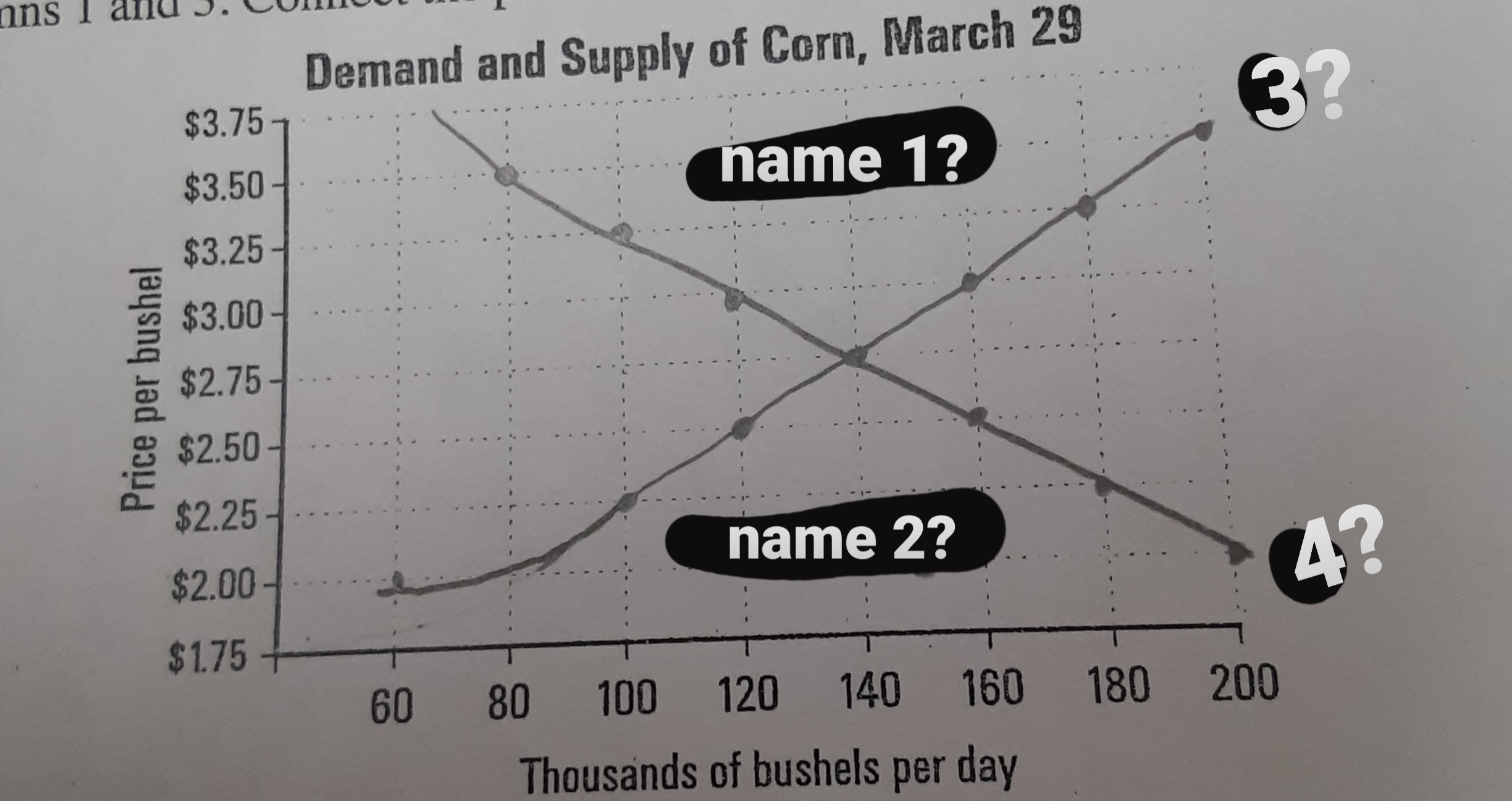
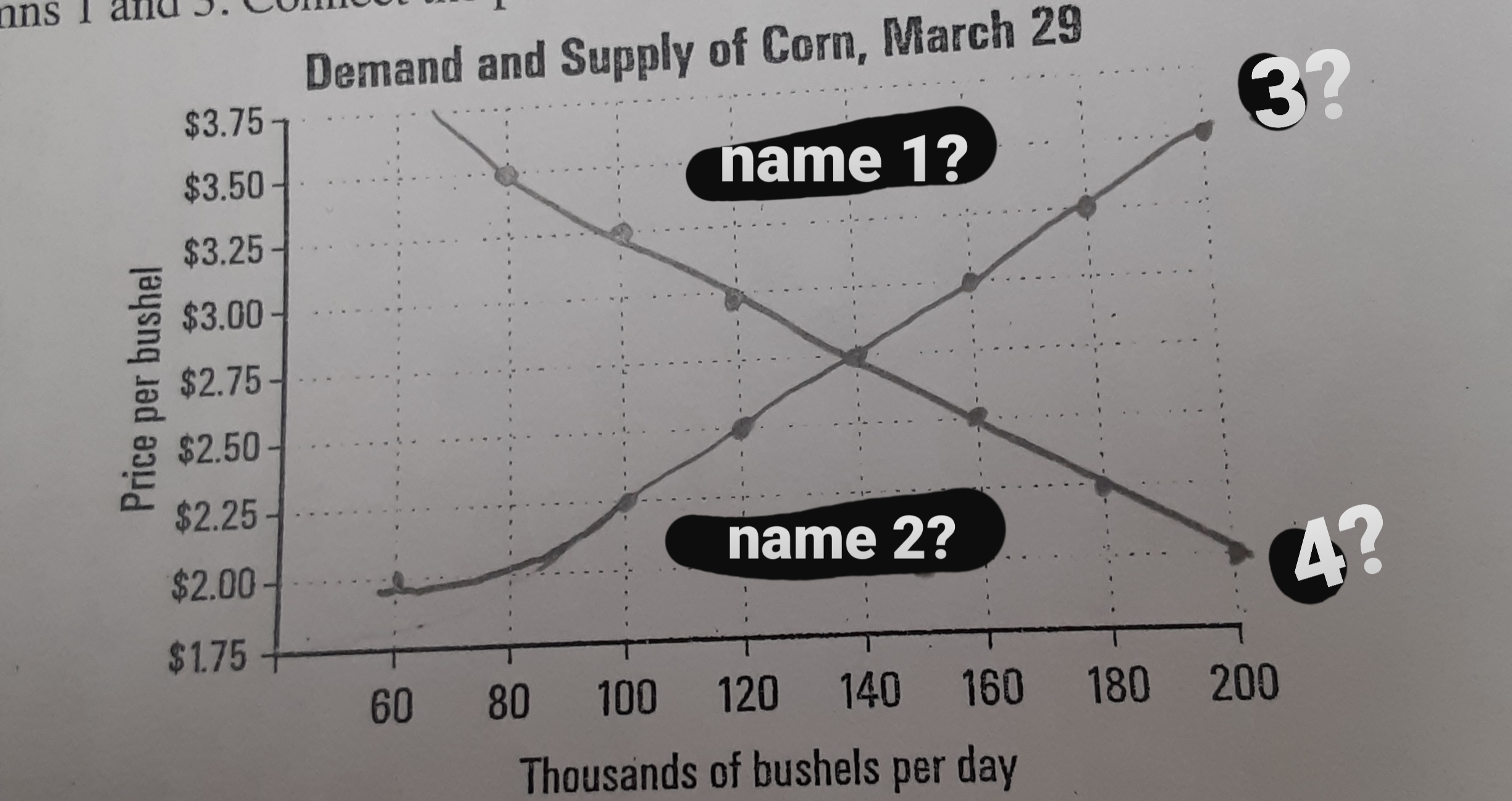
name 1?
surplus
99
New cards
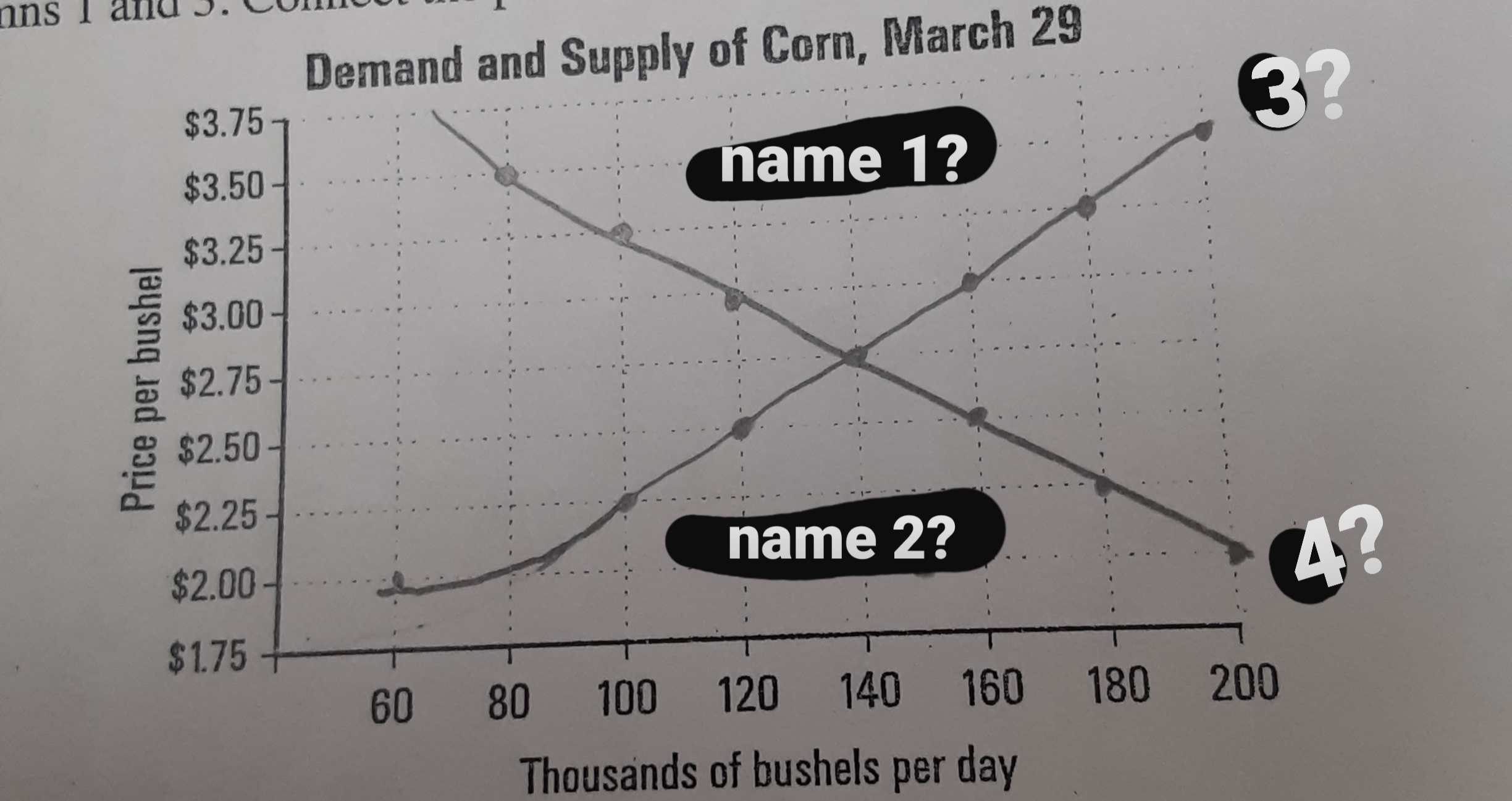
name 2?
shortage
100
New cards
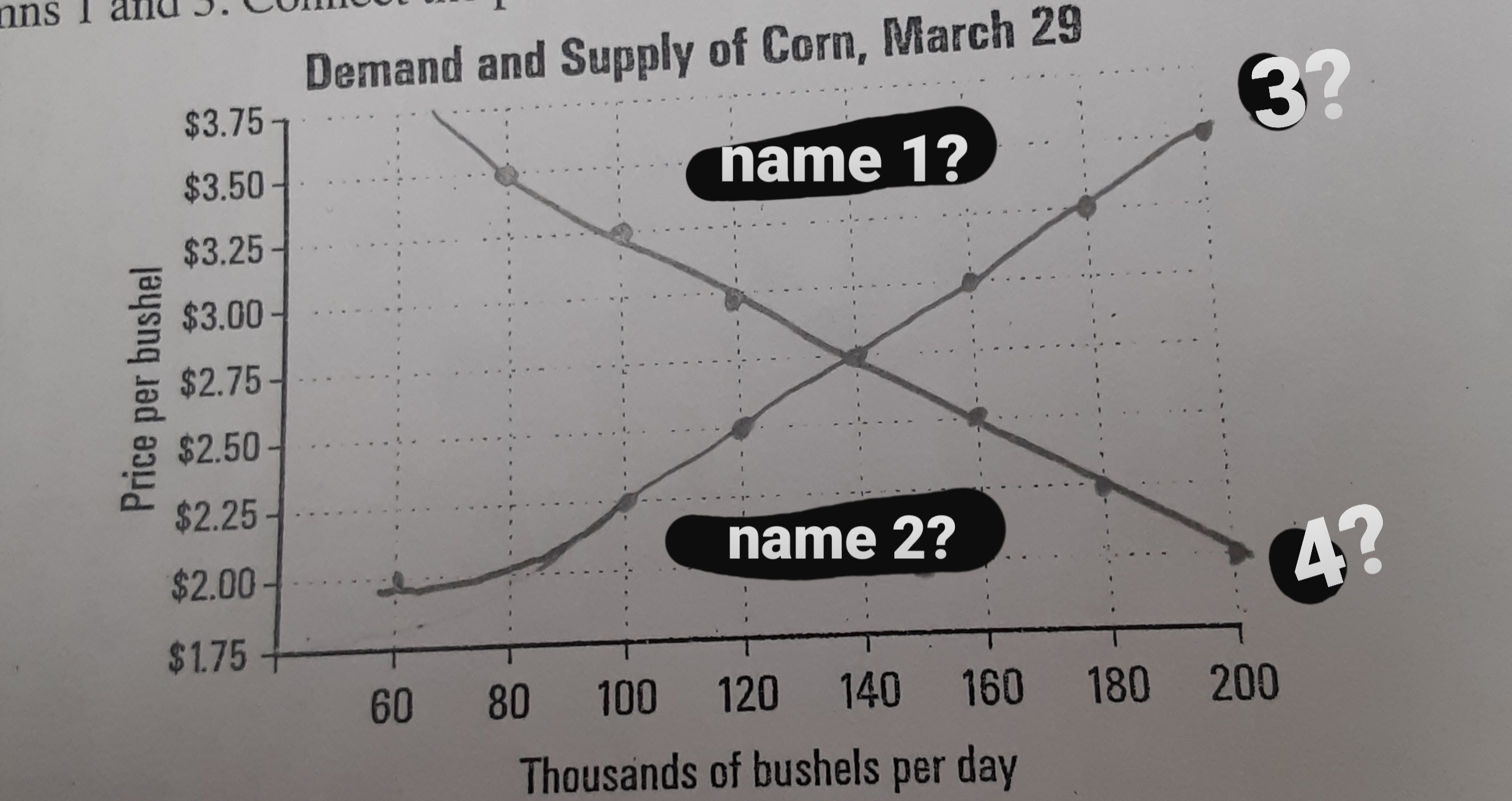
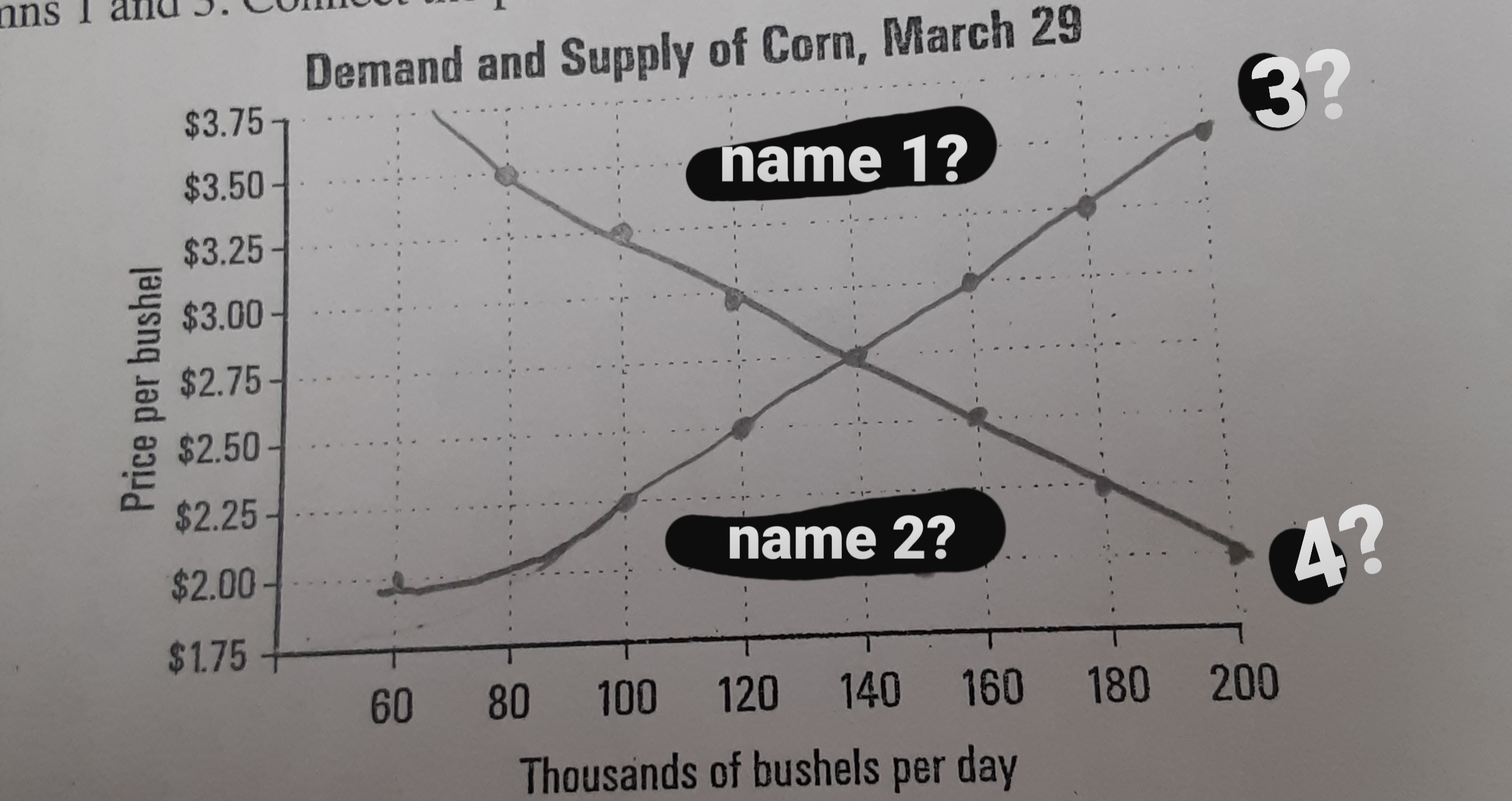
3?
supply