bio20b: form and function
 Call Kai
 Learn
Learn Practice Test
 Spaced Repetition
 Match
Match Flashcards
 Knowt Play
1/15

There's no tags or description
Looks like no tags are added yet.
Name | Mastery | Learn | Test | Matching | Spaced | Call with Kai |
|---|
No analytics yet
Send a link to your students to track their progress
16 Terms
what affects the way an animal interacts with its environment
its form, that is an animal’s size and shape
how do physical laws of water constrain evolution
water is roughly 1000x denser than air and is more viscous - anything that causes drag impedes the swimmer greatly. this caused the evolution of many fast swimming ocean animals to form a fusiform(tapered on both ends)
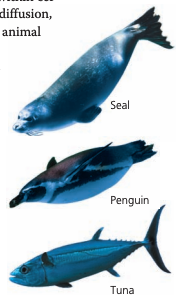
reasons for similar shapes of animals in the same environments
natural selection often results in similar adaptations when facing the same environmental challenges
how do physical laws influence animal body size
as body dimensions increase, thicker skeletons are required to maintain support aswell as muscles required in movement which must take up a greater fraction of the total body mass else mobility becomes limited.
what do animals exchange with the environment
nutritents, waste products, and gases with their environment
what does exchange mean in molecular terms
substances dissolved in an aqueous solution move across sthe plasma membrane of each cell
why are smaller, single celled organisms more efficient
a single celled organism such as a amoeba, has a sufficient membrane surface area in contact with its environment to cary out all necessary exchange.
surface area to volume relationship
the rate of exchange is proportional to the membrane surface area, whereas the amount of material that must be exchanged is proportional to the body volume.
what is required of a multicellular organization to work
if every cell has access to a suitable aqueous environment, either inside or outside the animal’s body
how do simple organisms maximize direct exchange of their cells
some animals have a body wall of two cell layers thick. Thus with an open cavity both layers of cells are routinely exposed to the environment.
Others maximize exposure with a flat shape which places most cells in direct contact with its particular environment
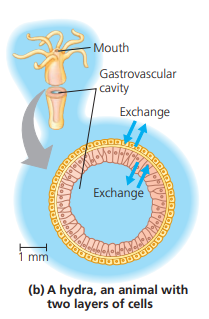
Explain the limitations of exchange surfaces in complex organisms
increasing the number of cells decreases the ratio of outer surface area to total volume.
A larger animal has more cells, nevertheless every cell must have access to nutrients
how are all cells of a larger animal involved in exchange
adaptations that allow sufficient exchange occur in specialized surfaces that are extensively branched or folded
what does branching and folding surfaces help achieve
this arrangement protects delicate tissues from cuts and dehydration.
its shape also increases the surface area
interstitial fluid
the spaces between cells are filled with fluid called interstitial fluid
internal body fluids link __ __ __ __ __
exchange surfaces to body cells
what enables all cells throughout the body to obtain nutrients and get rid of wastes
exchange between the interstitial fluid and a circulatory fluid (blood)

