AP Chem Unit 7 Chemical Kinetics

0.0(0)
studied byStudied by 0 people
0.0(0)
call with kaiCall with Kai
learnLearn
examPractice Test
spaced repetitionSpaced Repetition
heart puzzleMatch
flashcardsFlashcards
GameKnowt Play
Card Sorting

1/24

encourage image

There's no tags or description

Looks like no tags are added yet.

Study Analytics
Name
Mastery
Learn
Test
Matching
Spaced
Call with Kai

No study sessions yet.

25 Terms

1
New cards

Collision Theory

  • that bimolecular reactions occur when two correctly oriented molecules collide with sufficient energy.

  • For the bonds to form, the electrons in the atoms must be rearranged.  

  • Further, if A and BC have filled shells of electrons they will repel one another.

3 Conditions:

  1. The reactants must collide.

  2. The reactants must align properly to break and form bonds.

  3. The collision must provide the energy needed to “activate” the reaction.

2
New cards

Steric Factor

  • fraction of collisions with the proper orientation

3
New cards

Activation Energy

  •  a specific amount of energy to start breaking the bonds in the reactants.

4
New cards

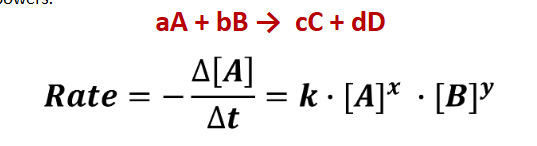
Reaction Rate

  • change in the concentration of a reactant or a product with time (M/s).

  • Can use ratios in moles in a chemical equation

  • Rates are Related to each other, Not Equal
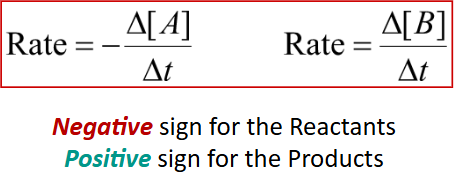
<ul><li><p><span style="background-color: transparent;"><em><span>change in the concentration of a reactant or a product with time </span></em><span>(M/s).</span></span></p></li><li><p><span style="background-color: transparent;"><span>Can use ratios in moles in a chemical equation</span></span></p></li><li><p><span style="background-color: transparent;"><span>Rates are </span><strong><span>Related</span><em><span> </span></em></strong><span>to each other, </span><strong><span>Not Equal</span></strong></span></p></li></ul><p></p>
5
New cards

Factors Affecting Reaction Rate

  • Number of reactants

    • More reactants/bonds → longer times

  • Surface Area

    • Increased Surface area → increased reaction rate → decreased time

  • Concentration of Reactants

    • More reactants →more particles → more collisions → increased Rxn rate

  • Temperature

    • Increased Temp → increased energy → increased collisions → increased Rxn rate

  • Catalyst

    • compounds affecting the rate of reaction.

    • Decrease activation energy

6
New cards

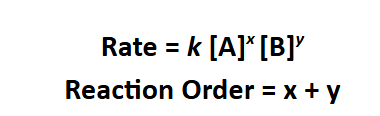
Differential Rate Law

  • Based solely on Experimental Data

  • x and y are coefficients

  • k is the rate constant

<ul><li><p>Based solely on <strong>Experimental Data</strong></p></li><li><p>x and y are coefficients</p></li><li><p>k is the rate constant</p></li></ul><p></p>
7
New cards

Reaction Order

  • sum of powers to which all reactant concentrations appearing in rate law are raised

    • x + y

    • won’t usually see greater than 3

<ul><li><p>sum of powers to which all reactant concentrations appearing in rate law are raised</p><ul><li><p>x + y</p></li><li><p>won’t usually see greater than 3</p></li></ul></li></ul><p></p><p></p>
8
New cards

Meaning of Zero Order

  • If the concentration of your reactant changes, but the rate remains constant

9
New cards

Meaning of First Order

  • If the concentration of your reactant doubles and the rate also doubles

10
New cards

Meaning of Second Order

  • If the concentration of your reactant doubles and the rate quadruples

11
New cards

Rate law & Reaction Order

knowt flashcard image
12
New cards

Types of Reaction Rates

  • Instantaneous Rate — One moment in time

  • Initial Rate — Right at start of reaction

  • Average Rate — Over interval (Slope of secant line between two points on the curve)

13
New cards

Integrated Rate Laws

  • The mathematical equation that relates the concentration of a reactant or product to the time it takes for a reaction to occur. 

  • Cam calculates the concentration(reactant and product) or time for reaction

  • Need data which is linear (k) for the equation

14
New cards

Zero Order Integrated Rate Law

  • Mainly seen for enzymes

  • Rate is Independent of the reactant concentration
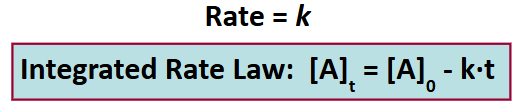
<ul><li><p>Mainly seen for enzymes</p></li><li><p>Rate is <strong>Independent</strong> of the reactant concentration</p></li></ul><p></p>
15
New cards

Zero Order Reactions Half Life

  • Value is constant

<ul><li><p>Value is constant</p></li></ul><p></p>
16
New cards

First Order Integrated Rate Law

knowt flashcard image
17
New cards

First Order Half Life

knowt flashcard image
18
New cards

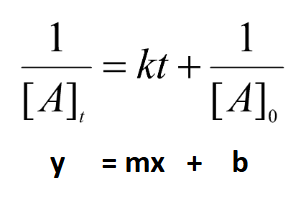
Second Order Integrated Rate Law

knowt flashcard image
19
New cards

Units for Integrated Rate Laws

  • Based on orders.

  • Is 1/m(order-1)s

  • Ex.

    • 0 order: s

    • 1st order: 1/s

    • 2nd order: 1/ms

20
New cards

Second Order Half Life

knowt flashcard image
21
New cards

Multistep Reaction Energy Profile

  • a visual representation of the energy changes occurring during a chemical reaction that happens in multiple steps

  • Peaks = Steps

  • Valleys = Intermediates

  • Highest Activation Energy is the rate-limiting step

<ul><li><p><span style="background-color: transparent;"><span>a visual representation of the energy changes occurring during a chemical reaction that happens in multiple steps</span></span></p></li><li><p>Peaks = Steps</p></li><li><p>Valleys = Intermediates</p></li><li><p>Highest Activation Energy is the rate-limiting step</p></li></ul><p></p>
22
New cards

Catalysis

  • When A catalyst decreases activation energy —> increasing rate of a reaction

  • more collisions will have the needed energy to form products!

23
New cards

Types of Catalysis

Important Ones:

  • Homogeneous Catalysis — Catalyst is completely mixed with reactants, maximizing collisions between reactants and catalyst

  • Heterogeneous Catalysis — Catalyst exists in a different phase than the reactants, often as a solid surface where the reaction occurs.

  • Enzyme Catalysis — enzymes, which are protein molecules, act as catalysts with high specificity for certain reactions.

Others:

  • Autocatalysis — when the reaction where one of the products acts as a catalyst for the reaction itself, accelerating its rate.

  • Acid-Base Catalysis — where an acid or a base increases the rate of the reaction by facilitating the transfer of a proton (H+) between species

  • Electrocatalysis — type of catalysis that occurs at an electrode surface, where the catalyst facilitates electron transfer during an electrochemical reaction.

24
New cards

Heterogeneous Catalysis

Usual Steps:

  1. Adsorption of the reactant(s) onto the surface of the catalyst.

  2. Activation of the adsorbed reactant(s).

  3. Reaction of the adsorbed reactant(s).

  4. Desorption of product(s) from the surface of the catalyst.

  • often termed “Surface Catalysis” because the reactants interact with an inert surface during the reaction

25
New cards

Enzymes

Characteristics:

  • Specificity: Enzymes are highly selective catalysts

  • Recyclability: Enzymes are not destroyed during a reaction, can be reused 

  • Insolubility: Enzymes are insoluble. 

  • Saturation point: Enzymes have a saturation point, where activity ceases once all the enzymes are occupied by substrate molecules.