Exam 3
 Call Kai
 Learn
Learn Practice Test
 Spaced Repetition
 Match
Match Flashcards
 Knowt Play
1/134

There's no tags or description
Looks like no tags are added yet.
Name | Mastery | Learn | Test | Matching | Spaced | Call with Kai |
|---|
No analytics yet
Send a link to your students to track their progress
135 Terms
Key Concepts: Salt Marsh Intro
Salt marshes are highly productive coastal wetlands with major ecological functions
Their formation depends on geomorphology: sediment supply, low wave energy, and shelter
Salt marsh plants are adapted to salinity and waterlogging through traits like salt glands, rhizomes, succulence
Species diversity is low but functional roles are high, dominated by Sporobolus, juncus, salicornia
Morphological strategies support resilience, driving high productivity, and persistence under stress
Salt Marsh Ecosystems
Salt marsh ecosystems are very productive
Ecological functions
Nursery ground
Habitat/production
Food source
Nutrient cycling
Sediment retention
Reduce erosion
Storm surge protection
Salt Marsh: Intro
2 types of vascular plant tidal communities one earth
Salt marshes: found where freezing air temps occur with regularity
Mangals: limited to latitudes remain at 20C or higher
Both restricted to low energy coastal regions
Salt Marsh: Intro
Salt marsh:
a halophytic grassland on alluvial sediments bordering saline water bodies where water level fluctuates either tidally or nontidally
Salt marshes are found in areas where the accumulation of sediments is equal to or greater than the rate of land subsidence and where there is adequate protection from destructive waves and storms
Salt Marshes: Geographical Extent
Found at mid-high latitudes along intertidal shorelines worldwide
Range from narrow fringes on steep shorelines to open expanses several miles wide
Found in/near
River mouths
Bays
Protected coastal plains
Protected lagoons
Different plant associations found with different coastlines but ecological structure and function similar worldwide
Geomorphology
Physical features determine extent of salt marshes within geographical range
Predominately intertidal areas
Gently sloping shorelines
Protection from wave and storm energy
Strong sediment supply from upland run-off
Geomorphology
Wetlands classified as forming in either marine-dominated or deltaic areas
Most north american salt marshes are marine dominated
Deltaic marshes found in south atlantic and gulf of mx
Either requires sufficient shelter to ensure sedimentation and prevent erosion
Geomorphology: Marine Dominated
Shoreline features that allow for the development of salt marshes
Shelter of spits, offshore bars, islands
Traps sediment on lee side, protects marsh from open ocean (Georgia and NC coasts)
Protected bays
Large bays with shallow areas and large sediment supply allow for extensive marsh development (Chesapeake Bay, San francisco Bay)
Estuarine zones
Shores of estuaries where shallow water and low gradients allow for sediment deposition, tidal action has to maintain higher salinities
Salt Marsh Plant Adaptations
Salt marsh vegetation has 2 key features
Adaptation of saline conditions
Ability to grow in/be exposed to waterlogged sediments (including peat deposits)
Salt Marsh Plant Adaptations
Flowering plants grouped into 3 classes based on adaptation to obtain and retain water
Xerophytes=
plants that have morphological, anatomical, reproductive adaptations to aide in retention and uptake of water (salt marsh plants, mangroves)
Mesophytes (glycophytic)= plants that grow in habitats where freshwater is avalible in the sediment, lack specialized adaptations to prevent water loss (wheat, beet)
Hydrophytes= plants that live in water, partially or wholly submerged (seagrasses)
Salt Marsh Plant Adaptations
Plants can be further divided based on salinity tolerance
Halophytes:
plants that have adaptations to prevent water loss and to grow in slaine habitats
Facultative= halophytes that do not require saline conditions for growth (most salt marsh plants)
Obligate= have specific requirement for sodium and not potassium, requires salt to complete life cycle
Most salt marsh species are facultative halophytes
All ecotypes occur in salt marsh due to gradation of salinity b/w estuarine and upland conditions
Salt Marsh Plant Adaptations
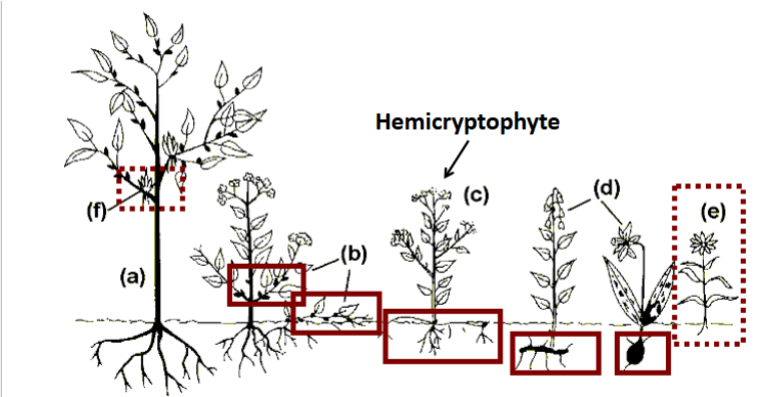
Species divided based on morphologies
Hemicryptophytes=
form of clonal growth where perennating buds are situated at or just below the soil surface (most common morphology for salt marsh plants)
Salt Marsh Plant Adaptations
Species divided based on morphologies
Therophytes=
annual plants, plant that overwinters as a seed
Varies across latitude and salt marsh groups
Dominant in mediterranean and semi-arid climates
Salt Marsh Plant Diversity
Not extremely diverse when compared to terrestrial grasslands
Widespread species distribution with related sp found on different continents
Limited # of halophytic species (although more diverse than mangal communities)
Salt Marsh Plant Diversity
Distribution pattern attributed to
Continental drift (vicariance hypthesis)
Dispersal by birds/vegetative repro
Salt Marsh Plant Diversity
No comprehensive list of salt marsh species
Differing definitions of salt marsh plant
Salt Marsh Plant Diversity
Range of species diversity
British salt marshes (325 sp, 45 are halophytes)
Eastern US (347 sp)
Mississippi coast (200 sp)
Salt Marsh Plant Diversity
Independent parallel evolution of xerophytes seen at local and continental scales
No clear pattern for flower or seed adaptations to salt marsh enviroment
Hard to genetically group species
Salt Marsh Plant Diversity
Commonly occurring families include
Poaceae, gramineae, chemopodiaceae, juncaceae, cyperaceae, plumbaginaceae, frankiaceae, asteraceae,
Salt Marsh Plant Diversity
Commonly occuring genera include
Spartine, sporobolus, salicornia, juncus, arthrocnemum, suaeda, plantago
Salt Marsh Plants
Detail on 3 rep sepceis
Sporobolus alterniflorus
Juncus roemarianus
Salicornia virginica
Sporobolus alterniflorus
Smooth cordgrass
Monocot in family Poaceae (Gramineae)
Species distribution:
Both coasts North America
Both coasts South America
Europe
Genus found worldwide
Sporobolus alterniflorus
2 main forms
Tall: 3 m tall; found along tidal creeks
Short: 0.2 – 0.8 m tall found in upper marsh
Sporobolus alterniflorus
Development of different forms attributed to phenotypic expression based on edaphic (soil) factors
Clonal species
Subterranean rhizome with sympodial branching - primary axis that develops from a series of short lateral branches and often has a zigzag or irregular forms
New shoots and roots produced from rhizome
Sporobolus alterniflorus
2 types of roots:
Unbranched anchoring roots covered with corky material
Ephemeral, fine, much- branched, matted absorbing roots
Sporobolus alterniflorus
Shoots and leaves account for 1/3 to 1/10 of plant biomass – the rest is belowground
Stems
Hollow center (air space)
Ring of lacunae alternating with vascular bundles on outside of stem
Both continuous to roots
Sporobolus alterniflorus
Leaves
Produced by basal intercalary meristem
Smooth flat blades with longitudinal furrows
Contain epidermal salt glands
Juncus roemerianus
Black Rush
Monocot member of Juncaceae family
8 genera
Most genera found in southern hemisphere
Genus Juncus has both fresh and salt water Species
Clonal plant
Juncus roemerianus
Subterranean branching rhizome
Rhizomes covered with suberized (corky tissue) scale leaves
Lacunae in cortex
Endodermal layer limiting cortex from pericycle
Juncus roemerianus
Fibrous root system
Erect stem with lacunae
Produce long needle like leaves up to 2 m tall
Leaves oval in cross section
Blades develop from basal intercalary meristem
Central portion of blade with parenchymatous mesophyll , vascular bundles, and lacunae
Epidermis is lignified with thick cuticle
Juncus roemerianus
Flowers occur in dense cymes –
an inflorescence in which each floral axis terminates in a single flower
Salicornia virginica
Pickle weed, American Glasswort
Dicot member of the Chenopodiaceae family
Stem and leaves are succulent
Pickle weed, American Glasswort
Common name comes from glossy nature of succulent stem
Dicot member of the Chenopodiaceae family
family with most halophytes
Stem and leaves are succulent
plant with fleshy tissues able to conserve moisture
Salicornia virginica
Appear swollen due to abundance of water- containing cells
Perennial species
Has a thick and waxy Cuticle
Stem procumbent – produces short erect branches
Stem produces advantageous roots to extend area
Blades reduced to scales
Succulent petioles wrapped around stem giving segmented appearance
Salicornia virginica
Petioles -
a slender stem that supports the blade of a foliage leaf
Lessons Learned (Salt Marsh Intro)
Salt marshes are highly productive coastal wetlands with major ecological functions
Their formation depends on geomorphology: sediment supply, low wave energy, and shelter.
Salt marsh plants are adapted to salinity and waterlogging through traits like salt glands, rhizomes, and succulence.
Species diversity is low but functional roles are high, dominated by Sporobolus, Juncus, and Salicornia.
Morphological strategies support resilience, driving high productivity and persistence under stress.
Key Concepts: Salt Marsh Enviroment
Salt marshes are harsh but productive ecosystems shaped by flooding, salinity, sediment supply
Plants persist through morphological and anatomical adaptations rhizomes, aerenchyma, xerophytic traits)
Ecophysiological strategies regulate salt and water: ion exclusion, succulence, salt glands, osmotic adjustments.
Photosynthetic pathways differ (C3 vs. C4), but all support high productivity under stress.
Diversity extends beyond grasses - algae, seagrass, ferns, and bryophytes add to function
Salt Marsh Enviroment
Plants have to be adapted to live in harsh environments:
Variable salinity
Flooding
Low oxygen
Edaphic changes
Strong gradients over small spatial scales
Morphological Adaptations: Flooding
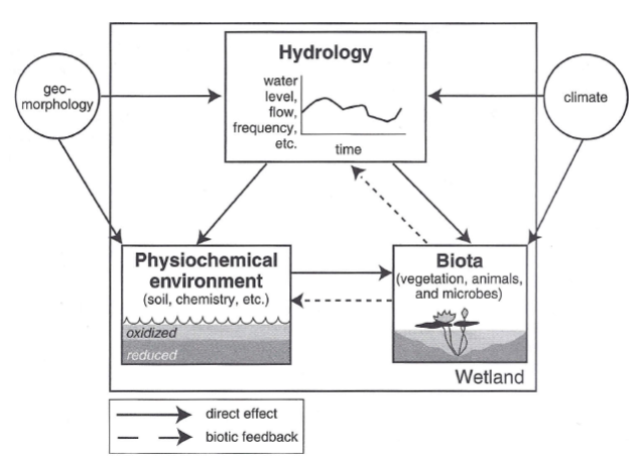
High tide results in:
edaphic changes (lower soil aeration and redox potential)
Lower photosynthesis
Damage or uprooting of plants due to water movement
Anaerobic sediments
Morphological Adaptations: Flooding
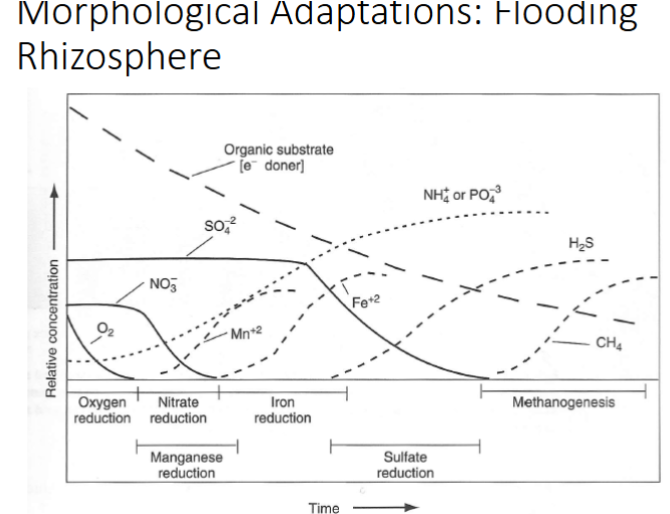
Anaerobic soils BIG problem
If oxygen cut off from roots and rhizomes toxic compounds (e.g. sulfides, reduced metal ions) can accumulate
Rely on oxygen produced in leaves to diffuse to belowground material
Morphological Adaptations: Flooding
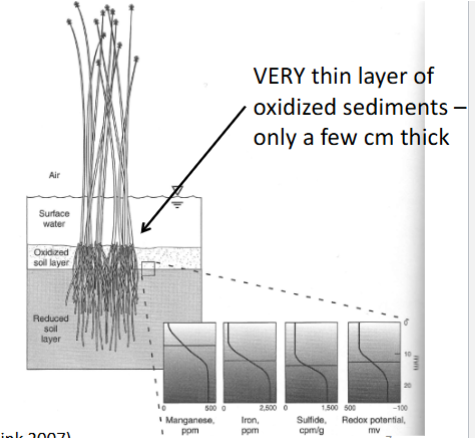
Thickness of oxidized layer directly related to:
Rate of O2 transport across the atmosphere-surface water interface
Population of oxygen-consuming organisms present
Photosynthetic oxygen production by algae within the water column
Surface mixing by convection currents and wind action
Morphological Adaptations: Flooding
Due to harsh salt marsh environment rhizomes very important
Few cm to 1 m below surface
Storage organs during periods of dormancy
Vegetative expansion
Reduce erosion due to anchoring and absorbing roots
Morphological Adaptations: Flooding
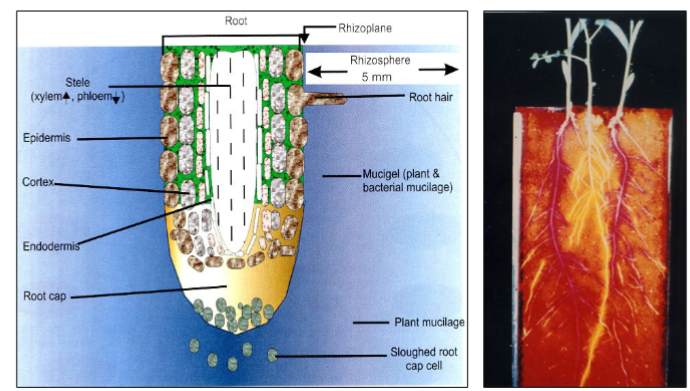
Rhizosphere -
narrow region of soil that is directly influenced by root secretions and associated soil Microorganisms
Morphological Adaptations: Flooding
Lacunae/aerenchyma =
up to 60% of total plant body
50% of root volume
Effective a moving O2 to roots
Level of air system development directly related to level of water- logging
Salt Marsh Enviroments: Anatomical Adaptations
Xerophytic adaptations to maximize water retention in stems, leaves, and roots:
Increased lignification
Complex epidermal development
Well-developed bundle sheaths
Leaves and stems also develop lacunae and aerenchyma
Salt Marsh Enviroments: Anatomical Adaptations
3 types of xeric leaves found in salt marsh plants:
1. Succulent – store water and dilute internal salt concentrations
2. Thick – increase vascular, water-storage and photosynthetic tissue
3. Dry-type (thin) – have enhanced cuticular resistance to water loss, produce epidermal hairs, and can curl to reduce water loss
Salt Marsh Enviroments: Anatomical Adaptations
S. alterniflorus has dry-type leaves
Upper (adaxial) side of leaf
higher concentration of stomates
Groves with specialized cells, collapse when dry conditions persist
Lower (abaxial) epidermis
thicker, lignified walls and cuticles
Causes leaf to roll up in a tube and the thicker cell wall is exposed reducing water loss
Salt Marsh Enviroments: Anatomical Adaptations
Succulence is an adaptation for
Water storage
Dilution of inorganic salts
Reduction in surface area (reduces water loss)
Occurs when petiole wraps around stem replacing leaf blade as photosynthetic organ
Ecophysiology of Salt Marsh Plants
Cope well with less than optimum habitat
Edaphic factors:
High sodium and chloride concentration
Limited essential nutrients
Anaerobic conditions
Ecophysiology of Salt Marsh Plants
Cope well with less than optimum habitat
Tidal immersion:
Temperature shock
Changes in photoperiod
Mechanical effects of tidal currents
Siltation of leaves by sediment (blocks stomates)
Ecophysiology: Salinity
Soil salinities vary across the salt marsh
Highest middle to upper marshes (depending on FW input)
High elevation within marshes limits tidal flushing
Combined with high evaporation salinity levels can become toxic
To take up groundwater there has to be a gradient in osmotic potential within the plant
Seawater at 35 PSU has a water potential of -2.5 mPa
Ecophysiology: Salinity
Roots of a halophyte has to be BELOW that osmotic potential to take up water
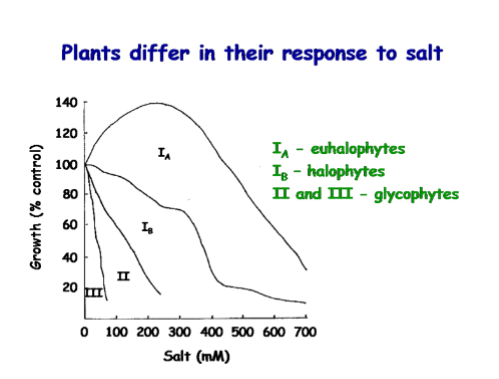
Most halophytes considered to be either:
Roots of a halophyte has to be BELOW that osmotic potential to take up water
Glycophytes cell osmotic potential of -0.5 to -1 mPa
Most halophytes considered to be either:
Osmoconformers – shows a gradient in osmotic potential between soil and plant
Osmoregulators – lacking a gradient and exhibiting sharp changes in internal ion concentration when subjected to changes in external salinity concern
Ecophysiology: Salinity
Regulation of shoot salt content accomplished by:
Ion exclusion in roots
Growth and Succulence
Shedding – concentrating ions then shedding material
Secretion – salt glands
Root discharge – move salt from growth areas to roots; then discharged into rhizosphere
Controlling water loss – reducing transpiration; lowers water needed and reduces subsequent salt uptake
Ecophysiology: Salinity
Enzymes of halophytes adapted to tolerate higher salinity without adjustments
Above threshold values salt becomes toxic
Production of organic solutes effective method at reducing salt stress
Cells with a 20 – 40% sugar concentration can acclimated up to 100 M m-3 of NaCl
Ecophysiology: Salinity
Salt Accumulation
Most commonly accumulated ions:
Na +, Cl -, SO4-2, NO3-
Tolerate Na + and Cl- at 10 – 13 psu
Above threshold = ribosomal breakdown
Ecophysiology: Salinity
Dehydration
Loss of water increases cellular ionic strength
Also results in loss of turgor pressure
Photosynthetic and metabolic shutdown
Curling
Wilting
Can be lethal
Ecophysiology: Salinity
Salinity also affects depth of rooting
Shallow-rooted plants subject to greater changes in salinity
Deeper-rooted plants do not deal with wide ranging salinities
Current research investigating changes in root morphology and depth with zonation and type of salt regulation
Ecophysiology: Photosynthesis
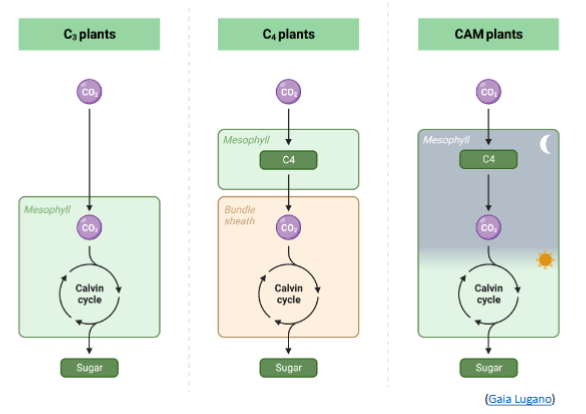
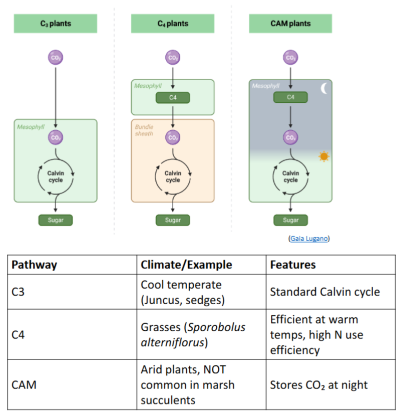
Advantages of C4 fixation:
High affinity of PEP carboxylase for CO2
Efficient use of N for growth and organic solute production
C4 photosynthesis is less efficient at colder temps
Ecophysiology: Costs
Halophytes have high energy costs and high anatomical requirements (specialized cell development)
Lower growth rates
Lower nutrient uptake (higher costs due to anaerobic soils)
Reduced photosynthesis
Other Salt Marsh Plants
Variety of types of plants found in salt marshes
Ferns, bryophytes, algae (micro and macro), seagrasses, epiphytes
Other Salt Marsh Plants: Ferns
Acrosticum most common genus found in warm temperate climates
Fringing understory in mangal systems
Overtop marsh plants in some areas (Florida west coast; African marshes)
Other Salt Marsh Plants: Bryophytes
> 50 moss species and 1 liverwort found in British marshes
Also found in arctic and Scandinavian areas
Understory in the upper elevations of tidal marshes
Few species found in lower latitudes
Other Salt Marsh Plants: Algae
Significant source of production
4 main communities:
Sediment microalgae
Macroalgal turf
Epiphytic algae on marsh plants
Subtidal drift or attached macroalgae
Other Salt Marsh Plants: Algae
Significant source of production
Microalgae found on lower slopes below salt marsh and on sediment below plants
Mostly blue-green algae and diatoms
Species composition is dynamic, seasonal, and localized
Generally limited by nutrients
Other Salt Marsh Plants: Algae
Significant source of production
Epiphytes are important source of primary production in salt marshes
Colonize area around dead stems
Provide food source for benthic and pelagic organisms
Other Salt Marsh Plants: Seagrass
May dominate shallow marsh basins
Most common species
Ruppia maritima
Zostera noltii
Zostera marina
Change in species composition due to climate
Take Home Messages (Salt Marsh Enviroment)
Adaptation enables survival in extreme environments.
Trade-offs matter: tolerance costs reduce growth but increase resilience.
Biodiversity underpins resilience and ecosystem services.
Big picture: Salt marsh physiology connects to coastal protection, nutrient cycling, and habitat provision
Key Concepts: Salt Marsh management
Salt marshes are structured, dynamic ecosystems shaped by abiotic and biotic interactions.
Zonation reflects adaptations to gradients in elevation, salinity, and inundation.
Human activity has drastically altered salt marsh extent and function.
Restoration and management rely on balancing ecological processes with human use.
Ecology of Salt Marshes: Key Drivers
Driving abiotic/biotic factors
Edaphic factors
Tides
Elevation
Climate
Zonation
Competition
Facilitation
Zonation
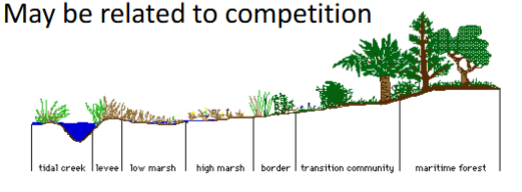
Zonation n salt marshes due to differing vertical ranges of species
Not just marsh vegetation (microalgal, seaweed, faunal components also zoned)
Mechanisms controlling zonation patterns not well understood
May be related to competition
Zonation
Number of zones depends on latitude, physical factors, criteria used to develop zones
NC= 4 veg zones
NW FL= 8 zones
Gulf of MX= 3 zones
Zonation
S of Chesapeake along atlantic coast see shift in marsh sp and zonation
Tall S. alterniflora only found in narrow bands around creek
Short form S. alterniflora found more commonly in middle zones
Juncus roemerianus replaces J. gerardi in high marsh
Zonation
Dominant species shifts to S. patens in Gulf of Mexico salt marshes
Dominates > 200,000 acres in Louisiana coastal marshes
Salt Marsh Succession & Stability
Succession in salt marsh systems complicated
Multiple stable states (subclimax)
Elevation drives community transitions
Disturbance= predictable recovery sequence
Salt Marsh Dynamics
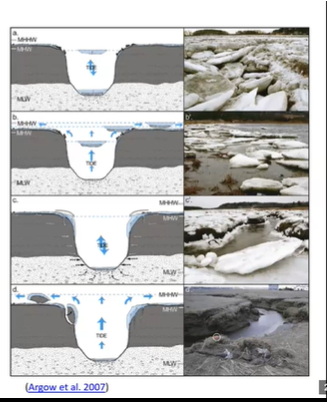
Disturbance common in salt marsh communities
Storms, fires, ice rafting, wrack deposition
Antropogenic Considerations: Human Uses of Salt Marshes (Historical)
Farming
Strip or open cast mining
Salt and chemical production
Land reclamation
Industrial and urban sites
Insect control
Wildlife management
Waste disposal
Recreation
Scientific studies
Antropogenic Considerations: Modern Impacts
Estuarine marshes exposed to industrial, agricultural, domestic runoff
Nutrients, metals, toxins stored in plants and sediments
Metals binds to sulfides or organic matter in porewater
Released back to food web through decomposition and grazing
Antropogenic Considerations: Uses & Impacts
Channelization for flood protection and insect treatment causes
Increased salinity
Sediment starvation downstream
Nutrient limitations
Antropogenic Considerations: Uses & Impacts
Lack of sediment can lead to large scale loss of salt marsh
Rising salinity reduces seed banks and plant recruitment
Marsh loss decreases filtration and water clarity
Industrial activity adds head and other stressors
Antropogenic Considerations: Uses & Impacts
Largest present-day impact due to urban expansion
Construction, dredging, filling
Antropogenic Considerations: Uses & Impacts
Building harbors and ports
Present global loss of salt marsh estimated at 60%
Exotic spartina species spreading in europe and CA
Hybrid forms outcompete native marsh plants
Disrupt ecosystem balance and migratory bird habitats
Antropogenic Considerations: Management Restoration
Until early 1950s tidal wetlands were treated as a commons
Quickly became example for tragedy of the commons
British public trust doctrine (PTD) 1st attempt to manage tidal resources
Antropogenic Considerations: Management Restoration
PTD not prefect solution problems with
Enforcement, liability issues, jurisdiction of regulators
Antropogenic Considerations: Management Restoration
Big ?-
where does intertidal beach begin and marsh end
Clean water act- protected wetland areas
Plans must be approved by USACE
Antropogenic Considerations: Management Restoration
Developed detailed management plans
Restrict inflow of pollutants
Stop dredge and filling
Restore coastal wetlands
Supreme Court Ruling on Wetland Definition (Sackett v. EPA, 2023)
Key Change
Wetlands must have a “continuous surface connection” to navigable waters to be federally protected
Excludes many isolated or intermittently connected salt marshes
Supreme Court Ruling on Wetland Definition (Sackett v. EPA, 2023)
Immediate Effects
Loss of federal Clean Water Act protection for many coastal wetlands
Increased vulnerability to filling, dredging, and pollution
Regulatory gaps where state protections are weak or absent
Greater uncertainty in permitting and project approvals
Supreme Court Ruling on Wetland Definition (Sackett v. EPA, 2023)
Management Challenges
Reduced funding and oversight for restoration on delisted wetlands
State and local agencies must take on more monitoring and enforcement
Fragmented protection across jurisdictions increases planning complexity
Supreme Court Ruling on Wetland Definition (Sackett v. EPA, 2023)
Ecological Consequences
Potential decline in filtration, flood protection, and habitat continuity
Loss of buffer zones critical to shoreline resilience and biodiversity
Long-term degradation of marsh ecosystems already under stress
Key Concepts: Salt Marsh Management
Salt marshes are structured, dynamic ecosystems shaped by abiotic and biotic interactions.
Zonation reflects adaptations to gradients in elevation, salinity, and inundation.
Human activity has drastically altered salt marsh extent and function.
Restoration and management rely on balancing ecological processes with human use.
What Are Seagrasses?
Marine flowering plants (angiosperms) that live fully submerged in salt water
Form extensive meadows in shallow, protected coastal zones
Belong to multiple monocot families, not one taxonomic group
Defined by ecological function and habitat, not ancestry
Seagrass Common Characteristics
What defines a seagrass
The plants must be adapted to life in a saline medium
The plants must be able to grow when fully submerged
The plants must have a secure anchoring system
The plants must have a hydrophilous pollination mechanism
The plants must be able to compete successfully with other organisms in the marine enviroment
Seagrass Common Characteristics
What defines a seagrass
The plants must have a hydrophilous pollination mechanism
Hydrophilous=
water mediated, abiotic pollination
Why So Few Marine Angiosperms
Known species vs 300,000+ terrestrial and freshwater angiosperms
Marine life presents
High salinity, wave energy, low light
Few plants evolved full submersion tolerance and hydrophilous pollination
Seagrass Vs Algae
Seagrass
Complex root structure to anchor plant in the sediment, and extract nutrients and minerals
Photosynthesis restricted to cells in leaves
Transport minerals and nutrients in aerenchyma and the lacunae (veins)
Sexual reproduction via flower, fruits, seeds
Seagrass Vs Algae
Marine algae
Simple holdfast to anchor to hard substrate such as rocks or shells
Photosynthesis undertaken by all cells
Uptake of minerals and nutrients from water column via diffusion
Sexual reproduction via spores
Seagrass Distribution
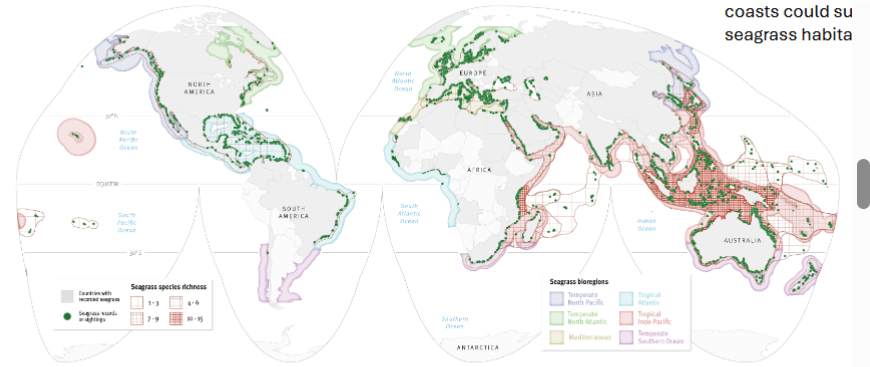
18% of earths shallow coasts could support seagrass habitat
Seagrass Evolution
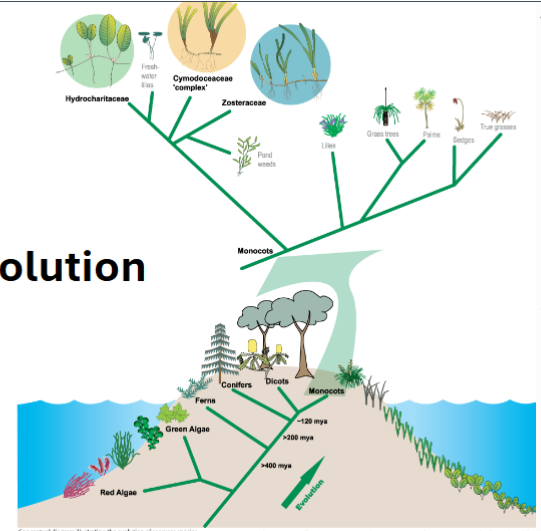
Returned to marine life 100 million years ago (Cretaceous)
Independent adaptations among several lineages
All within Order Alismatales (monocots)
Families: Zosteraceae, Cymodoceaceae, Posidoniaceae, Hydrocharitaceae
Not true grasses (Poaceae)= more closely related to lilies and pondweeds
70 sp globally, mostly in Zosteraceae and Cymodoceacea
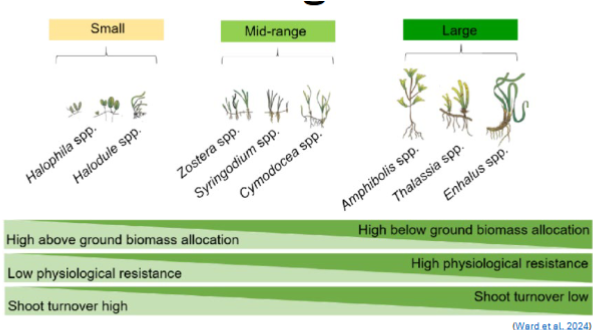
Common Seagrass genera
Temperate: Zostera, Phyllospadix, Ruppia, Amphibolis
Tropical: Thalassia, Halodule, Syringodium, Halophila, Cymodocea, Enhalus, Posidonia
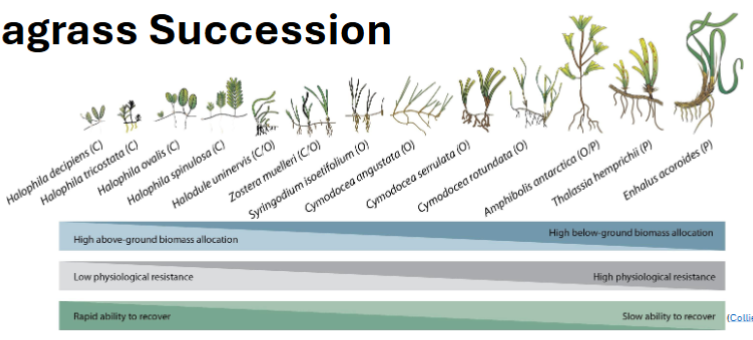
Seagrass Succession
Succession shifts from small fast colonizing pioneer species to larger slow growing species
Climate community can be monospecific or multi-species (mixed)
Maximum biomass shifts from above-grown to below ground as community matures
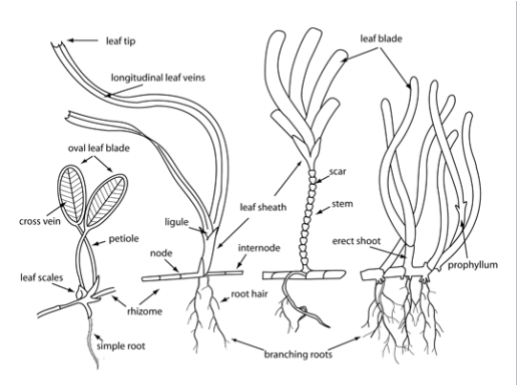
Seagrass Morphology
Leaves:
Rhizomes:
Roots:
Shoots:
strap-like or petiolate, with parallel veins and no cuticle
horizontal stems connecting shoots, store carbohydrates
adventitious, arise from rhizome nodes, anchor ins sediments
contain multiple leaves at different growth stages
Size range: few cm (Halophile) to several m (enhalus)

