chp 6 -143 sem 2
 Call Kai
 Learn
Learn Practice Test
 Spaced Repetition
 Match
Match Flashcards
 Knowt Play
1/103

There's no tags or description
Looks like no tags are added yet.
Name | Mastery | Learn | Test | Matching | Spaced | Call with Kai |
|---|
No analytics yet
Send a link to your students to track their progress
104 Terms
Medical x-ray units can be classified as either
diagnostic or therapeutic
time selection controls length of exposure
timer circuit
rotor switch changes speed of rotating anode
stator
controls kvp level through kvp selection
autotransformer
Diagnostic procud:
General procedures, head procedures, fluoroscopy, cardiac cath
Therapeutic:
Treatment
Range of diagnostic units: tube current:
10 to 1,200 mA
Range of diagnostic units: exposure time
0.001 to 10 seconds
Range of diagnostic units: potential difference
25 to 150 kVp
Range of therapeutic units: tube current
below 20 mA
Range of therapeutic units: exposure time
1 to 60 minutes
Range of therapeutic units:x-ray energy
4 to 40 meV
most common xray tables called
Bakelite or Carbon graphite fiber
usually found on fluoro tables. Also called ‘dished’.
curved tables
advantages of curved tables
more comfortable, allows the body part to be placed closer to the film,
Decrease in OID
disadvantages of curved tables
difficult to keep the patient in an oblique or lateral position, useless for tabletop radiography, unable to perform decubitus or cross-table exams
most in-table grids are_____ which will
“reciprocating” -- this will blur out grid lines
90 – 15 table-tilts
90 degrees in one direction (feet down) and 15 degrees in the other direction (head down)
most tables are at a fixed height (usually
30 to 40 inches or 75 to 100 cm)
Ancillary equipment has -
foot board: used for gastro studies, shoulder supports: used when head
tilted down, hand grips, compression bands: May restrain or be used during exam
five types of tube supports:
overhead, floor-to-ceiling, floor, mobile, C-arm
Overhead suspension system cont. it can rotate 360 degrees around the column it can roll or pitch up to
60 degrees
the most flexible and most expensive system
overhead suspension system
cheaper and less flexible than overhead system
Floor-to-ceiling Suspension Systems
floor-to-ceiling mounted “c-arm” (also ‘U-arm’) used specifically to radiograph the cranium, facial bones, and cervical spine
“Franklin Head Units”
does not include a table patient sits between tube and image
receptor can obtain very precise angles and is easy on the patient
“Franklin Head Units”
usually contains a Bucky unit used for chests, c-spines, sinuses, AC
joints, weight bearing studies, etc.
Upright Units (Chest Stands)
upright Bucky unit with an automatic film feed from a storage box (100 14x17 films) to receive magazine great for doing upright chest films, but lousy for doing anything else
Chest Units or Chest Changers
used for dental or mandibular x-rays described with tomography summer
semester
Panoramic Units or Panoramic Tomography
Incoming line current or Main power Comes in the form of:
Single-phase power or Three-phase power (Multiphase Power)
Nearly all x-ray equipment operates on
210-220V
U.S. supplied electricity rate to all buildings
60 Hz alternating current
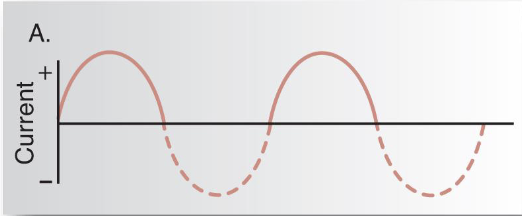
incoming line: Alternating Current or AC , negative side
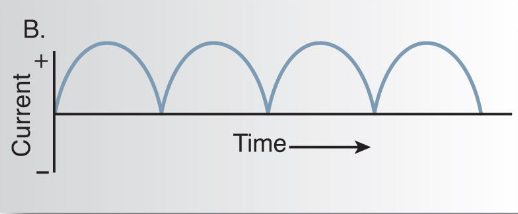
Can also have incoming Line changed to DC or Direct Current also called a full-wave rectified, single phase power
the tube will drop to zero (every time it crosses the line on the sine wave) 120 times a second using an incoming line of 60 Hertz
Single phase
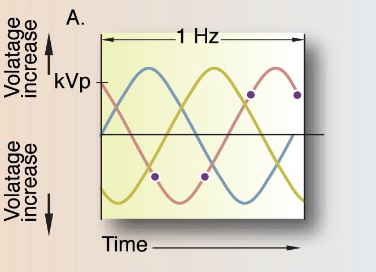
Three phase incoming Line, alternating current, will drop To zero
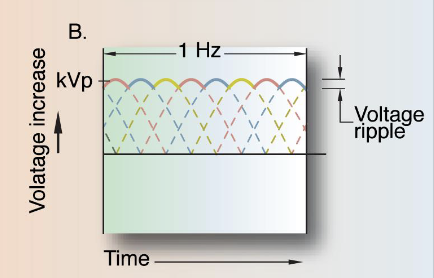
Three phase incoming line With Direct Current, full Wave rectified
T H R E E - P H A S E I N C O M I N G L I N E W /
D I R E C T C U R R E N T , F U L L W A V E
R E C T I F I E D
Every time the power begins to drop it is boosted back up by the next incoming wave of power. Voltage never reaches zero
Two circuits in an x-ray unit:
Main; tube, or high voltage circuit, Filament; low voltage circuit
The Main or tube circuit supplies
the x-ray tube with modified power and to provide
potential difference (kVp)
The Main or tube circuit purpose
to produce x-rays.
The Filament circuit supplies
the filament with modified power.
The Filament circuit purpose
create enough current to thermionically emit the proper amount of
electrons
Modifies incoming line power to produce thermionic emission from the filament wire.
the filament circuit
The incoming voltage is stepped down to _____ in filament circuit and Amperage (current) is modified to ______
6-12, 3-5
When you set the mA station (100, 200, 400, etc.) you are actually adjusting the number of _____flowing through the filament circuit
amps
The amperage/current in the filament circuit is adjusted with a
variable resistor (rheostat) – mA selector
Once the technique is set and the exposure begins the current is sent to the ______ to be modified before it reaches the filament.
step-down transformer
The tube (main) circuit modifies the incoming power so that the radiographer can control the
voltage, amperage, exposure time
Turn Power on and off
main switch
Prevent overload (fire)
circuit breakers
A remote-controlled device to allow the flow of electrons through the circuit that activates the rotating anode
exposure switch
Which side of circuit will radiographer stand?
low voltage side Exception is mobile radiography where the cord
must be 6 feet minimum.
Three types of exposure timers:
electronic timer, mAs timer, automatic exposure control (AEC)
most complicated and expensive, but the most accurate timer most common timer used in modern radiographic equipment
electronic timer
operates by charging a silicon-controlled rectifier (SCR) which then terminates the exposure and accurate to 1 millisecond
electronic timer
used in capacitor discharge units
mAs timer
A falling load generator will
utilize the tube’s loading potential to a greater extent
D I S A D V A N T A G E O F U S I N G F A L L I N G L O A D
G E N E R A T O R :
the operator will not know what mA the machine will select and must rely on the mAs timer to terminate the exposure Also, shorten tube life due to higher mA setting being used, shorten tube life due to higher mA
automatic exposure controls (AEC) or automatic exposure devices (AED) are programmed to
automatically terminate the exposure when a predetermined exposure has been reached
they only control the exposure time – the mA and kVp must be set
AEC
- two types of AECs:
Phototimer or photomultiplier and Ionization chamber
older device that used a thyratron to regulate the exposure its placed under the patient and the cassette
phototimer
the problem with phototimer AEC
photomultiplier is behind the cassette, it is often inaccurate
process of phototimer AEC
light energy to electrons by photomultiplier tube and when the number of electrons reaches a preset value, the exposure is terminated
ionization chamber must be____ thin and radiolucent and it is placed _____
5mm, between the patient and the cassette
in the ionization chamber the x-rays
ionize the gas in the chamber and the liberated electrons cause a current to a wire to the timer in circuit
in the ionization chamber when the predetermined amount of current
is produced the exposure is
terminated
All AECs have a Minimum Reaction Time of
0.05 second 1/20th sec
the Minimum Reaction Time of AECs is
the length of time necessary for the AEC to respond to the radiation and for the generator to terminate the exposure
ionization chambers are more efficient at
providing the exact time necessary to produce the density required
will terminate the exposure at a specific time even if the AEC does not read the predetermined exposure and should always be set when using AEC
Backup Time
the backup time cannot exceed the tube limit and it should be set to _____ of the anticipated manual mAs
150% (x mAs by 1.5)
if you think you may need about 50 mAs – set the backup timer for
75 mas
U.S. Public Law 90-602 states that generators must terminate the exposure at ____mAs for exposures ____ 50 kVp and ____mAs for exposures _____ 50 kVp
600 above, 2000 below
All of the technologist-operated controls are located on the ____ voltage side of the circuit to minimize the hazard of electrical shock.
low
The main and filament circuit combine here to complete the basic circuit.
control console
Monitors electricity coming in.
line monitor
Keeps constant source of power.
line compensator
control console consists of
line monitor, line compensator, rotor/exposure switch, mA selector(rheostat), time selector, kvp selector (autotransformer)
Used to increase kVp level for x-ray production
Step up transformer
helps prevent you from being electrocuted
ground
what measures current
mA meter
Changes AC to DC
Rectification bridge
used in filament circuit to increase current flow to the cathode
Step down transformer
Single-phase (1Ø) generator
Full-wave rectified current produces 2 pulses per cycle or 120 pulses per second, the voltage drops to zero twice per cycle, 100% “ripple”
Three-phase, six-pulse (3Ø 6P) generator
Full-wave rectification produces 6 pulses per cycle or 360 pulses per second, Current never drops to zero,13 to 25% ripple
Produced approximately 35% MORE average photon energy that single-phase
Three-phase, six-pulse (3Ø 6P) generator
Three-phase, 12-pulse (3Ø 12P) generator
12 diodes, 1 wye, and two delta connections 4 to 10 percent ripple
Produces about 40% more average photon energy than single-phase
Three-phase, 12-pulse (3Ø 12P) generator
Uses AC to DC Converters to change the frequency of the incoming current from 60 Hz to about 6,000 Hz
high frequency
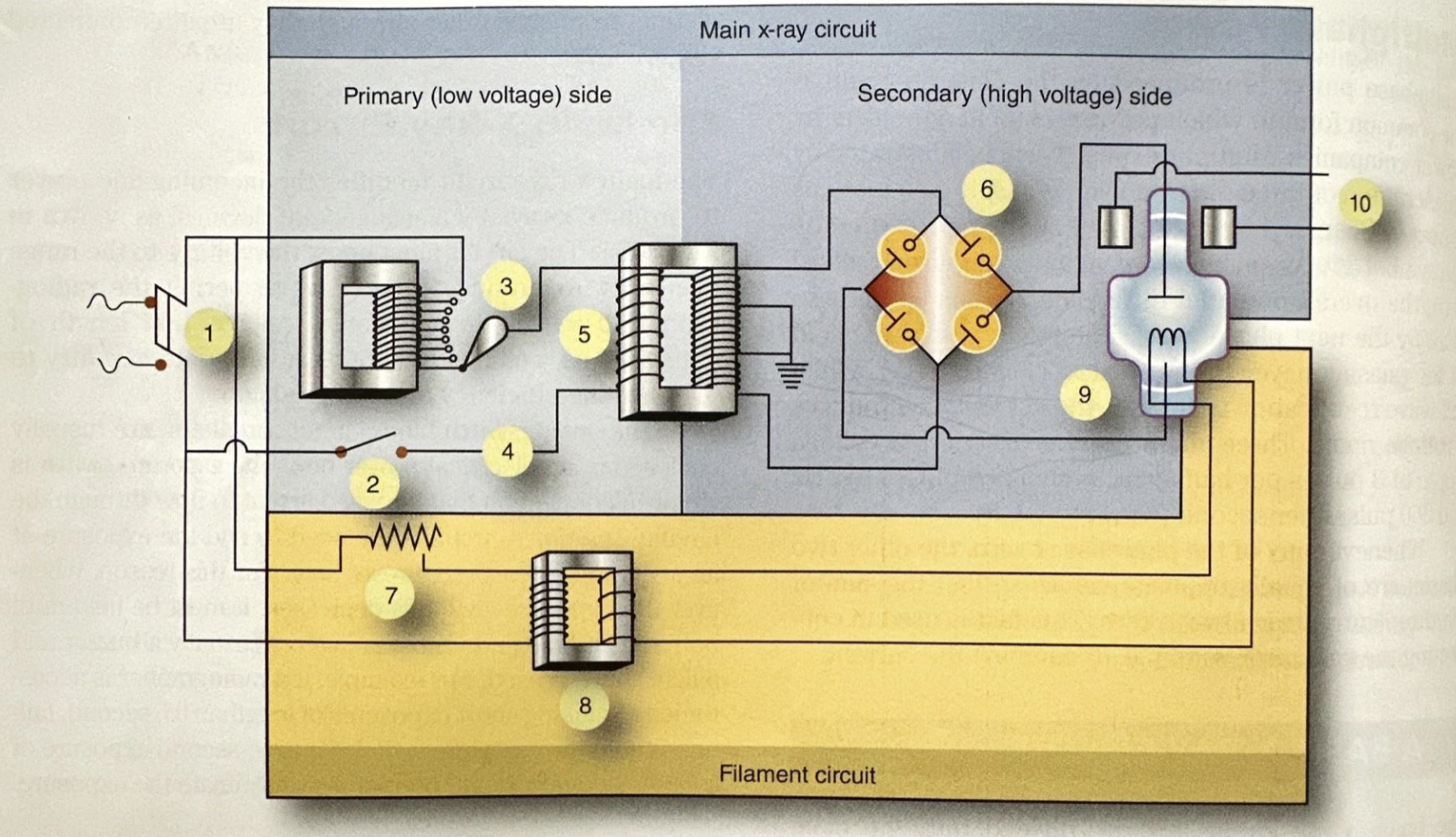
1
main breaker
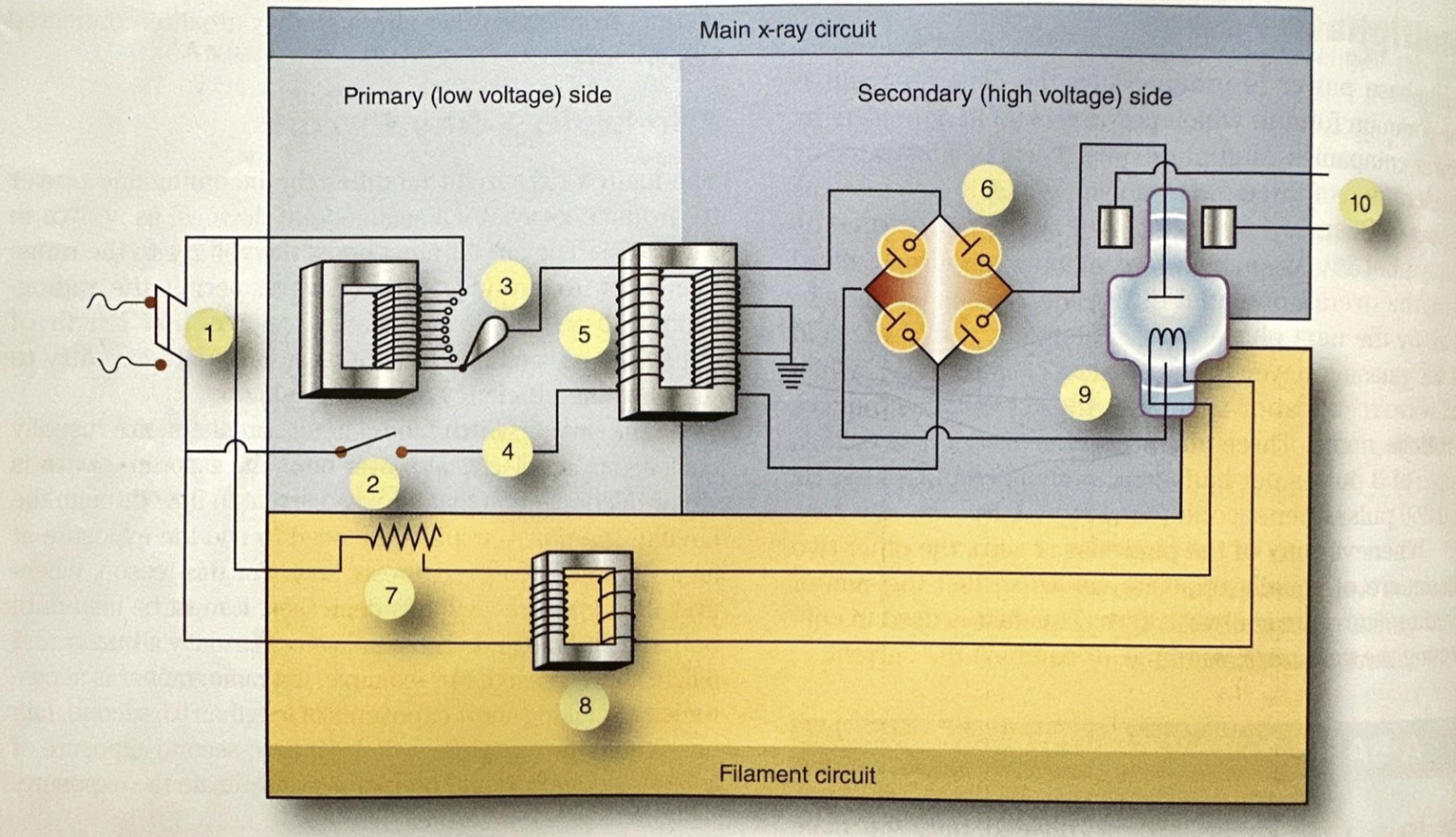
2
exposure switch
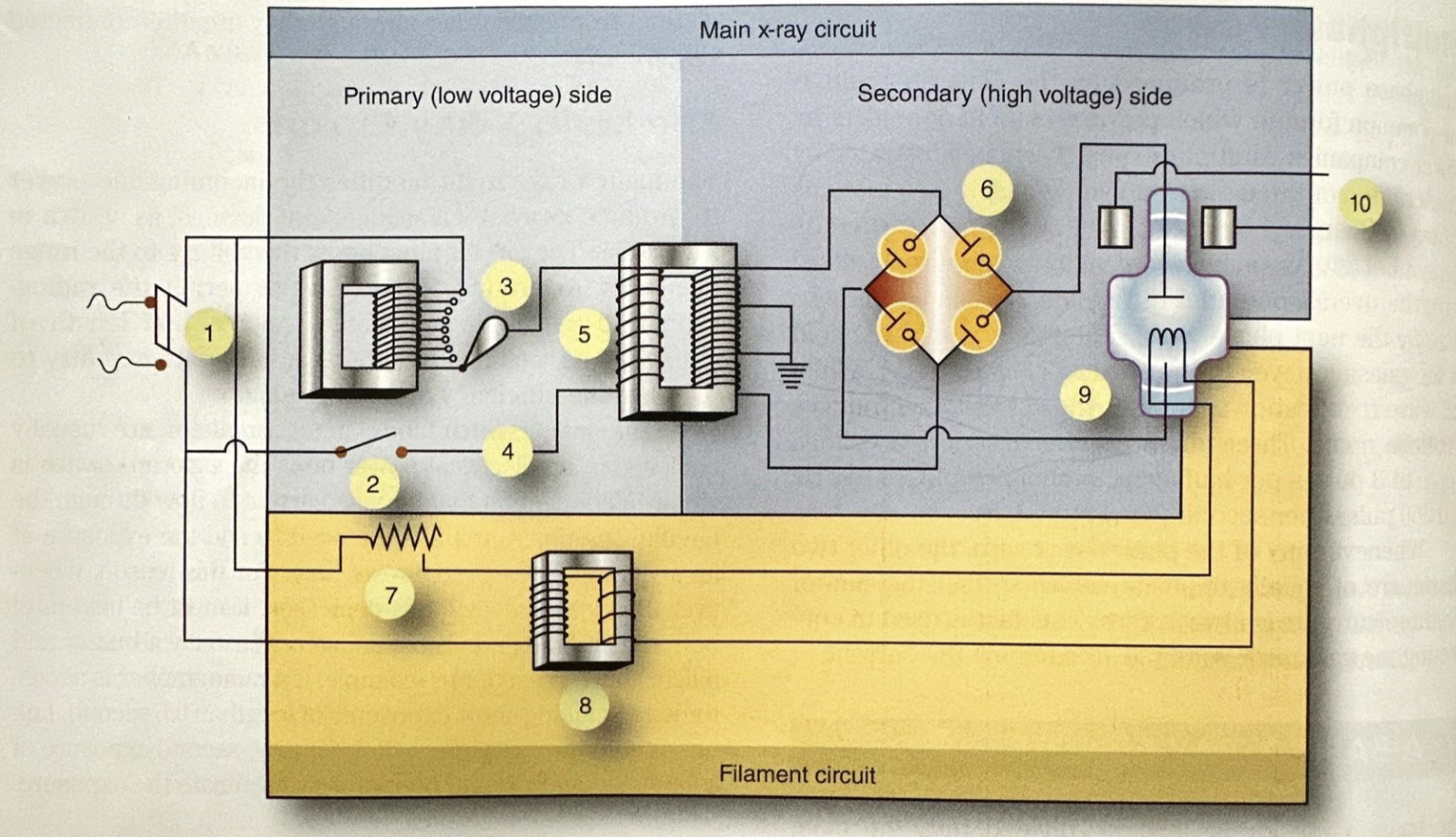
3
autotransformer
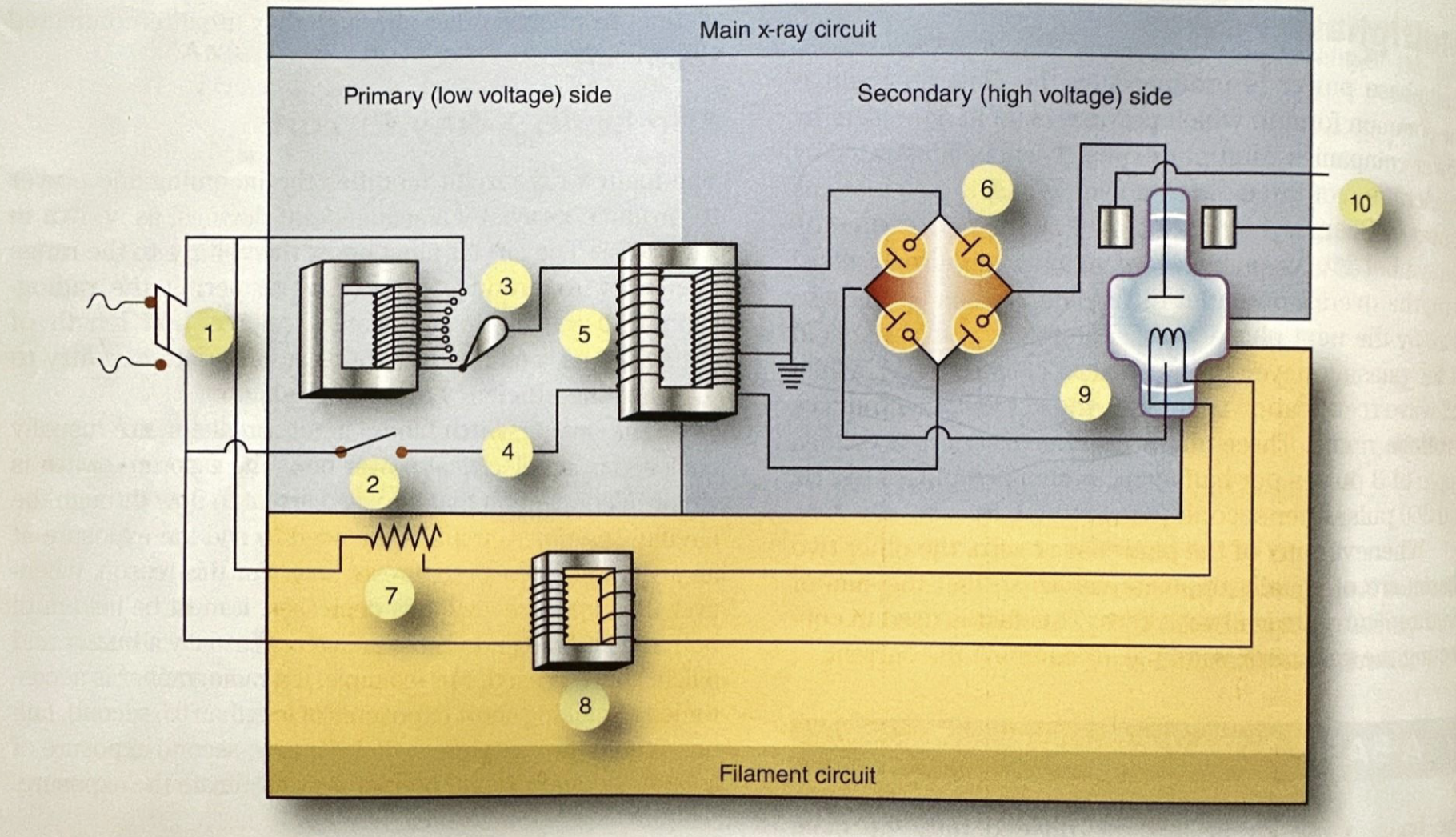
4
timer circuit
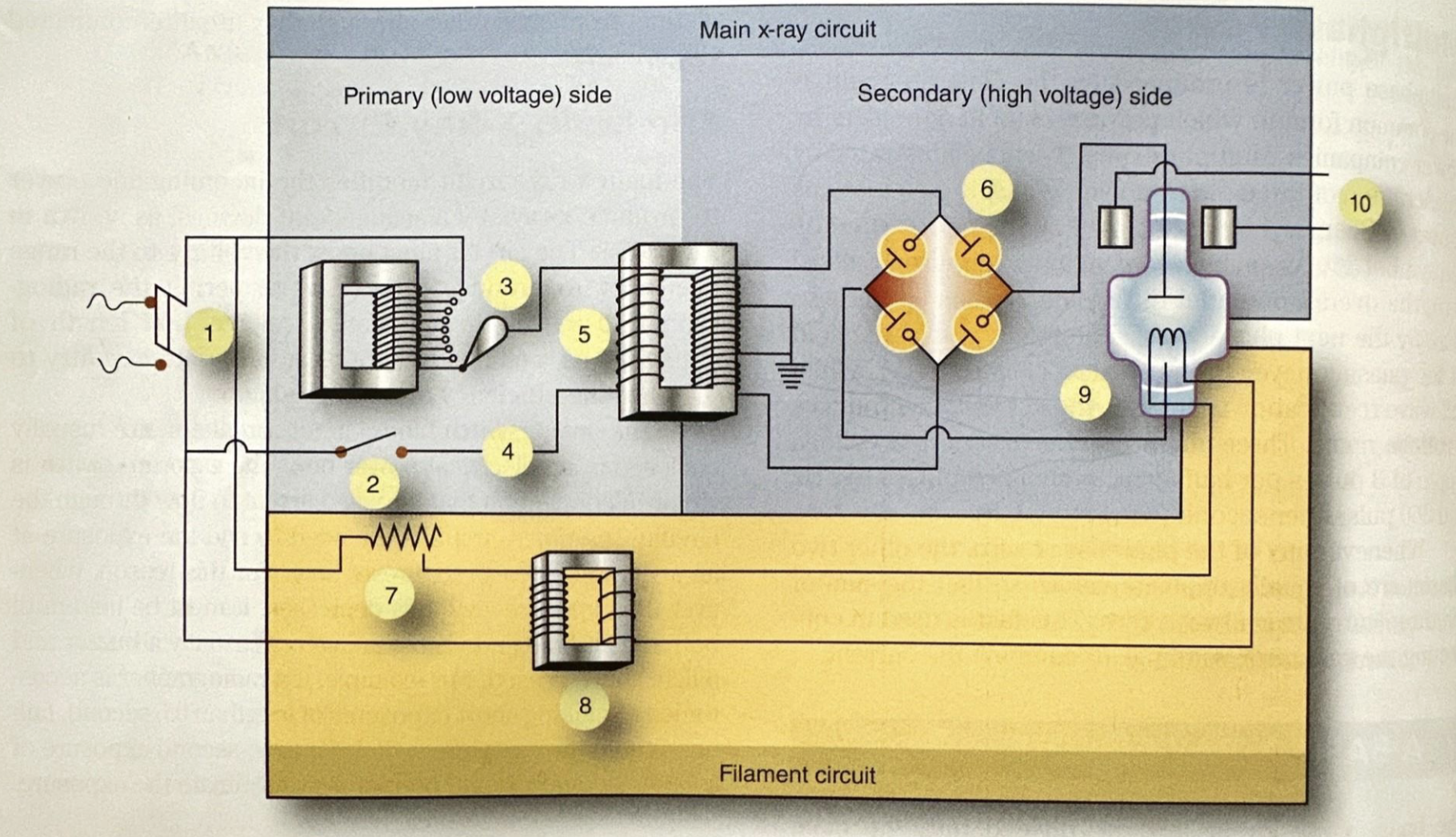
5
high voltage transformer
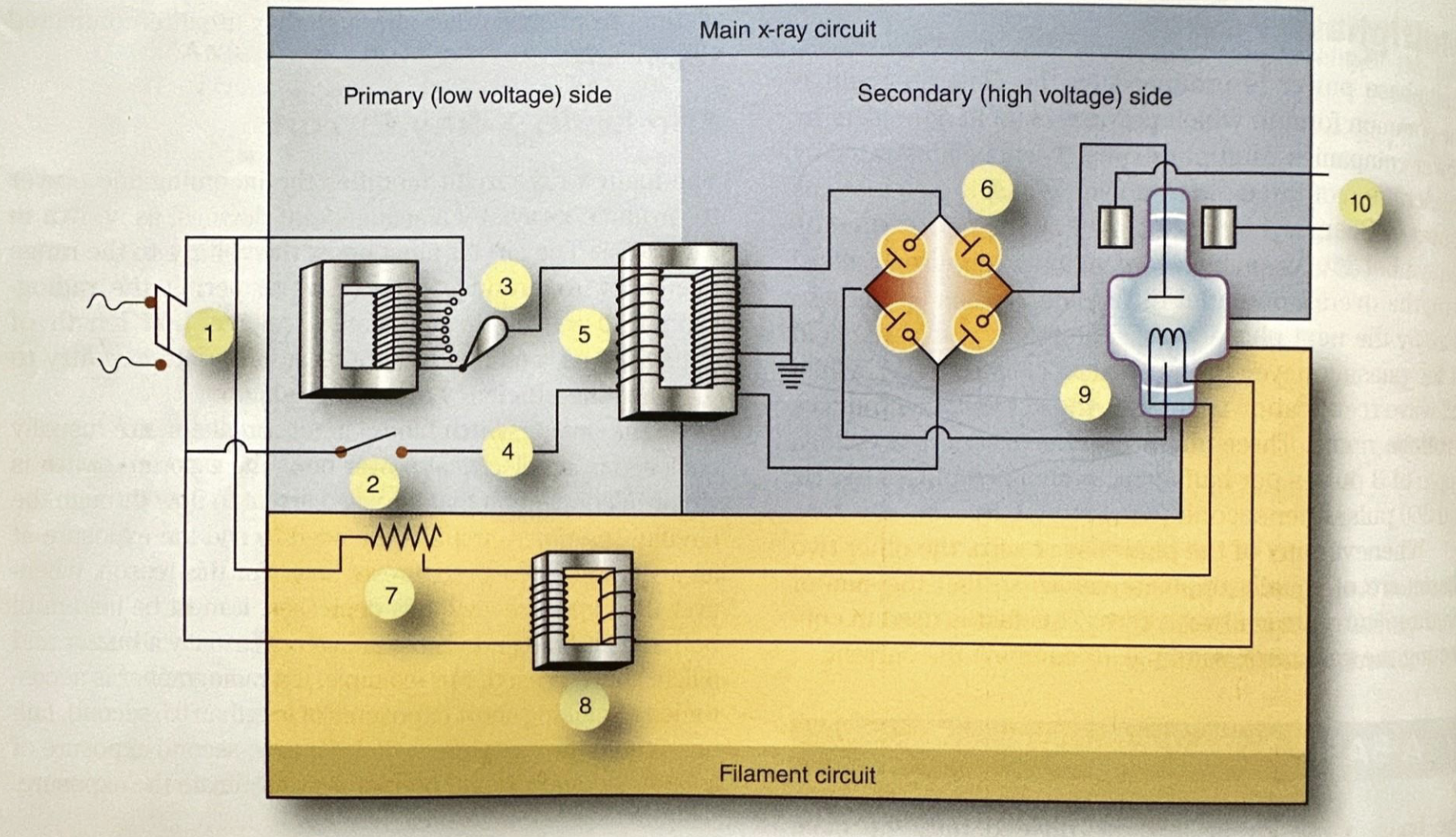
6
4diode rectification circuit
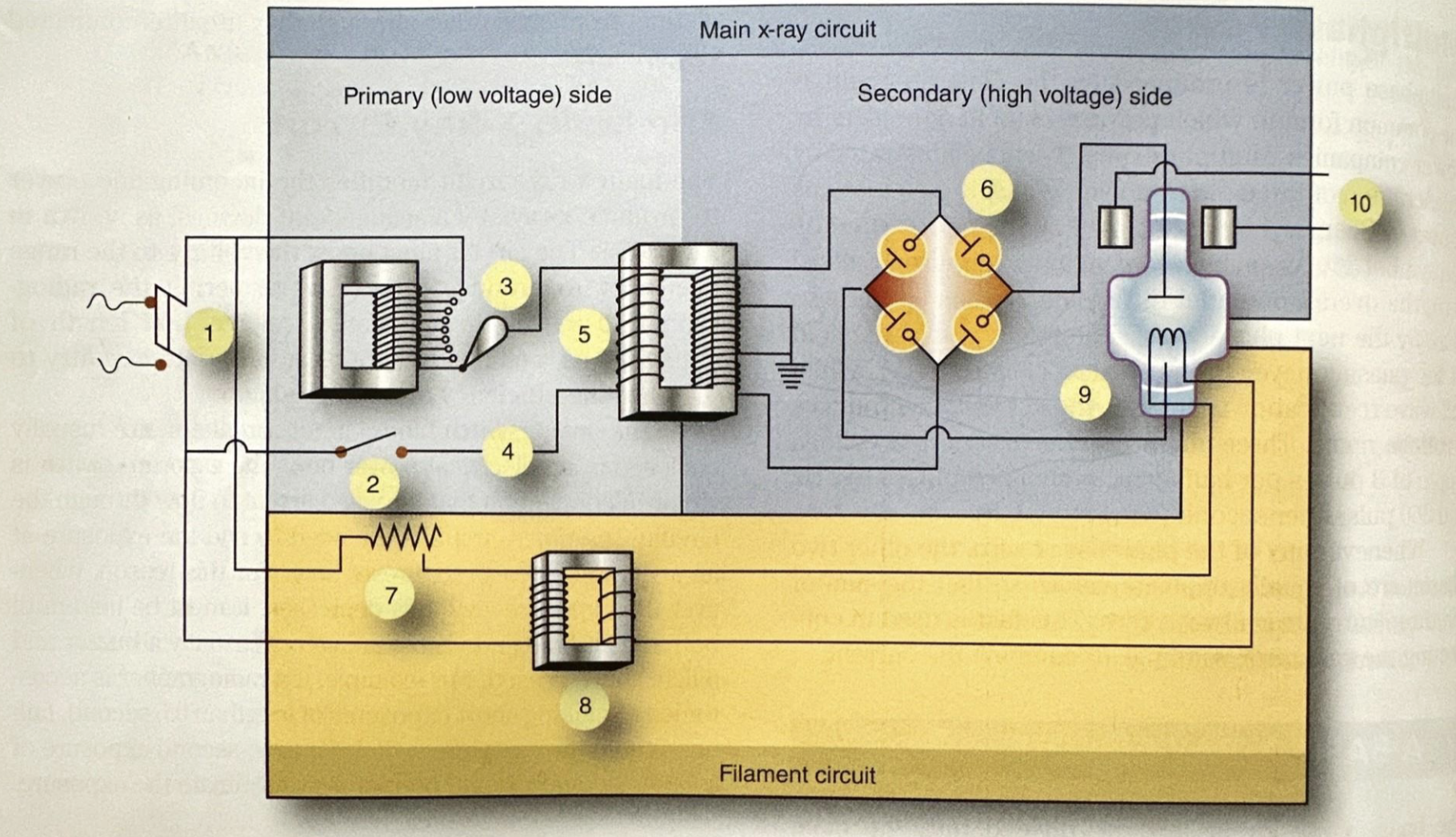
7
filament circuit variable resistance
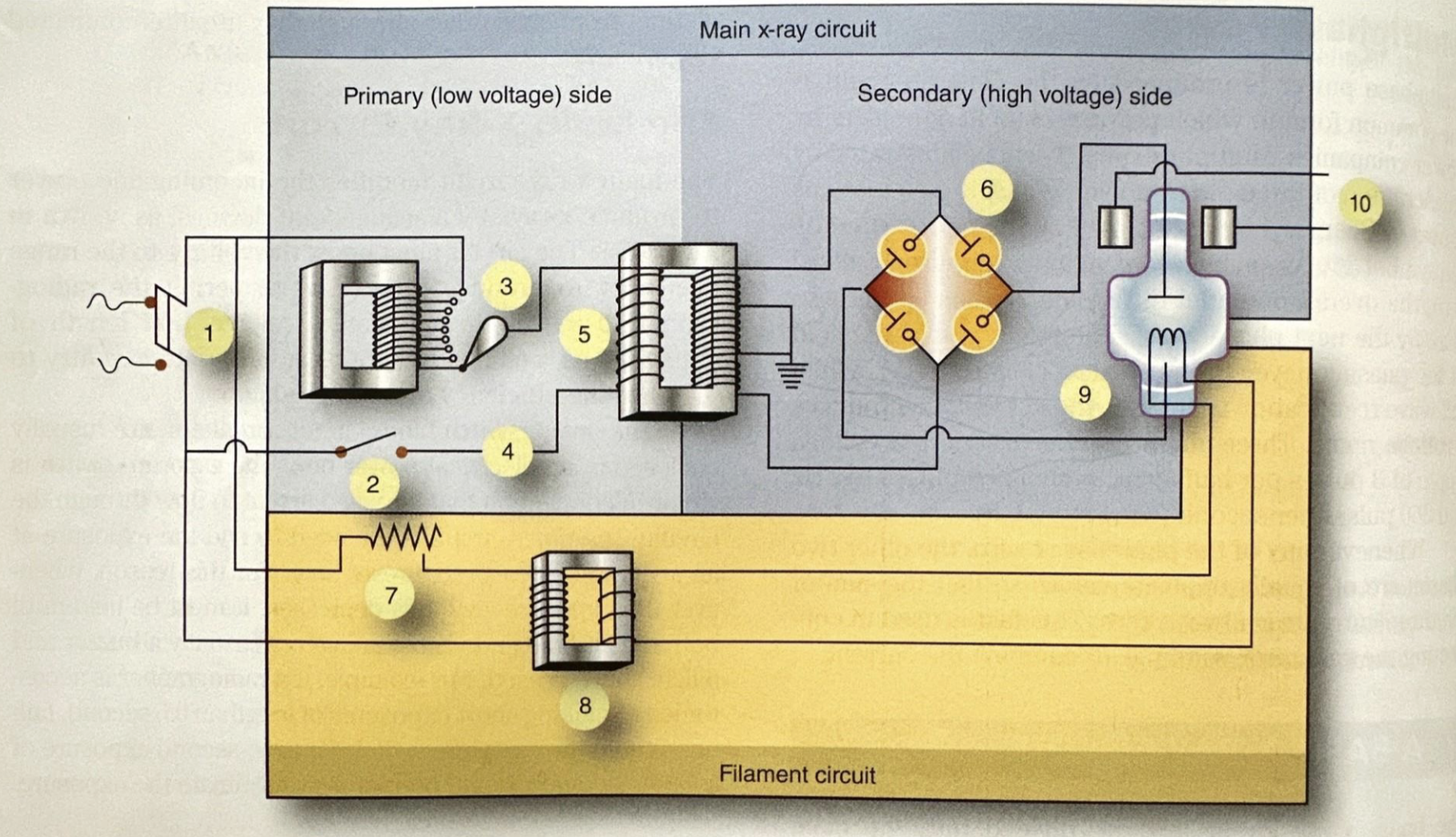
8
filament step-down transformer
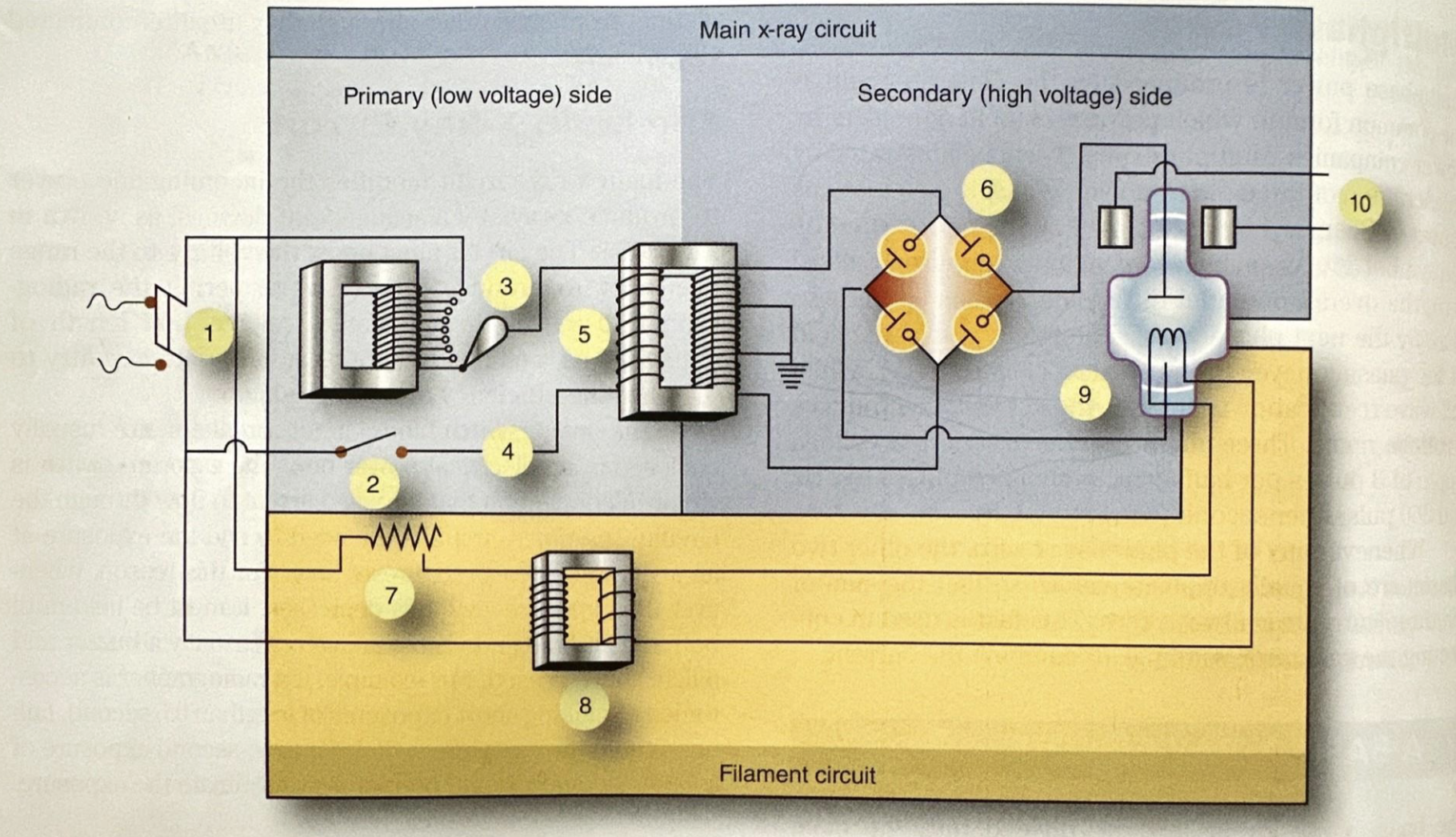
9
xray tube

