Culture PPT
 Call Kai
 Learn
Learn Practice Test
 Spaced Repetition
 Match
Match Flashcards
 Knowt Play
1/21

There's no tags or description
Looks like no tags are added yet.
Name | Mastery | Learn | Test | Matching | Spaced | Call with Kai |
|---|
No analytics yet
Send a link to your students to track their progress
22 Terms
_________ set of guidelines that one can inherit as a
member of a particular group or society.
culture
_______ is group of people who have different goals
and interests within a primary culture. Ex. Bikers
subculture
________ refers to the belief that one’s culture is
superior to that of others.
ethnocentrism
_________ is the often-erroneous assumption that a
person possesses certain characteristics or traits simply
because they are a member of a particular group.
stereotyping
_______ increasing interdependence of
the world's populations, due to increased
trade, travel, and technology
globalization
Cultural differences between the clinician
and the client can serve as _______.
barriers
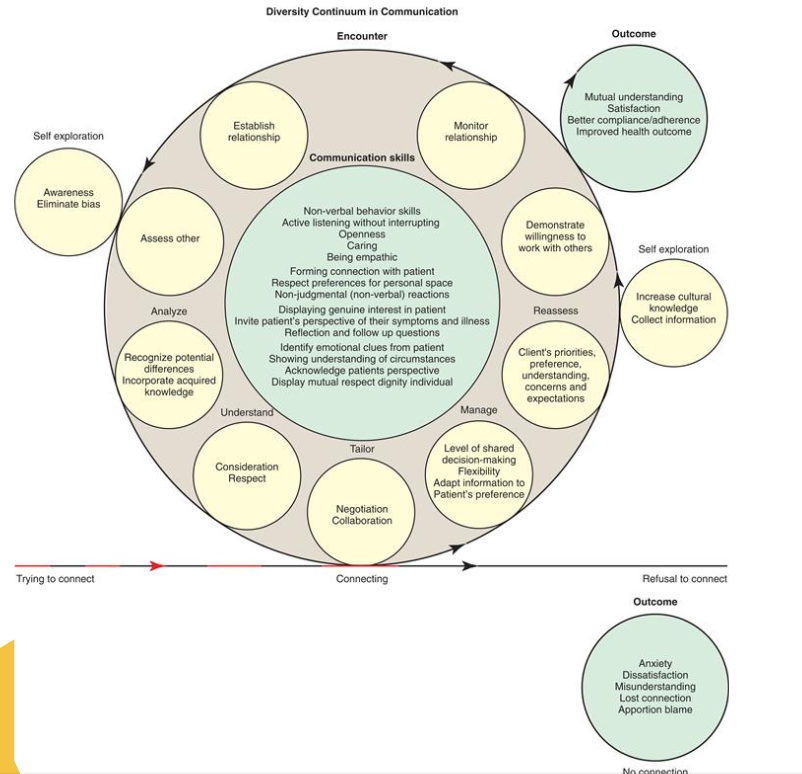
The diversity continuum in communication model emphasizes the presence of the clinician’s _______ and ______ as being a necessary first step in the provision of culturally competent care.
self- awareness and self-exploration
The clinician is encouraged to ask
clients about their _______ and
their cultural backgrounds.
health beliefs
_________ is an awareness that cultural differences and
similarities exist, which affect values,
learning, and behaviors.
cultural sensitivity
_________ involves awareness of one’s own biases or prejudices and is rooted in respect, validation, and openness toward differences. This involves recognizing patients as _______, while understanding that experiences, beliefs, values, and language affect perceptions of healthcare delivery and clinical outcomes.
Cultural competence, unique individuals
Communicate using _____, not judgments. The use of gestures, eye contact, etiquette, physical contact, and listening will differ among cultures. When in doubt, it is best to ________ to necessary touch only.
facts, restrict physical contact
_________ Group is viewed as the fundamental unit of society
• In this culture, decisions are not made independently but rather
are made as a group.
• Decisions may be made through a process of collaboration among family
members and friends.
• A client from a this culture may feel threatened or disoriented by
autonomous decision making (e.g., informed consent).
collectivist culture
_________ views the single person as central, with
autonomy and self-determination being essential to medical and
dental care
Individualistic culture:
__________ are differences in health status or in the
distribution of health determinants among different population
groups. _____ is a major contributor to health disparities and a barrier to individuals meeting their basic human needs for systemic and oral health. __________ is correlated with race and ethnicity.
health disparities/inequities, poverty, Socioeconomic status (SES)
Research indicates that there are large _________ based on social status that are pervasive and
persistent.
health disparities
_______ is a key predictor of poor oral and systemic health; it affects
where one lives, how one spends money, where one receives
healthcare, and ultimately, one’s general and oral health status.
Poverty
A major emphasis of ________ is ensuring equitable,
high-quality care among diverse and disadvantaged groups.
culturally competent care
The ___________ should take on the responsibility of
reducing barriers to improve clients’ access to and quality of care.
oral health professional
______ with empathy and understanding to the person’s perception
of the situation
______ culturally relevant information and Explain your perception of
the situation
________ the other person’s strengths rather than pointing out
their deficits
________ options/alternatives and Respect the person and their
choices
_________ agreement/compromise
L Listen, E Elicit, A Acknowledge, R Recommend, N Negotiate (LEARN model)
Which of the following concepts and practices will guide the clinician towards providing culturally competent care?
a. The clinician is encouraged to ask clients about the patient’s health beliefs and their cultural backgrounds.
b. Having an awareness that cultural differences and similarities exist.
c. Understanding that cultural differences affect values, learning, and behaviors.
d. Recognizing patients as unique individuals, while understanding that experiences, beliefs, values, and language affect perceptions of healthcare delivery and clinical outcomes.
e. All of the above
e. All of the above
Research indicates that there are large health disparities in the United States that are pervasive and persistent. These health disparities reflect inequalities that exist in our society and are correlated with: ____________.
a. socioeconomic status
b. race
c. ethnicity
d. All of the above
d. All of the above

