(ExRx) CHAP 7- Clinical Exercise Programming
 Call Kai
 Learn
Learn Practice Test
 Spaced Repetition
 Match
Match Flashcards
 Knowt Play
1/16

There's no tags or description
Looks like no tags are added yet.
Name | Mastery | Learn | Test | Matching | Spaced | Call with Kai |
|---|
No analytics yet
Send a link to your students to track their progress
17 Terms
Benefits
Functional capacity improvements
10%-30% cardiorespiratory fitness
Disease-related behaviors
Reduced subsequent heart-related serious events
Approximately 30%-40% reduction in risk of serious clinical event for each 1 MET increase in fitness
Reduced risk of death
High-intensity interval training
Participation
Referral rate high
Enrollment and adherence rates low
Discussion of diet, stress, exercise and medications with pts
High intensity interval training, if able to handle it and offered
cardiac rehab program effectivness
How many phases are there for cardiac rehabilitation?
3
Whats phase 1 of cardiac rehab? (5 key points)
inpatient
discussion with physician
visit from staff (clinical exercise physiologists, nurse or pt)
referral to phase 2
ambulation and education in preparation for discharge
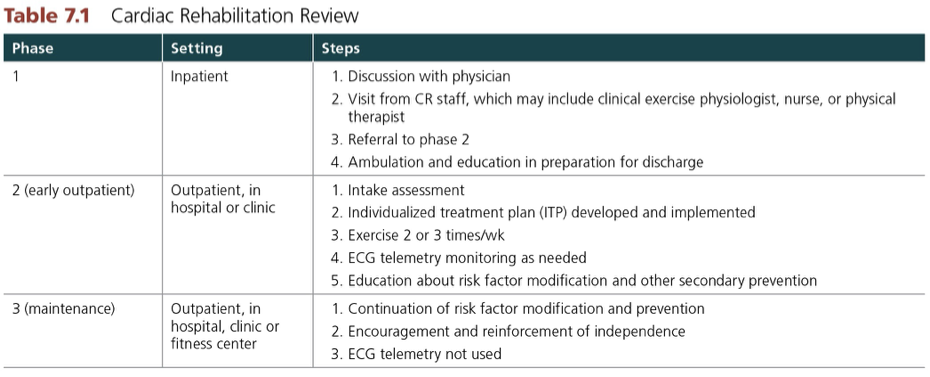
Whats phase 2 of cardiac rehab? early outpt (6 key points)
outpatient (hospital or clinc)
intake assessment
individualized treatment plan (ITP) developed and implemented
exercise 2-3 times/wk
ECG telemetry monitoring as needed
education about risk factor modification and other secondary prevention
Whats phase 3 of cardiac rehab? maintenance (4 key points)
outpatient (hospital, clinic or fitness center)
continuation of risk factor modification and prevention
encouragement and reinforcement of independence
ECG telemetry not used
what are the phases of cardiac rehab? (4 keypoints)
pt has cardiac event then referred by physician
pt is evaluated and ITP developed by CR team, physician signs off of it
pt participates in program and ITP is updated every 30 days
physician approved ITP until program ends
Typically referred after cardiac event requiring hospitalization
Insurance requires a diagnosis
Exercise Prescription developed and updated regularly
Signed monthly by physician
Part of medical record
Daily discussions
Individuals with cardiac disease benefit from participation in regular exercise and lifestyle change.
Cardiac rehabilitation (CR) is commonly used to deliver exercise and lifestyle interventions.
reduce risk for future events,
foster healthy behaviors and compliance to these behaviors, reduce disability, and promote an active lifestyle for patients with cardiovascular disease (CVD)
Have to have a diagnoses
Stress testing may catch heart disease
cardiac rehabilitation program policies
Acute Coronary Syndromes (ACS)
Angina, MI, or sudden death
Cardiovascular Disease (CVD)
Involves heart and/or blood vessels
Hypertension, CAD, PAD. Includes but not limited to atherosclerotic arterial disease.
Cerebrovascular disease (Stroke)
Disease of blood vessels that supply brain
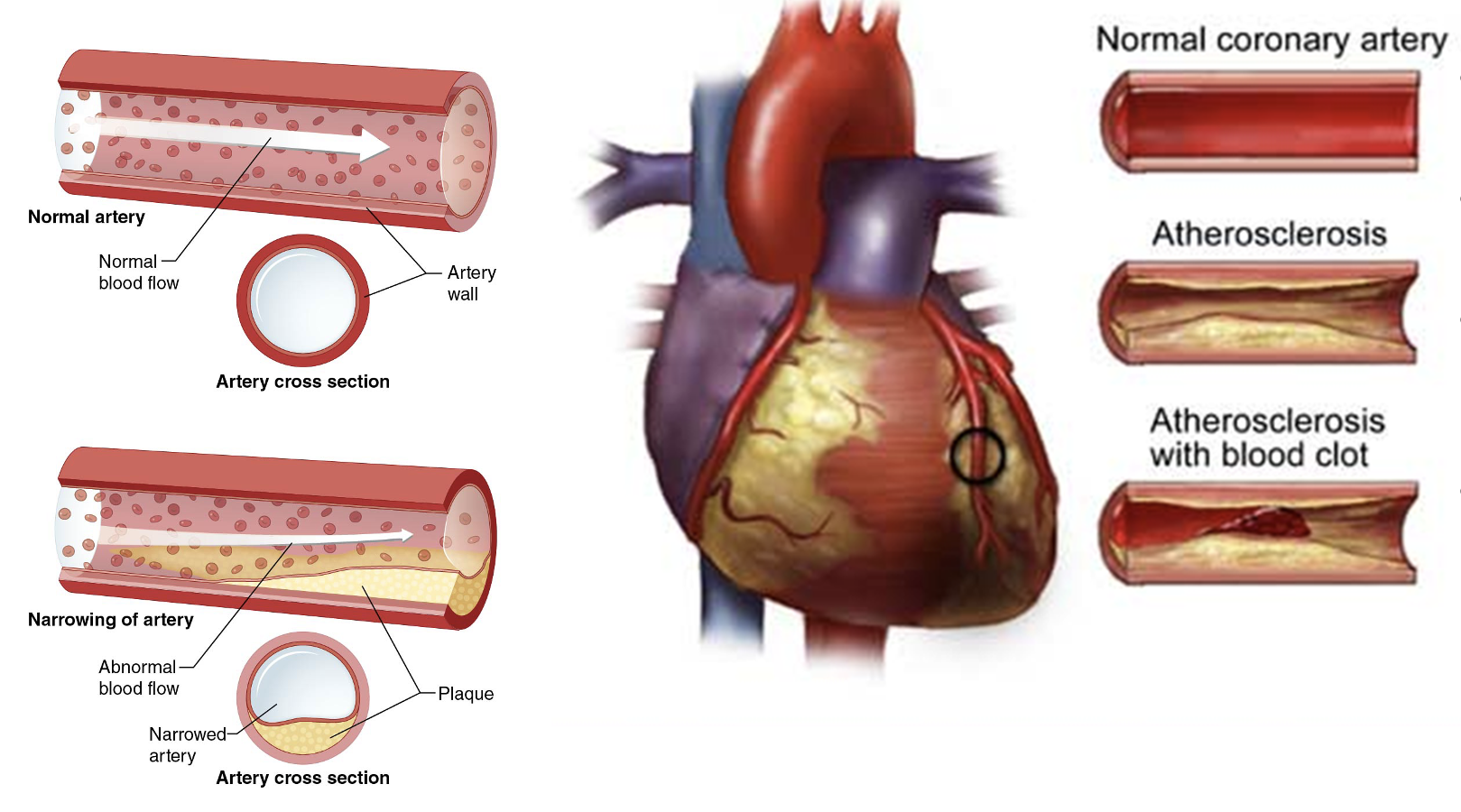
Coronary Artery Disease (CAD)
Disease of arteries of heart (usually atherosclerotic)
Myocardial Ischemia
Temporary lack of coronary blood flow to myocardial O2 demands. Often manifested as angina.
Myocardial Infarction (MI)
Injury/death of muscular tissue of heart
Peripheral Artery Disease (PAD)
Disease of blood vessels outside heart and brain
conditions and procedures covered by insurance
angina, MI, or sudden death
Acute Coronary Syndromes (ACS)
Involves heart and/or blood vessels
Hypertension, CAD, PAD. Includes but not limited to atherosclerotic arterial disease.
Cardiovascular Disease (CVD)
Disease of blood vessels that supply brain
Cerebrovascular disease (Stroke)
Disease of arteries of heart (usually atherosclerotic)
Coronary Artery Disease (CAD)
Temporary lack of coronary blood flow to myocardial O2 demands. Often manifested as angina.
Myocardial Ischemia
Injury/death of muscular tissue of heart
Myocardial Infarction (MI)
Disease of blood vessels outside heart and brain
Peripheral Artery Disease (PAD)
The myocardium relies on ATP for contraction.
In the heart, 40% of the muscle cells are mitochondria.
At rest, the body extracts 25% of the oxygen present in arterial blood.
Even at rest, the heart muscle extracts 75% of the O2 delivered to it.
heart disease and stroke pathophysiology
Early outpatient (phase 2)
2-3 days/wk
Aerobic machines
Single-lead ECG
Some may have a stress test prior to participation
“Rule of thumb” heart rate: 20-30 beats over rest or RPE
Sandwich bouts of exercise (10-20 min) between warm-up and cool-down
Evaluated daily for intensity
Maintenance (phase 3)
% HR reserve
cardiac rehabilitation program structure and process

