Gymnosperms and Cycads: Phylogeny, Structure, and Reproduction
 Call Kai
 Learn
Learn Practice Test
 Spaced Repetition
 Match
Match Flashcards
 Knowt Play
1/78

There's no tags or description
Looks like no tags are added yet.
Name | Mastery | Learn | Test | Matching | Spaced | Call with Kai |
|---|
No analytics yet
Send a link to your students to track their progress
79 Terms
What are gymnosperms?
Seed plants that produce seeds not enclosed in an ovary.
What is an example of a cycad?
Sago palm (Cycadaceae) or Zamia (Zamiaceae).
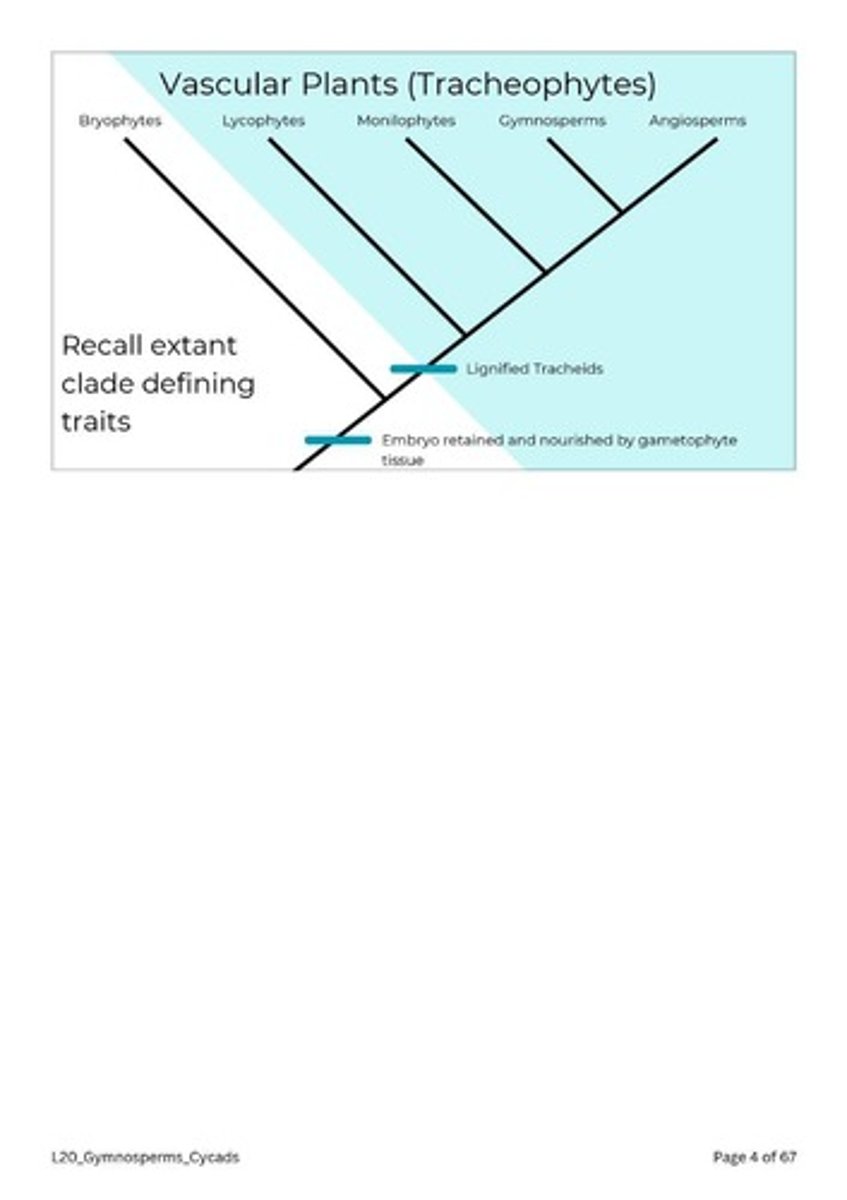
What are the defining traits of gymnosperms?
Lignified tracheids, ovules retained within integument, and megaphyll leaves.
What is secondary growth in plants?
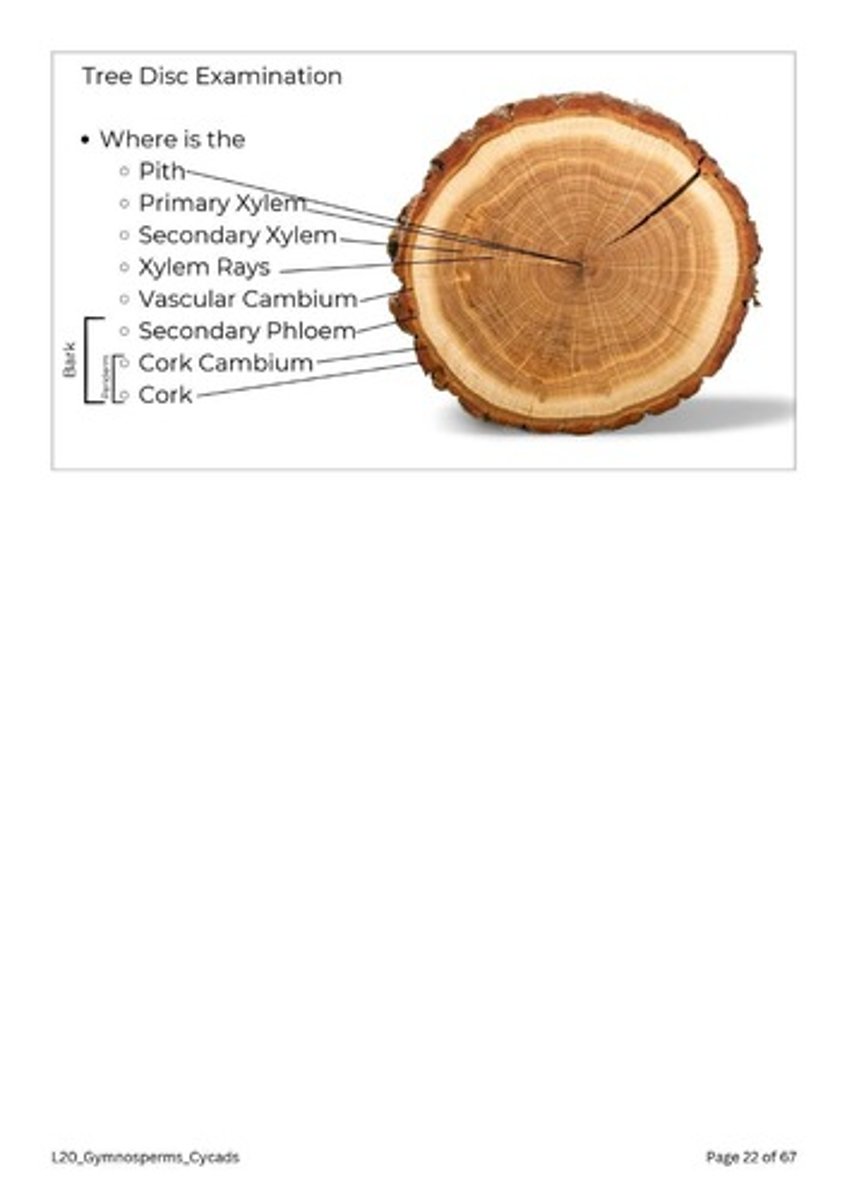
Growth that increases the diameter of stems and roots, primarily through the vascular cambium.
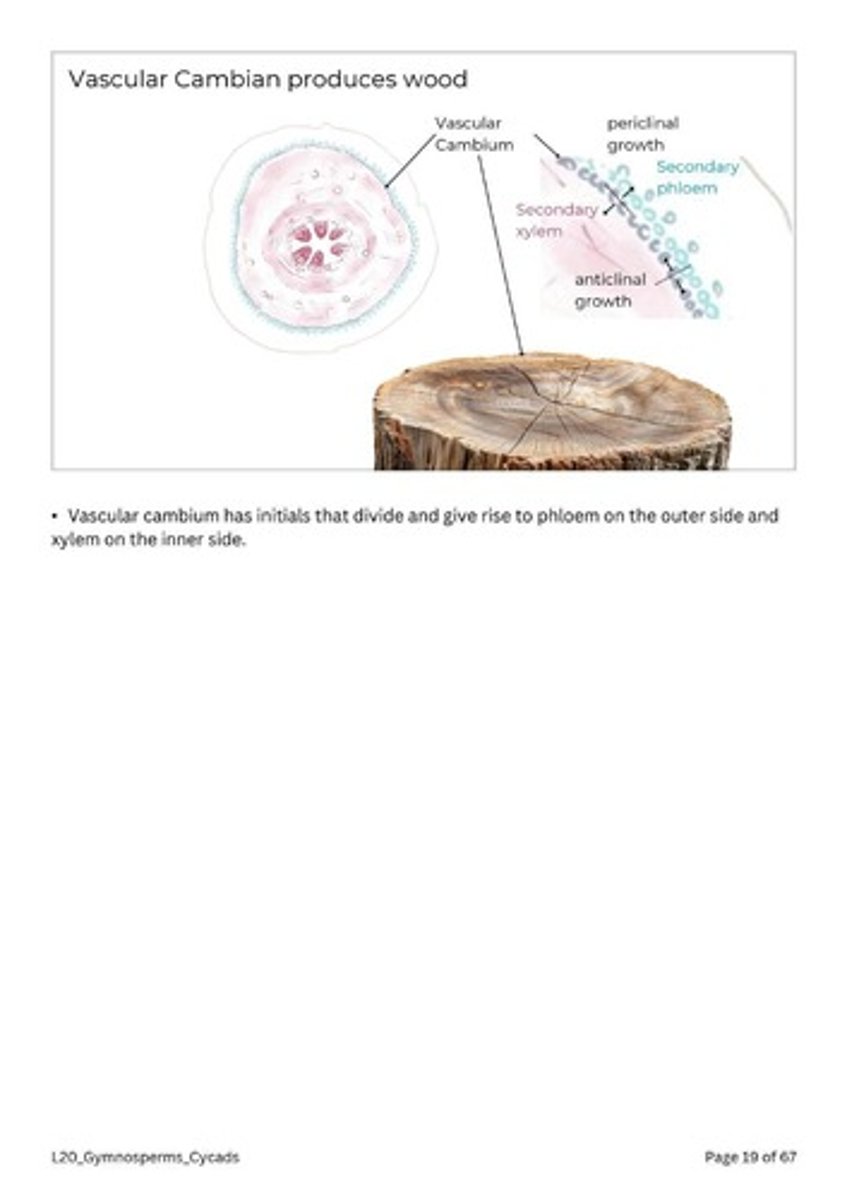
What is the role of the vascular cambium?
It produces secondary xylem (wood) and secondary phloem (inner bark).
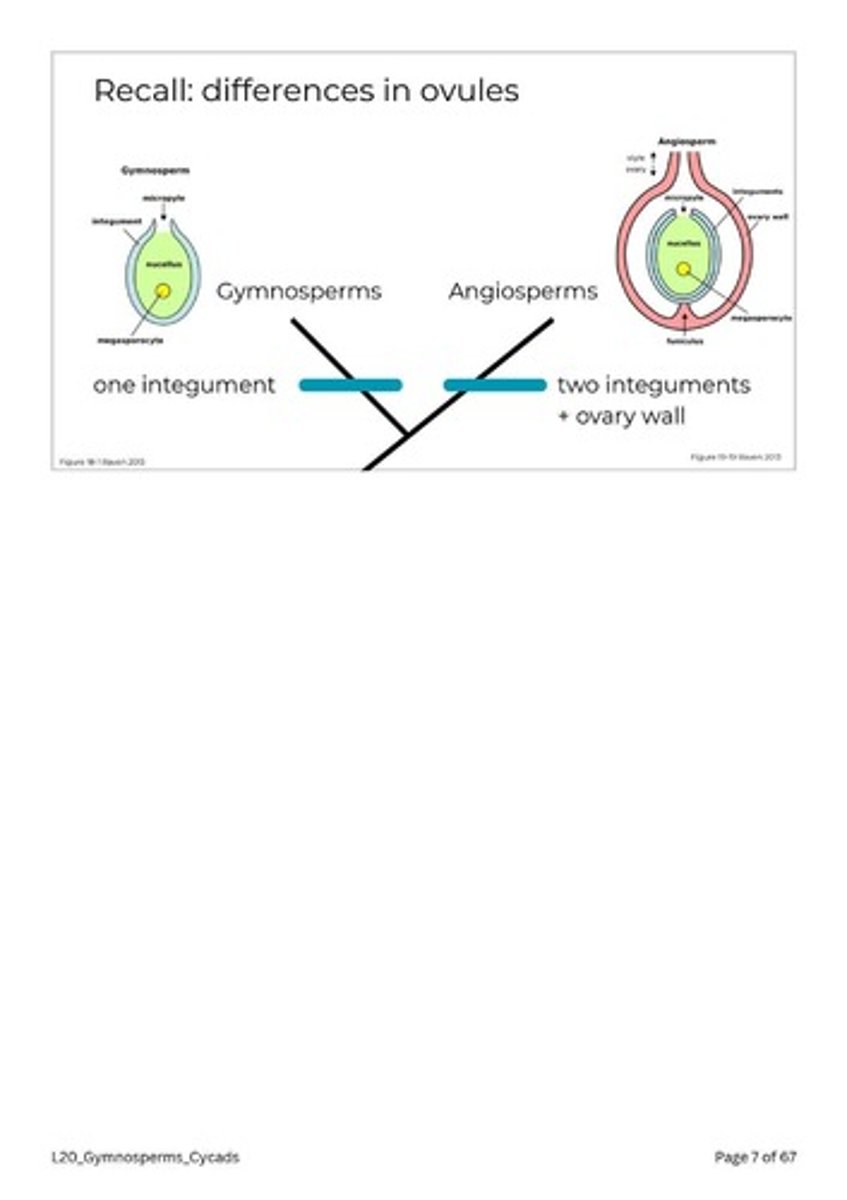
What is the difference between gymnosperm and angiosperm ovules?
Gymnosperms have one integument, while angiosperms have two integuments and an ovary wall.
What is a key feature of gymnosperm pollen?
Pollen is dispersed by wind and can produce a pollen droplet to capture airborne pollen.
What is the significance of tracheids in gymnosperms?
Tracheids are long, narrow cells that facilitate water transport, providing safety against cavitation.
What distinguishes angiosperms from gymnosperms?
Angiosperms have vessel elements in their xylem, allowing for more efficient water transport.
What is the Gneptine hypothesis?
It suggests that vessels in angiosperms and gnetales are an example of convergent evolution.
What is the function of the cork cambium?
It produces cork and contributes to the formation of the periderm, which replaces the epidermis in secondary growth.
What is the structure of a mature pine ovule?
It includes integument, micropyle, nucellus, and megasporocyte.
What are the two types of water-conducting cells in vascular plants?
Tracheids and vessel elements.
How do pollen tubes function in gymnosperms?
Pollen tubes grow through the nucellus toward the archegonium, facilitating fertilization.
What is the role of the female gametophyte in gymnosperms?
It houses the egg and supports fertilization and development of the embryo.
What is the primary difference between primary and secondary xylem?
Primary xylem is formed during the initial growth, while secondary xylem is produced by the vascular cambium.
What is a characteristic of cycads?
Cycads have non-motile sperm and are often mistaken for palms.
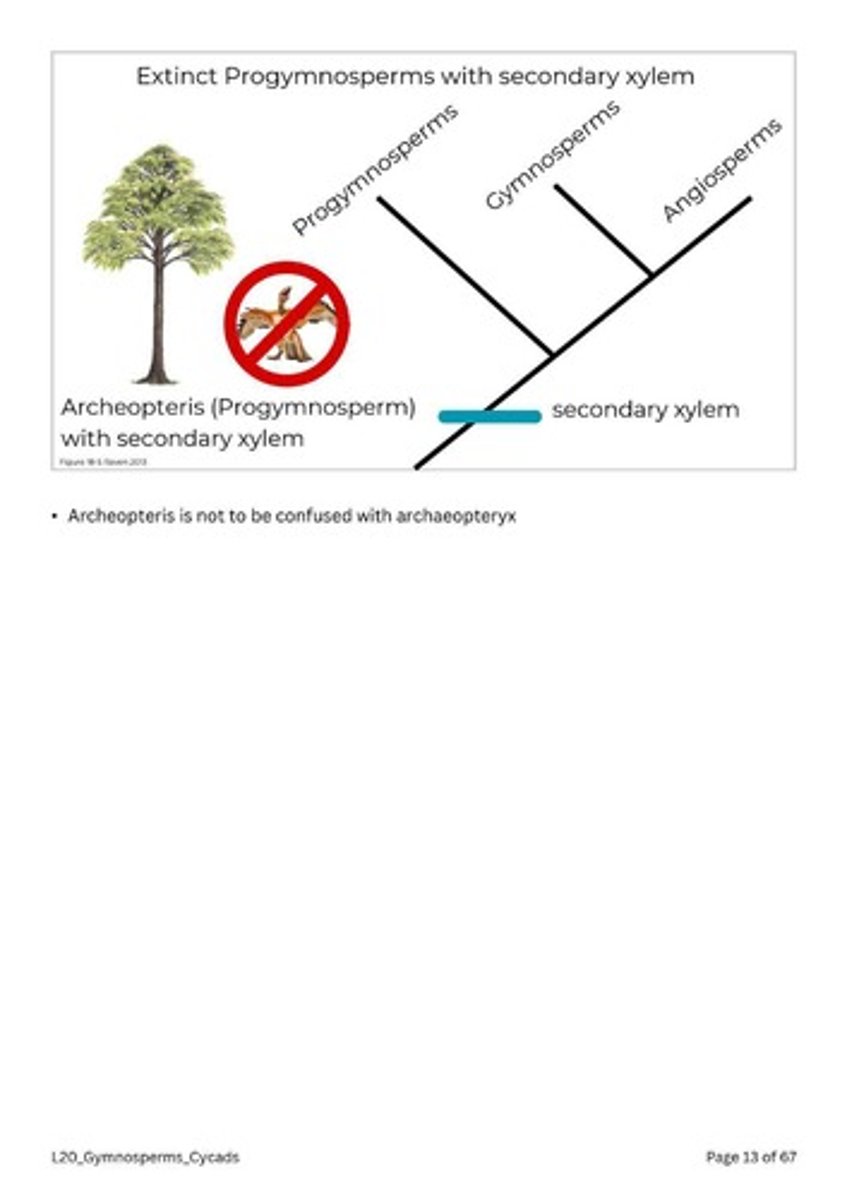
What is the significance of the archeopteris?
It is an extinct progymnosperm that had secondary xylem and is a precursor to modern gymnosperms.
What are the components of bark in gymnosperms?
Bark includes secondary phloem, cork cambium, and cork.
What is the function of xylem rays?
Xylem rays facilitate lateral transport of nutrients and water within the wood.
What is the significance of megaphyll leaves?
They are characterized by branched venation and are found in more advanced vascular plants.
What is the evolutionary significance of non-motile sperm in gymnosperms?
It indicates a reduced dependence on water for fertilization compared to earlier plant forms.
What is the role of the integument in ovule development?
The integument surrounds and protects the developing ovule.
What is the difference in sperm mobility between gymnosperms and earlier plants?
Gymnosperms typically have non-motile sperm, while earlier plants had motile, flagellated sperm.
What are the main groups of seed plants?
Gymnosperms and angiosperms.
What is the role of the pith in plant structure?
The pith stores nutrients and provides support in the center of the stem.
What is a pollen tube in gymnosperms?
An exosporic, tube-like extension from the pollen grain that grows towards the archegonium.
How do cycads and Ginkgo deliver sperm?
Sperm swim to the fertilization chamber via the pollen tube.
What is the role of the pollen tube in Pines?
The pollen tube grows through the nucellus, digesting it for nutrients as it travels.
What is the significance of the Gnetifer hypothesis?
It suggests a close relationship between Gnetophytes and conifers.
What does the Gnepine hypothesis propose?
It posits that Gnetophytes are more closely related to pines than to other gymnosperms.
What is the Anthophyte hypothesis?
It proposes that angiosperms are closely related to gnetophytes.
What is the typical height range for cycads?
Cycads typically grow to be 1-5 meters tall.
What type of growth do cycads exhibit?
Cycads exhibit little secondary growth, contributing to their short stature.
What are the main components of cycad stems?
Cycad stems consist of epidermis, cortex, pith, and primary vascular bundles.
What does the acronym CADS stand for in relation to cycads?
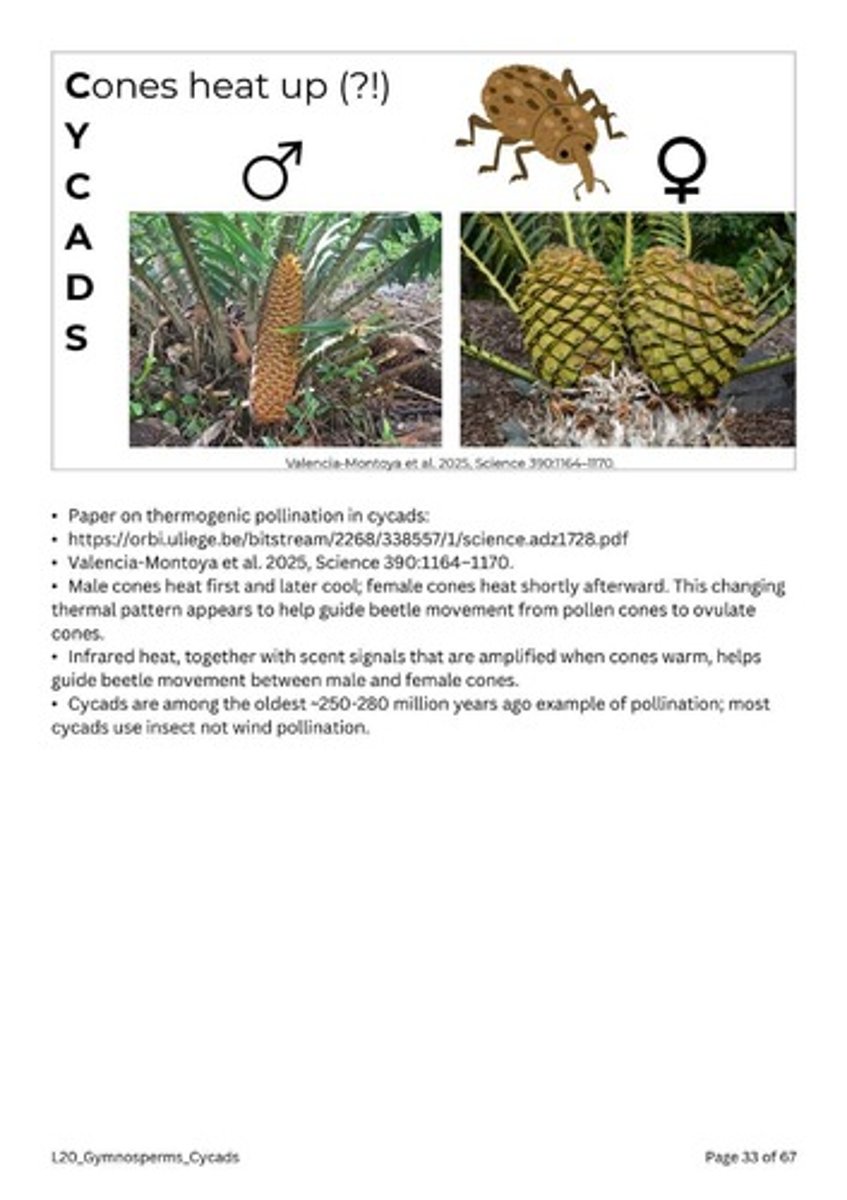
C - Cones heat up, A - Ancient lineage, D - Dioecious, S - Swimming sperm.
What is thermogenic pollination in cycads?
It is a process where male cones heat up to attract beetles for pollination.
What toxins do cycads produce?
Cycads produce neurotoxins, such as cycasin, to deter herbivores.
How have Indigenous communities adapted to cycad toxicity?
They have developed methods to detoxify cycad seeds for consumption.
What is circinate vernation?
It is the coiled arrangement of young pinnate leaves in cycads.
What does dioecious mean in the context of cycads?
It means that cycads have separate male and female plants.
What is unique about the genus Cycas?
In Cycas, megasporophylls are not organized into an ovule cone.
What is the significance of Encephalartos woodii?
It is a male cycad species known as 'The Loneliest Cycad' because a female has never been found.
What is the age range of cycads?
Cycads are among the oldest plants, dating back approximately 250-280 million years.
What is the primary method of pollination for most cycads?
Most cycads use insect pollination rather than wind pollination.
What are microstrobili?
They are pollen cones in cycads that bear microsporophylls with microsporangia.
What are megastrobili?
They are ovulate or seed cones in cycads that bear megasporophylls with ovules/seeds.
What is the role of the archegonium in gymnosperms?
The archegonium is the female reproductive structure where fertilization occurs.
What is the function of the nucellus in gymnosperms?
The nucellus provides nourishment to the developing gametophyte and seeds.
How do cycads adapt to their environments?
Cycads are adapted to tropical and dry environments.
What is the relationship between cycads and dinosaurs?
Cycad ancestors lived alongside dinosaurs approximately 230 million years ago.
What does dioecious mean in relation to Cycadophyta?
It means that there are separate male and female plants.
What type of sperm do cycads produce?
Swimming sperm.
What are the two major families of Cycadophyta?
Cycadaceae and Zamiaceae.
How can you identify Cycadaceae leaves?
They have pinnate leaves with a single mid-rib but no lateral veins on leaflets.
How can you identify Zamiaceae leaves?
They have pinnate leaves that lack a mid-rib but have dichotomously branched longitudinal veins.
What is the distinguishing feature of Stangeria genus leaves?
They have pinnate leaves with a midrib and lateral veins.
What is a dichotomous key?
A tool used to separate organisms based on their characteristics.
What is the life cycle stage of Zamia that involves microstrobili?
The male reproductive structure that produces pollen.
What are megasporophylls?
Structures that bear ovules in female cones.
What is the function of the integument in ovules?
It protects the ovule.
What is the role of the micropyle in ovules?
It is the opening through which pollen enters the ovule.
What is the process of pollen development in gymnosperms?
Microsporocytes undergo meiosis to produce microspores, which develop into pollen grains.
What is the function of the pollen tube in cycads?
It grows into the nucellus and facilitates fertilization.
What is the significance of the generative cell in pollen?
It divides to form sperm cells.
What type of dispersal do cycad seeds often undergo?
Animal dispersal, often by animals that consume the fleshy outer coat.
What are the major features of Cycadophyta?
Ancient lineage, palm-like growth form, dioecious reproduction, and motile sperm.
How do you distinguish between Cycas and Zamia?
Cycas has leaflets with a single midrib and no lateral veins, while Zamia has leaflets that lack a midrib with longitudinally branched veins.
What is the role of vascular cambium in wood formation?
It produces secondary xylem inward and secondary phloem outward.
What are xylem rays?
Radial bands of parenchyma cells that allow lateral transport and storage across the stem.
What is the periderm in plants?
The protective outer tissues including cork and cork cambium.
What is the function of cork cambium?
It produces cork, which forms the protective outer bark.
What is the significance of the sarcotesta in cycad seeds?
It is the fleshy outer layer that is often consumed by animals for seed dispersal.
What is a microgametophyte?
The male gametophyte that develops from a microspore.
What are archegonia?
Structures that develop from the megagametophyte and contain eggs.
What is the typical structure of pollen in cycads?
It typically contains prothallial cells, a generative cell, and a tube cell.
What is the ecological role of cycads?
They are often pollinated by insects, particularly beetles.
What is the significance of the term 'haustrorial' in relation to pollen tubes?
It refers to the nutritive function of the pollen tube before sperm release.
Still learning (78)
You've started learning these terms. Keep it up!

