idiographic and nomothetic approaches to psychological investigation
 Studied by 0 people
 Call Kai
 Learn
Learn Practice Test
 Spaced Repetition
 Match
Match Flashcards
 Knowt Play
1/13

There's no tags or description
Looks like no tags are added yet.
Name | Mastery | Learn | Test | Matching | Spaced | Call with Kai |
|---|
No analytics yet
Send a link to your students to track their progress
14 Terms
What is the idiographic approach?
An approach to psychological research that focuses on the individual case as a means of understanding behaviour.
It focuses on individuals and emphasises uniqueness, aswell as favouring qualitative methods in research.
What is the nomothetic approach?
An approach that aims to formulate general laws of behaviour.
This is based on the study of groups and the use of statistical (quantitative) techniques.
Which approach has the majority of psychology favoured?
The nomothetic approach
Why is the idiographic approach qualitative?
Because the focus is on gaining insights into human behaviour by studying unique individuals in depth rather than gaining numerical data from lots of people and determining average characteristics.
The focus is on the quality of information rather than the quantity.
It’s also qualitative as it uses qualitative methods such as unstructured interviews and case studies.
What are some examples of the idiographic approach?
Freud used case studies in his patients - eg Little Hans. The case consisted of over 150 pages of quotes and descriptions of events in Hans’ life.
Humanistic psychologists also favour the idiographic approach as they focus on the whole person and seeing the world from the perspective of that person. What matters for them is the person’s subjective experience.
NOMOTHETIC APPROACH: what is the goal of the nomothetic approach?
It seeks to make generalisations and develop laws/theories about behaviour.
This is also the goal of the scientific approach to psychology.
Why is the nomothetic approach quantitative?
Quantitative research is based on numbers - measures of central tendency and dispersion, graphs etc. These calculations require large data samples.
Normative research (eg establishing norms in IQ) requires thousands of participants.
What are some examples of the nomothetic approach?
The biological approach seeks to portray the basic principles of how the body and brain work.
Cognitive psychology aims to develop general laws of behaviour that apply to all people, such as understanding typical memory processes.
An example is also Eysenck’s psychometric approach to personality in his EPQ (sticky notes on board in class).
Explain Eysenck’s 1947 personality questionnaire (EPQ).
He studied personality using psychometrics - measuring psychological characteristics such as intelligence and personality and intelligence. He did this through a questionnaire of personality.
The EPQ was used to collect large amounts of data which produced different personality types.
Large groups were tested (nomothetic) and their scores were distributed to inform us of normal and abnormal personality types.
What were the personality traits identified using factor analysis of the data collected in the EPQ (image of graph)
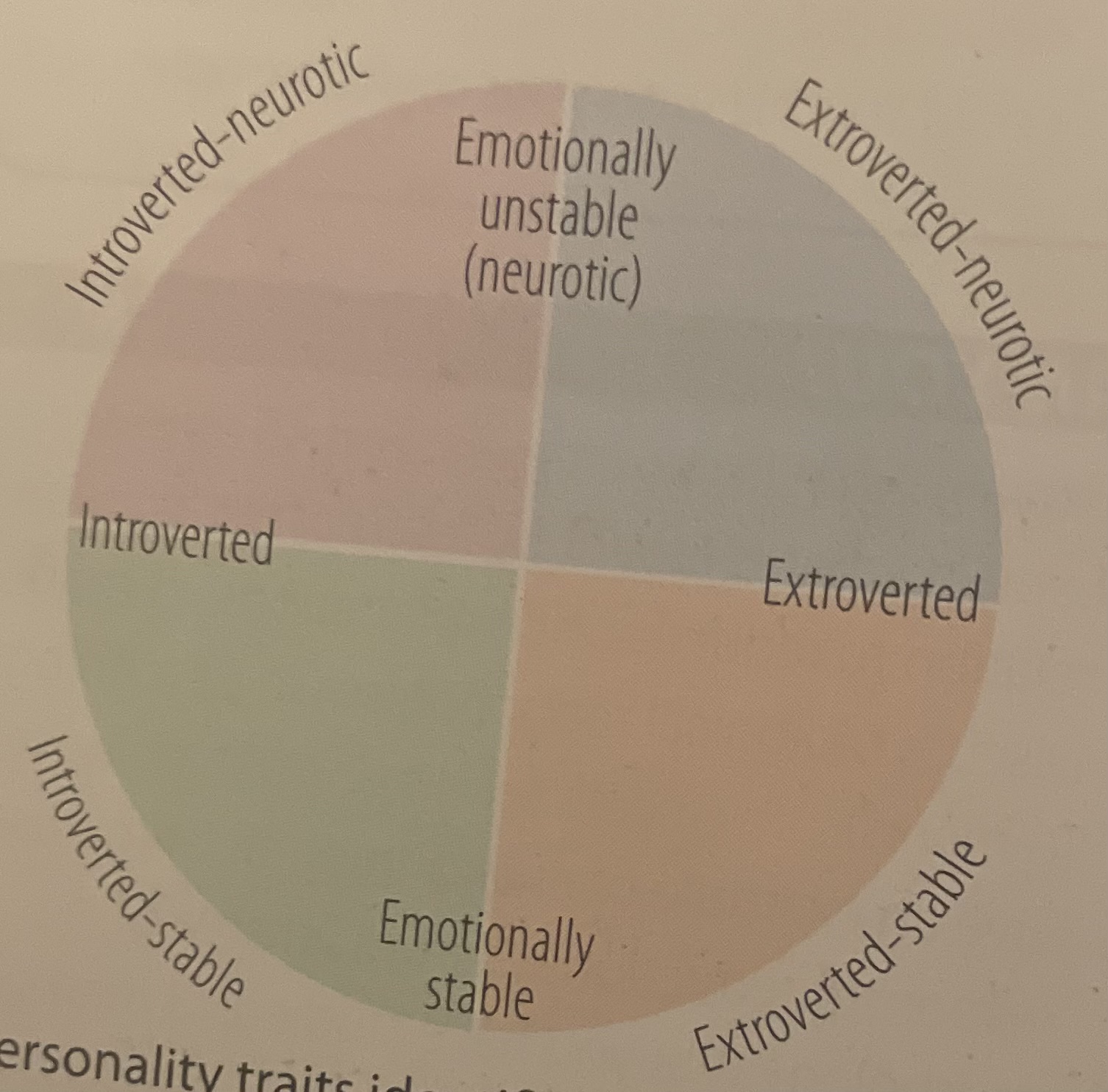
What is factor analysis?
A statistical technique that reduces data to a smaller set of component variables.
Eval/discussion
Focus on the individual - the idiographic approach focuses on studying on the unique individual. Allport said that we need to understand the whole person to truly predict behaviour. So a strength of the idiographic approach is that it brings psychology back to a human focus, instead of just analysing data.
Scientific basis - idiographic research is less scientific as it uses qualitative methods such as case studies. Although modern qualitative research can be systematic. So idiographic techniques can be scientific in their own way.
More eval
Idiographic approaches are unable to make general predictions - too focused on individuals. This limits practical uses.
The nomothetic approach is less time consuming than the idiographic approach. It is also quicker and easier to analyse large groups.
Conclusion
The idiographic approach gives deep, meaningful insight into individuals but lacks generalisability and is time-consuming.
The nomothetic approach produces broad, scientific laws but overlooks personal meaning.
The solution to the debate is to take an interactionist view - using both approaches together to gain a full understanding of human behaviour.
 Note
Note  Flashcards (49)