study pack 2 bio/ biochem
 Studied by 0 people
 Call Kai
 Learn
Learn Practice Test
 Spaced Repetition
 Match
Match Flashcards
 Knowt Play
1/6

There's no tags or description
Looks like no tags are added yet.
Name | Mastery | Learn | Test | Matching | Spaced | Call with Kai |
|---|
No analytics yet
Send a link to your students to track their progress
7 Terms
Microbiota are beneficial for food digestion, macromolecule absorption, and immunity. Researchers investigated the role of microbiota in shaping the brain and some physiological functions. They analyzed activity and structure on slides of the hypothalamic–pituitary–adrenal (HPA) axis in three types of mice: germ-free mice (GF), mice raised with some germs but lacking specific pathogens (SPF), and mice raised carrying a selected group of pathogenic microorganisms (gnotobiotic, GB).
Experiment 1
Researchers exposed GF and SPF mice to either 1 h restraint stress or ether. The adrenocorticotropic hormone (ACTH) and cortisone levels were higher in GF mice than in SPF mice after 1 h restraint, while ether exposure did not cause any change.
Experiment 2
On prepared slides, researchers observed no structural differences in the adrenal and pituitary glands between GF and SPF mice after they had been restrained. However, they observed increased hypothalamic levels of corticotropin-releasing factor (CRF) in GF mice when compared to SPF mice.
Experiment 3
Researchers compared the stress response in SPF, GF, and GB mice carrying either the gram-positive Bifidobacterium infantis or the gram-negative Escherichia coli (Figure 1).
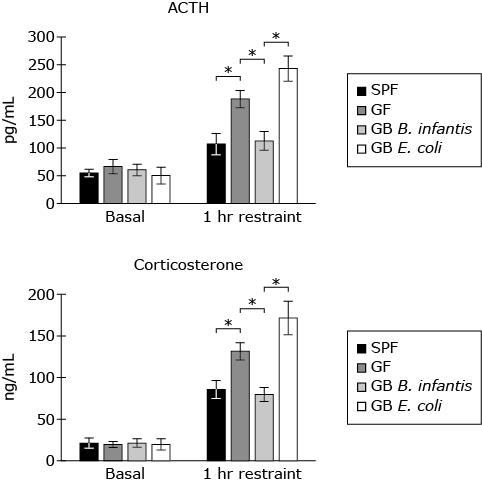
Figure 1. Effects of restraint stress on plasma ACTH and corticosterone levels in different animal models (Note: Hormone levels at 1 h restraint were significant when compared to their basal levels for both hormones and all mouse models.)
Which other hormone is produced by the structure that had high CRF levels in Experiment 2?
A
Follicle-stimulating hormone
B
Growth hormone
C
Prolactin
D
Vasopressin
Solution: The correct answer is D.
FSH is produced by the anterior pituitary, not the hypothalamus.
It is the anterior pituitary that produces growth hormone, not the hypothalamus.
Prolactin is produced by the cells of the anterior pituitary, not by the cells of the hypothalamus.
According to the passage, CRF levels were elevated in the hypothalamus. Although vasopressin is released in circulation by the posterior pituitary gland, it is actually produced by the hypothalamus
Which structure is closest to the CRF-producing structure?
A
Cerebellum
B
Medulla oblongata
C
Occipital lobe
Answer choice eliminated
D
Thalamus
Solution: The correct answer is D.
The cerebellum is located posteriorly to the hypothalamus, and it is farther away than the thalamus.
The medulla oblongata is at the base of the brain and is farther away from the hypothalamus than the thalamus.
The occipital lobe is located posteriorly from the hypothalamus and farther away than the thalamus.
Researchers found high levels of CRF in the hypothalamus; among the options given, the thalamus is the structure that is the closest to the hypothalamus.
According to Figure 1, in GB E. coli mice, which type of hormone shows the highest fold increase after 1 h restraint, and how will it circulate in blood?
A
The lipid, which will circulate freely
B
The lipid, which will circulate bound to a carrier
C
The peptide, which will circulate freely
D
The peptide, which will circulate bound to a carrier
Solution: The correct answer is B.
Indeed, the levels of corticosterone increase 7 times; however, corticosterone is a lipid and will be circulating attached to a transporter, not freely in blood.
The levels of corticosterone go from 25 ng/mL at basal level to 175 ng/mL after 1 h restraint, thus they increase 7 times. Corticosterone is a lipid and will be circulating attached to a transporter.
The levels of ACTH only increase by 5 times (from 50 to 250 pg/mL), thus less than corticosterone, which increases by 7 times.
According to the figure, the levels of ACTH only increase by 5 times; furthermore, the peptide will circulate freely, not bound to a carrier.
Peptide hormones (e.g., insulin, growth hormone, ADH) are water-soluble (lipid-insoluble), so they circulate freely in the blood. They bind to cell surface receptors.
Lipid hormones (e.g., steroid hormones like cortisol, thyroid hormones) are not water-soluble and require carrier proteins to circulate in the blood. They can diffuse through the cell membrane to bind to intracellular receptors.
Steroid Hormones -lipid-soluble, nonpolar/hydrophobic, derived from cholesterol, require transport proteins to travel through the blood (which is polar/hydrophilic), diffuse across the plasma membrane of endocrine cells to enter the nucleus and regulate transcription, synthesized as needed (used immediately/not stored), have a longer half-life in blood (effects in body are slower but longer-lasting than those of peptide hormones). Ex: estrogen, testosterone, aldosterone, cortisol
Peptide Hormones - lipid-INsoluble, polar/hydrophilic, derived from a chain of AAs/polypeptides, do NOT require transport proteins to travel through the blood, must bind to a EXTRAcellular receptor on the surface of target cells and activate a secondary messenger cascade to exert its physiological effects (peptide hormones themselves are the primary messenger), stored in vesicles until signaled for excretion, have a shorter half-life in blood (effects in body are shorter but more rapid than those of steroid hormones). Ex: FSH, LH, ADH, oxytocin
Which structure(s) is(are) present in both the microorganisms carried by the GB mice used in Experiment 3?
A
Membrane-bound organelles
B
Double membrane
C
Circular DNA
D
Thin cell wall
Solution: The correct answer is C.
Bacteria do not have membrane-bound organelles.
Only gram-negative, but not gram-positive, bacteria have a double membrane.
Both microorganisms are bacteria. Bacteria have circular DNA.
Only gram-negative, but not gram-positive, bacteria have a thin cell wall. The cell wall in gram-positive bacteria is thick.
From which germ layer does the organ with high CRF levels originate?
A
Ectoderm
B
Endoderm
C
Mesoderm
D
Trophoderm
Solution: The correct answer is A.
The hypothalamus is a brain structure that originates from the ectoderm.
No structure in the brain originates from the endoderm.
The hypothalamus derives from the ectoderm; few structures of the brain originate from the mesoderm, like the vessels, for instance.
The trophoderm gives rise to the placenta, not to brain structures.
ENDODERM- "end-ternal organs" most internal organs..
ECTODERM- "attracto-derm" brains(NS) and looks(skin and sense organs)
(this one is my favorite) MESODERM- "means to get around/movement" skeletal/musculature, cardiovascular, gonads and kidneys(bc you need to move to go pee)
Which method did researchers most likely use to analyze adrenal and pituitary glands in Experiment 2?
A
Immunohistochemistry
B
Northern blot
C
Southern blot
D
Western blot
Solution: The correct answer is A.
As indicated in the passage, researchers looked at the structure on slides, thus they most likely used immunohistochemistry.
Northern blot will give information about gene expression, not the structure of an organ.
Southern blot will give information about the DNA content, not the structure of the organs.
To perform a western blot, the organ needs to be homogenized, which limits the analysis of its structure.
SNoW DRoP (snow drop)
S D : southern/DNA
N R : northern/RNA
o o
W P : western/protein
 Note
Note  Flashcards (27)