Class 20, ch 3 and ch 11 first 2 sections
 Call Kai
 Learn
Learn Practice Test
 Spaced Repetition
 Match
Match Flashcards
 Knowt Play
1/53

Earn XP
Description and Tags
Ch3 and Ch11 first half
Name | Mastery | Learn | Test | Matching | Spaced | Call with Kai |
|---|
No analytics yet
Send a link to your students to track their progress
54 Terms
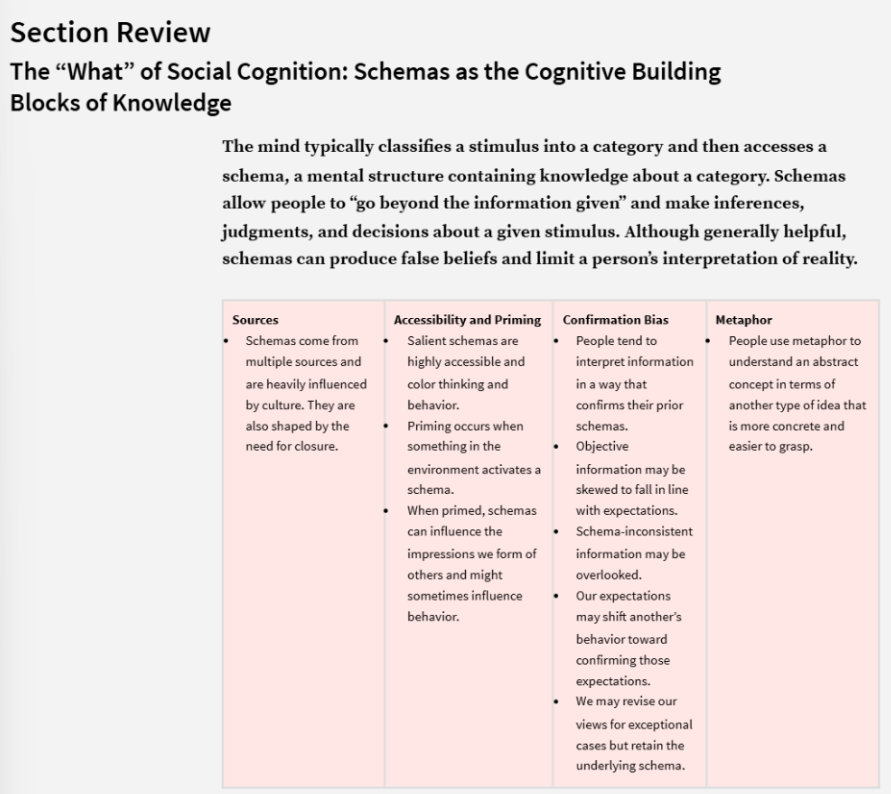
schema
A structured framework or plan that organizes and interprets information, often used in psychology and cognitive science to describe mental models.
party schema
Tells you what to expect, how to behave, how to dress
mom schema
Helps you predict and interpret things your mom will say and do
Confirmation Bias
We hold a schema, then we tend to seek out and evaluate new info so that it confirms what we already believe or feel & ignore information that doesnt fit
Way people can preserve their worldview, keep it stable and constistent
Often leads to inaccurate interpretations of new information
Confirmation bias study- Snyder & Frankel 1976
Participants shown silent videotape of woman being interviewed, Participants had to assess the interviewee’s emotional state
Told the interview was about sex
Participant rated interviewee as more anxious
Told the interview was about politics
Participants expected the woman to be anxious over discussion personal topic and so they interpreted the ambiguous signals as anxiety
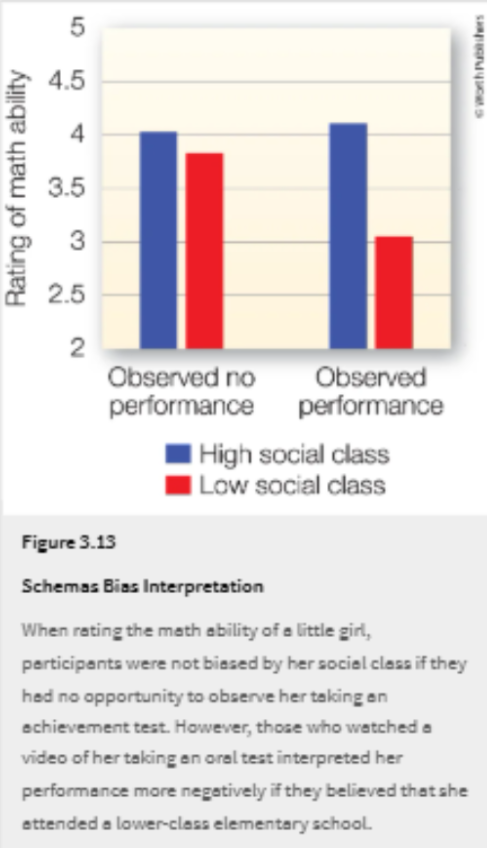
Confirmation Bias study- Darley and Gross (1983)
I like dont get this
Set up: 2 videotapes of 9y/o 4th grader, Hannah, showing playground in back and scenes of her neighborhood and school
No performance group: watch ^^ video first, then asked to rate her academic abilities
The performance group: watch second video of her answering questions, then asked to rate abilities
Video where Hannah was clearly upper class → schema = academically successful
Video where Hannah was lower class → schema = unsuccessful
Results: objective evidence increased rather than decreased the bias
No performance group estimated her abilities to be the same regardless of whether she was upper class or lower class
Performance group: rated her much better if she was upper class rather than lower class
“Objective evidence” is interpreted as confirming what they already believed they knew abt her ability based on status
Confirmation Bias study- Snyder & Swann (1978)
participants had discussion with a partner who was described to them as being extraverted or introverted. Had to assess whether the description was true
given set of questions to guide convo
participants asked questions that already assumed the hypothesis was true
Extroverted: questions like: “when are you most talkative?”
Introverted: “what do you dislike about loud parties?”
Bias information gathering:
People tend to seek evidence that fits teh hypothesis they are testing rather than seearching for evidence that might not fit that hypothesis
Self-fulfilling prophecy
Robert Merton (1948)
[find actual definition]
Perceivers’ expectations about others can shift people’s behavior toward confirming those expectations
Self-fulfilling prophecy study: Robert Rosenthal and Lenore Jacobson (1968)
Administered tests to students in elementary school and told their teachers randomly selected names of some kids in their class who were “on the verge of experiencing a substantial leap forward in general learning abilities”
Late bloomers were abt to display intellectual growth spurt
2 years later, kids scored substantially higher than other classmates
Teachers’ positive expectations for their students can shape how well those students actually perform
Their expectations affect their behavior towards students in ways that actually improve their learning
More attention, more nods, more smiles, more challenges, positive reinforcement
Students respond w more engagement, effort, and learning
Conceptual metaphor theory
The idea that people understand abstract concepts through metaphorical mappings from more concrete experiences, shaping language and thought.
metaphor
Cognitive tool people can use to understand abstract social ideas in terms of other types of ideas that are more concrete and better understood
example
“Christmas is fast approaching”
Using knowledge abt moving objects to conceptialize time
Even though theres no such thing of an event moving forward, it is how she can make sense of what “time approahcing” means bc time is a vague concept
Blends our knoweldge of one thing with knowledge of a different type of thing
Something about bodily experiences and schemas
relates to how physical sensations and experiences shape cognitive frameworks, influencing perception and understanding of abstract concepts.
Section review
Ch 3- Confirmation Bias