accounting midterm #2
 Call Kai
 Learn
Learn Practice Test
 Spaced Repetition
 Match
Match Flashcards
 Knowt Play
1/190

Earn XP
Description and Tags
sessions 8-16
Name | Mastery | Learn | Test | Matching | Spaced | Call with Kai |
|---|
No analytics yet
Send a link to your students to track their progress
191 Terms
start of session 8 information - statement of cashflows
wonderful
what is CFO
cash flow from operating activities
how to figure out CFO
2 methods: direct and indirect
indirect method for CFO (how to and benefits)
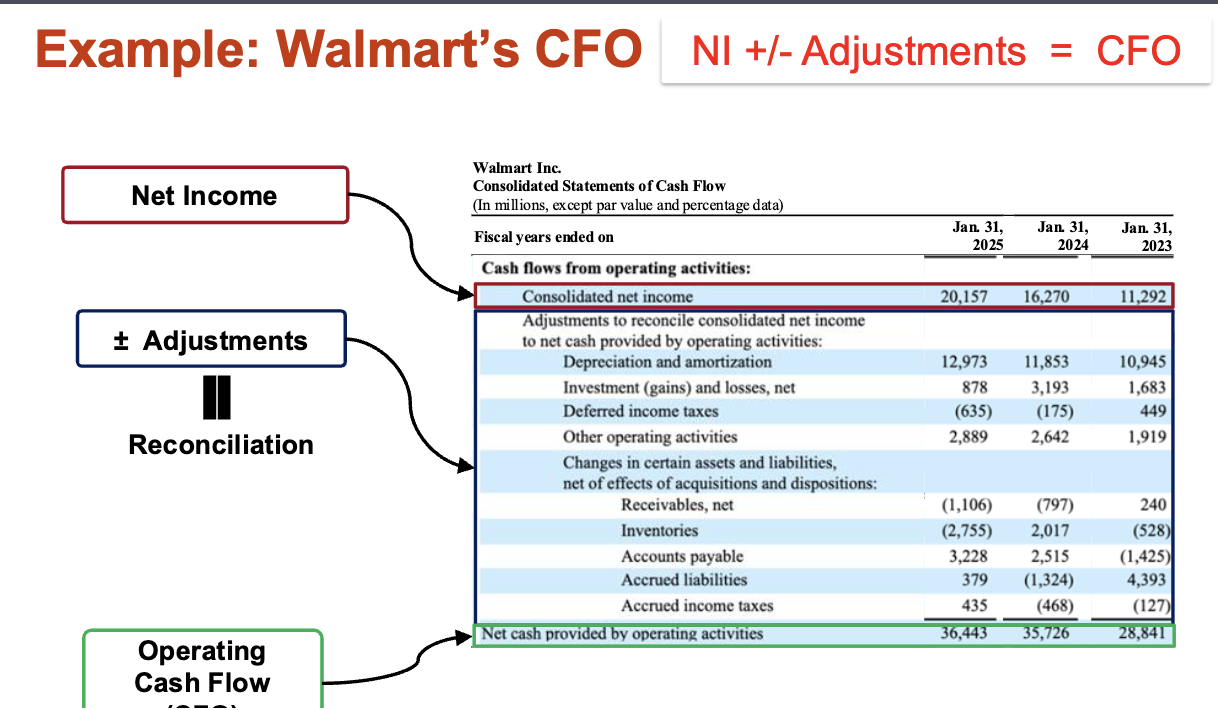
start with net income (which comes from income statement)
makes adjustments to figure out CFO
helps users see why NI is different from operating cash flow (because of those adjustments that are made).
example of CFO using indirect method
link between balance sheet and SCF - logic
(from IB memory):
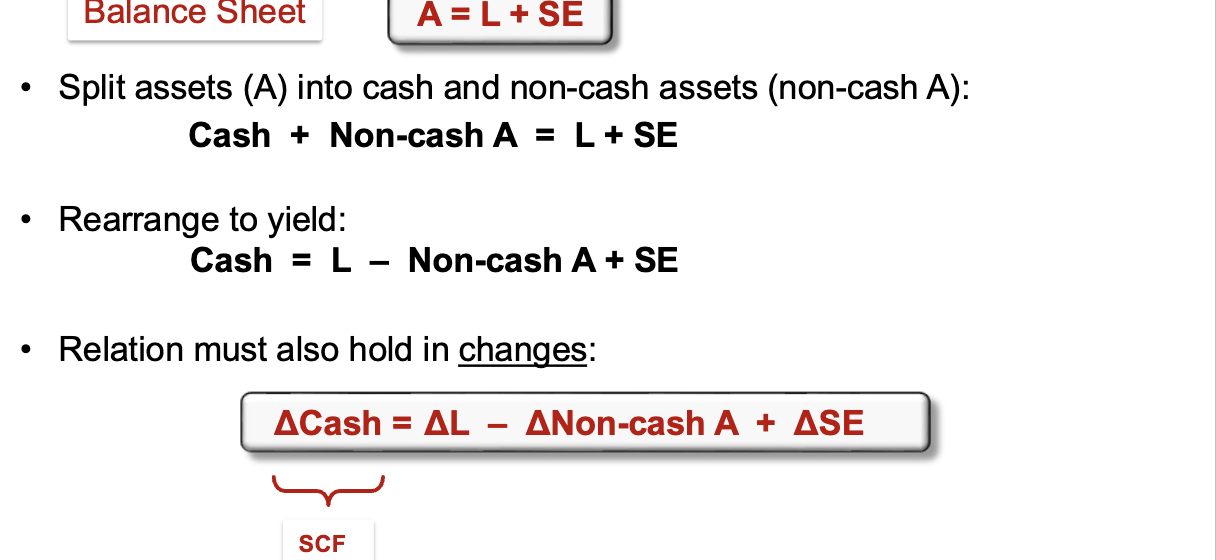
the SCF shows the change in cash, and that number is included in the assets section of the B/S
link between balance sheet and SCF - equation
change in cash = change in liability - change in non cash assets + change in SE
what is the financial statment that’s split into three sections
SCF (operating, financing and investingt)
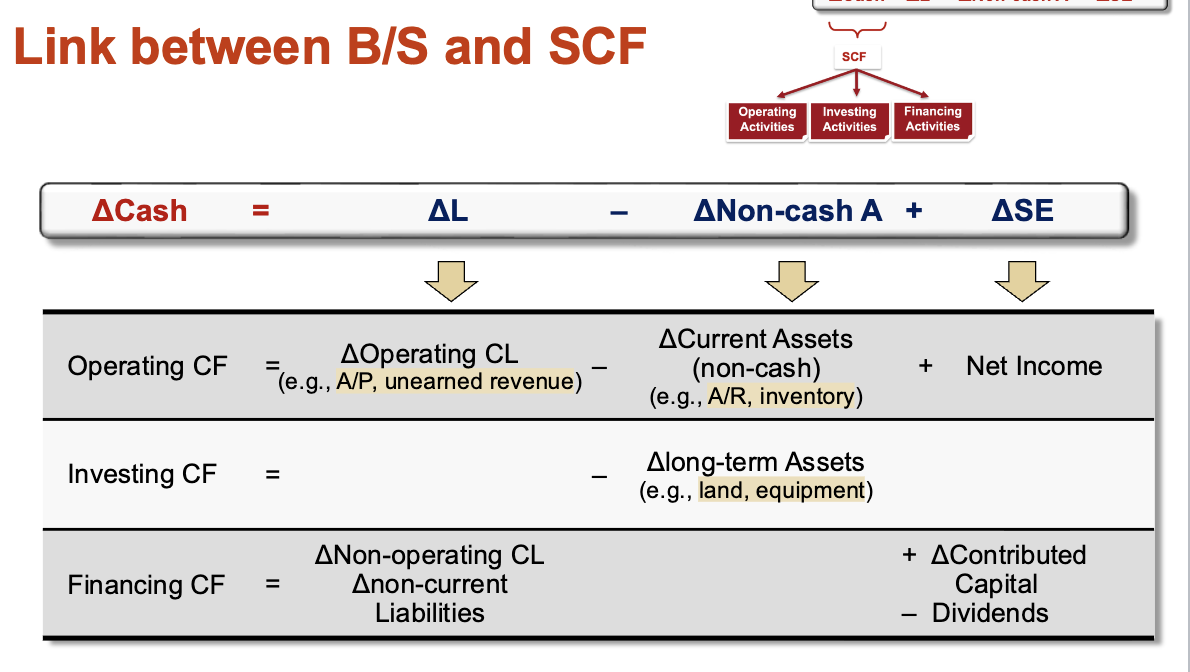
what does operating cash flow consist of
change in Operating Current Liabilities - Current Non Cash Assets + Net Income
examples of change in operating current liabilities
A/P, unearned rev
examples of change in change in current non cash assets
A/R, inventory
investing cash flow involvs
Change in Liabilities - change in Long-term Assets + change in SE
what does Financing CF consist of
Change in Non operating CL and Non current Liabilities - Change ing Noncash Assets + Change in SE
connection to B/s from SCF table
is net income purely operating related?
NO. it includes:
core operating activities income
expenses and income from non-operating activities, taxes and interest
Operating Income (Operating Profit/EBIT): Measures profit strictly from core business activities (selling goods/services) after deducting operating expenses like rent, payroll, and COGS. It ignores how a company is financed or its tax burden.
Net Income (Bottom Line): Takes the operating income and further adjusts it for non-operational items, interest, and taxes.
is net income purely cash-based?
no. why? it includes
non cash expenses
non operating gains and losses
examples of
non cash expenses
non operating gains and losses
Non-cash expense (e.g., depreciation — reduce NI but do not reduce cash)
• Non-operating gains/losses (e.g., gain on sale of PP&E — included in NI but related to CFI
operating income vs net income
Operating Income (Operating Profit/EBIT): Measures profit strictly from core business activities (selling goods/services) after deducting operating expenses like rent, payroll, and COGS. It ignores how a company is financed or its tax burden.
Net Income (Bottom Line): Takes the operating income and further adjusts it for non-operational items, interest, and taxes.
how to make CFO: indirect method
1) start with net come
2) make adjustments across the three groups
3) sum all adjsutments and calculate the CFO
3 groups of adjustments for CFO’s made with indirect method
1) non cash expenses
2) non operating gains and losses in NI
3) changes in operating working capital
non cash expenses details (for CFO indirect method adjustments)? do you add or deduct
example: depreication expenses
ALWAYS add back depreciation exp
2) non operating gains and losses in NI details? do you add or deduct
exmaples: gains/losses form sale of PPE or long term investments
deduct: non-operating gains
add: non operating losses
3) changes in operating working capital
exmaples: current assest and liabilities
changes in operating assets = inventory, A/R
changes in operating liabilities = A/P, unearned rev
operating cf equation

CFI
cash flow from investing activities
what is the equation of CFI (direct method)
changes in long term assets (land, equipment)
increase vs decrease in long term assets for CFI
increase: purchase = cash outflow
decrease: sale = cash inflow
steps for CFI direct method
list purchase and sale of each long term asset
add them to get CFI
CFF
cash flow for financing activities
euqation for CFF (direct method)
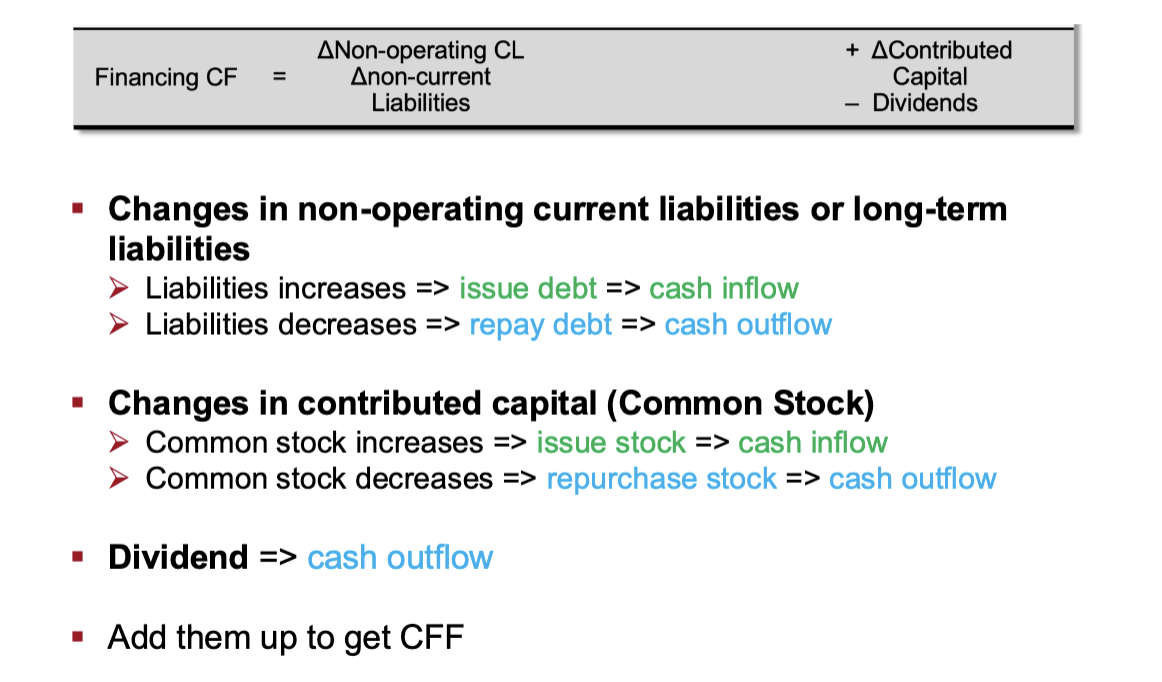
changes in non operating current liabilities or long term liabilities + change in contributed capital - dividends

changes in no operating current liabilities or long term liabilities: increase/decrease

what is contributed capital
common stock!
changes in contributed : increase/decrease for CFF

changes in dividends for CFF: increase/decrease
dividend = cash outflow
how to get CFF
add everything up
end of session 8 / start of session 10
session 10 : prepping SCF using direct/indirect method
goal for session 10 (outside of flashcards)
learn to prep SCF using direct and indirect method, and t-accounts
what does the direct vs indirect method report differeintly for cash flows
The direct method reports actual cash inflows/outflows (e.g., cash from customers, payments to suppliers)
The indirect method reconciles net income to cash flow by adjusting for non-cash items
focus of the direct vs indirect method for Cash Flows
direct = providing high transparency into operational liquidity
indirect =focusing on the quality of earnings
shows the WHYYY of the CFO
more popular for financial analysis
how to find value of dividends
net income - retained earnings = dividends
what must you do with all non-cash expenses
they are always POSITIVE adjustments
operating assets include
changes in:
A/R
Inventory
Prepaid Expense
operating liabilities include
changes in
A/P
Wages Payable
Unearned Rev
why do you deduct the increase in A/R and the increase in Prepaid expenses if they experience an increase over time?
For A/R
remember this is a CFO, so we;re only concerned about the cash. A/R isn’t technically cash, you’re not recieveing cash for anything (at least not yet, so that’s BAD for the CFO). Revenue and NI increases, but not cash. so it’s a deduction.
if you don’t do this, net income is TOO HIGH and it would account for cash that you don;t have
For Prepaid Expenses:
prepaid expenses means that even though the expenses aren’t recorded yet, you still paid CASH for it. so it decreases cash. if not, NET INCOME STAYS TOO HIGH
why do we add the increase in wages payable on the CFO
because the expense has been recorded, but technically you haven’t traded any cash for it yet. if you were to deduct it, the NI would be too low, because you technically still have that cash!
why do we add the increase in unearned revenue on the CFO
because with unearned revenue, you haven’t actually executed any action/service but you still got the cash. so, it makes sense to add it. otherwise, the NI would be too low
what does a NEGATIVE valye for A/R mean on the CFO
that there’s an increase in A/R
what does a POSITIVE valye for A/P mean on the CFO
that there’s an increase in A/P
what else do you have to learn how to do for session 10
reading and analyze the SCF and what it means
use the information to asses financial condition of a corporation
Session 10 SCF a User’s Perpsective to practice
end of session 10 / beginning of session 11 (accounts recieveables)
what are assets ordered in on the b/S
in order of liquidity
what does accrual accounting mean
revenue is recognized before cash is recieved from customers
reasons to extend credit to customers, what is the risk,
boost sales
customers dont always pay their bills
and why analyze A/R
What is the firm’s credit policy?
- Does the firm have a lot of bad debt?
- How efficient is the company in collecting receivables?
what is bad debt
debt that is not going to be payed
Bad debt expense is an operating expense incurred when customer credit accounts become uncollectible, reducing net income.
aka uncollectible accounts
what does GAAP require companies to do due to risk of uncollectibale accounts
estimate the amount of uncollectible accounts at the end of each accounting cycle (adjusting process)
HOW DO companies estimate the amount of uncollectible accounts at the end of each accounting cycle (adjusting process)
companies anticiapte that some of their credit sales will NOT be collected
they dont wait till the customer fails to pay, they js guess how much it’s gonna be and record it as an expense
matching principal
when companies anticipate their uncollectable accounts/bad debt and they dont wait till the customer fails to pay, they js guess how much it’s gonna be and record it as an expense
what is the adjusting entry for depreciation
Gross Cost of PPE - Accumulated Dep = net PPE

what is established when adjusting for depreciation AND bad debt
a reserve is established
for depreciation it’s contra-asset (X)
for bad debt, it’s…
what is the reserve for bad debt
AUA (±XA)
estimated amount of uncollectible recivables
journal entry for bad debt
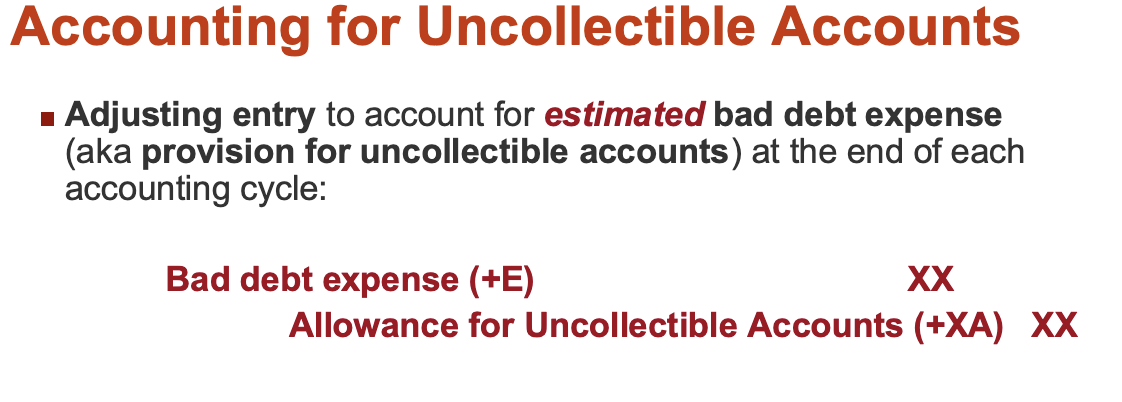
balance sheet stuff for AUA
A/R gross - AUA = A/R net
on balance sheet, what to look out for when it comes to A/R
it’ll say A/R and then “net allowance of $x". that amount = the amount of AUA/bad debt. if you add those, you’ll get gross A/R
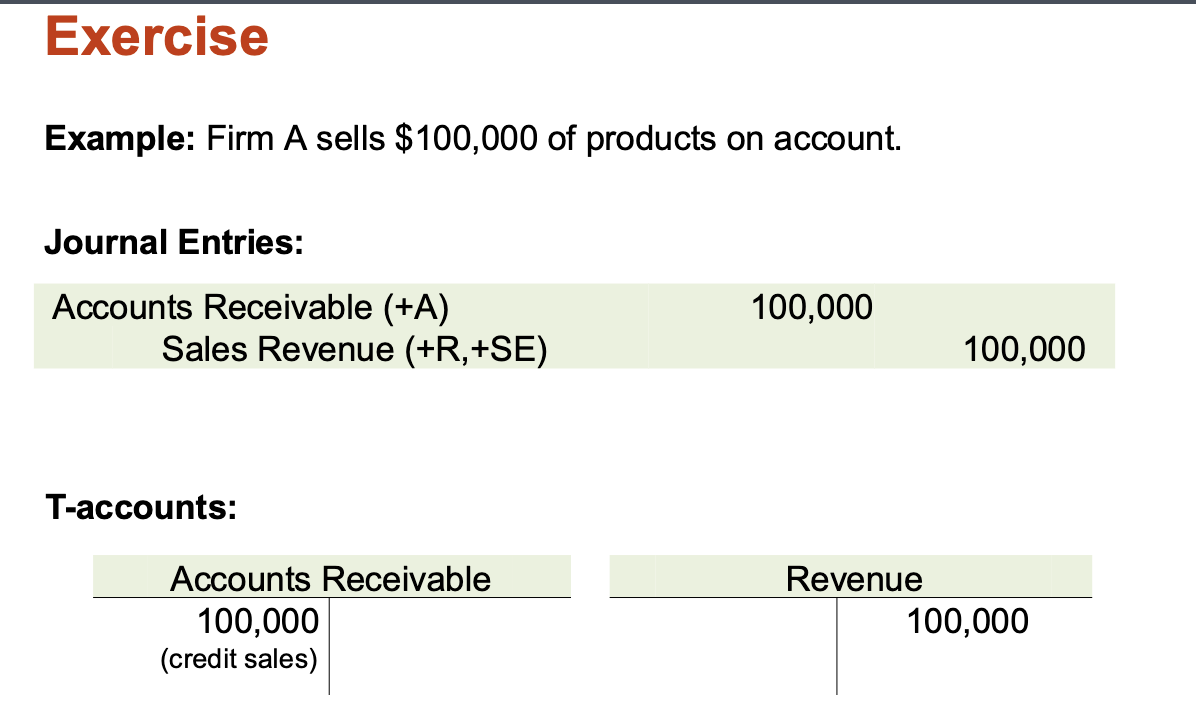
if a company sells products on account, what is the journal entry
A/R(+A) xx
Sales Rev (+R, +SE) xx
what do you make t-accounts for
for EACH account involved in the journal entry
so the entry talks about A/R and Revenue:
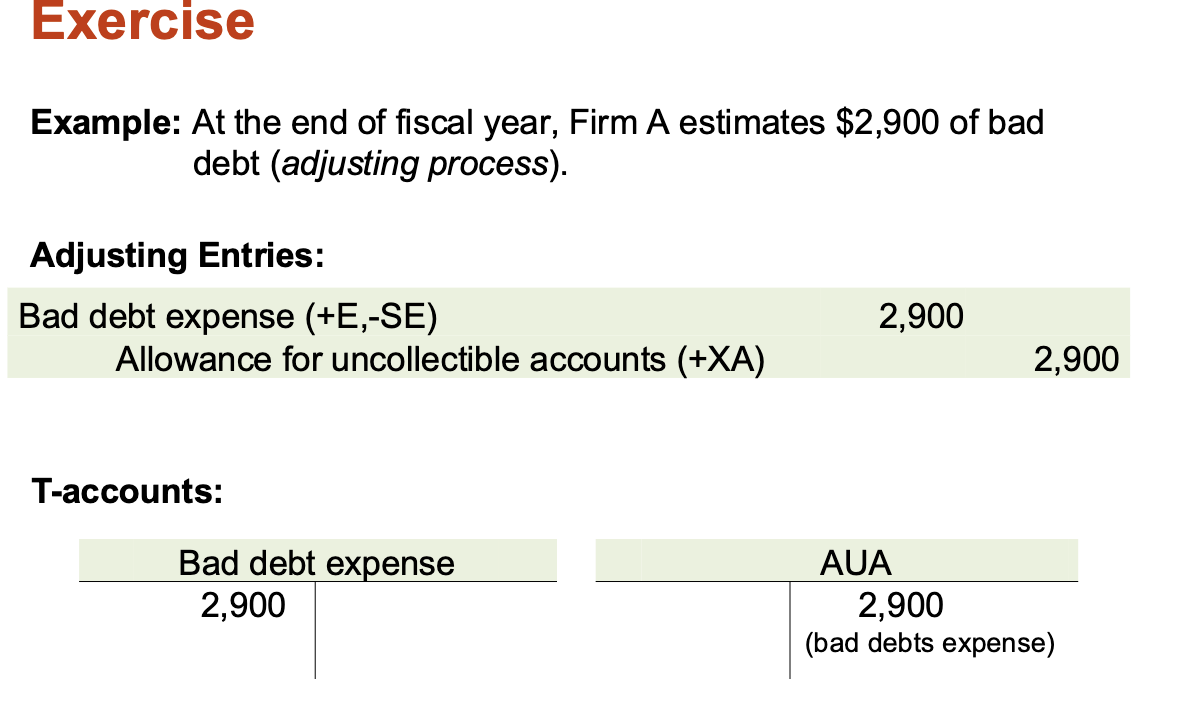
journal entry and t-accounts for bad debt for adjusting process
write off
when you remove an amount from A/R and reduce the AUA
why do you write things off
when a specific account is deemed to actually be uncollectible (not just estimating that it is)
write off = the account for actual bad debt
when do write offs happen
When the firm receives notice that one of its customers
declare bankruptcy.
- Companies have specific policies to determine when to
classify an unpaid receivable as uncollectible (in the FOOTNOTES)
journal entry for write-offs
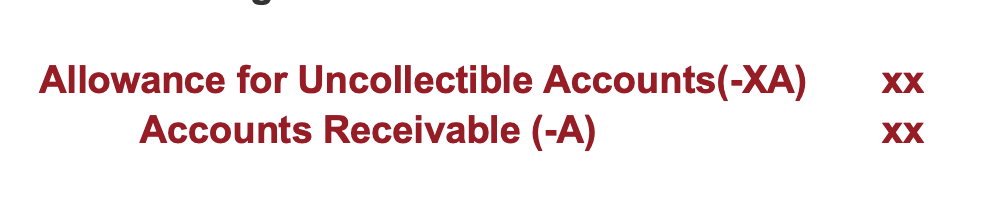
do write offs affect the income statement?
no
The “hit” to earnings already happened earlier when the company estimated bad debt expense.
That estimate reduced net income before
The write-off is just confirming: “yep, this specific customer won’t pay”
👉 So at the time of write-off:
No new expense
No impact on net income
Intuition:
The income statement cares about estimates of losses, not the exact timing of when accounts go bad.
do write off affect net A/R reported on B/S
👉 No, net A/R stays the same.
Why?
A write-off does two things at the same time:
Decreases Accounts Receivable (gross)
Decreases Allowance for Uncollectible Accounts
Same amount.
Example:
Before write-off:
A/R = 1,000
Allowance = (100)
Net A/R = 900
Write off $50:
After write-off:
A/R = 950
Allowance = (50)
Net A/R = 900 ✅ (unchanged)
🧠 Intuition:
You already expected not to collect that money, so removing it doesn’t change the “true” value.
write offs affect on I/S and net A/R
Write-offs do NOT affect net income
→ because expense was already recorded earlierWrite-offs do NOT affect net A/R
→ because both A/R and allowance go down equally
What does affect the income statement?
👉 Bad Debt Expense (the estimate)
That is what:
Reduces net income
Increases the allowance
two accounts affected with write offs
AUA and A/R
two accounts affected with write offs - T ACCOUNTS
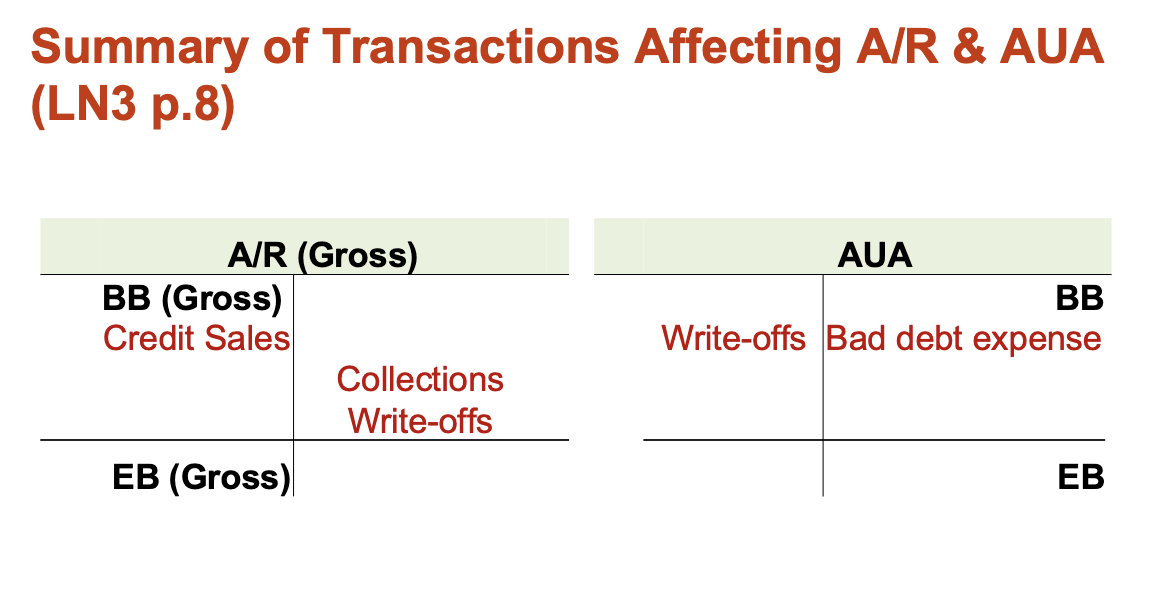
adjusting entry to account for ESTIMATED VS ACTUAL bad debt
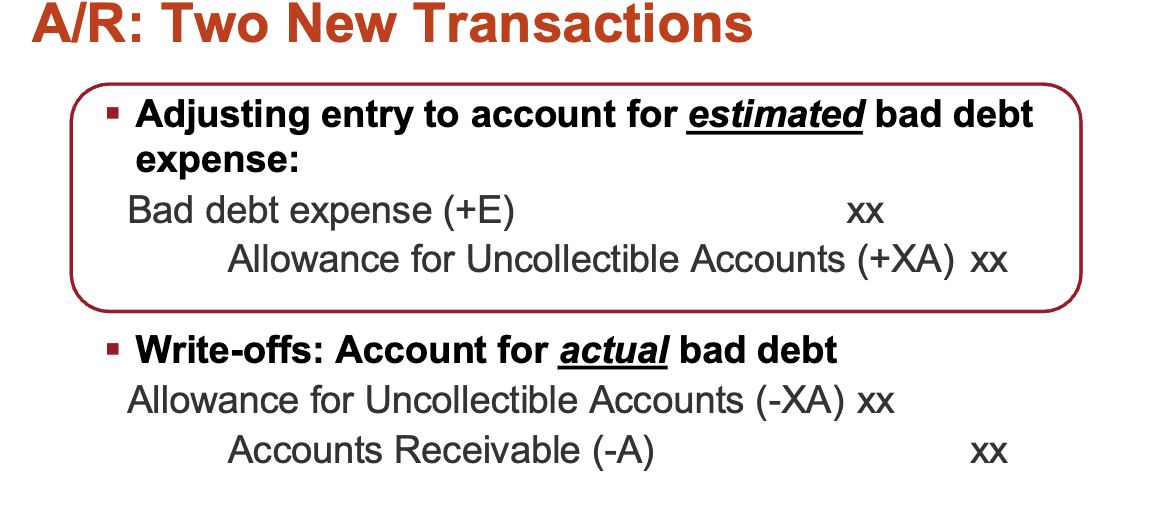
for ESTIMATED VS ACTUAL bad debt, which one affects net income? how about net A/R
for estimated: You’re anticipating losses, so both income and A/R are adjusted early.
for actual: You’re just using the estimate you already made, not creating a new loss. this ends up NOT AFFECTING ANY OF THE STATEMENTS (according to chat, so double check)
2 ways to estimate AUA
percentage of sales and recievables
percentage of sales
estimate AUA based on a
percentage of total sales
percentage of recivables
estimate AUA based on
a percentage of A/R ending balance
AUA equation to memorize
EB AUA = BB AUA + Bad Debt Exp - Write Offs
percentage of recievables steps
get ending balance of gross A/R (add the bad debt and the net income)
estimate how muhc of gross A/R would be collectiable (you’re typically given a percentage). multiply this percentage by the gross A/R
step two yeilds the ending balance of AUA
use the equation and use bad debt exp as the “plug number” (EB AUA = BB AUA + Bad Debt Exp - Write Offs)
percentage of recievables method: other name
BALANCE SHEET METHOD (not confusing at all!)
actual vs estimated bad debt recap slide
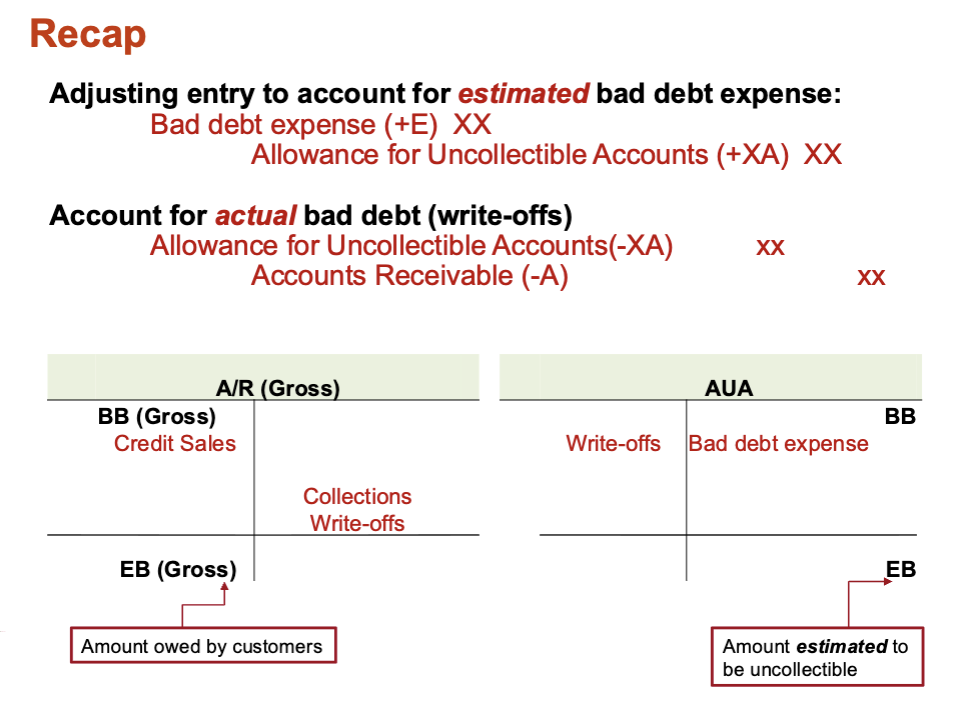
end of session 11/ start of session 12 (still about A/R)
yep
more detailed way of percentage of receivables
an aging analysis
you’re given all the percntages
what does aging analysis do/ how are recivables classified
receivables are classified based
on age
for aging analysis, what is each balance multipled by?
and each balance is multiplied by its
estimated uncollectible percentage.
what is the total amount of each balance with aging analysis
it is the ending balance for the AUA
step 1 of aging analysis
Get the ending balance of gross A/R, but classify the balance into
different buckets based on the age of the accounts.
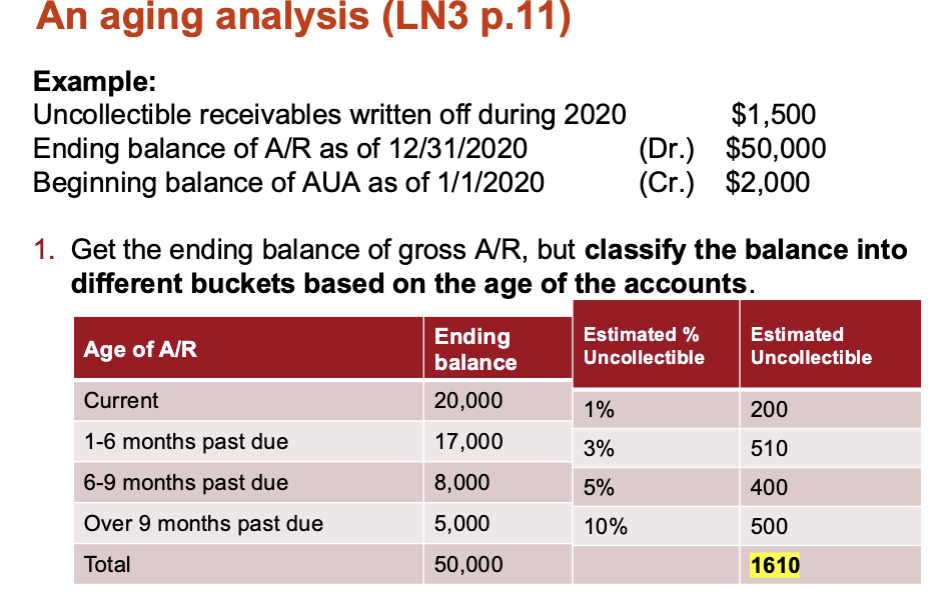
step 2 of aging analysis
Estimate the % of uncollectible in each bucket.
Sum of estimated amount of uncollectible accounts for all buckets =
Ending balance of AUA
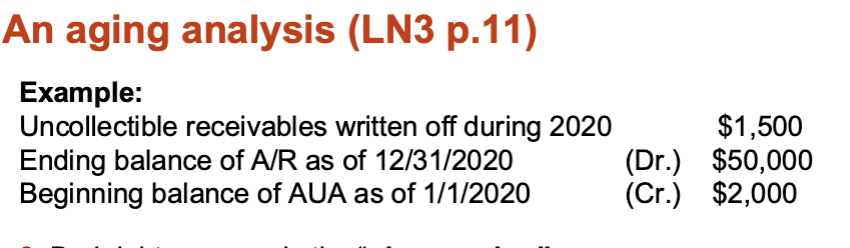
steo 3 of aging analysis
plug number!
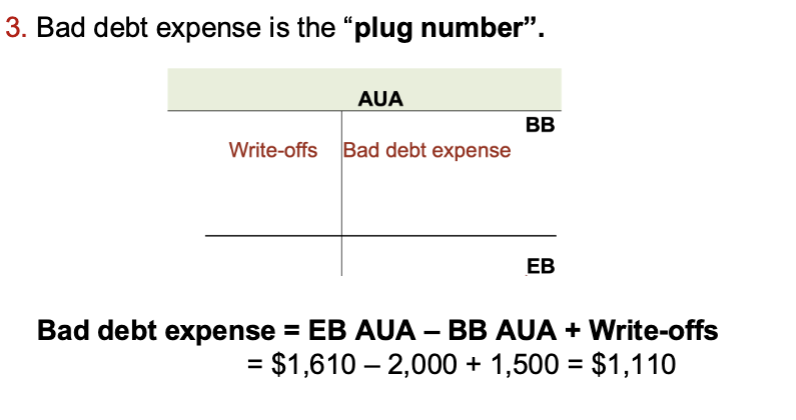
negative reserve example
debt ending balance for AUA
what is a negative reserve
a large amount of unexpected write-offs (i.e.,underestimated bad debt expense last year)
are negative reserves allowed
no, not by GAAP
how to avoid negative reserve and why this works
increase provision (i.e., bad debt expense) in the current year
why:
negative reserve = underestimated bad debt = did not set aside enough
bad debt expense = the provision
increase in provisions because If the reserve is negative, it needs to be brought back up
The only way to increase it is to record more Bad Debt Expense now
negative reserve, its fix and why
Negative reserve = not enough expense recorded before →
Fix = record more expense now to rebuild the allowance
Increase provision because it directly increases ____ and corrects the ____
Increase provision because it directly increases the allowance (THE AUA) and corrects the shortfall

