Humanities H - Art
 Call Kai
 Learn
Learn Practice Test
 Spaced Repetition
 Match
Match Flashcards
 Knowt Play
1/65

There's no tags or description
Looks like no tags are added yet.
Name | Mastery | Learn | Test | Matching | Spaced | Call with Kai |
|---|
No analytics yet
Send a link to your students to track their progress
66 Terms
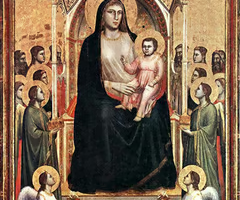
Gothic Neo-Byzantine period
- 12th-15th centuries
- often characterized by religious art Christian religious figures and themes
- worldwide view primarily focused on the devotional and religious
- iconography, didactic, divine, transpersonal
The Renaissance Period
- 14th-17th century
- expanded subject matter to pagan mythology, living rulers, aristocrats, human scenes
- while Christian themes were still common, were humanized and less ideal
- worldwide view focus on human figure and human achievement
- humanistic, didactic, temporal, personal
(Gothic/Neo-Byzantine) Mostly ____________ alter pieces
Religious
(Gothic/Neo-Byzantine) Highly ____________
Stylized
(Gothic/Neo-Byzantine) Lacked _____________
Perspective
(Gothic/Neo-Byzantine) _____________ stacked on top of each other
Figures
(Gothic/Neo-Byzantine) Important figures often ______________, creating an _________________ scale.
larger, unrealistic
(Gothic/Neo-Byzantine) ________________ vivid line and color
Emphasized
(Gothic/Neo-Byzantine) Gold-leaf highlights, highly _______________
Elaborate
(Gothic/Neo-Byzantine) _________________ facial features and almond shaped eyes represent _______________
Elongated, piety
(Gothic/Neo-Byzantine) __________________ : window to the transcendent.
Iconographic
Nimbus
Spotlight on saints
Renaissance means
Rebirth
The printing press
- 1454
- Johanes Gutenberg
- gives average man access to works (philosophy, art)
Humanism
- God made earth for humans, to build earth up & cultivate with no limits.
(Early Renaissance) Revival of ______________ forms, ____________
Classical, mythology
(Early Renaissance) Concern with secular life, ________________
Humanism
(Early Renaissance) Explored ___________________ perspective.
Atmospheric
(Early Renaissance) ___________________ line and color
De-emphasized
(Early Renaissance) Less decorative surfaces and ________ - _______ highlights
Gold-leaf
Early Renaissance wanted to accomplish
- Paint man and the intention of his soul
- Natural, representational subjects
- Humanism, the temporal connection the divine
- Depth
Linear perspective
A mathematical system for creating the illusion of space and distance on a flat surface
Horizon line
- Runs across the canvas at eye-level
- The horizon is where the sky appears to meet the ground
Vanishing Point
- Located near the center of the horizon line
- The single point all parallel lines run toward the horizon line to come together to a single point.
Aerial/Atmospheric Perspective
- Creates a sense of depth in painting by limiting the way the atmosphere makes distant objects appear less distinct and more bluish than they would be if nearby.
Tondo
Italian for round and the favored shape of pictures hung in private homes.
Sfumato
- Italian for smoky
- The Artist coats the object in the picture with layers of thin paint to soften the edges and blur the shadows
- This creates a dreamlike effect of atmospheric mist/haze
In scurto
Extreme foreshortening that creates intimacy.
Chiaroscuro
- Contrasts light and dark
- In depicting the fall of light and shadow, figures look as if they have a mass and volume
Quadratura
- A form of illusionistic mural painting in which images of architectural features are painted into walls or ceilings so that they seem to extend the real architecture of the room into an imaginary space beyond the confines of the actual wall or ceiling.
Byzantine artist's achievements
1. Didactic
2. Religious themes
3. Iconic figures
Mannerist artists achievements
1. Spiritual awakening
2. Anti-classical
3. Shock value
Southern renaissance artists achievements
1. Humanism
2. Depth & dimension
3. Realism
Baroque artists achievements
1. Phycological penetration
2. Elaborate detail
3. The story of the individual
Northern renaissance artist's achievements
1. Ordinary, day-to-day
2. Individual consciousness
3. Natural light
4. Domestic detail
Linear
Figures clearly outlined the boundaries of each solid element.
Painterly
Figures fused together and contours are lost in shadows.
Planar
Elements of the painting are arranged on planes together.
Recessional
Composition is dominated by figures placed at an angle.
Closed form
- Conveys an impression of stability & balance arrangements.
- Self-contained
- Static, pyramid design
Open form
- unlimited space
- not contained within the frame
- figures are cut off
- composition: dynamic
- suggests: movement
Multiplicity
- painting is made up of distinct parts
- each figure is clearly filled
- colors are singular
Unity
- painting is fused together through light
- no figure is solely single or isolated
- colors are blended
Mannerism characteristics
- strange, bizarre
- bizarre themes
- unstable, disjointed, asymmetrical, no real focal point
- violates frame, ambiguous
- distorted, abnormal long limbs
- tense, twisted, tortured emotion, overexcited, exaggerated apathy
- clashing colors, unnatural
- artificial
Northern Renaissance characteristics
- every day life
- religious but toned down
- more portraits
- more landscapes
- cleaner
- tighter
- focus on representational emotional aspects
Strictly iconographic
Byzantine
Dynamic movement displayed in the tension, motion, and energy —infinite space
Baroque
Strange and bizarre religious themes
Mannerism
Pyramid figure composition that creates balance and stability.
Southern Renaissance
Androgynous Mary & manly Jesus.
Byzantine
Disjointed composition that violate the frame, and create instability through imbalance
Mannerist
Representational figures portrayed with realistic expressions, emotions, and poses.
Southern & Northern Renaissance
Unnatural figures in twisted, tortured, and tense poses, and exaggerated apathy.
Mannerist
Representational figures portrayed with more expressions of grief and mortality to illustrate.
Northern Renaissance
Intense spirituality and celebrating ecstasy scenes and passions of the soul.
Baroque
Illusion of depth to create 3D forms through the use of innovative techniques that provide perspective.
Southern & Northern Renaissance
Almond pious eyes, elongated features.
Byzantine
Narrative, vitality, sense of story.
Baroque
Gold nimbus and gold-leaf highlights.
Byzantine
Humanism that includes composition of every-day scenes, landscapes, and portraits that include more that the torso, but marriage, friendship and leading to works that were decidedly humble, presenting a more toned down view of everyday reality. Art was taken off its glorified pedestal that had previously been occupied by only the rich and powerful and made accessible to the new burgeoning merchant classes.
Northern Renaissance
Naturalism that shows precise anatomy, an ideal model for God's universe and creations.
Southern Renaissance
Dramatic composition that is theatrical and mystical.
Baroque
Psychological focus expressed in figure compositions that was concerned with the inner working of the individual.
Baroque
The popularity of printmaking in Northern Europe at the time allowed images to be mass produced and widely available to the public and these artists retained a Gothic sensibility.
Northern Renaissance
Artificial substance that focuses on the spiritual as part of nature rather than representational.
Mannerist
Lacked perspective, composition includes mainly flat figures stacked on top of each other.
Byzantine

