Reflection, Diffraction, & Absorption - 10/13
 Studied by 0 people
 Call Kai
 Learn
Learn Practice Test
 Spaced Repetition
 Match
Match Flashcards
 Knowt Play
1/50

There's no tags or description
Looks like no tags are added yet.
Name | Mastery | Learn | Test | Matching | Spaced | Call with Kai |
|---|
No analytics yet
Send a link to your students to track their progress
51 Terms
what is sound reflection?
when sound waves bounce off of a surface (echo or reverberation)
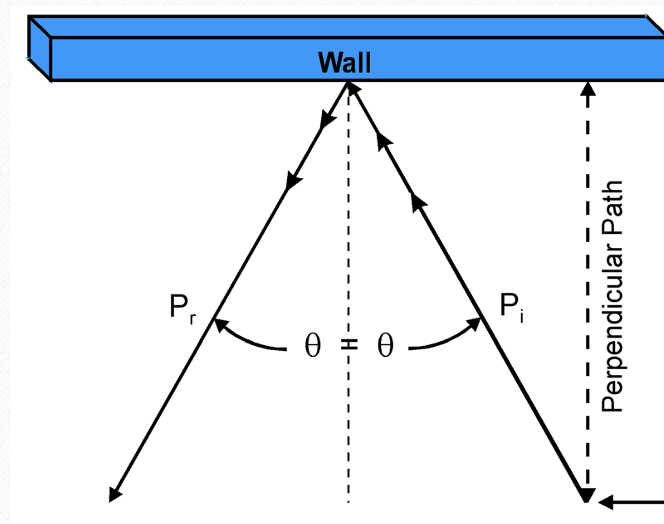
the angle of the reflected path to the perpendicular is equal to…
the angle of the incident path to the perpendicular
when a sound is reflected from air to air, there is a [low/high] impedance mismatch and a [low/high] energy transfer
low impedance mismatch, high energy transfer
if continuing to travel in the same medium, when reflected off of an obstacle, a sound wave’s speed of propagation [will/will not] change
will not
does inverse square law hold when a sound is reflected in the same medium? why?
no. reflections add to the intensity by creating constructive interference with the original waves
the decrease in intensity of a reflected sound wave is [more/less] than the inverse square law would predict
less. energy is retained in medium
under what circumstance will a ray be reflected back on itself toward the source?
when the ray of incidence comes in at 0 degrees
![<p>this is an example of a [convex/concave] surface. </p>](https://knowt-user-attachments.s3.amazonaws.com/a037bfa9-6613-47b5-a21e-4cd910c367f6.png)
this is an example of a [convex/concave] surface.
convex
![<p>when sound reflects off of a convex surface, it becomes [more/less] intense. why?</p>](https://knowt-user-attachments.s3.amazonaws.com/7de360a1-235f-4e79-af75-aca054b026f4.png)
when sound reflects off of a convex surface, it becomes [more/less] intense. why?
less intense because the sound diverges in many different directions → causes the sound to spread out more
![<p>this is an example of a [convex/concave] surface. </p>](https://knowt-user-attachments.s3.amazonaws.com/8624c23d-40a7-4a58-8be0-7e39eba2d9ee.png)
this is an example of a [convex/concave] surface.
concave
![<p>when sound reflects off of a concave surface, it becomes [more/less] intense. why?</p>](https://knowt-user-attachments.s3.amazonaws.com/5a9eec79-da70-4686-bbfb-b84632e96e92.png)
when sound reflects off of a concave surface, it becomes [more/less] intense. why?
more intense because the reflected waves converge, and sound energy is collected - intensity is greatest at focal point
regardless of whether the obstacle surface is plane, convex, or concave, the angles of reflected rays to the perpendicular equal….
the angles of the incident rays to the perpendicular
if the roof of a building is removed, will there be [more/less] echos? why?
less because there is less area for sound to reflect off of
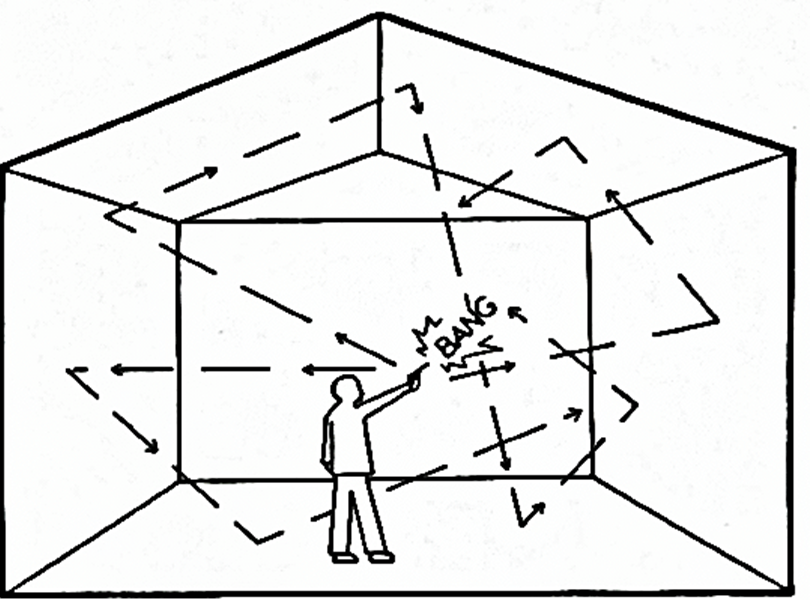
what are reverberant rooms? give an example
rooms with hard surfaces to maximize reflections, like a church or a house with no furniture = more echos
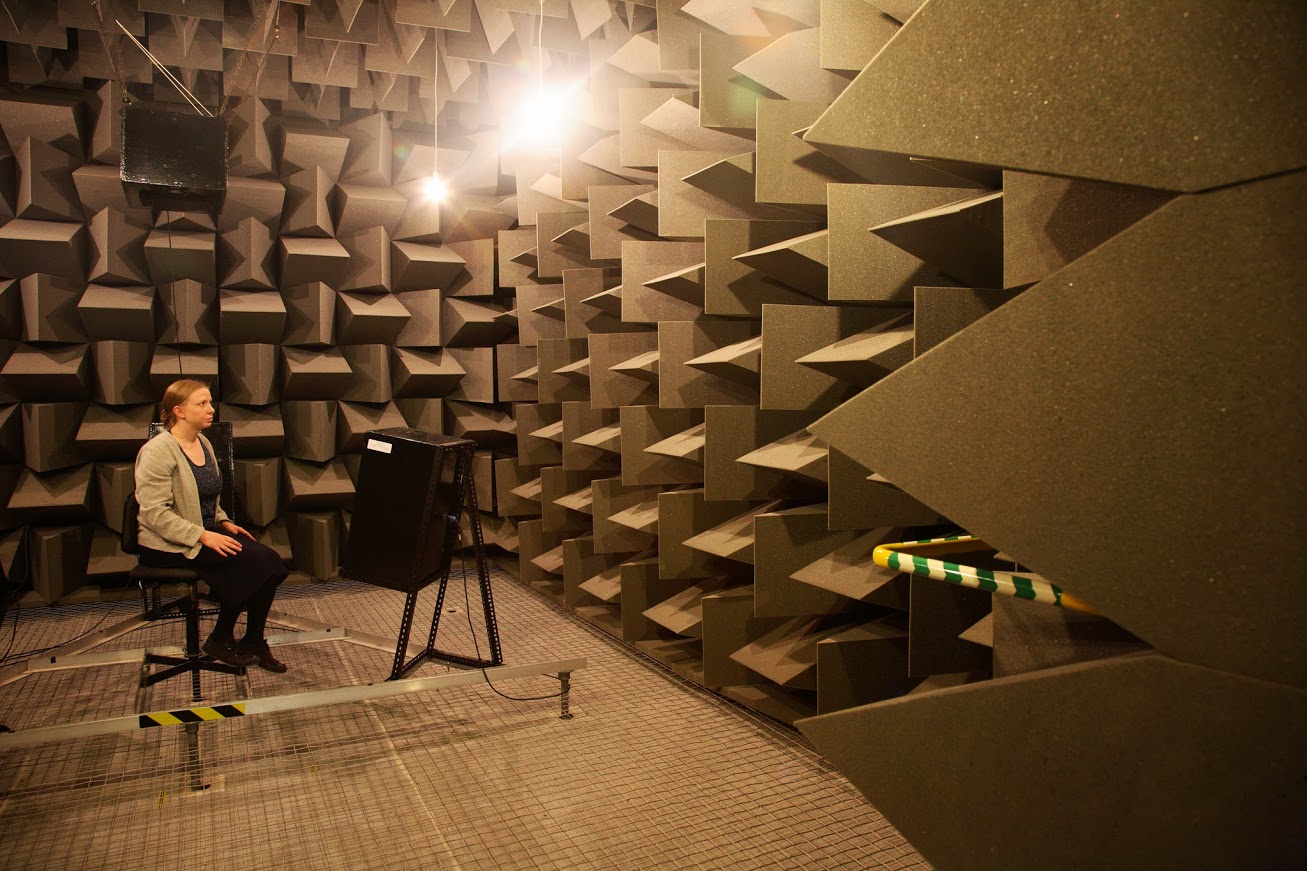
what are anechoic rooms? give an example
rooms for absorbing surfaces to minimize reflections, like a sound booth = less echos
what is T60?
reverberation time = the time it takes for a sound to decay by 60dB
we want T60 to be [longer/shorter]
shorter = less echo-y
a classroom will have a [longer/shorter] T60 value
shorter
a church or large, open space will have a [longer/shorter] T60 value
longer
empty rooms are very echo-y because….
there is nothing to absorb sounds
what is sound diffraction?
when sound waves bend around an object
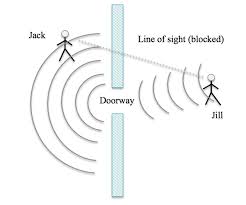
this is an example of….
diffraction
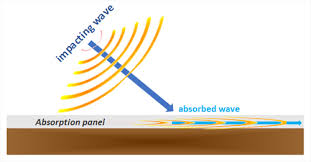
what is sound absorption?
when sound is absorbed (converted to other forms of energy) to reduce echos in a room
if an object’s impedance is infinite, the intensity of the reflected wave will equal the intensity of the incident wave (Ir = Ii. why?
if there is infinite opposition, nothing will be absorbed by the object
if impedance is not infinite, [some/all/none] of the sound energy will be absorbed by the new medium
some
if impedance is not infinite, how do the intensity of the reflected and incident waves compare?
the intensity of the reflected wave will be less than the intensity of the incident wave (Ir < Ii) because some energy is absorbed by the new medium
the magnitude of absorption is given by the absorption coefficient ____. what does it represent?
alpha (α). represents the proportion of energy in the incident wave that is absorbed by material
alpha (α) =
α = Ia / Ii = energy absorbed/energy of incident wave
the absorption coefficient of a material that absorbs all energy will be closer to….
1
[anechoic/reverberant] rooms will have a high absorption coefficient (close to 1)
anechoic
the absorption coefficient of a material that absorbs no energy will be closer to….
0
[anechoic/reverberant] rooms will have a low absorption coefficient (close to 0)
reverberant
if SPL i = 80 dB, and 0.1% is absorbed, what is the SPL of the sound wave retained in the medium?
79.996 dB SPL is retained in the medium
dB = 10Log(0.999) = -0.004
dB SPL = 80 - 0.004 = 79.996
a material’s absorption coefficient [does/does not] change with intensity
does not change with intensity
a material’s absorption coefficient [does/does not] change with frequency
does change with frequency
does a material’s absorption coefficient vary with the intensity of the incident wave (Ii)?b
no because a material has a fixed absorption coefficient.
α = 0.001, how much of the energy is absorbed regardless of the intensity of the incident wave?
0.1%
absorption and reflection have a [direct/inverse] relationship
inverse
as the absorption coefficient increases, reflection and reverberation time [increase/decrease]
decrease
if you use high quality sound absorbing materials, T60 value will go [up/down]
down
every material has an α, which varies with _____
frequency
total absorption in a room depends on what two things
absorption and room volume
in a large, bare room with an open window, with the a=1 for the window, will the sound reflect?
no. the window has 100% absorption, so there is no surface for the sound to reflect off of
will materials have an α of 1? will open spaces?
materials will never have an α of 1 (100% absorption), but yes, open spaces like windows or doors will have an α of 1
what is the relationship between T60 and V (volume of a room)? how is the sound energy affected?
directly proportional. T60∝V. If the volume of a room increases, then T60 increases. Sound energy is retained in the room for a longer period of time
what is the relationship between T60 and A (area of an opening)? how is the sound energy affected?
inversely proportional. T60∝ 1/A. if the area of an opening increases, then T60 decreases. sound energy escapes the room more quickly
how can you lower (improve) a T60 value?
by having more openings (windows/doors)
what is total absorption (A’)?
the sum of the total absorptions of individual surfaces.
A’ = S1 α1 + S2 α2 +…. + Sn αn
T60 varies with ___ and ___
Volume of a room and frequency of a sound
what is the doppler effect?
as a sound gets closer to a person, its pitch increases. as a sound gets further from a person, its pitch decreases.
why does the doppler effect happen?
as a sound gets closer to a person, its wavelength decreases, causing frequency to increase.
as a sound gets further from a person, its wavelength increases, causing frequency to decrease.
 Note
Note  Flashcards (44)