schedules of reinforcement
 Studied by 0 people
 Call Kai
 Learn
Learn Practice Test
 Spaced Repetition
 Match
Match Flashcards
 Knowt Play
1/45

Earn XP
Description and Tags
exam 2
Name | Mastery | Learn | Test | Matching | Spaced | Call with Kai |
|---|
No analytics yet
Send a link to your students to track their progress
46 Terms
Schedules of Reinforcement
A rule stating how and when discriminative stimuli and behavioral consequences will be presented
The arrangement of the environment in terms of discriminative stimuli and behavioral consequences.
Specifies the requirements for reinforcement.
a statement of the conditions under which a behavior is reinforced.
The arrangement of discriminative stimuli, operants, and consequences
Performances on schedules of reinforcement have been found to be very similar across:
Species
Types of behavior
Types of reinforcing consequences
Why are schedules of reinforcement important?
Approximates some of the complex contingencies that operate with humans in everyday environment
Schedules of reinforcement tend to:
produce stereotypical response patterns
Patterns are:
a product of exposure to the contingencies of reinforcement
Contingency
the focus on the relationship between behavior and its consequences
Steady-state performance
the pattern of response that develops after repeated exposure to a contingency of reinforcement
Example: The fixed-ratio pause-and-run pattern
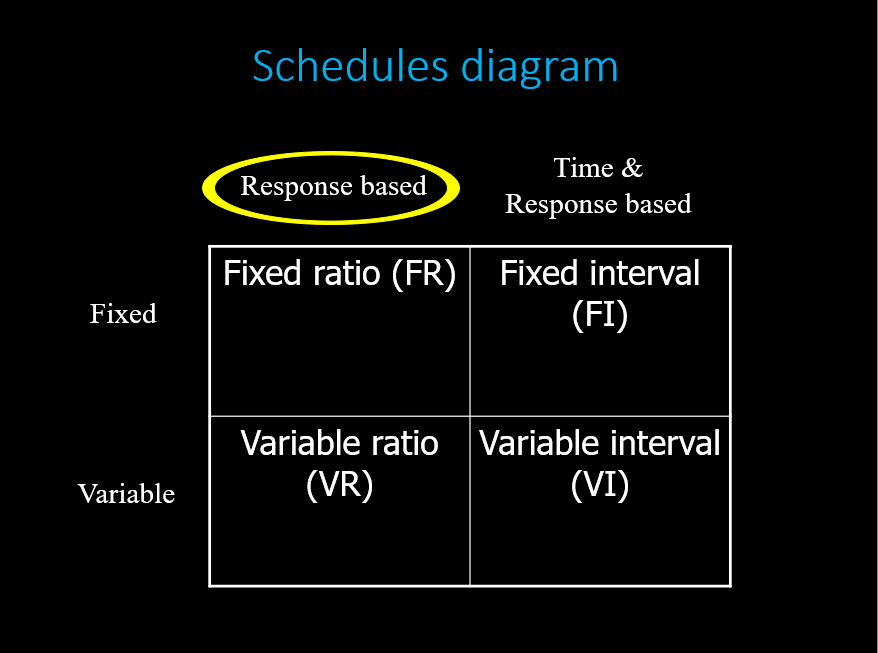
The Most Common Types of Schedules
Reinforcement for a particular number of responses
Reinforcement for a response after a particular interval of time has passed
what does Inter response time (IRT) mean?
time between responses
how many basic schedule types are there?
four
Continuous reinforcement (CRF):
behavior is reinforced for every response — Often used in the early stages of shaping
Examples include showering, eating, vending machines
Intermittent schedules of reinforcement
behavior reinforced occasionally — Requirements can be based on the number of responses required, time, or both, and are more resistant to extinction
Examples include checking the mail, checking your phone.
schedules diagram
Ratio Schedules
An organism has to respond a specified number of times for reinforcement
The rate of responding will influence the rate of reinforcement.
The faster you respond, the faster you earn reinforcers
Reinforces shorter interresponse time (IRT) because IRT prior to reinforcement is likely to be short
Fixed Ratio Schedules (FR)
The number of responses required for reinforcement is constant

this schedule is a:
fixed ratio
PRP
post-reinforcement pause
FR 5
5 responses to earn a reinforcer
A fixed ratio schedule on a graph is called a:
break-and-run pattern
the ‘break’ happens after the response occurs EVERY time
Characteristics of Fixed Ratio Performance:
break and run
Post reinforcement pause (PRP)
Ratio strain
Break-and-run
A typical pattern associated with fixed ratio schedules that has a high response rate until reinforcement is received and then a post-reinforcement pause or PRP
Post reinforcement pause (PRP)
A pause in responding after a reinforcer is delivered (‘break’ in break-and-run)
This occurs because of the workload ahead
“Pre-ratio pause”
Ratio strain
Extended pauses after reinforcement or during a run of responses. Occurs when shaping is done too quickly or with too large of steps
This can be avoided with proper training
It happens when the reinforcement have increased too quickly
Stops responding when everything increases too quickly
FR
LOWER resistance to extinction , and rapid response, with short pause after reinforcement
Typical FR (fixed ratio) response pattern

Higher ratios generate higher rates of responding and longer pauses
A real-life example of fixed ratio schedules is piecework…manufacturing an American flag
Variable Ratio Schedule (VR)
A changing number of responses is required for reinforcement
Specifies the average number of responses required
Generally produces the highest rate of responding
NO BREAKS/pauses
steep slope
VR3 = an average of 3 responses to earn a reinforcer (ITS AVERAGE…SO IT COULD BE 2, COULD BE 5)

this schedule is a…
Variable ratio
Characteristics of Variable Ratio Performance
PRPRs do not usually occur in variable ratio schedules
Ratio strain is possible
VR has a higher resistance to extinction
VR
HIGHER resistance to extinction, and high, steady rate without pauses
Interval Schedules
An organism’s behavior is reinforced for the first response after a ‘given time interval’ has passed
The response MUST occur for reinforcement
The rate of responding has little influence on the rate of reinforcement
Both long and short interresponse times are reinforced
There is a time component
Fixed Interval (FI) Schedule
The first response after the constant time interval has expired is reinforced
examples include waiting for the bus or checking the mail
after 10 minutes have passed a response will occur
scalloped

This graph is …
Fixed interval
FI 1 min = response after 1 min or longer earns a reinforcement
further explanation: You don’t check the oven right after you put the cookies in the oven, you check after 15 minutes to see if the cookies are ready. You have to wait a certain amount of time. so you would have FI 15 min.
Characteristics of Fixed Interval Performance
PRP is common
After a pause, behavior may progressively increase (SCALLOPED)
or, behavior may become rapid and steady (break and run)
As the interval gets closer to timing out, the probability of reinforcement increases, so your response gets faster and faster
real life example: checking the clock
FI
LOWER resistance to extinction, and long pause after reinforcement yields
Variable interval (VI) schedule
The first response after the variable time interval has expired will be reinforced. States the average interval after which a response will be reinforced.
Examples include calling someone whose line is busy, or waiting for a letter in the mail.
On average have to wait about 30 seconds for my response to occur
Shallower slope
Deals with seconds

this graph is a …
variable interval
VI 30 seconds = response after an average of 30 seconds earns a reinforcer
Characteristics of variable interval performance
Brief PRPs occur occasionally
An increase in the size of the interval produces a decrease in the response rate
Moderate
VI
HIGHER resistance to extinciton, and steady rate without pauses
real life example: surfing with waves
Response Independent Schedules (also known as time-based schedules)
fixed time (FT)
variable time (VT)
May lead to superstitious behavior (through accidental behavior)
Fixed Time (FT)
after a fixed amount of time, a consequence is delivered regardless of the responding
Variable Time (VT)
after an average amount of time, a consequence is delivered regardless of responding
Fixed
every time
variable
average amount of time
The use of Schedules of Reinforcement
form a stable baseline
The baseline can be used to test IVs such as drug administration
be used as IVs themselves
it teaches us more about basic behavioral process
to test if your lab is working properly
you should be able to get the proper response patterning for each schedule
Advantages of Intermittent Schedule
FR schedule (e.g. FR 10) generates higher rates of responding than CRF schedules
Less chance of satiation
Under some circumstances, behavior is more resistant to EXT (variable schedules)
Schedules more closely simulate the natural environment
Satiation
fully satisfied
 Note
Note  Flashcards (73)