Population and Community Ecology - Full Set
 Studied by 5 people
 Call Kai
 Learn
Learn Practice Test
 Spaced Repetition
 Match
Match Flashcards
 Knowt Play
1/244

There's no tags or description
Looks like no tags are added yet.
Name | Mastery | Learn | Test | Matching | Spaced | Call with Kai |
|---|
No analytics yet
Send a link to your students to track their progress
245 Terms
The Optimal Defense Hypothesis states which of the following?
Plants allocate resources to defenses against herbivores in a way that maximizes plant fitness
Which of the following correctly describes the Resource Availability Hypothesis?
All of these
T/F
Secondary plant substances are by-products of the primary metabolic pathways and are not found in all plants.
True
Define the Plant Vigor Hypothesis
herbivores prefer to attack fast-growing, vigorous plants rather than slow-growing, stressed plants
Define the Plant Stress Hypothesis
herbivores prefer to attack stressed plants, which produce leaves that are higher in nitrogen
Which of the following statements is consistent with the Overcompensation Hypothesis?
As grazing pressure increases from very low to very high levels, plant production will increase at first and then decrease
Define Grazing facilitation
Grazing by one herbivore species improves the food supply available to another herbivore species
T/F
Chemicals that defend plants against herbivory are confined primarily to plants in the tropical and sub-tropical regions
False
T/F
Plants within the same species will exhibit the same set of chemical defenses against herbivory.
False
T/F
Some plants can produce both chemical and physical defenses against herbivory.
True
T/F
Resource availability affects the ability of plants to produce both chemical and physical defenses against herbivory.
True
T/F
Plants within the same species may exhibit different sets of defenses against herbivory depending on the suite of herbivore species to which they are exposed.
True
Grazing can benefit plants depending on which of the following?
All of these
What are mycorrhizae?
fungi
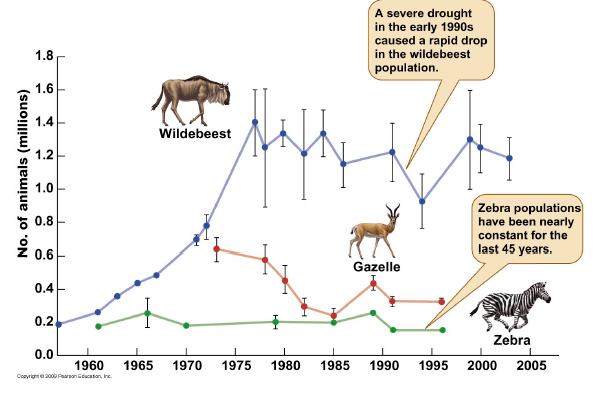
T/F
The following figure indicates strong grazing facilitation among the herbivores on the Serengeti Plains.
False
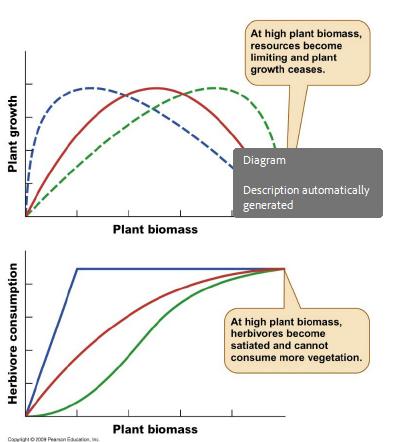
Which of the following statements about the grazing model are correct?
All of these
T/F
When an individual of one animal species kills (and may eat) an individual of a second animal species, this is defined as predation
True
Which of the following are among the most important findings of the “classical” laboratory experiments on predator-prey systems?
Predator-prey systems never were sustainable in the laboratory
Which of the following played an important role in sustaining predator-prey cycles in the “classical” laboratory experiments on predator-prey systems?
Spatial heterogeneity in habitat suitability
Which of the following population dynamics can be generated by the Lotka-Volterra predator-prey equations?
All of these

In the Lotka-Volterra predator prey equations, the k2 term represents
The ability of predators to convert prey into more predators

In the Lotka-Volterra predator prey equations, the k3 term represents
The per capita mortality rate of predators in the absence of prey
Which of the following are the types of functional responses of predators to changes in prey abundance?
Type 1, Type 2, & Type 3
Among the types of numerical responses of predators to changes in prey abundance are:
Aggregative response
Evolutionary change in two or more interacting species is called
Co-evolution
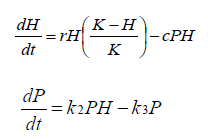
What do these represent?
mathematical representations of predator-prey interactions
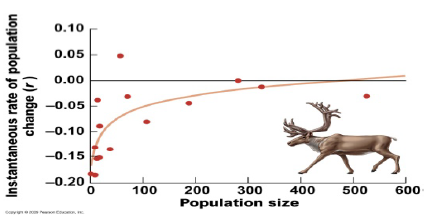
Consider the graph below of woodland caribou population growth rates observed at various population sizes. How does this graph contradict the basic theory of density-dependent population growth?
As population size increases, the population growth rate should decrease
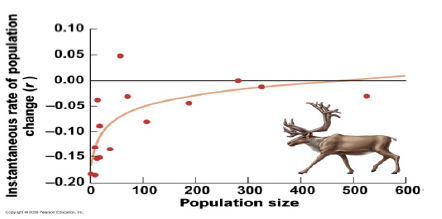
Consider the graph above of woodland caribou population growth rates observed at various population sizes. What does this graph demonstrate?
The Allee effect
T/F
Generalist predators tend to stabilize prey numbers
True
T/F
Specialist predators tend to cause instability in prey numbers
True
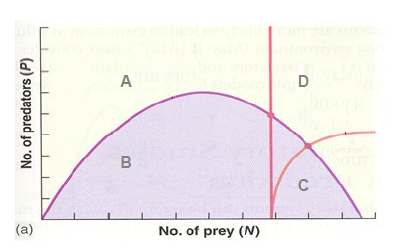
In the figure, in which area do both predator and prey populations increase?
C
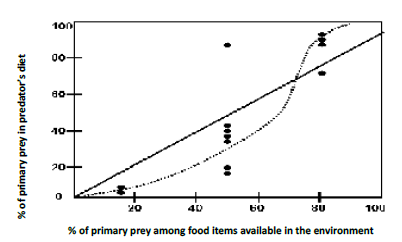
What does the graph represent?
Predator “switching” to alternative prey as a function of relative prey abundance
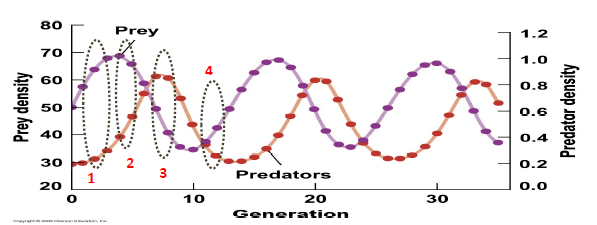
What does the graph represent?
All of these
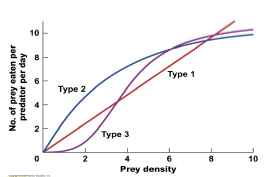
Which statements about the graph are correct?
The Type 1 curve represents a linear numerical response of predators to changes in prey density
Which of the following are among the most important aspects of predator-prey relationships that are ignored or simplified in both the mathematical theory and the classic laboratory experiments, which make the theoretical and laboratory results difficult to apply in field?
All of these
T/F
If the percent mortality imposed by the predator population on the prey population increases as prey population density increases, then the predator population may control the prey population.
True
T/F
For predators to play an important role in the evolution of prey characteristics, they must be able to limit the density of their prey species
True
The hypothetical example of the sticky-tongued frog and the slippery-footed fly serves to demonstrate which of the following?
Co-evolution
A simple SIR compartment model that assumes constant population size can be used to address which of the following questions?
A. Will an epidemic occur?
B. Will the host population sustain itself?
C. What proportion of the host population need to be vaccinated to eradicate the disease?
A and C
T/F
According to your textbook, disease agents and parasitism cannot interact with competition and predation to affect population dynamics.
False
T/F
The simplest form of compartment models used in the study of diseases assumes a constant host population.
True
T/F
Compartment models are not very useful for answering questions about the stability of the host-disease agent interaction.
False
T/F
Disease agents and parasitism can affect reproduction and mortality rates.
True
T/F
Parasites and disease agents coevolve with their hosts to become more benign.
False
Simple compartment models of a population containing a disease could include which of the following?
All of these
T/F
According to your textbook, the relationship between contact rate and population density is curvilinear
True
The Red Queen hypothesis is
The idea that adaptations of one species are offset by selection acting on other species in the community
The most critical parameter determining whether a disease will spread is
Ro
T/F
Simple host parasite models can predict extinction, stability, or stable cycles.
True
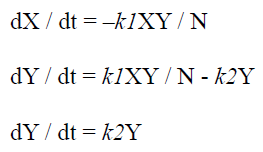
If X, Y, and Z in the following equations are defined as the number of susceptible, infected, and recovered individuals, respectively, in a closed population exposed to a disease, and N = X + Y + Z, which of the statements following the equations is/are correct?
All of these
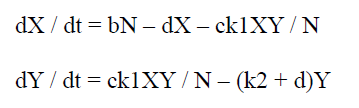
If X and Y in the following equations are defined as the number of susceptible and infected individuals, respectively, in a population exposed to a disease, where N = X + Y, c represents the contact rate between X and Y, and b and d represent birth and death rates, respectively, which of the statements following the equations is/are correct?
k1 represents the transmission rate per encounter between X and Y
T/F
The current thinking of scientists about the coevolution of host-parasite systems in nature is that virulence is selected against and, thus, a well-adapted parasite is benign
False
T/F
Brucellosis in bison populations is a good example of an SIR system in which the disease cannot be maintained if population size drops below a critical threshold.
True
A simple SIR compartment model that assumes constant population size can be used to address which of the following questions?
A. Will an epidemic occur?
B. Will the host population sustain itself?
C. What proportion of the host population need to be vaccinated to eradicate the disease?
A and C
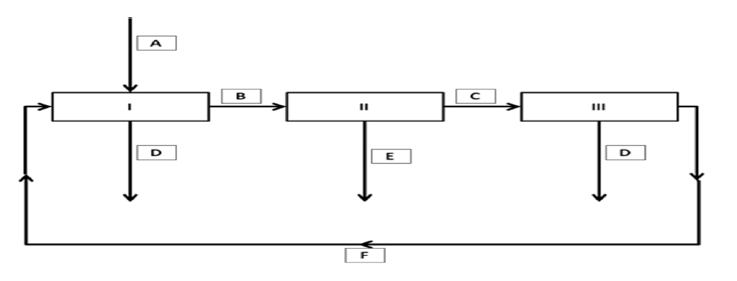
Considering the following box and arrow diagram which represents the dynamics of an infectious disease in a host population, which of the statements following the diagram is/are correct?
All of these
Simple host parasite models can predict which of the following dynamics?
extinction, stability, or stable cycles.
Extinction of the host and/or parasite population(s)
A simple SI compartment model that assumes potentially variable host population size can be used to address which of the following questions?
A. Will the disease reduce host population size?
B. Can the pathogen be eradicated by culling host organisms?
C. Will the host and pathogen populations exhibit stable cycles?
A and B
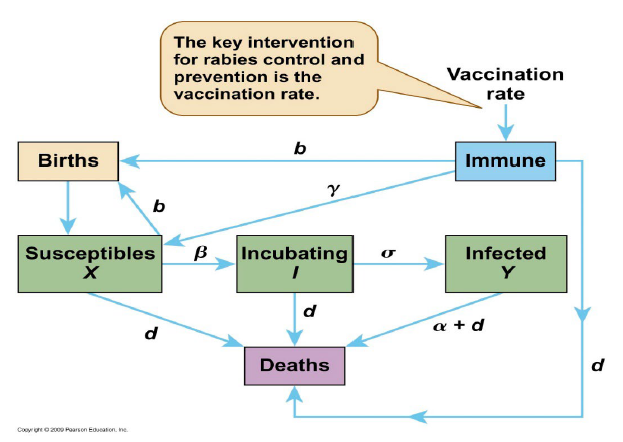
Considering the following box and arrow diagram which represents a compartment model for rabies, which of the statements following the diagram is/are correct?
The diagram represents the dynamics of rabies in a closed population
Within the context of the dynamics of host-pathogen systems, virulence could be described as which of the following?
The degree to which a pathogenic organism can cause disease in a host organism
Which of the following are among the parameters that define the dynamics of host-pathogen systems?
All of these
T/F
The Red Queen hypothesis predicts a stable equilibrium between parasites and hosts.
False
T/F
During serial passage experiments in the laboratory, pathogen virulence increased rapidly as pathogens were passed from one host to another while holding host properties constant
True
T/F
As a general rule, the basic reproductive rate (R0) of a virus is highest at intermediate levels of virulence
True
Thinking about the diagram (from your class notes) summarizing population regulation that we discussed in class, which of the following was not among the hypothesized density-dependent mechanisms of intraspecific population regulation?
Pollution
In an unstable environment, one would expect that _____ limit population growth
Density-independent factors
In a stable environment, one would expect that _____ limit population growth.
Density-dependent factors
Which of the following factors represent the state of a population as stability decreases due to increasing stochastic variation?
Biotic decoupling and Abiotic limitation
T/F
In the schematic in your text representing ecological systems along a continuum from stable to unstable, both biotic instability caused by internal feedbacks, as well as stochastic domination caused by strong environmental fluctuations, can result in instability.
True
Within the context of population regulation and limitation, a factor is defined as a regulating factor if a change in the factor produces a change in the average, or equilibrium, density of a population.
False
T/F
Within the context of population regulation and limitation, a factor is defined as a limiting factor if a change in the factor produces a change in the average, or equilibrium, density of a population.
True
The first principle of population regulation states that
No closed population (i.e., without immigration or emigration) stops increasing unless either the per capita birth rate or the per capita death rate is density dependent
The second principle of population regulation states that
Differences in equilibrium densities of two populations can be caused by variation in either density dependent or density independent per capita birth or death rates
T/F
Within the context of population regulation and limitation, mortality imposed upon a population by weather events always is considered as density-independent mortality.
False
Ecological systems exist along a continuum from stable to unstable. With this in mind, which of the following statements is correct?
All of these
Which of the following statements about meta-populations is correct?
Meta-populations consist of source and sink populations linked together via dispersal
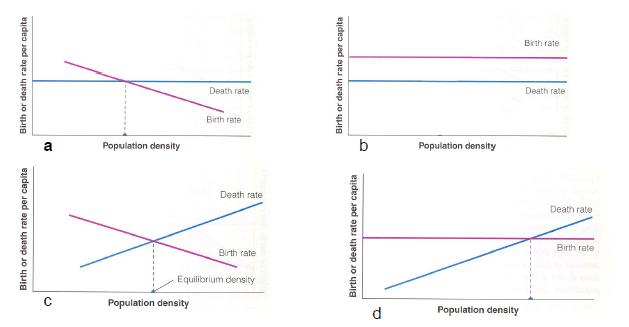
Which of these graphical models illustrates density-dependent birth rates and density-independent death rate?
A
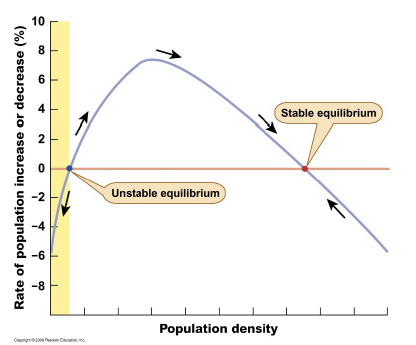
What does the following graph represent?
The Allee effect
T/F
Additive mortality and compensatory mortality are two terms used to refer to the type of factor (e.g., weather, inter-specific competition, predation) that is imposing mortality upon a population.
True
T/F
One approach to studying population dynamics is via Key Factor Analysis, which assumes all sources of mortality are additive.
True
Which of the following statements about plant population regulation is correct?
The same principles of population regulation applied to animal populations can be applied to plant populations
T/F
Within the context of managing meta-populations, sink populations are a “drain” on the meta-population and serve no useful purpose.
False
Which of the following statements about the evolutionary implications of population regulation is correct?
All of these
Which of the following statements describing hypotheses about intra-specific, density-dependent mechanisms of population regulation is correct?
All of these
Thinking about the diagram summarizing population regulation/limitation that we discussed in class, which of the following was not among the factors hypothesized as density-dependent mechanisms of intraspecific population regulation?
Shifting proportions of “r- selected” and “K-selected” individuals in the populations that regulates per capita reproduction
T/F
Population regulation requires density dependence. That is, to stop population growth, per capita natality, mortality, or emigration rates must change with population density.
True
T/F
Two questions that are central to understanding population dynamics are: (1) What stops population growth? and (2) What determines average abundance.
True
The maximum rate of growth in a population occurs when population density is equal to
K/2
T/F
Maximum sustainable yield is obtained when population density is less than carrying capacity.
True
Which of the following are assumptions of the logistic harvesting model?
None of these
In the interval from C to D in the diagram below, the population is
Being harvested sustainably
Dynamic pool models include estimates of
All of these
T/F
According to the logistic harvesting model, there is not a fixed relationship between maximum economic rent and maximum sustainable yield (i.e., maximum economic rent can occur at a harvesting level above or below maximum sustainable yield).
False
Which of the following descriptions of the three classical types of fishery harvest strategies is incorrect?
Constant recruitment rate in which a constant proportion of the stock is replenished
T/F
Maximum sustainable yield (MSY) can be defined as the maximum number of individuals, or maximum biomass, that can be harvested from a population repeatedly (e.g., each year) without causing the population to decline.
True
T/F
The “Tragedy of the Commons” refers to the inherent tendency toward the overexploitation of resources characterized by free access and unlimited demand.
True
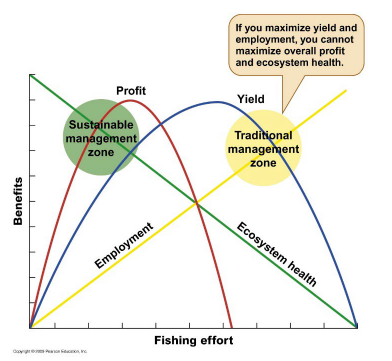
Thinking about the diagram below and the concept of optimum yield, which of the following statements is correct?
None of these
T/F
One of the axioms of modern fisheries ecology is that the important density-dependent processes occur during the later adult life stages.
False
T/F
In fisheries ecology, the match/mismatch hypothesis refers to the spatial and temporal overlap, or lack thereof, in the demand for food during early life stages of the harvested species and the availability of food resources.
True
Thinking about dynamic pool models, based on the information in the table below, what is the yield per recruit?
13g
 Note
Note  Flashcards (70)