Cerebral Hemi I + II

0.0(0)
Studied by 0 people
call kaiCall Kai
learnLearn
examPractice Test
spaced repetitionSpaced Repetition
heart puzzleMatch
flashcardsFlashcards
GameKnowt Play
Card Sorting

1/31

encourage image

There's no tags or description

Looks like no tags are added yet.

Last updated 4:38 AM on 4/2/26
Name
Mastery
Learn
Test
Matching
Spaced
Call with Kai

No analytics yet

Send a link to your students to track their progress

32 Terms

1
New cards

Structure of the cerebral cortex

  • 6 Layers of Neocortex (isocortex)

  • Structure of the cerebral cortex

~90% of the cerebral cortex consists of neocortex (remainder is phylogenetically older forms of cortex —> allocortex)


6 Layers of Neocortex (isocortex)

  • I - Molecular (plexiform) layer

  • II - Outer granular layer

  • III - Outer pyramidal layer

  • IV - Inner granular layer

  • V - Outer pyramidal layer

  • VI - Multiform layer


  • 6 layers not uniform throughout

  • Primary motor and sensory areas provide the greatest contrast and are referred as hetereotypical.

  • Primary motor cortex (agranular cortex) —> dominated by pyramidal neurons

  • Primary sensory cortex (granular cortex) —→ dominated by smaller, stellate cells.
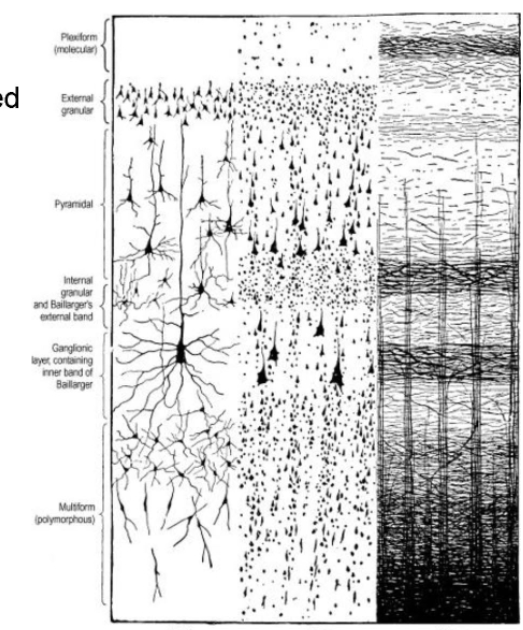
<p>~90% of the cerebral cortex consists of <strong>neocortex</strong> (remainder is phylogenetically older forms of cortex —&gt; allocortex)</p><div data-type="horizontalRule"><hr></div><p>6 Layers of Neocortex (isocortex)</p><ul><li><p>I - Molecular (plexiform) layer</p></li><li><p>II - Outer granular layer</p></li><li><p>III - Outer pyramidal layer</p></li><li><p>IV - Inner granular layer</p></li><li><p>V - Outer pyramidal layer</p></li><li><p>VI - Multiform layer</p></li></ul><div data-type="horizontalRule"><hr></div><ul><li><p>6 layers not uniform throughout</p></li><li><p>Primary motor and sensory areas provide the greatest contrast and are referred as hetereotypical. </p></li><li><p>Primary motor cortex (agranular cortex) —&gt; dominated by pyramidal neurons</p></li><li><p>Primary sensory cortex (granular cortex) —→ dominated by smaller, stellate cells. </p></li></ul><p></p>
2
New cards

Cortical nuerons

  • Pyramidal

  • Intrinsic

Pyramidal

  • All players expect layer 1 (molecular); prominent in layers 2,3,5

  • Large apical dendrite —> extends towards molecular layer; Basal dendrites —> project horizontally

  • Major output pathway of the cerebral cortex (projection, association, and collosal fibers)

  • Giant pyramidal neurons of Betz (only motor cortex; in layer 5)


Intrinsic

Stellate (aspiny and spiny) neurons

  • Most numerous in layer 4 —> receives thalamacortical projections

  • Spiny stellate cells only excitatory interneurons (Glu)

Chandelier cells

  • Layer 3, dendrites in layer 4

Basket cells

  • Layer 3 and 5; dendrites in all layers

Cells of Martinotti

  • Found in deeper layers; multipolar neurons w/ short branching dendrites and an axon that projects to more superficial layers.

Note: Fusiform shaped modified pyramidal cells that project to thalamus are found in layer 6
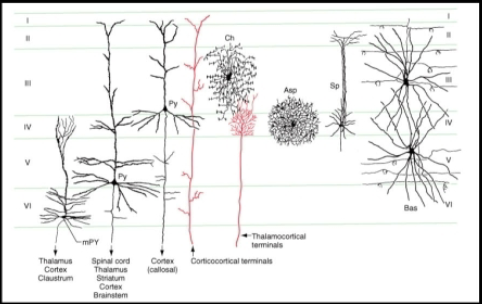
<p>Pyramidal</p><ul><li><p>All players expect layer 1 (molecular); prominent in layers 2,3,5</p></li><li><p>Large apical dendrite —&gt; extends towards molecular layer; Basal dendrites —&gt; project horizontally</p></li><li><p>Major output pathway of the cerebral cortex (projection, association, and collosal fibers)</p></li><li><p>Giant pyramidal neurons of Betz (only motor cortex; in layer 5)</p></li></ul><div data-type="horizontalRule"><hr></div><p>Intrinsic</p><p>Stellate (aspiny and spiny) neurons</p><ul><li><p>Most numerous in layer 4 —&gt; receives thalamacortical projections</p></li><li><p>Spiny stellate cells only excitatory interneurons (Glu)</p></li></ul><p>Chandelier cells</p><ul><li><p>Layer 3, dendrites in layer 4</p></li></ul><p>Basket cells</p><ul><li><p>Layer 3 and 5; dendrites in all layers</p></li></ul><p>Cells of Martinotti</p><ul><li><p>Found in deeper layers; multipolar neurons w/ short branching dendrites and an axon that projects to more superficial layers. </p></li></ul><p>Note: Fusiform shaped modified pyramidal cells that project to thalamus are found in layer 6</p>
3
New cards

Axons

  • Intrahemispheric

  • Interhemispheric

Intrahemispheric (association fibers)

  • Long association (in layer 3 and 5) —> connects lobes together (distinct regions)

  • Short association (in layer 2 and 3) —> connect gyri together

Interhemispheric (Callosal fibers)

  • In layer 3; connects left and right hemispheres (corpus callosum) and temporal poles (anterior commissure).
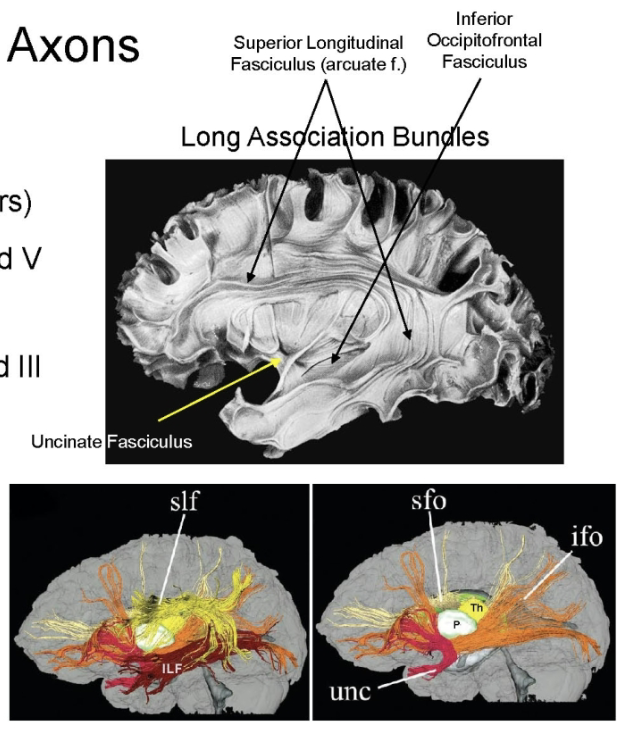
<p>Intrahemispheric (association fibers)</p><ul><li><p>Long association (in layer 3 and 5) —&gt; connects lobes together (distinct regions)</p></li><li><p>Short association (in layer 2 and 3) —&gt; connect gyri together</p></li></ul><p>Interhemispheric (Callosal fibers)</p><ul><li><p>In layer 3; connects left and right hemispheres (corpus callosum) and temporal poles (anterior commissure).</p></li></ul><p></p>
4
New cards

Axons

  • Local intrinsic neuron

  • Corticofugal

  • Corticopetal

Local intrinsic neuron

  • Connects different layers together

Corticofugal

  • Goes to subcortical areas, brainstem, and spinal cord.

  • Types

    • Corticobulbar (layer 5 and 3)

    • Corticostriate and corticopontine (layer 5)

    • Corticothalamic (layer 6)

Corticopetal

  • From the thalamus (thalamocortical) to layer layer 5 (some to layer 3 and 6)

    • Noradrenergic, serotonergic, dopaminergic, cholinergic from other subcortical nuclei - diffuse inputs regulating cortical excitability

5
New cards

Cortical organization

  • A seconds vertical pattern of organization —> demonstrated physiologically

  • Exemplified via primary somatosensory cortex.
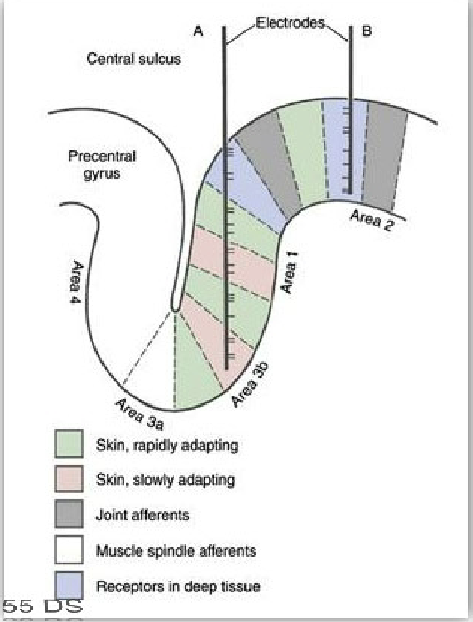
<ul><li><p>A seconds vertical pattern of organization —&gt; demonstrated physiologically</p></li><li><p>Exemplified via primary somatosensory cortex. </p></li></ul><p></p>
6
New cards

Cerebral cortex - Function areas

  • Structure and function of the cortex are heterogeneous, although it appears as homogenous sheets.

  • Structure (cytoarch.) differences are based on cortical thickness, width of individual layers, type, and number of cells per layer

  • Korbinian Bordmann described 47 cytoarch. ares in man.

  • Brodmann’s areas used to describe function ares of cortex —> stoke and functional imaging have validity in these associations.
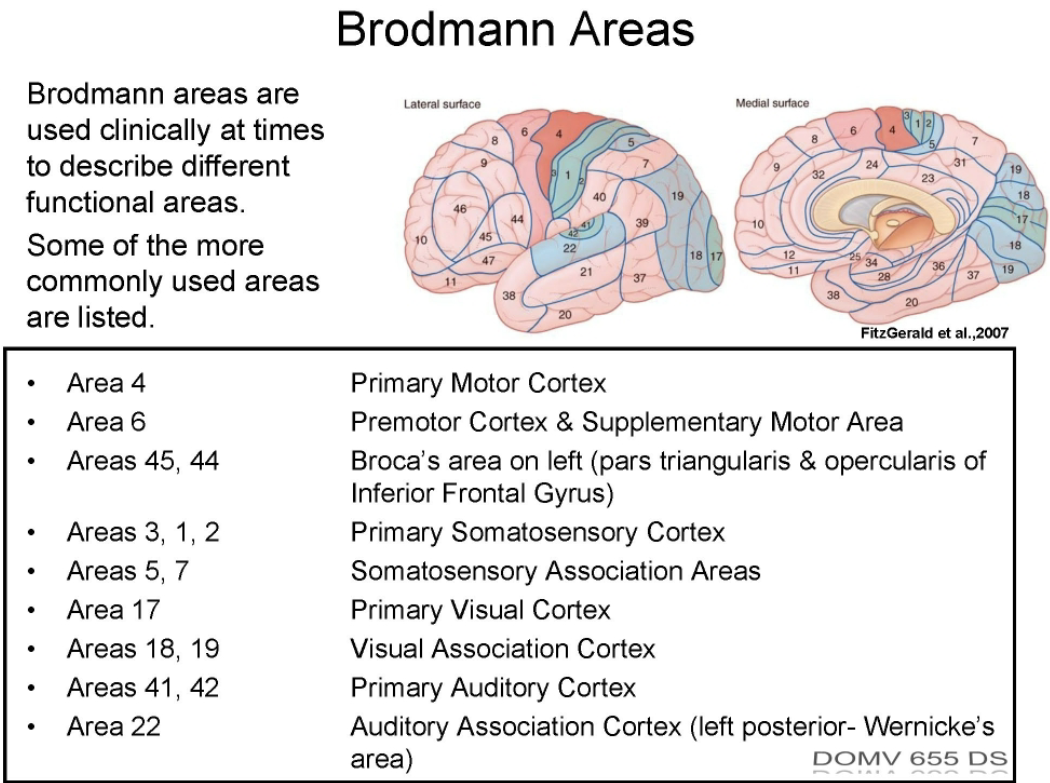
<ul><li><p>Structure and function of the cortex are heterogeneous, although it appears as homogenous sheets. </p></li><li><p>Structure (cytoarch.) differences are based on cortical thickness, width of individual layers, type, and number of cells per layer</p></li><li><p>Korbinian Bordmann described 47 cytoarch. ares in man. </p></li><li><p>Brodmann’s areas used to describe function ares of cortex —&gt; stoke and functional imaging have validity in these associations. </p></li></ul><p></p>
7
New cards

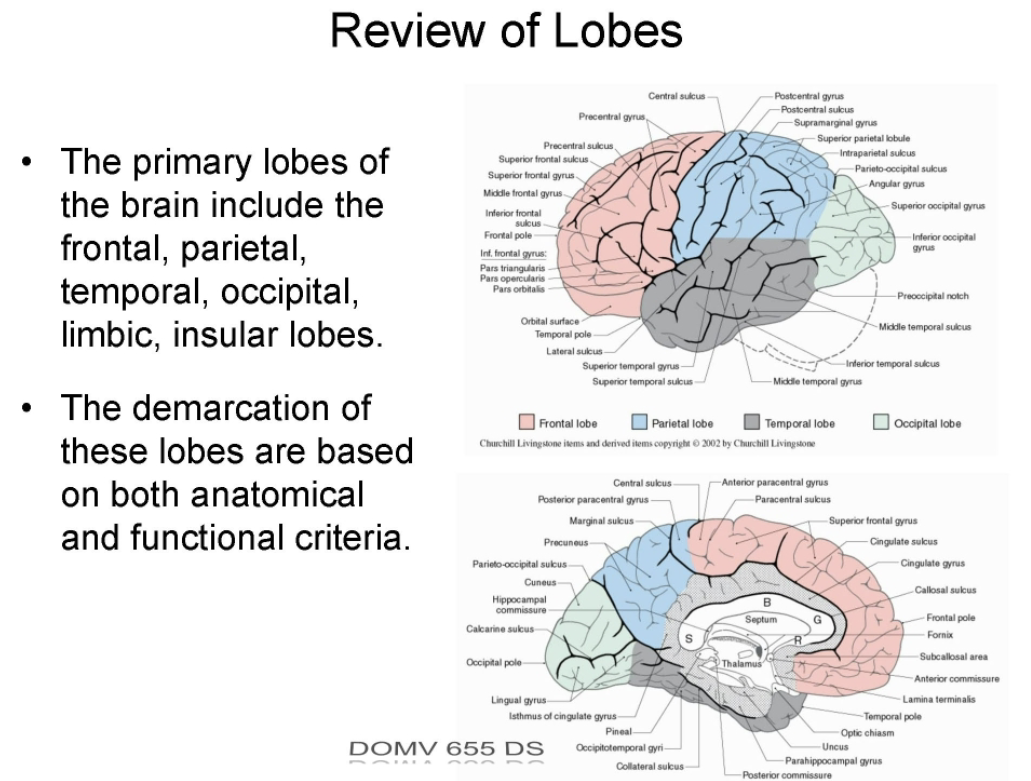
Review of lobes

knowt flashcard image
8
New cards

Frontal lobe

  • Major functional components

  • Anatomical boundaries

Largest lobe in brain, has motor and cognitive functions

  • Major functional components:

    • Primary motor cortex

    • Supplemental motor areas

    • Frontal eye fields

    • Prefrontal cortex

Anatomical boundaries

  • Separated from the parietal lobes by the central sulcus and the temporal lobe by proximal portion of the lateral fissure.

9
New cards

Frontal lobe

  • Gyri and sulci

  • Primary gyri of the frontal lobe includes the precentral gyrus (primary motor cortex) and the superior, middle, and inferior frontal gyri.

  • Separated by the precentral sulcus and superior and inferior frontal sulci.

  • On medial surface, the precentral gyrus continues within the longitudinal fissure as the anterior paracentral gyrus (ant. portion of the paracentral lobule)

  • The superior frontal gyrus extends on the medial surface down to the cingulate sulcus (aka medial frontal gyrus)
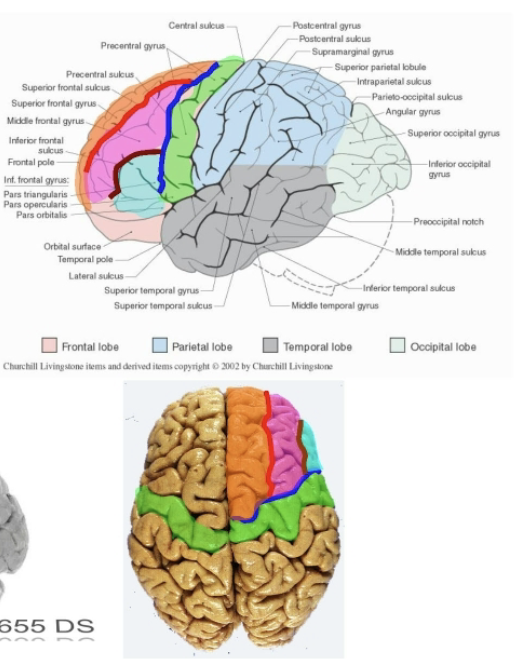
<ul><li><p>Primary gyri of the frontal lobe includes the precentral gyrus (primary motor cortex) and the superior, middle, and inferior frontal gyri.</p></li><li><p>Separated by the precentral sulcus and superior and inferior frontal sulci.</p></li></ul><ul><li><p>On medial surface, the precentral gyrus continues within the longitudinal fissure as the anterior paracentral gyrus (ant. portion of the paracentral lobule)</p></li><li><p>The superior frontal gyrus extends on the medial surface down to the cingulate sulcus (aka medial frontal gyrus)</p></li></ul><p></p>
10
New cards

Frontal lobes

  • Paracentral lobule

  • Precentral gyrus

Paracentral lobule

  • Medial extension of both pre and post central gyri

  • Contains both primary motor (anterior) and primary sensory (posterior) functional areas.

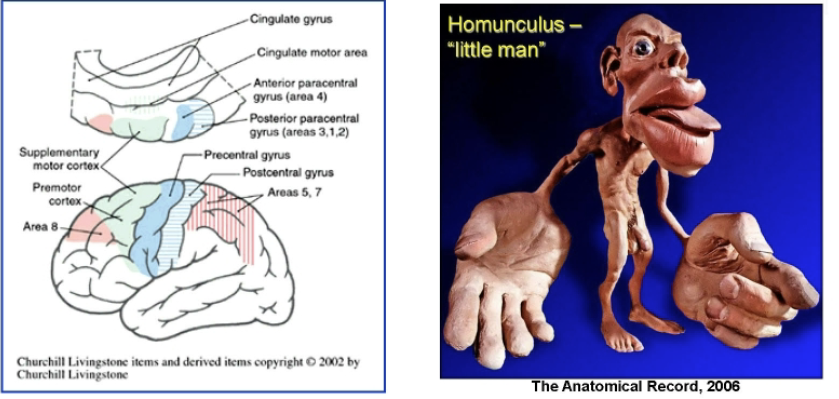
Precentral gyrus

  • Part of the primary motor complex (broadmann area 4) —> major motor output register to spinal cord +brain stem

Somtatotopically organized

  • Legs located in anterior paracentral gyrus

  • Trunk, head, tongue located inferiorly and laterally

  • Tongue near lateral fissure

<p>Paracentral lobule</p><ul><li><p>Medial extension of both pre and post central gyri</p></li><li><p>Contains both primary motor (anterior) and primary sensory (posterior) functional areas.</p></li></ul><p>Precentral gyrus</p><ul><li><p>Part of the primary motor complex (broadmann area 4) —&gt; major motor output register to spinal cord +brain stem</p></li></ul><p>Somtatotopically organized</p><ul><li><p>Legs located in anterior paracentral gyrus</p></li><li><p>Trunk, head, tongue located inferiorly and laterally</p></li><li><p>Tongue near lateral fissure</p></li></ul><p></p>
11
New cards

Supplementary Motor Areas

  • In front of the precentral gyrus —→ supplementary motor and premotor area related to planning of motor activities (area 6)

  • These areas communicate with area 4 and subcortical structures (basal ganglis, cerebellum, ect) in the planning of movements.

12
New cards

Frontal lobe

  • Functional area

  • Inferior frontal gyrus primary parts:

  • Anterior to premotor cortex in the frontal eye fields (area *)

  • These ares facilitate cortical (conscious) control of eye movements via connections to eye movments centers in brain.


Inferior frontal gyrus primary parts:

  • Pars opercularis (near lateral fissure)

  • pars trangularis

  • Pars orbitalis


Pars opercularis + trangularis correspond to Broca’s area (area 45,44), the motor area for speech in the dominant (usually left) hemisphere

  • These areas connect the brainstem nuclei for CN that control the motor output for speech.
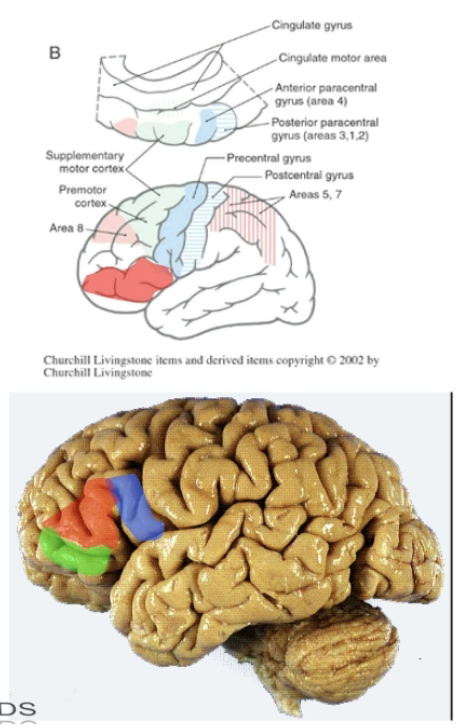
<ul><li><p>Anterior to premotor cortex in the frontal eye fields (area *)</p></li><li><p>These ares facilitate cortical (conscious) control of eye movements via connections to eye movments centers in brain. </p></li></ul><div data-type="horizontalRule"><hr></div><p>Inferior frontal gyrus primary parts:</p><ul><li><p>Pars <mark data-color="blue" style="background-color: blue; color: inherit;">opercularis</mark> (near lateral fissure)</p></li><li><p>pars <mark data-color="red" style="background-color: red; color: inherit;">trangularis</mark></p></li><li><p>Pars <mark data-color="green" style="background-color: green; color: inherit;">orbitalis</mark></p></li></ul><div data-type="horizontalRule"><hr></div><p>Pars opercularis + trangularis correspond to Broca’s area (area 45,44), the motor area for speech in the dominant (usually left) hemisphere</p><ul><li><p>These areas connect the brainstem nuclei for CN that control the motor output for speech. </p></li></ul><p></p>
13
New cards

Prefrontal cortex

Much of the remainder of the frontal lobe (prefrontal lobe) classified as multimodal associational with a diverse cognitive functions

  • Judgment, foresight, a sense of purpose, responsibility, and social propriety.

  • Contains ~25 percent of the entire cortex of the human brain (primary broadmann areas 9-12)
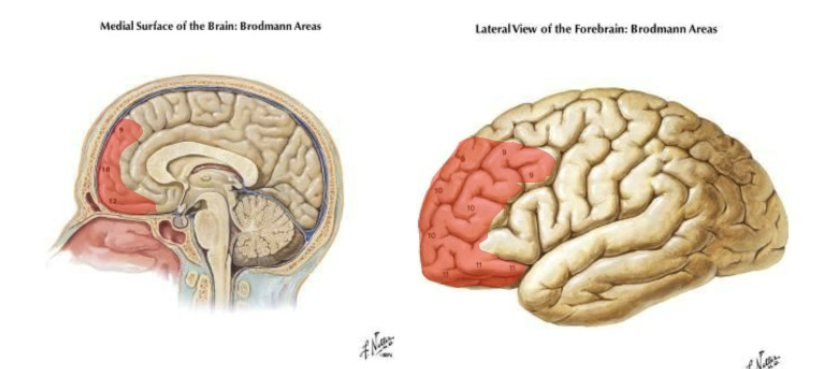
<p>Much of the remainder of the frontal lobe (prefrontal lobe) classified as multimodal associational with a diverse cognitive functions</p><ul><li><p>Judgment, foresight, a sense of purpose, responsibility, and social propriety.</p></li><li><p>Contains ~25 percent of the entire cortex of the human brain (primary broadmann areas 9-12)</p></li></ul><p></p>
14
New cards

Frontal lobe

  • Ventral aspect

  • Ventrally, the prefrontal areas extend into the orbitofrontal gyri

  • The olfactory bulb and tract lie in the olfactory sulcus, forming the medial boundary of the orbitofrontal gyri.

  • Most medially, next to the longitudinal fissure is the gyrus rectus (extension of the medial aspect of the superior frontal gyrus)
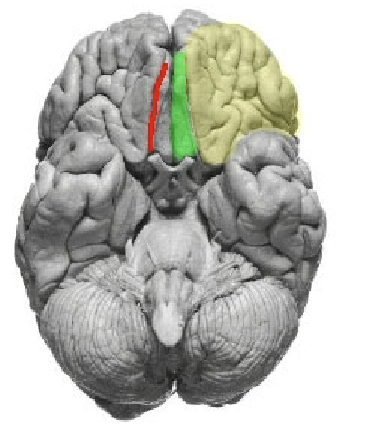
<ul><li><p>Ventrally, the prefrontal areas extend into the<span style="color: rgb(0, 0, 0);"> <mark data-color="yellow" style="background-color: yellow; color: inherit;">orbitofrontal gyri</mark></span></p></li><li><p>The olfactory bulb and tract lie in the<mark data-color="red" style="background-color: red; color: inherit;"> olfactory sulcus</mark>, forming the medial boundary of the orbitofrontal gyri. </p></li><li><p>Most medially, next to the longitudinal fissure is the <mark data-color="green" style="background-color: green; color: inherit;">gyrus rectus</mark> (extension of the medial aspect of the superior frontal gyrus)</p></li></ul><p></p>
15
New cards

Parietal lobes

  • Contents

  • Boundaries

Sensory and multimodal associative function

  • Contents

    • Primary somatosensory cortex (postcentral gyrus)

    • Sensory association areas w/ functions including understanding written language (usually left hemisphere)

Boundaries

  • Laterally, parietal lobes lie posterior to the central sulcus and anterior to the extension of the pariteo-occiptal sulcus to the pre-occipital notch.

  • Above the lateral fissure and a line between approx. the middle of the lateral fissure and the extension of the parieto-occipital sulcus.
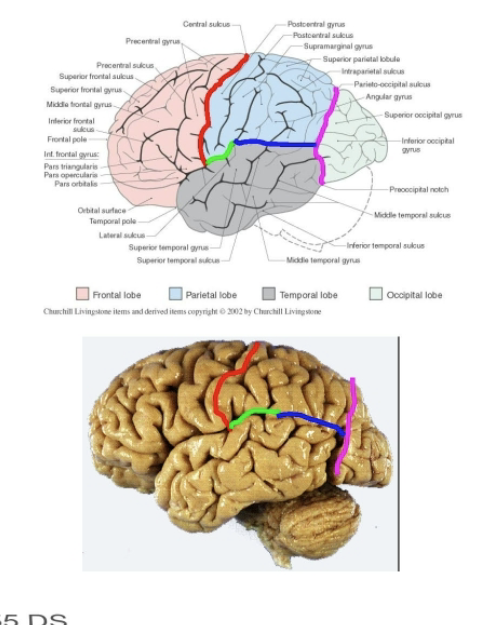
<p>Sensory and multimodal associative function</p><ul><li><p>Contents</p><ul><li><p>Primary somatosensory cortex (postcentral gyrus)</p></li><li><p>Sensory association areas w/ functions including understanding written language (usually left hemisphere)</p></li></ul></li></ul><p>Boundaries</p><ul><li><p>Laterally, parietal lobes lie posterior to the <mark data-color="red" style="background-color: red; color: inherit;">central sulcus</mark> and anterior to the extension of the pariteo-occiptal sulcus to the pre-occipital notch. </p></li><li><p>Above the lateral fissure and a <mark data-color="blue" style="background-color: blue; color: inherit;">line</mark> between approx. the middle of the lateral fissure and the extension of the parieto-occipital sulcus. </p></li></ul><p></p>
16
New cards

Parietal lobes

  • Primary components

Primary components

  • primary somatosensory cortex (postcentral gyrus)

  • superior parietal lobe

  • inferior parietal lobe (supramarginal gyrus, angular gyrus)

Superior and inferior parietal lobules are separated by a intraparietal sulcus
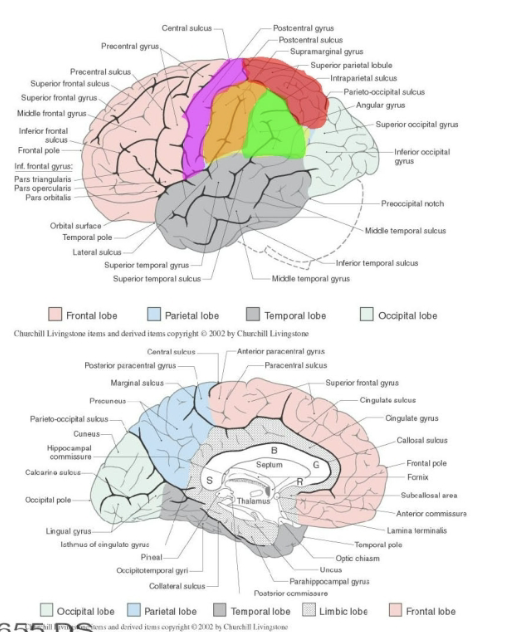
<p>Primary components </p><ul><li><p><mark data-color="purple" style="background-color: purple; color: inherit;">primary somatosensory cortex</mark> (postcentral gyrus)</p></li><li><p><mark data-color="red" style="background-color: red; color: inherit;">superior parietal lobe</mark></p></li><li><p>inferior parietal lobe (<mark data-color="yellow" style="background-color: yellow; color: inherit;">supramarginal gyrus,</mark> <mark data-color="green" style="background-color: green; color: inherit;">angular gyrus)</mark></p></li></ul><p>Superior and inferior parietal lobules are separated by a intraparietal sulcus</p>
17
New cards

Parietal lobes

  • Postcentral gyrus contents and location

  • Lies behind the central sulcus and anterior to the postcentral sulcus.

Contents

  • Primary somatosensory cortex, (SI-broadmann areas 3,1,2) on lateral surface of the hemisphere.

  • Posterior paracentral lobule on the medial surface of the hemisphere.
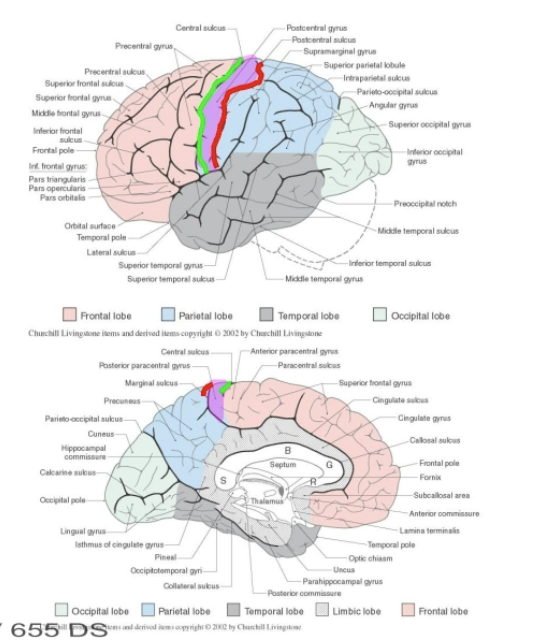
<ul><li><p>Lies behind the <mark data-color="green" style="background-color: green; color: inherit;">central sulcus </mark>and anterior to the <mark data-color="red" style="background-color: red; color: inherit;">postcentral sulcus. </mark></p></li></ul><p>Contents</p><ul><li><p>Primary somatosensory cortex, (SI-broadmann areas 3,1,2) on lateral surface of the hemisphere. </p></li><li><p>Posterior paracentral lobule on the medial surface of the hemisphere. </p></li></ul><p></p>
18
New cards

Parietal lobes

  • Somatotopic organization

  • Secondary somatosensory cortex (SII); location and features

Simular to motor cortex

  • Sensory areas from genitals, foot and leg are on the medial hemisphere in the post paracentral gyrus.

  • Tongue is located laterally

Neurons in postcentral gyrus respond to modality specific stimuli of discriminative touch, vibration, position, pain, and temperature.

Secondary somatosensory cortex (SII) is located on the medial surface of the parietal operculum.

  • Has an additional crude somatosensory map

  • SII receives projections from SI and is also interconnected with SII of the opp. hemisphere.

  • Unlike SI, neurons in SII have larger bilateral receptive fields.
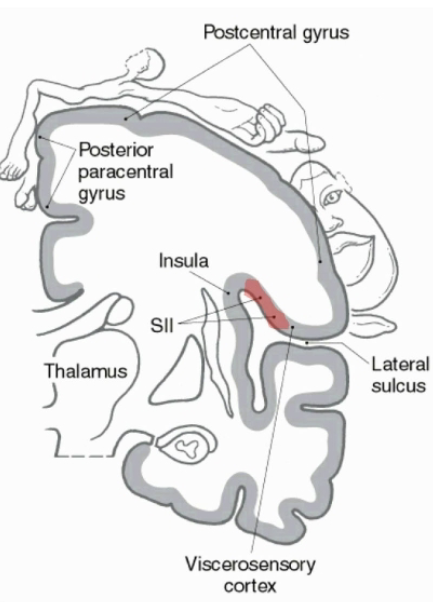
<p>Simular to motor cortex</p><ul><li><p>Sensory areas from genitals, foot and leg are on the medial hemisphere in the post paracentral gyrus. </p></li><li><p>Tongue is located laterally</p></li></ul><p>Neurons in postcentral gyrus respond to modality specific stimuli of discriminative touch, vibration, position, pain, and temperature. </p><p></p><p>Secondary somatosensory cortex (SII) is located on the medial surface of the parietal operculum. </p><ul><li><p>Has an additional crude somatosensory map</p></li><li><p>SII receives projections from SI and is also interconnected with SII of the opp. hemisphere. </p></li><li><p>Unlike SI, neurons in SII have larger bilateral receptive fields. </p></li></ul><p></p>
19
New cards

Insula

  • SII areas project top insular cortex —> distributes to limbic areas (tactile learning and memory)

  • The insula contains long and short insular gyri surrounded by boarders of the lateral fissure (circular sulcus).

  • Viscerosensory input (including taste) projects to the dorsal insula.

  • The anterior insula (near motor cortex) may also help to coordinate articulatory movements necessary for speech.
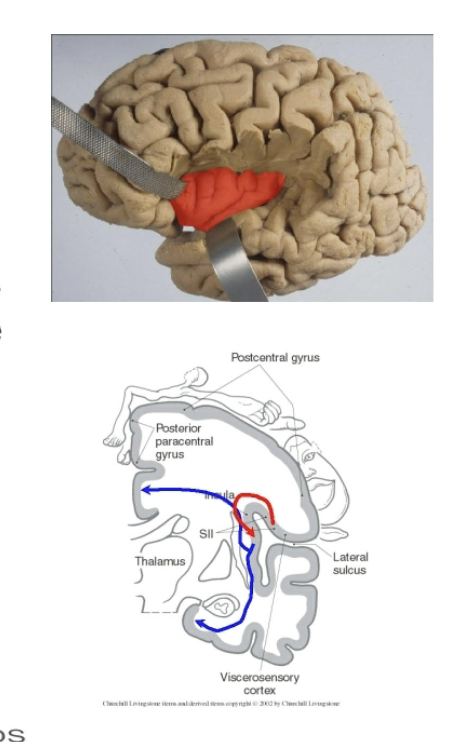
<ul><li><p>SII areas project top insular cortex —&gt; distributes to limbic areas (tactile learning and memory)</p></li><li><p>The <mark data-color="red" style="background-color: red; color: inherit;">insula</mark> contains long and short insular gyri surrounded by boarders of the lateral fissure (circular sulcus). </p></li><li><p>Viscerosensory input (including taste) projects to the dorsal insula. </p></li><li><p>The anterior insula (near motor cortex) may also help to coordinate articulatory movements necessary for speech. </p></li></ul><p></p>
20
New cards

Parietal lobes

  • Superior and inferior parietal lobules; what are they separated by and associated areas

Superior and inferior lobules

  • Separated by the intraparietal sulcus.

  • Superior lobule (broadmann areas 5 and 7) integrates somatosensory input from multiple modalities —→ used in motor planning (kinesthetic sense, hand eye, coordination)

  • Project to supplementary motor areas in the frontal lobe.
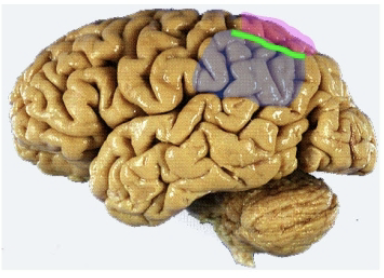
<p><mark data-color="#e016d8" style="background-color: rgb(224, 22, 216); color: inherit;">Superior</mark> and <mark data-color="blue" style="background-color: blue; color: inherit;">inferior</mark> lobules</p><ul><li><p>Separated by the<mark data-color="green" style="background-color: green; color: inherit;"> intraparietal sulcus.</mark></p></li><li><p>Superior lobule (broadmann areas 5 and 7) integrates somatosensory input from multiple modalities —→ used in motor planning (kinesthetic sense, hand eye, coordination)</p></li><li><p>Project to supplementary motor areas in the frontal lobe. </p></li></ul><p></p>
21
New cards

Parietal lobes

  • Inferior parietal lobule

  • Angular gyrus

  • Supramarginal gyrus

  • The inferior parietal lobule contains the angular gyrus (area 39) and supra marginal gyrus *area 40)

  • General functions of this areas differ with the hemisphere involved. In the dominant hemisphere, the angular gyrus is a center for comprehension of written language.

  • Areas of the supramarginal gyrus and posterior superior temporal gyrus (Wernickes ares, broadmann areas 22) is the areas for comprehension of spoken language.

22
New cards

Parietal lobes

  • hemineglect syndrome

  • In the non dominant hemisphere the inferior parietal lobule modulates attention to stimuli both on the body and in the visual field (perceptrertual awareness)

  • Lesions to this areas are associated with hemineglect syndrome (failure to recognize the left side of the body as self).
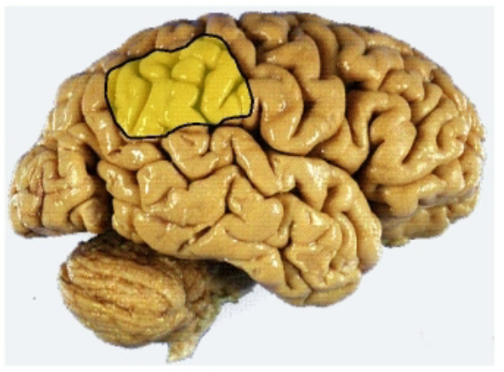
<ul><li><p>In the non dominant hemisphere the inferior parietal lobule modulates attention to stimuli both on the body and in the visual field (perceptrertual awareness)</p></li><li><p>Lesions to this areas are associated with hemineglect syndrome (failure to recognize the left side of the body as self).</p></li></ul><p></p>
23
New cards

Occipital lobes

  • Contents

Occipital lobes: visual function

Contains

  • Primary visual cortex and causal association (extrastriate) cortex

  • The primary identified guru are associated with the medial aspect of the hemisphere.

24
New cards

Occipital lobes

  • calcarine sulcus

  • extra striate cortex

  • Medially, the usually well defined parieto-occiptal sulcus separates the parietal and occipital lobes.

  • The calcarine sulcus divides the medial occipital lobe into the cunceus above and lingual gyrus below.

  • Remaining areas of the occipital lobe (extra striate cortex, areas 18 and 19) ae involved in the processing of visual data leading to the perception of motion, depth (binocular vision), color, and position of an object.
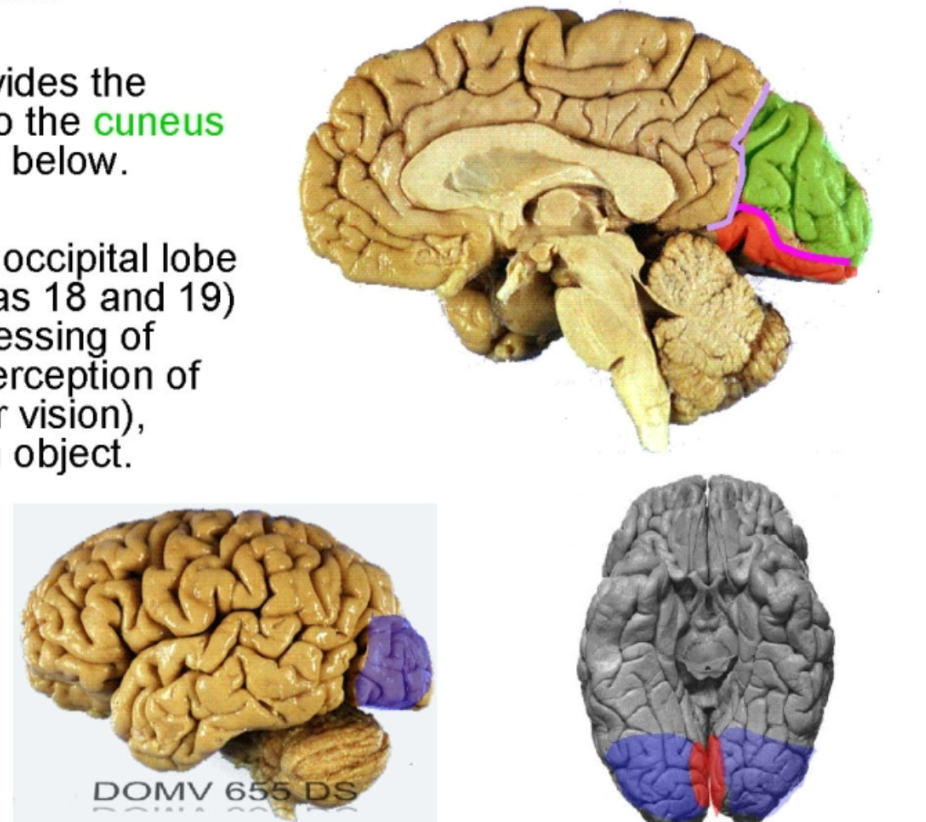
<ul><li><p>Medially, the usually well defined parieto-occiptal sulcus separates the parietal and occipital lobes.</p></li><li><p>The <mark data-color="purple" style="background-color: purple; color: inherit;">calcarine sulcus</mark> divides the medial occipital lobe into the <mark data-color="green" style="background-color: green; color: inherit;">cunceus</mark> above and <mark data-color="red" style="background-color: red; color: inherit;">lingual</mark> gyrus below.</p></li><li><p>Remaining areas of the occipital lobe (<mark data-color="blue" style="background-color: blue; color: inherit;">extra striate cortex</mark>, areas 18 and 19) ae involved in the processing of visual data leading to the perception of motion, depth (binocular vision), color, and position of an object.</p></li></ul><p></p>
25
New cards

Occipital lobes

  • Primary visual (area 17) cortex

  • Primary visual (area 17) cortex is not he medial side of her ocicitla lobe on either side of the calacarine sulcus.

  • The retinal surface (therefore the visual field) is represented in a topographic (retinotopic) fashion int he areas around the calcimine sulcus.

26
New cards

Temporal lobes

  • Contents

Temporal lobes: integrative sensory, some memory, auditory, and olfactory function.

Contains

  • Primary auditory cortex

  • Nearby Wernickes areas that coordinates the understanding of spoke. language

  • Limbic areas including the hippocampus.

27
New cards

Temporal lobes

  • Basic anatomy

On the lateral surface the temporal lobe is composed of:

  • Superior, middle, and inferior temporal gyri

  • Separated but the superior and inferior temporal sulci.
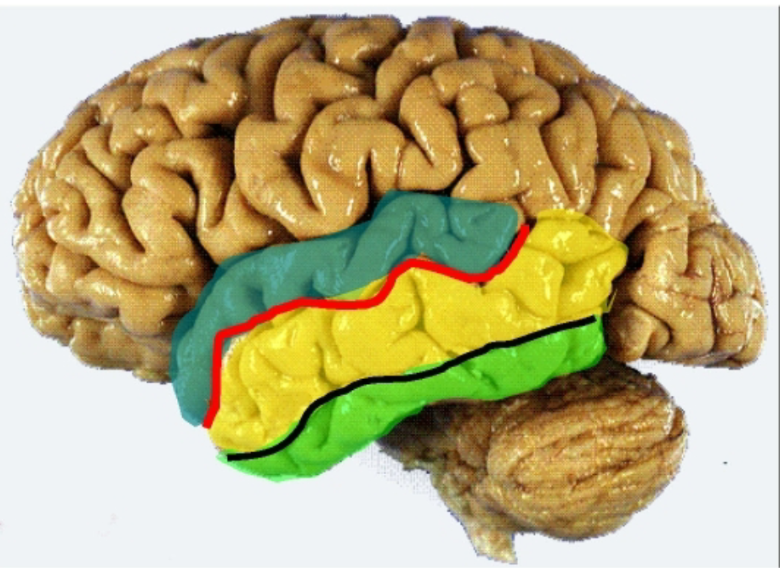
<p>On the lateral surface the temporal lobe is composed of:</p><ul><li><p><mark data-color="#1c6bbb" style="background-color: rgb(28, 107, 187); color: inherit;">Superior</mark>, <mark data-color="yellow" style="background-color: yellow; color: inherit;">middle</mark>, and <mark data-color="green" style="background-color: green; color: inherit;">inferior</mark> temporal gyri</p></li><li><p>Separated but the superior and inferior temporal sulci. </p></li></ul><p></p>
28
New cards

Temoral lobe

  • Inferior

  • The occipitotemporal gyrus (fusiform gyrus) is located on the ventral aspect of the hemisphere medially adjacent to the inferior temporal gurus.

  • The occipitotemporal sulcus operates these structures.

  • These areas + adjacent areas of the ocecitpal lobe area involved in the recognition of objects and face.
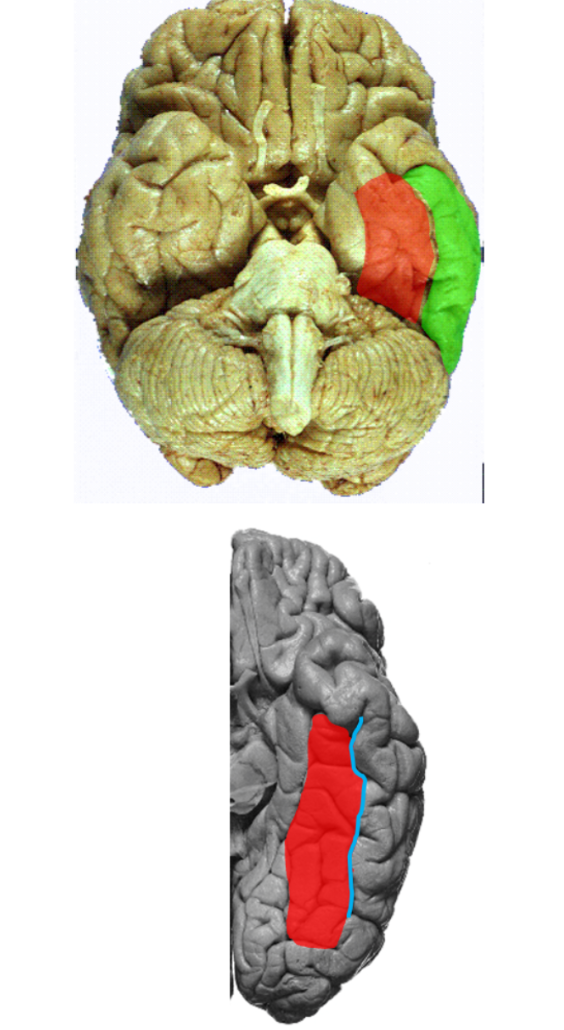
<ul><li><p>The <mark data-color="red" style="background-color: red; color: inherit;">occipitotemporal gyrus</mark> (fusiform gyrus) is located on the ventral aspect of the hemisphere medially adjacent to the i<mark data-color="green" style="background-color: green; color: inherit;">nferior temporal gurus. </mark></p></li><li><p>The<mark data-color="#197bc9" style="background-color: rgb(25, 123, 201); color: inherit;"> occipitotemporal sulcus</mark> operates these structures. </p></li><li><p>These areas + adjacent areas of the ocecitpal lobe area involved in the recognition of objects and face. </p></li></ul><p></p>
29
New cards

Primary auditory cortex

  • transverse temporal gyrus

  • Function

  • Within the lateral fissure, the superior surface of the temporal lobe contains the transverse temporal gyrus (of Heschl, areas 41 and 42)

  • The primary auditory cortex is responsible for audition, receiving information. from both ears

  • Together with the immediately surrounding association cortex, its is generally involved in the process the association and recognition of sounds.

30
New cards

Limbic lobe

  • Anatomy

31
New cards

Limbic lobe

  • Defining sulci

32
New cards

Hippocampus and cingulate gyrus

Explore top notes

note
Capacity and Surrogacy
Updated 1410d ago
0.0(0)
note
AP HUMAN MAPS
Updated 704d ago
0.0(0)
note
APUSH
Updated 1285d ago
0.0(0)
note
IB Music - Ultimate Study Guide
Updated 453d ago
0.0(0)
note
Thermodynamics
Updated 1095d ago
0.0(0)
note
Capacity and Surrogacy
Updated 1410d ago
0.0(0)
note
AP HUMAN MAPS
Updated 704d ago
0.0(0)
note
APUSH
Updated 1285d ago
0.0(0)
note
IB Music - Ultimate Study Guide
Updated 453d ago
0.0(0)
note
Thermodynamics
Updated 1095d ago
0.0(0)

Explore top flashcards

flashcards
GENKI Lesson 13: Vocabulary
56
Updated 393d ago
0.0(0)
flashcards
La Mafia
33
Updated 1176d ago
0.0(0)
flashcards
Unit I: Authors
49
Updated 1136d ago
0.0(0)
flashcards
Spanish 2 3A Vocab
45
Updated 903d ago
0.0(0)
flashcards
Sig. Codes Flashcards
181
Updated 885d ago
0.0(0)
flashcards
BIO EXAM 3 REAL ONE
99
Updated 358d ago
0.0(0)
flashcards
GENKI Lesson 13: Vocabulary
56
Updated 393d ago
0.0(0)
flashcards
La Mafia
33
Updated 1176d ago
0.0(0)
flashcards
Unit I: Authors
49
Updated 1136d ago
0.0(0)
flashcards
Spanish 2 3A Vocab
45
Updated 903d ago
0.0(0)
flashcards
Sig. Codes Flashcards
181
Updated 885d ago
0.0(0)
flashcards
BIO EXAM 3 REAL ONE
99
Updated 358d ago
0.0(0)